# Other Ports
*Black Flag, An Exodus NDS Era Book, the Caribbean, 1660 to 1730, mapped in 1716. Source: https://exodusnds.com/era-books/black-flag/other-ports*
Beyond Nassau and Port Royal, Companies call at six groups of ports: the English colonies; Spanish, French, Dutch and Danish harbours; the logwood, Mosquito and salt coasts; and the African coast. Nine receive full entries: Charles Town, Kingston, Havana, Cartagena, Cap-Français and Léogâne, Saint-Pierre and Fort-Royal, Willemstad, St Thomas, and Campeche and the Logwood Coast. Others have shorter accounts, using the same cards and sections. Places and Campaign Tools supplies distances and voyage times; Gear and Prices, Availability by Place lists goods; Era Rules supplies procedures. Entries describe 1716 unless dated otherwise.
### Reading an Entry
- **Held by** is who gives the orders and who can give a commission, a pardon or a hanging.
- **For a Company** is what the port is good for: water, stores, a fence, repair, news, law.
- **Who to meet** names real officeholders and the kinds of people a Company deals with. A real person has no stat block and is never played (Running the Era, Real People at the Table).
- **Danger** is what turns a stop into a problem. **Hook** is an offer or a rumour to start a session.
- **Attitudes** use the Prejudice rule (Era Rules) and the Infamy rule where an entry points to it, and are the GM's call; a fence uses the Fence step of the Prize and Fence Loop, Average in a pirate port and Hard anywhere else.
- **Population and garrison** are given only where the record gives a count. Where it does not, the entry describes the scale in words and the GM does not invent a number.
### Which Port for What
| A Company needs | Go to | Why |
|:--|:--|:--|
| A buyer for a prize cargo, no questions | Nassau | The beach is the market and no court sits; the fence check is Average |
| A buyer for a prize after a court has condemned it | Kingston | The merchants who left Port Royal live here and buy through the court |
| A buyer for wine, brandy or rum | Charles Town, Bridgetown, Kingston | Planters' markets and merchants who deal in barrels; the fence check is Hard |
| A harbour that takes any flag | St Thomas | Open to every nation from 16 August 1716 at 5 and 6 per cent duty; a prize is inspected before it is sold |
| A buyer who will not ask where the goods came from | St Thomas, Willemstad | Danish planters short of buyers; Dutch merchants who sell to three empires |
| Arms and powder | Charles Town | Sold under the governor's licence; Havana sells none to an English Company, and Bermuda is thin on arms |
| A new hull or a hard refit | Bermuda | The home of the Bermuda sloop, built of cedar |
| A commission | Port Royal, Charles Town | A governor may give one; Carolina's deputy governor was giving them to sloop masters by August 1716 |
| A pardon | Harbour Island (1716 to 1717); Bermuda (1718); Bath (1718) | A local pardon, and a proclamation's pardon after 5 September 1717 |
| Word of the Yamasee War and the Florida garrison | St Augustine, Charles Town, Pensacola | Refugees went south to Florida, and Carolina accused the garrison of arming the raiders |
| Word of the navy | Bridgetown, Port Royal, Fort-Royal | Station ships come and go, and the governors write to each other |
| Word of Spanish silver | Havana, Veracruz, Cartagena | The fleets gather at Havana; the Isthmus has had no fair since 1708 |
| Word of French complaints against Jamaica | Léogâne, Cap-Français | The governor general and the intendant write from Léogâne |
| Logwood | The Campeche coast, the Belize River | Cut by English crews and claimed by Spain; the camps at Términos fell in December 1716 |
| A pilot, a harpooner or a turtle hunter | The Mosquito Coast | The Miskito sail in English vessels and are paid for it |
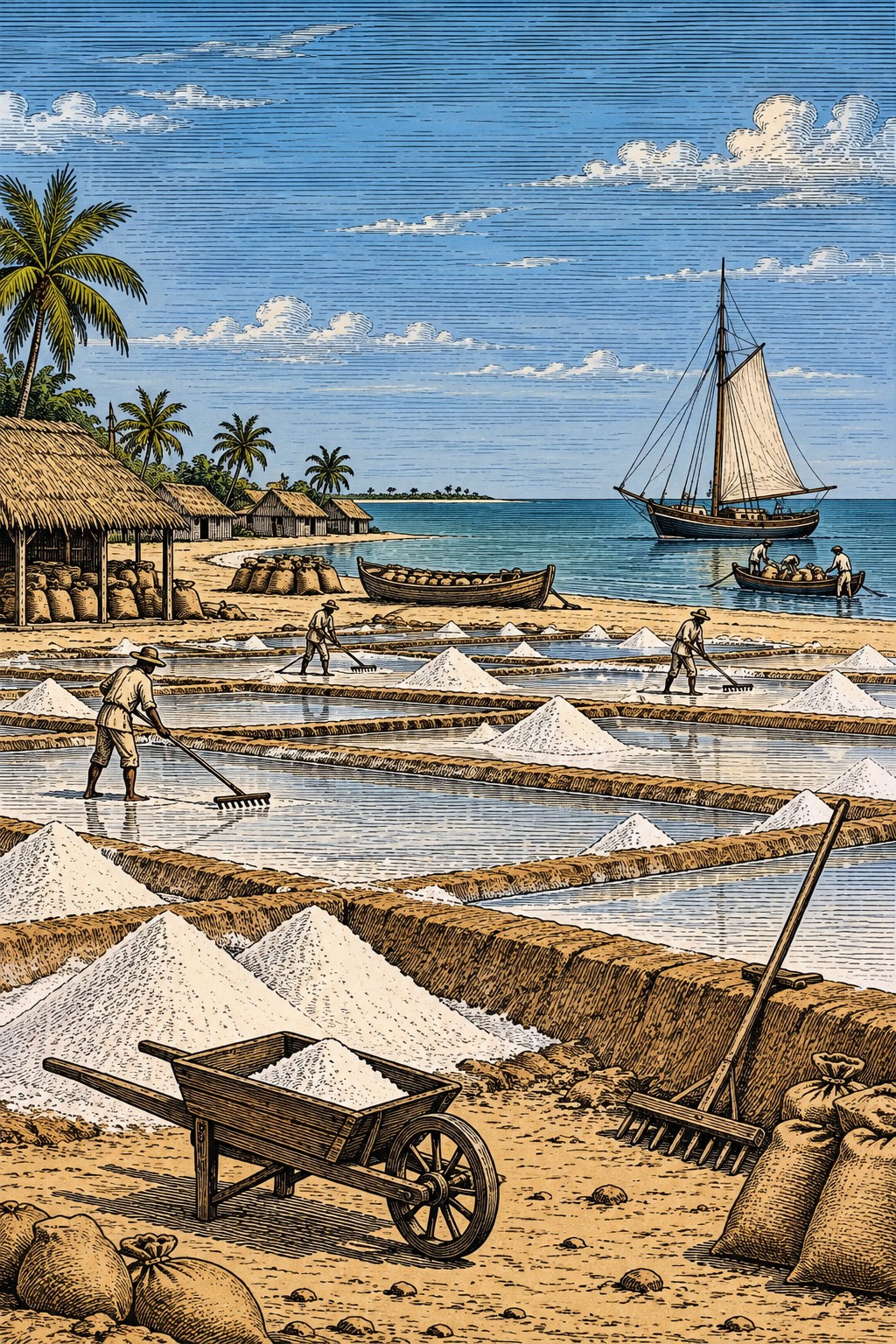
| Salt | The Turks Islands | Sixty-five Bermuda vessels raked there in 1716; the Bahamas dispute it |
| A careening beach out of sight | Ocracoke | A shifting-bar inlet; see Places and Campaign Tools |
| Cheap French rum | Tortuga, Cap-Français, Saint-Pierre | Tafia could not be sold in France, so it was sold to whoever came (Trade and Shipping) |
| Where people are sold | Cape Coast Castle, Elmina, Whydah, Bridgetown, Cartagena | The trade ran from the coast to the colonies (Trade and Shipping, What a Person Was Sold For) |
| Where a Company is tried | Port Royal, Charles Town, Nassau (from December 1718), Cape Coast Castle (1722) | Courts sat at Charles Town, Spanish Town, Nassau and Cape Coast (Historical Reference); this book seats Jamaica's at Port Royal (Port Royal, Law: Prizes, Courts and the Gallows) |
Quay Cargo
## The English Colonies
English colonial harbours offer Nassau's nearest friendly markets and its nearest courts. Charles Town and Kingston dominate trade; Bermuda builds ships, Bridgetown serves planters, and Boston and Bath mark the coast's farther reaches.
### Charles Town
##### Charles Town
*The walled port of Carolina, 560 miles from Nassau.*
- **Held by:** The Lords Proprietors of Carolina, through Deputy Governor Robert Daniell, who has held the government since April 1716. Robert Johnson, approved as Deputy Governor on 6 December 1716, takes the government in April 1717.
- **For a Company:** A planters' market for rice, naval stores and wine; powder and arms under the governor's licence; private man-of-war commissions; a court that sits on pirates.
- **Who to meet:** Daniell; Nicholas Trott, Chief Justice and Vice-Admiralty judge (Historical Reference); Captain Howard of HMS *Shoreham*, on the Carolina coast in August 1716; a wine factor on the wharf.
- **Danger:** A colony at war with the Yamasee, and commissions handed out to sloop masters who may stretch them. A Company's Infamy is read here.
- **Hook:** An August 1716 report from the colony says Hornigold's sloop was taken and destroyed under the governor's commissions. The sloop is gone; Hornigold is not, and Nassau wants to know who gave the order.
#### The Place
Earthworks enclose Charles Town on its south, west and north sides. Built in 1704, their ditch runs about 6 feet deep and 24 to 36 feet wide beneath walls 8 to 10 feet high. Harbour-side brickwork began in the 1690s, halted unfinished in 1704, then resumed; Crisp's 1711 plan shows a continuous waterfront line. The temporary earthworks have endured twelve years, including hurricane damage in 1713 and 1714. Since 1715 the Yamasee War has absorbed colonial funds, costing 95,000 pounds by August 1716.
Meeting Street's junction with Broad Street holds the sole land gate and its drawbridges. Granville Bastion occupies the south-east corner; the Half-Moon Battery guards Broad Street's eastern end. Cumberland Street's Powder Magazine dates to 1712 and 1713. Sakers and minions provide the small guns. Behind the wharf, steep-shingled timber and brick houses face marsh and moss-hung live oaks beyond the defences. Rice and naval-stores barrels crowd a long wooden wharf beside anchored sloops, schooners and a few ships.
##### LEGEND
Later accounts place Bonnet's execution at White Point on Charles Town's waterfront. His hanging on 10 December 1718 is documented (Historical Reference); the precise location rests on those later accounts.
#### Dealing Here
From Nassau, Charles Town's planter market lies 560 miles away, about 6 days at Speed 3. Tar, pitch, rice and wine are available. Arms and powder require the governor's licence; Military items come through a governor or fence (Gear and Prices). Fencing is Hard: 25 in 100 of cargo value plus 10 per net Success. Merchants openly acknowledge buying from sloops.
Lacoste buys rum on the wharf, paying wine and brandy for cargoes other markets refuse (Pregenerated Characters). She tastes each cask. France's ban creates her opportunity (Historical Reference, The French royal declaration on brandy).
Daniell can issue a private man-of-war commission naming an enemy. Captured prizes still require court condemnation before sale (Era Rules, Law at Sea and Ashore). Stretching an anti-pirate commission to attack a friendly flag is piracy, a distinction Charles Town understands well.
#### Law and Trouble
Vice-Admiralty judges condemn prizes; Admiralty commissioners try pirates, as in Bonnet's 1718 case. The commission court has Fair Disposition in 1716 and Hostile after the 1718 blockade. Apply Infamy Attitudes to a recognised Name: Wary 1 at Infamy 1 or 2, Hostile 2 at 3 or more (Era Rules, Infamy). Commissioned captains are Neutral. Slave codes make an enslaved person's testimony against a white defendant Closed 3.
War has emptied the treasury and made strangers suspect. December 1716 accusations that St Augustine supplied Yamasee raiders give officials particular reason to watch Spanish Companies.
Carolina connections bring business. Kinsella's Charles Town Jacobite agent needs passage for two exiles (Pregenerated Characters). A merchant tracking the Company's Nassau prizes may offer better than the beach's fence rate for its next cargo, while asking which captain lost it.
On 18 June 1718 Johnson reports Teach offshore with a 40-gun ship and over 400 men. The council supplies the demanded medicine chest. That autumn Nicholas Trott presides over Bonnet's trial.
### Ocracoke
##### Ocracoke
*A narrow inlet in the sand bars off North Carolina, 280 miles from Charles Town.*
- **Held by:** North Carolina, under Governor Charles Eden, who held the post from 28 May 1714 until he died on 26 March 1722. No officer is recorded at the inlet.
- **For a Company:** Water and a quiet anchorage; a place to careen; a pilot's knowledge of the bars; a road up to Bath.
- **Who to meet:** Nobody the record names at the inlet; a pilot of the sound, if the Company can find one. At Bath: the collector and the secretary of the council.
- **Danger:** The bar. A hull of Scale 4 or more that crosses it wrong is aground.
- **Hook:** A pilot of the sound offers to take a sloop through the bars for a share, and knows the way up to Bath.
#### The Place
Ocracoke's channel twists through shifting sand bars. Places and Campaign Tools, Ocracoke and Bath covers the inlet, Bath fifty-odd miles up the Pamlico, and Teach's pardon in 1718. For 1716, the record shows an anchorage without town, court or navy, usable without a Base.
Eden has governed for two years. North Carolina is recovering from civil conflict in 1711 and the Tuscarora war, ended by 1715 (Bath). Customs operate at Bath; no official, court or naval presence is recorded at Ocracoke. A sloop can anchor quietly.
#### Dealing Here
Water, careening and concealment draw Companies here. There is no market or fence; Charles Town is 3 days away. On the sound side, a hull can lie out of sight of the sea if tides and bar permit (Places and Campaign Tools, the bar rule).
Bath is the port of entry, so cargo landed there faces customs. Quiet sales go through sound-side planters and traders rather than the wharf. The check is Hard.
#### Law and Trouble
No authority is recorded at the inlet in 1716. The GM decides Attitudes: a Company without an audience is Neutral, as is an unpaid local pilot. The bar and remoteness provide the danger.
Teach receives Eden's pardon at Bath in June 1718 and dies at the inlet in November. A letter found on his body names council secretary Tobias Knight; prize goods turn up in Knight's barn, and four crewmen testify to delivering them. In 1719 Moseley accuses Eden of profiting. Officials arrest and fine Moseley; the council accepts Eden's account.
### Bath
##### Bath
*North Carolina's first town, on the Pamlico River, fifty-odd miles from the sea.*
- **Held by:** North Carolina, under Governor Charles Eden; the colony's nominal capital since 1712, with no permanent institutions.
- **For a Company:** A port of entry with a customs collector; a house and a clerk who can sign a pardon (1718); planters of the sound who will trade quietly.
- **Who to meet:** The collector of customs; the secretary of the council, Tobias Knight; a planter of the Pamlico; a pilot who knows the road down to the inlet.
- **Danger:** A town of a dozen houses where every stranger is known by evening.
- **Hook:** A planter near Bath has a cargo of naval stores and no ship, and a Company that can reach the inlet by night can carry it to Charles Town.
#### The Place
North Carolina chartered its first town and port of entry on 8 March 1705. John Lawson laid out seventy-one waterfront lots, but Bath remained small: twelve houses and about fifty people in 1708. Cary's Rebellion, drought and yellow fever struck in 1711. The Tuscarora war brought attacks on town and plantations before defeat of the Tuscarora by 1715. Bath became nominal capital in 1712; Edenton replaced it in 1722.
A few houses, a landing and a collector make up the recovering river port. The twelve-house count belongs to 1708; no later total survives. Reaching Bath requires a pilot through the inlet and more than fifty miles of river.
#### Dealing Here and Law and Trouble
Bath offers neither useful supplies nor a wharf-side fence. Its value lies in official signatures. Eden grants pardons here in 1718, including Teach's and those of at least twenty crewmen in June (Places and Campaign Tools). In 1716, Eden and his council exercise little visible authority. The Company remains Neutral until customs notices its cargo.
### Boston
##### Boston
*The northern port of Massachusetts, 820 miles from Charles Town.*
- **Held by:** The Crown, through the Province of Massachusetts Bay.
- **For a Company:** Northern rum and molasses at a lower price than the British islands'; stores; a way north and home; a court that has hanged pirates.
- **Who to meet:** A rum merchant, a ship's chandler, a captain loading for the islands, the Surveyor of customs.
- **Danger:** Distance. Nobody here has news of Nassau for nine days to two weeks, and a Company far from its Base is easy to find. Boston also hangs pirates.
- **Hook:** (Later, 1717.) Boston hears first of the wreck of Bellamy's *Whydah Gally* off Cape Cod on 26 April 1717 (Historical Reference). In 1716 the hook is a captain loading for the islands who pays for an escort.
#### The Place
About 9,000 people inhabit Boston when Shute arrives in 1716; the 1722 census counts 10,567. From about 1710, Captain Oliver Noyes's Long Wharf project extends a third of a mile into deep water. Half finished in 1716, it carries piles, planking and new warehouses; completion follows in 1721. The available Boston price list dates to early 1720 and is Legend (Trade and Shipping, What Moved: Goods and Their Prices).
Boston imports sugar, rum and molasses from foreign islands. On 2 August 1716 customs Surveyor Archibald Cumings reports purchases from Suriname, Cayenne, Saint-Domingue and St Thomas and proposes a 4 and a half per cent duty. Antigua's Hamilton forwards an act prohibiting foreign sugar, rum, cotton and molasses on 12 July 1716. These measures show mounting pressure on the foreign trade (Trade and Shipping, The English Frame).
#### Dealing Here
Northern rum costs less than island rum, making Boston a source for Charles Town or Lacoste. Distance also helps a Company escape notice. Fencing is Hard. French and Danish rum finds willing buyers, while the Surveyor presses for duty on those imports.
#### Law and Trouble
Nassau news takes nine days to two weeks to reach Boston. Apply Infamy Attitudes to a recognised Name only if the Company's Reach extends this far (Era Rules, Infamy). A commissioned Company is Neutral.
Boston tried Quelch and his men without a jury under Admiralty law in 1704, the first such overseas piracy trial. They marched to Scarlet's Wharf and hanged on Friday 30 June 1704. Quelch warned spectators to "take care how they brought Money into New England to be Hanged for it." Their bodies were buried between tide marks.
Six Bellamy crewmen face Boston's court on 18 October 1717 and hang at Charlestown on 15 November, with Cotton Mather accompanying them across the harbour. Their *Whydah Gally*, London-built for Sir Humphrey Morice in 1715 or 1716, fell to Bellamy in the Windward Passage after a three-day chase in late February 1717. She wrecked off Cape Cod on 26 April; Southack mapped the site on 3 May.
### Bermuda
##### Bermuda
*A cedar island in the Atlantic, 920 miles from Nassau, on the road home from the Caribbean.*
- **Held by:** The Crown, through Lieutenant Governor Benjamin Bennett, who took the government again on 27 September 1715.
- **For a Company:** The yard that builds the Bermuda sloop; stores, pilots who know the shoals and a market in salt.
- **Who to meet:** Lieutenant Governor Bennett, a master shipwright, a pilot for the shoals, a salt merchant.
- **Danger:** A governor who writes to London about the pirates, and a rivalry with the Bahamas over salt.
- **Hook:** On 8 August 1716 Bennett wrote that the Jamaica men forced the Bermuda men from the wreck; both sets of salvors tell the Company a different story.
#### The Place
Bermuda lies north of the Bahamas on the homeward Atlantic route, building the cedar, single-masted fore-and-aft sloops described in Ships. St George's is its capital; the Crown took over from the Somers Isles Company in 1684 (Historical Reference). Cedar-covered hills shelter the sound. Whitewashed limestone cottages, a few tall plain stone houses, a headland fort and a timber quay line the shore. Shipwrights shape timber beside sloops on stocks and at anchor.
Salt drives Bermudian commerce. Rakers have worked the Turks Islands since the 1670s (Salt Tortuga and the Turks). By 1700 Bermuda already had about sixty sloops. Merchant houses on the American coast and in Newfoundland buy salt to cure cod. The same ships carry grain, cocoa, brandy and wine to the West Indies. Raiding is only one use of these working traders.
##### LEGEND
Forts on St George's, St David's, Paget and the Castle Islands are said to guard St George's Harbour and Castle Harbour. The cedar is said to last about 30 years against 10 for oak. Each rests on one secondary account.
#### Dealing Here
Shipwrights sell hulls and refits, but arms are scarce (Gear and Prices). Fencing is Hard. Crew composition reflects island law: at most twelve white sailors on vessels of 40 feet keel or more, nine on smaller craft, with no limit on enslaved men. Black sailors make up about 28 in 100 of sloop crews during 1708 to 1720, and 34 in 100 in 1720. Bermudian recruits know the shoals.
Bermudians work Turks salt pans and wrecks (Places and Campaign Tools, The Salt Cays; Salt Tortuga and the Turks). Their salvors looted submerged Port Royal after 1692, and Bennett's letter of 8 August 1716 again places them at a wreck.
#### Law and Trouble
Bennett reports pirates to London. Recognised Companies take the Charles Town Infamy Attitudes; commissions confer Neutral. A Bermudian crewman is Welcome 1 among his own people. Courts have Fair Disposition. Nassau Companies face hostility over the longstanding Turks salt dispute (Salt Tortuga and the Turks).
Bennett's 30 July 1717 letter supplies the estimate of a thousand Bahamas pirates. Jennings accepts pardon in Bermuda in January 1718, arriving with Bennett's son Captain Bennett and seven or eight men. In July 1719 the governor and Council worry over white Bermudian sailors assisting pirates as shoal pilots.
### Bridgetown
##### Bridgetown
*The sugar port of Barbados, 1,190 miles from Port Royal.*
- **Held by:** The Crown. Robert Lowther is Governor of Barbados, in office since 1711 and again since 1715 after a year's recall.
- **For a Company:** Barbados rum, the quality rum of the 1710s; word of the navy; a market that deals in sugar and in people.
- **Who to meet:** Lowther; the captain of a station ship; a rum factor; a sugar planter; a ship's chandler.
- **Danger:** Station ships come and go, and the planters are the people who pay for the trade that pirates rob.
- **Hook:** A planter with an estate near the town and no seamanship begins to talk of an armed sloop. The Historical Reference has the end of that story.
#### The Place
Carlisle Bay's wharves, warehouses and fortifications serve Barbados's sugar trade. Windmills dot the inland hills. Samuel Copen's engraved 1695 prospect records houses, vessels, boats, defences, wharves and mills. Cranes or sheerlegs shift hogsheads while clerks tally loads.
Settlement began in July 1628 under Charles Wolverstone, with sixty-four settlers on the Earl of Carlisle's claim, each taking a hundred acres north of the Careenage; the centre was a drained swamp. After 1654 a new bridge over the Careenage gave the Town of Saint Michael its later name. The Careenage, a creek where hulls are hove down, is the working harbour. Needham's Fort at Needham's Point, begun in 1650 and later called Charles Fort, guards the bay and the town from the south. In 1697 the port exported goods to England valued at about £196,532. The island is crowded: Barbados counted 16,888 white people in 1715, and about 387,000 enslaved Africans were sent there over the whole length of the trade.
#### Dealing Here
Lacoste purchases Barbados rum when available (Pregenerated Characters). Fencing is Hard. Station ships bring naval news: Captain Hume's HMS *Scarborough* lies here in November 1716.
Bridgetown's African Company auctions and contracts sell men, women and children (Trade and Shipping, What a Person Was Sold For). White indentured servants also arrive for sale by term (Trade and Shipping, Other People in the Hold).
#### Law and Trouble
A station ship in Carlisle Bay watches visiting traders. On 20 July 1717 Lowther reports unprecedented piracy around the islands. Recognised Companies use Charles Town's Infamy Attitudes (Era Rules, Infamy). The GM may assign Hostile 2 while a naval ship is present. A commissioned Company is Neutral.
##### LEGEND
Stede Bonnet, a planter with an estate near Bridgetown, is said to have sailed from Carlisle Bay in April 1717 in an armed sloop. A white servant is said to have sold for about £20 and the loss of an enslaved man to cost his owner £40 or £50, against two or three years' wages for a servant. Both pairs of figures come from an author who compiled earlier accounts, so the year is not fixed. Bridgetown is also said to have held 10,641 people in 1712, more than Boston, Philadelphia or New York; the figure has no source and may be an island or parish count.
### Kingston and Spanish Town
##### Kingston and Spanish Town
*Jamaica's trading town and its seat of government, across the harbour from Port Royal and thirteen miles inland.*
- **Held by:** The Crown, through Jamaica's government. In October 1716 Peter Heywood signs as Commander in Chief (Port Royal, Who Governs Jamaica). The Council and the Assembly sit at Spanish Town.
- **For a Company:** The merchants who buy a prize after a court has condemned it; wharves, chandlers and word from every port; the court town where a Company is tried.
- **Who to meet:** A merchant factor on Harbour Street; a wharfinger; a clerk of the Assembly; a captain waiting on a convoy.
- **Danger:** A town of merchants who know each other's debts, and an Assembly that knows who owes the island for a Company's last sloop.
- **Hook:** A Kingston merchant wants a sloop to carry forty people to a Spanish port with the papers "taken care of". The Company may refuse, and Trade and Shipping says what the people are.
#### The Place
Kingston was established on 22 July 1692 for earthquake survivors beneath the Liguanea plain. Tent dwellers first occupied Colonel Barry's Hog Crawle; mosquito-borne disease killed about two thousand in the opening months. Growth followed Port Royal's January 1703 fire. John Goffe's grid runs between North, East, West and Harbour Streets, with 66-foot main streets carrying plantation carts. Buyers received only seafront land, no more than their former Port Royal holdings. By 1716 Kingston leads Jamaica in size and trade, although no population count survives.
Spanish Town, St Jago de la Vega, lies thirteen road miles inland. England retained the former Spanish capital after 1655; after 1692 it alone holds the government. Its cathedral fell in the hurricane of 28 August 1712 and was rebuilt in 1714. The duty roll of 15 November 1716 lists 42 men, 40 women, 139 children and 105 Black people, small enough to supply households for play. Jamaica's 1713 total was about 7,000 whites and 55,000 enslaved people, serving the sugar estates behind both towns.
#### Dealing Here
Kingston merchants retain agents on Port Royal's wharves. Court-condemned cargo sells through them without a check at 50 in 100 less court fees (Era Rules, The Prize and Fence Loop). Uncondemned goods require Hard fencing; merchants accustomed to court documents make dealings comparatively orderly. Chandlers stock canvas, cordage, powder and shot. Military goods require a governor or fence.
Jamaican traders supply Spanish America with tens of thousands of Africans during 1710 to 1760, legally and illegally. A later bill of lading, from 1738, records a hundred people sent from Kingston to Havana under company brands. It illustrates the factor's business beyond the play period. Miskito raiders also supply Jamaica's sugar estates with captives (Mosquito Coast).
#### Law and Trouble
Assembly and Council sit at Spanish Town. For play the Admiralty court occupies Port Royal (Port Royal, Law), although recorded trials took place at St Jago de la Vega. There Sir Nicholas Lawes's court tried Rackham's crew in November 1720. Bonny and Read pleaded pregnancy at their trial on 28 November 1720. Rackham's men hanged at Gallows Point and Kingston.
A Company known by its Name takes the Infamy Attitude (Era Rules, Infamy): Welcome 1 in a merchant's counting room that has bought its prizes, Wary 1 at the governor's table. The Prejudice rule applies to the Company's own people: an enslaved person's testimony against a white defendant is Closed 3 (the slave codes).
## The Spanish Ports
Peace between Britain and Spain offers little protection to an unauthorised English Company. Spanish ports admit smugglers and bribed guests, or hold prisoners. Havana is best known; elsewhere silver is produced, awaited or taxed. Fortified towns depend on Mexican situado payments for their garrisons and lack goods English traders supply.
### Havana
#### The Place
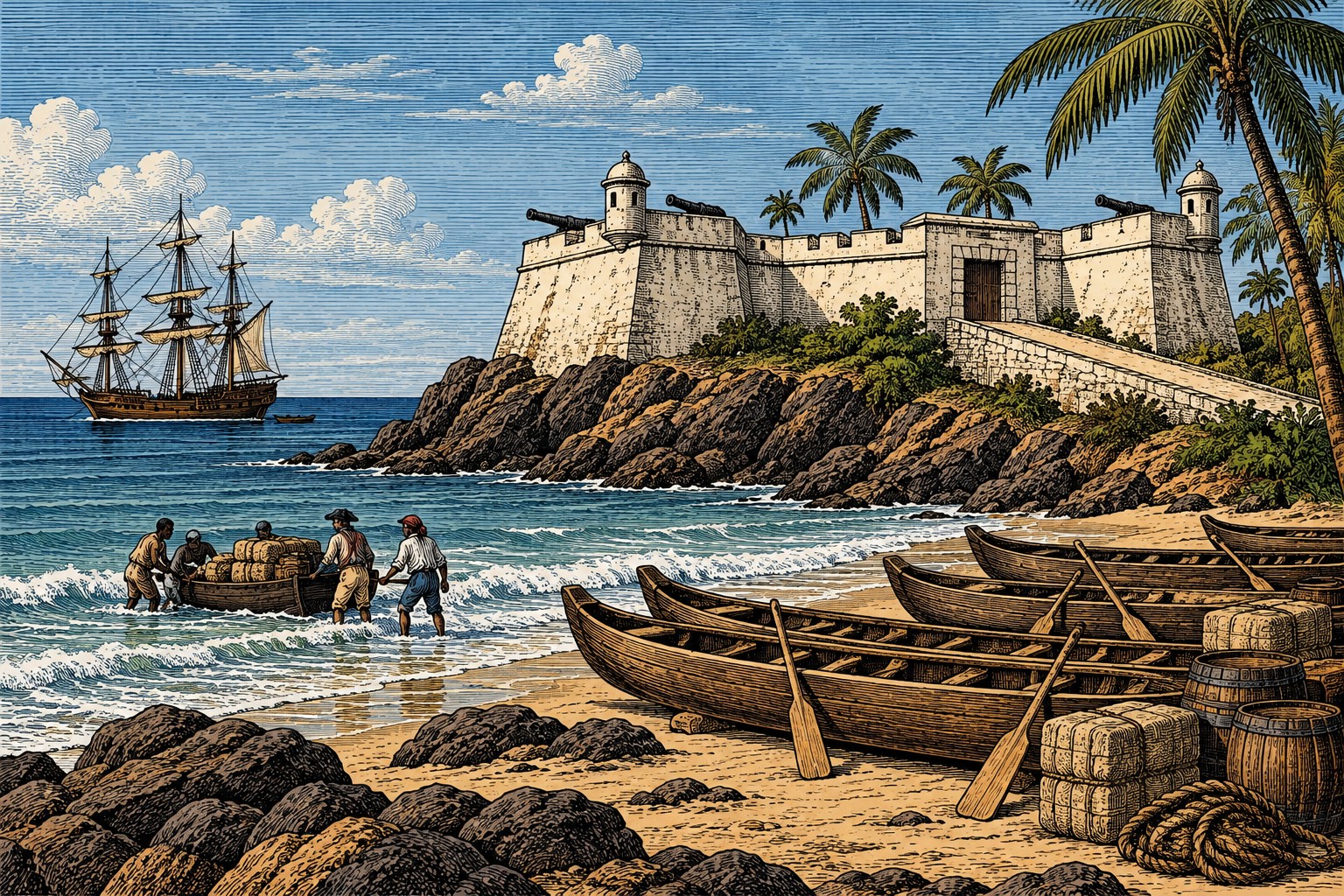
Havana assembles Spain's homeward fleets and directs the 1715 salvage. A visitor in 1697 to 1698 described a lighthouse, three castles, unfinished walls and a floating timber chain across the entrance. During his stay, ships loaded about 30 million pesos in precious metals over several weeks. Mexican situado funds paid troops and fortifications. Fleets gather from May to August and leave by September (Trade and Shipping, Convoys, Fleets and Escorts).
A high eastern castle and lighthouse face a lower western fort across the narrow entrance. La Fuerza, the third castle, stands on the inner town frontage. Pale limestone and plaster houses under low red tile rise behind wharves and warehouses, punctuated by church towers. Landward walls, begun in 1674, remain unfinished. Galleons, balandras and lateen boats anchor behind the harbour chain.
##### Havana
*Spain's treasure port, about 410 miles from Nassau.*
- **Held by:** The Spanish Crown, through the Governor of Cuba: the Marquis of Casa Torres to 26 May 1716, and Vicente de Raja from 26 May 1716 to 23 August 1717.
- **For a Company:** A market that buys goods sold to the Spanish flag or to a bribe; news of the plate fleets and the salvage; a Spanish prison for a Company that gets it wrong.
- **Who to meet:** The Governor and his clerks; an officer of the castles; an official of the salvage; a harbour pilot; a priest.
- **Danger:** A chain across the harbour, three castles, and the Spanish guardacostas that the English call picaroons. A Company taken here is held until someone pays.
- **Hook:** A Port Royal merchant pays a Company to carry a clerk with a letter of reparation to the Governor: Peter Heywood wrote to the Governor of Havana on 16 August 1716 about vessels condemned as prizes.
##### LEGEND
One traveller of 1697 counted almost 27,000 people, over half the island, and a third of the townspeople of African descent, only a handful free; his own earlier figure of 3,000 looks like households. The wall begun in 1674 is said to have been finished only in 1740. Neither is a count.
The same visitor names a battery nicknamed the Twelve Apostles. Later usage puts a battery of that name at the foot of the Morro on the channel; the 1697 account may mean the Morro's own twelve great guns. The book does not fix its place.
#### Dealing Here
Flag and bribe determine what Havana permits. In 1697 and 1698 officials overloaded galleons beyond Council of the Indies limits while townspeople and sailors traded illicitly. Buyers price the legal risk. English Companies cannot buy arms (Gear and Prices). Fencing is Hard: 25 in 100 plus 10 per net Success.
Entry waits on the harbour chain, beneath both castles' guns. A smuggler's pilot or bribe may secure passage; refusal keeps the Company outside (Places and Campaign Tools, Journey: Prize Wine to Havana). Salvage vessels left for Florida by late August 1715. Havana still has news of losses and seizures there (Historical Reference, The plate fleet hurricane).
#### Law and Trouble
Utrecht's treaty of 13 July 1713 keeps Britain and Spain at peace until the declaration of war on 17 December 1718. English ships are Wary 1 in peace and Hostile 2 in war; Catholics are Welcome 1, Dutch traders Neutral. Peace offers no protection for robbing Spanish shipping.
The guardacostas are the governor's privateers, commissioned by the Governor of Cuba. The record names the periagua, a half-galley with up to 120 men, and the balandra, a sloop with up to 25, based at Santiago and Trinidad (Historical Reference, The Spanish guardacostas); the record's dates for these craft are mostly the 1730s and 1740s. They seized Jamaican men fishing on the wrecks; Heywood reported it on 11 August 1716. In a deposition of 14 October 1715 Richard Ward reported that the Spanish at Havana planned to attack the people of the Bahamas over the piracies, and the raid on the salvage camp in early 1716 gave them more cause (Historical Reference, The Jennings and Vane raid).
Tobacco growers drive Raja from Havana in August 1717. An acting governor serves until Gregorio Guazo Calderón arrives on 23 June 1718.
### St Augustine
##### St Augustine
*Spain's garrison port in Florida, accused in December 1716 of supplying the Yamasee.*
- **Held by:** The Spanish Crown, through the governor of Florida: Francisco de Córcoles y Martínez to 13 July 1716, Pedro de Olivera y Fullana from 13 July, and Juan de Ayala y Escobar, interim, from 30 October 1716.
- **For a Company:** News of the Yamasee War and of Carolina's enemies; a Spanish market for goods sold to the flag or to a bribe; nothing for a Company that has robbed Spanish ships.
- **Who to meet:** An officer of the garrison; a Yamasee refugee; a supply master waiting on the packet from Havana; a soldier of the free Black militia.
- **Danger:** A garrison that is a target of Carolina and has reason to distrust any English sloop.
- **Hook:** The garrison's pay and stores come by packet from Havana (Starter Adventure). A Company that wants the packet, or wants to warn it, has to learn when it sails.
#### The Place
Florida's sole stone fortress, St Augustine's Castillo de San Marcos, began on 2 October 1672 under Manuel de Cendoya and was completed in 1695 under Laureano de Torres y Ayala. Forced Timucua, Guale and Apalachee labour built its coquina shell-stone walls; the province's other works are timber. From 10 November to 30 December 1702, 174 regulars and about 1,500 civilians sheltered there for fifty-one days; one count totals 1,445 inside. Moore's militia and Indian allies burned the town before withdrawing. Carolinians and Muscogee destroyed the Apalachee missions in January 1704. By late 1706 only St Augustine and Pensacola remained of Spanish Florida.
Several hundred men hold the post: two foot companies dating to the 1500s, a third added in 1687, and cavalry from 1706, formalised in 1714. No 1716 count of paid plazas survives. Yamasee refugees allied with Spain after fleeing south in 1715. Estimated town population is well below two thousand, including soldiers' families.
#### Dealing Here
Fencing is Hard, with no arms for English Companies (Havana; Gear and Prices). Food and stores can outvalue plate to a hungry garrison. Since the missions' destruction in 1702 to 1706, supplies depend on the Mexican situado, Havana and illicit Carolina purchases. Juan de Ayala y Escobar buys Carolina flour at steep mark-ups and resells it privately. Interim governor from 30 October 1716, he will face arrest for English contraband in 1718.
#### Law and Trouble
English ships are Wary 1 under the 1716 peace (Havana). Carolina faces Hostile 2: its officials accuse the garrison of supplying Yamasee raiders. Charles Town arrivals are watched; known raiders of Spanish ships are refused entry.
Carolina's enslaved people have escaped south since 1687. Quiroga refused their return in 1688; Charles II's 1693 edict grants freedom to fugitives reaching Florida who accept baptism. An all-Black militia unit dates to 1683. A fugitive serving the Company knows the route.
On 4 April 1717 Ayala receives Creek chief Chipacasi and 157 delegates requesting restoration of San Marcos de Apalache. He supplies 154 muskets.
### Pensacola
##### Pensacola
*A two-company presidio on the Gulf coast, supplied from Veracruz and watched by French Mobile.*
- **Held by:** The Spanish Crown, through Governor Gregorio de Salinas Varona, who holds the post from 1711 to 1717.
- **For a Company:** Word of the Gulf coast and of the French at Mobile; a Spanish market for the same goods as St Augustine; nothing else.
- **Who to meet:** An officer of the two companies; a Yamasee refugee; a supply officer waiting on Veracruz.
- **Danger:** A hungry garrison and the memory of Creek and Carolina raids.
- **Hook:** The garrison's resupply from Veracruz is irregular. A Company that carries flour is welcome; a Company that carries only plate is an invitation.
#### The Place
Andrés de Arriola founded Presidio Santa María de Galve and Fort San Carlos de Austria in November 1698. New Spain administers and irregularly supplies the unpopular, poor-soiled post through Veracruz. Two infantry companies guard a fort beside a village and church. France established Biloxi's Fort Maurepas in 1699 and Mobile in 1702, about 59 miles away by the old land road. Creek and Carolina raiders twice besieged Pensacola in 1707. Yamasee refugees arrive after 1715.
#### Dealing Here and Law and Trouble
No arms are sold to an English Company, and the fence is Hard. An English ship is Wary 1 in peace and Hostile 2 in a year of war. A Company that lands here can expect to be asked who is paying it.
Pensacola changes hands repeatedly during the War of the Quadruple Alliance. Bienville takes it on 14 May 1719, sending the garrison to Havana in French ships. Spain recaptures it in August; Champmeslin retakes it in September. Peace comes with The Hague treaty of 17 February 1720. French forces burn the town before returning it in 1722; Spain rebuilds on Santa Rosa Island, occupied from 1722 to 1752.
### Santo Domingo
##### Santo Domingo
*The oldest Spanish city in the Indies, on the Ozama River, ~455 miles from Port Royal.*
- **Held by:** The Spanish Crown, through Governor and Captain General Fernando Constanzo Ramírez, who holds the post from 1715 and presides over the Real Audiencia.
- **For a Company:** A Spanish market for contraband; a French frontier where cattle and mules cross; the high court of the islands.
- **Who to meet:** Constanzo and the judges of the Audiencia; a drover from the cattle trade; a smuggler of the French frontier.
- **Danger:** A court that takes a Company's ship and sends the papers to a council weeks away.
- **Hook:** A cattle trader on the French frontier wants arms for his drovers and pays in hides.
#### The Place
Fortaleza Ozama guards Santo Domingo's river mouth. The walled city houses the Real Audiencia for the islands and Tierra Firme coast; its president also serves as governor and captain general. Appeals from Cuba, Puerto Rico and Caracas take weeks to arrive.
No town population survives. The Spanish colony totals about 18,410 in 1718, its growth supported by cattle trading and immigration. Fugitives from French territory have settled at San Lorenzo de los Minas since 1678. Small legal slave imports are supplemented by illicit landings and escapees from Saint-Domingue.
#### Dealing Here
Cattle, draught animals and timber cross into French Saint-Domingue, driven largely by former and escaped slaves. Santo Domingo's guardacostas profit from contraband seizures. Fencing is Hard. Across the border, French officials are protesting to Jamaica (Cap-Français and Léogâne).
#### Law and Trouble
Britain and Spain are at peace in 1716, and an English ship is Wary 1. Constanzo is the name on any Santo Domingo paper in 1716. A Company tried here is tried by the Audiencia, and an appeal goes to Madrid.
##### LEGEND
The walls are said to run from the Ozama to the Puerta del Conde, and to have been redrawn in a late sixteenth-century design close to the city, with a small moat, bastions for grazing fire and fortified gates; one account calls it an accessory to the cliff, of mixed wood and stone. The detail comes from summaries.
### San Juan
##### San Juan
*The fortified Spanish port of Puerto Rico, ~705 miles from Port Royal and a day from St Thomas.*
- **Held by:** The Spanish Crown. Juan de Ribera was removed on 3 May 1716; José Francisco Carreño holds the government as interim governor until Alberto Bertodano y Navarra is sworn on 30 August 1716.
- **For a Company:** A Spanish market for contraband; the base of the guardacostas that take English and Danish sloops; news of St Thomas.
- **Who to meet:** The governor; a captain of the guardacostas; the Captain of Sea and War, Miguel Enríquez.
- **Danger:** Privateers who are paid in what they take.
- **Hook:** A shoemaker's son who became a privateer proposes in 1716 to take Danish St Thomas with about 500 militiamen. The proposal is refused. A Company that knows it can sell the news to St Thomas.
#### The Place
San Juan's permanent garrison exceeded 400 in 1596 and remained near that strength through the following century. No figure survives for 1716, nor a population count or description of San Cristóbal's condition that year. Mexican situado payments often fail, making contraband essential to local commerce.
Born about 1674 to a freed woman, Miguel Enríquez trained as a shoemaker and was convicted of contraband in 1700. From 1701 he privateers under Gutiérrez de la Riva. Recognition as Captain of Sea and War follows on 11 July 1710, then the Medal of the Royal Effigy and Caballero title with "Don" on 12 March 1712. Historical people receive no stat blocks; the Company encounters his vessels.
#### Dealing Here and Law and Trouble
Crone, the governor of St Thomas, traded illegally with Juan de Ribera, the previous governor of Puerto Rico, and in summer 1715 the St Thomas planters demanded satisfaction from Spain for slaves who fled to Puerto Rico and for ships seized in the war. A fence deal in San Juan is Hard, and an English Company is Wary 1.
##### LEGEND
Enríquez is said to have commanded some 300 vessels in his career, 150 of them lost, and to have employed nearly 1,500 sailors, with a fortune over 500,000 pieces of eight. One account gives thirty vessels and about twenty prizes for 1702 to 1713. The larger figures come from a biography.
### Cartagena and Portobelo
##### Cartagena and Portobelo
*The great port of the Main and the silent port of the Isthmus, ~525 and ~610 miles from Port Royal.*
- **Held by:** The Spanish Crown. At Cartagena the governor is Jerónimo de Badillo or Francisco de Baloco y Leigrave, who relieved him in 1716; Badillo returns in 1717. The viceroyalty is Peru's until New Granada is named on 27 May 1717.
- **For a Company:** A rich market that depends on Jamaican merchants; the slave market and asiento port; word of the galleons.
- **Who to meet:** The governor; a contador of the customs; a Jamaican factor; a harbour pilot; at Portobelo, an officer of the three castles.
- **Danger:** The guardacostas that call every English sloop a smuggler, and a governor who may be in the contraband himself.
- **Hook:** A Jamaican factor in Cartagena offers a Company a cargo of goods to land at Portobelo, where no fair has been held since 1708 and the warehouses are empty.
#### The Place
Cartagena's walls enclose a city on a lagoon bay. Population counts give 14,223 in 1698, 10,230 in 1701 after the 1697 sack and fever, and 12,932 in 1732. Earlier enumerations counted fighting-age adult men, making whole-town totals approximate. Three grounded ships obstructed Bocagrande on 17 March 1640, shifting defence to Bocachica. Juan de Somovilla designed San Luis in 1646; lack of funds delayed completion to about 1661. Pointis partly destroyed it in 1697. Restoration runs from 1719 to 1728; in 1716 the patched channel castle offers less protection than the city walls.
Pointis arrives in April 1697 with a French squadron, 1,200 soldiers and 650 buccaneers assembled under du Casse at Saint-Domingue. After Bocachica and the Half Moon gate fall, Diego de los Ríos capitulates on 6 May. Plundering continues to 24 May; totals remain disputed. Rare galleon visits leave Cartagena buying necessities from Jamaica (Powers of the Caribbean). It is also the Main's leading asiento landing place and a major slave market.
#### Portobelo
Portobelo replaced Nombre de Dios. San Felipe de Sotomayor (Todo Fierro), Santiago de la Gloria and San Jerónimo overlook its swampy bay; San Lorenzo protects the Chagres mouth. A customs house faces the shore. Morgan occupied the town for fourteen days in 1668 with about 450 men, demanding 100,000 pesos. Coxon captured it in 1680. Without a fair between 1708 and the 1720s, the 1716 port contains a waiting garrison, sick inhabitants and empty warehouses.
#### Dealing Here
At Cartagena a Company arrives under a Jamaican factor's business or in custody. Fencing is Hard; a governor involved in contraband can become a valuable buyer.
The *San José* lies off Cartagena from 1708 through the remaining play period. Charles Wager's squadron sank the Tierra Firme flagship near the Barú peninsula south of the bay on 8 June 1708, returning from Portobelo. Court papers claim a cargo value; they provide no registered total.
#### Law and Trouble
An English Company is Wary 1 in peace. The Spanish guardacostas call every English sloop a smuggler and a pirate. The garrison is not recorded for either port, and the GM prints no number.
##### LEGEND
A late encyclopaedia says Portobelo was "very much crowded when the galleons are here", with artisans coming over from Panama for the fair, and otherwise thin. It is a description of the fair, long after 1716. New batteries are said to have been built around Bocachica from 1714; the source is a travel site. Pedrosa y Guerrero, who set up the new viceroyalty in 1718 to 1719, is said to have uncovered a conspiracy by Badillo and other senior officials to undervalue the cargoes of arriving ships; the source is a short summary.
### Veracruz
##### Veracruz
*The port of New Spain, a fever town under the island castle of San Juan de Ulúa, ~925 miles from Havana.*
- **Held by:** The Spanish Crown. The castellan of San Juan de Ulúa and the city's magistrate; their names in 1716 are not recorded.
- **For a Company:** Nothing it can lawfully do. It is where Mexican silver goes out and where Pensacola and the Gulf are fed.
- **Who to meet:** The corregidor; the castellan of Ulúa; a mule-train master from the Jalapa road.
- **Danger:** Fever and the northers; a castle that sees everything that anchors.
- **Hook:** A Company that wants a Spanish prize's papers read finds a clerk of the corregidor who can read them.
#### The Place
Veracruz occupies New Spain's sandy coast. No 1716 population is known; an estimated 6,000 around 1700 comes from one encyclopaedia. Offshore San Juan de Ulúa shelters shipping from northers. Enlarged in 1635, it was rebuilt after the 1683 sack to Jaime Franck's bastioned plan of 1688. Sources give completion as about 1693 or 1707. Ships unload to lighters beneath the island fortress. The Barlovento Armada has served from Veracruz since 1640.
Flota cargoes pass from San Juan de Ulúa's anchorage into lighters, then mule trains up the Jalapa road. Mexico City merchants control these sales. Jalapa's own fair begins in 1720 to 1721 and receives a fixing cédula in 1728; it does not yet operate in 1716.
#### Dealing Here and Law and Trouble
Veracruz is too far from Jamaica for an English Company to put into except as a prisoner or a smuggler. In a norther nothing moves. A fence deal is Hard. The castellan's residence on the island is the seat of authority over fort and city, and the office is the more honoured post. English ships are Wary 1 in peace.
Pensacola's pay and stores come from New Spain by way of this port (Pensacola, above).
## The French Ports
France and Britain are at peace in 1716. Governors general command the military from Léogâne in Saint-Domingue and Fort-Royal in the Windwards; intendants control finance, justice and trade. Commerce centres on Le Cap and Saint-Pierre. The Exclusif reserves colonial sugar to French ships, making an English sloop at a French wharf illicit.
### Tortuga
##### Tortuga
*A small island off the north coast of Saint-Domingue, nearly empty in 1716.*
- **Held by:** France, as part of Saint-Domingue, whose officers sit at Léogâne.
- **For a Company:** Nothing but history and a rumour: the buccaneers once lived here.
- **Who to meet:** A French officer from the mainland; a trader in tafia.
- **Danger:** A French officer's complaint to Jamaica, with your sloop's name on it.
- **Hook:** The intendant and the governor at Léogâne have protested to Jamaica about sloops fitted out of Jamaica that rob French shipping in the Bay of Hondo; the intendant wrote on 18 June 1716 and Blénac on 18 July. A Company is blamed for another man's work.
#### The Place
Between about 1650 and 1680, Anglo-French buccaneers raided Spain from Jamaica, Martinique and Tortuga. Filibusters dispersed and Tortuga was deserted by 1700. Nearly empty in 1716, the French island retains the memory of its former crews. Cap-Français, the north-coast French harbour, lies 330 miles from Port Royal.
##### LEGEND
Tortuga is said to have declined from the early 1670s after Spanish and French raids, with Petit-Goâve taking its trade. Tavern talk puts a pirate fleet there in 1716, but no source places a pirate base there after the 1670s. Laurens de Graaf, who died in 1704, is said to have lived at Petit-Goâve in French service with Anne Dieu-le-Veut (1661 to 1710); the account has no citation.
#### Dealing Here
French islands produce cheap, unaged tafia, also called guildive or kill-devil, and sell inexpensive molasses to North Americans. Aged rum travels abroad; cheaper tafia is chiefly drunk locally. France bars its landing (Trade and Shipping, The French and Spanish Frames), pushing sales towards New France, New England and African slaving ports. Companies can buy inexpensive cargoes along this coast. Fencing is Hard, and English papers bring Wary 1 at best.
### Cap-Français and Léogâne
#### Cap-Français
D'Ogeron and a dozen colonists founded Cap-Français around 1670. City status followed in 1711, along with the colony's capital and chief commercial harbour. Destruction remains within living memory. A Spanish force of 2,600 killed Cussy, burned the town and abducted women, children and enslaved people in January 1691. In July 1695 an Anglo-Spanish fleet of 24 ships and 6,000 men took Port-de-Paix and plundered the north; du Casse recovered it with 3,000 men.
Timber buildings dominate Le Cap in 1716. Brick costs more than French imports; barracks await construction, with stone ones arriving in 1720 to 1721. The chief slave port lands roughly a thousand captives annually. Its second Conseil supérieur dates to June 1701. Irish Jacobite planters have occupied the Plaine du Nord since 1691. Cattle and mules cross the Spanish frontier a day's ride east. Money is scarce, the governor general resides at Léogâne, and Jamaicans usually buy the sugar. Saint-Domingue counted 6,668 whites and 35,451 enslaved people in 1715; the latter total more than doubles by 1730 (Trade and Shipping).
##### Cap-Français and Léogâne
*The French capital of Saint-Domingue and the seat of its government, 330 miles and ~280 miles from Port Royal.*
- **Held by:** France. Louis de Courbon, comte de Blénac, is governor general until he leaves in 1716; Charles Joubert de La Bastide, marquis de Châteaumorand, is received on 11 January 1717. The intendant is Jean-Jacques Mithon de Senneville.
- **For a Company:** French sugar and tafia; a market for Spanish cattle and mules; the officials who write to Jamaica; a harbour that a Company can enter only under a French flag or a bribe.
- **Who to meet:** The intendant; the governor of the north, the marquis d'Arquien, at Le Cap; Jean-Pierre de Charitte, lieutenant of the governor general; a planter of the Plaine du Nord; a drover from the Spanish frontier.
- **Danger:** A colony that has been invaded twice in living memory and has no fleet to answer a complaint.
- **Hook:** Mr Morett, sent from Léogâne on 25 July 1716 to demand reparation of Jamaica for vessels taken at the Bay of Hondo, is at Port Royal. A Company that carries him home, or that holds the goods he wants, is in the middle of it.
#### Léogâne
French government occupies half-built Léogâne in 1716. Choiseul-Beaupré and Mithon laid it out in 1709 to 1710 on two estates half a league inland, chosen for fresh water and freedom from swamp. Philippe Cauvet designed the grid around the first church. Settlers bitterly opposed lending enslaved workers for construction. Reports from Mithon and Blénac in 1713 and 1714 describe rapid growth, but brick shortages delaying barracks and magazines here and at Petit-Goâve.
A day west lies Petit-Goâve, former filibuster harbour and council seat. Its Conseil souverain dates to August 1685; the Code Noir was registered on 6 May 1687. Bahoruco Maroons control the southern mountains, where an expedition killed three and captured eleven in 1702. Pork barques coasting towards Jamaica are exposed to raids.
#### Dealing Here
English papers bring Wary 1 at best along the French coast. Sugar and tafia reach Antigua and Boston in 1716 despite trade restrictions. Fencing is Hard. Spanish mule drovers and Curaçao sloops sustain south-coast commerce.
#### Law and Trouble
On 18 June 1716 Mithon protests to Jamaica's Hamilton about English-fitted vessels, including Jennings's, seizing French ships in the Bay of Hondo. Blénac's 18 July letter describes daily robberies by Jamaica-based sloops. Officials receiving Jamaican papers know those complaints. Blénac, seeking recall from the damaging climate, leaves in 1716.
Later, Léon de Sorel is named governor general on 1 September 1718, received at Le Cap on 10 July 1719.
### Saint-Pierre and Fort-Royal
##### Saint-Pierre and Fort-Royal
*The commercial and the military capitals of Martinique, ten miles apart, ~1,060 miles from Port Royal.*
- **Held by:** France, through Abraham Duquesne-Guitton, governor general of the Windward Islands, who has word of his recall. His successor, the Marquis de La Varenne, lands on 5 January 1717 aboard *La Valeur*, with the new intendant, Ricouart, who replaces Vaucresson.
- **For a Company:** French sugar, tafia and cocoa; the best roadstead in the Windwards; the governor general's justice.
- **Who to meet:** Duquesne; a Saint-Pierre merchant who advances cloth and flour against next year's sugar; the captain of a Fort-Royal guard ship; a Dominican of the stone church.
- **Danger:** The Exclusif and the Vauban wall. A foreign ship in the Carénage is an event.
- **Hook:** A Saint-Pierre merchant wants a cargo moved before the new intendant arrives in January 1717.
#### Saint-Pierre
Saint-Pierre was founded on 1 September 1635 by d'Esnambuc and is the island's commercial capital, with the better roadstead. A "Mouillage" ward looks over the anchorage, where ships ride more securely than under the fort, and a "Galère" ward runs along the shore from Fort Saint-Pierre to the Jesuits' river. The Dominicans' stone church stands in the Anchorage. Houses are built of grey pumice or lava from the beach. The Ursulines opened a girls' school in 1682. Gabaret built the Saint-Nicolas battery to cover the bay. Ships load barriques of clayed sugar and tafia; a garrison in grey-white coats with blue cuffs holds the fort. An English account of 1692 called Saint-Pierre the capital of the French Antilles and "a place of considerable trade"; the elder Blénac, Charles de Courbon, governor general of the Windward Islands, made Fort-Royal the seat that year. The island's Conseil souverain, which dates from 1645, is a council of planters. Saint-Pierre is the trade and Fort-Royal is the law.
#### Fort-Royal
Ten miles south, Fort-Royal houses the government. Du Parquet ordered Fort Saint-Louis in 1638; it was soon destroyed. Rebuilding began under de Baas in 1669 and continued under the elder Blénac to Vauban principles. In 1673 the Company resolved to build a town despite malaria. Blénac drained bogs, laid streets around the Savane and erected a stone church. Over ten years a wall 487 metres long, four metres high and two thick enclosed the peninsula. Capital status followed in 1692.
On 19 to 20 July 1674 de Ruyter attempted to land 3,400 men from 30 warships, nine supply ships and 15 transports. Calm weather and French booms kept ships outside. The landing failed with 143 Dutch dead against 15 French, remembered in France as the battle of the rum.
#### Dealing Here and Law and Trouble
Martinique is the richer island; in 1717 it expels its governor, and in 1718 it loses its cocoa. The island's population in 1694 was 19,581, with 1,110 men and 641 boys fit to bear arms and 12,900 enslaved: a militia under two thousand white men on an island of thirteen thousand enslaved people. A fence deal is Hard, and a foreign sloop at Saint-Pierre is a smuggler by the Exclusif.
Duquesne is a new Catholic, and he is going home. An English Company is Wary 1; a Company with a French commission is Neutral.
##### LEGEND
Captain Aycard is said to have scuttled his laden ship to block the Carénage in 1674. The account has no citation.
## The Dutch and Danish Ports
Commercial harbours give Dutch and Danish companies influence despite scant naval strength. Curaçao holds legal free-port status from 1674; St Thomas opens its harbour on 16 August 1716 (Trade and Shipping, The Free Ports and the Pirate Harbours). Both buy widely. Duties, fees and inspection purchase the Company's access to willing markets.
### Willemstad
##### Willemstad
*The Dutch free port of Curaçao, ~665 miles from Port Royal.*
- **Held by:** The Dutch West India Company, through a provisional director, Jonathan van Beuningen, who has held the post since 1715 (Jeremias van Collen before him, 1710 to 1715).
- **For a Company:** A free port that sells to three empires; salt, dyewood and hides; Venezuelan cacao; a buyer of goods whose origin nobody asks about.
- **Who to meet:** Van Beuningen; a merchant of the Mikvé Israel community; a WIC clerk; an officer of Fort Amsterdam; a cacao factor with sloops on the Venezuelan coast.
- **Danger:** The asiento is British, so every sale to Spanish America from here is contraband, and Spanish guardacostas take Dutch cacao sloops.
- **Hook:** A merchant house with cacao on a Venezuelan beach wants a sloop to bring it out past the guardacostas, and pays in goods a Company can sell at Kingston.
#### The Place
Punda, "the point", grew beside Fort Amsterdam from 1634. Over 200 houses stood within its walls by the late seventeenth century; Willemstad's name first appears in 1680. In 1675 the Company authorised Pietermaai outside the walls, leaving a roughly 500-metre clear zone for artillery. Otrobanda, "the other side", began across St Anna Bay in 1707. Nine years later its new houses provide cheap lodging beyond the important households' quarter.
Soldiers and enslaved Angolans built Fort Amsterdam at St Anna Bay's mouth in 1634 to 1635 or 1636. Three-metre walls and four of five planned bastions surround the WIC headquarters, with guns chiefly facing seaward. On 21 August 1634 about 200 Dutch troops defeated 32 Spanish defenders after three weeks. No 1716 garrison total survives. Mikvé Israel's synagogue dates to 1703; 140 of 460 European households were Jewish in 1713.
#### Dealing Here
Curaçao forwards salt, dyewood, hides, Venezuelan cacao and European supplies to three empires' colonies. Britain's asiento has reduced captive imports from thousands to a few hundred annually, and Main-bound sales are contraband. Fencing is Hard. Dutch merchants accept almost anything they can resell.
Expulsion from French islands under the Code Noir of 1685 brought many Jewish settlers to Curaçao. Their community anchors island commerce (Powers of the Caribbean).
#### Law and Trouble
No Dutch measure against pirates is on record for 1716. The colonies bought themselves out of Cassard's raids, so a Dutch governor is a buyer, not a champion (Powers of the Caribbean). On 18 February 1713 Cassard landed at Sint Kruis Bay; the Dutch troops could not stop him, fell back on Willemstad and disabled the guns of Fort Sint Michiel; the town capitulated on 24 February, and he took a ransom of 600,000 livres and left, wounded. The town paid, and remembers. An English Company is Neutral; a Company that flies French colours or carries French papers is Hostile 2. A small slave revolt is said to have been put down in 1716; the record is one uncited summary (Powers of the Caribbean, Legend).
##### LEGEND
Other accounts of the sum Cassard took in 1713 give about 250,000 francs or 115,000 pesos (unresolved). A counting of 1717 is said to have found 135 enslaved people in the city behind the fort and 214 buildings in it; the source is a tourism summary.
### St Thomas
##### St Thomas
*The Danish island port of Taphus, open to every flag from 16 August 1716, ~780 miles from Port Royal.*
- **Held by:** The Danish West India and Guinea Company. Mikkel Knudsen Crone governed from 1710 and died on 8 August 1716; Erik Bredal, who had been the company's secretary and bookkeeper, is elected governor on 5 September 1716.
- **For a Company:** A harbour that takes any flag; a buyer for cargoes at a 5 per cent import duty; planters short of customers; a prize inspector.
- **Who to meet:** Bredal; the council that served Crone; a planter; a lieutenant of the harbour guard.
- **Danger:** Crone's council is still in office, still in debt and about to be convicted of fraud; a Company's prize is inspected before it is sold.
- **Hook:** A planter's factor offers to buy a cargo outright if the Company will let the prize inspector pass it as bought from a Danish ship.
#### The Place
Jørgen Iversen Dyppel's second expedition landed on 25 May 1672 and began Fort Christian, finished over eight years. Stone curtains form a square between diamond bastions, with northern, eastern and western ravelins and a central round tower. The fort houses government and jail and serves as town centre. Only 29 of the original 190 settlers survived the first year. Four waterfront taverns appeared west of the fort in 1675, giving Taphus its "beer house" name. Charlotte Amalie is another name for the town.
The 1715 count gives 160 plantations, 547 white planters and 3,042 enslaved people, exceeding five to one. Plantation bondage supports the small white town. Enslaved people already outnumbered Europeans by 1680; the first census, in 1688, counted 422 Africans and 317 Europeans. Brandenburg leased a quarter for thirty years from 24 November 1685, chiefly for slave trading. Denmark seized it in 1693. No record establishes a remaining Brandenburg presence in 1716.
#### Dealing Here
Neutrality after 1702 expanded St Thomas's trade. Utrecht in 1713 severed its Spanish West Indian markets, followed by an extra 25 per cent company tax. Crone limited foreign purchases to shortages of Danish goods while himself trading illicitly with Puerto Rico's governor. On 16 August 1716 royal resolution reduces emigration tax from 25 to 10 per cent and admits foreign commerce, except from the Danish realm, Hamburg and Bremen. Duties are 6 per cent outward, 5 inward. Planters seek any customers, pirates included.
Before selling a prize, privateers must establish their identity and obtain approval under Crone's 1710 decree. Fencing is Hard; passing inspection is the immediate obstacle.
#### Law and Trouble
St Thomas has a pirate-friendly reputation a generation old. Governor Adolph Esmit sheltered the pirate Jean Hamlin, whose *La Trompeuse* took eighteen Jamaican ships in 1682; HMS *Francis*, Captain Carlile, found Hamlin at St Thomas on 30 July 1683 and burned *La Trompeuse* the next night, under fire from the Danish fort. In 1689 Governor Lorentz laid heavy taxes on pirates and Brandenburg traders, seized warehouses and cargoes, and was repudiated by Copenhagen. When Kidd anchored outside on 6 April 1699 Lorentz told him that if he was an honest man he could come in freely, and refused him protection and a safe-conduct for a barge.
Planters petitioned to restore privileges in 1714 and sent delegates to Copenhagen in 1715. The King referred their case to a special commission on 14 April 1716. Crone's council later faced fraud convictions; his property paid his debts. English Companies are Neutral.
Later, Bredal officially established St John on 25 March 1718.
##### LEGEND
The tower called Skytsborg is dated 1679, and the town page says "more than 3,000 white settlers lived in town"; neither carries a citation, and the second conflicts with the census of 1715. The renaming of Taphus as Charlotte Amalie is dated 1691 in one source only.
## The Logwood, Mosquito and Salt Coasts
These working coasts lack towns and wharves. English logwood cutters, Miskito seafarers and Bermudian salt rakers produce cargoes without a resident European governor. Spain claims the logwood country; the Miskito control their shore; Bermuda and the Bahamas dispute the salt islands.
### Campeche and the Logwood Coast
##### Campeche and the Logwood Coast
*Spain's walled port on the Yucatán coast and the swamps of logwood to the west and south, ~985 miles from Port Royal.*
- **Held by:** The Spanish Crown, through the governor of Yucatán, Juan José de Vértiz y Hontañón, in post since December 1715, who sends Andrade's squadron against the camps in December 1716. The camps at Términos and on the Belize River are held by no one.
- **For a Company:** A cargo of logwood, a dye, at £3 a ton bought and £6 sold at Port Royal (Places and Campaign Tools, The Logwood Coast); camps that sell for rum; word of the Spanish expeditions.
- **Who to meet:** A cutter captain; a camp's headman; a Spanish officer of the coast guard; a smuggler's pilot.
- **Danger:** Spanish expeditions have cleared the camps again and again over forty years, and in December 1716 they stay. A Company at Términos in late 1716 finds soldiers.
- **Hook:** A Port Royal merchant pays a Company to carry stores to the camps at Términos and bring back a cargo, not knowing that a Spanish squadron is about to take the camps and stay.
#### Campeche
Logwood, salt and shipbuilding sustain Campeche, Yucatán's main port. Two sacks prompted its walls. Myngs and Mansfield arrived with fourteen ships and about 1,400 men on 8 to 9 February 1663 against roughly 150 militia, killing 50 and taking about 150,000 pieces of eight and 14 ships. De Graaf occupied it from 6 July 1685 for two months, leaving in September after burning houses and executing unransomed prisoners. Louis Bouchard de Becour's unified defences were built from 1686 to 1704: an irregular 2,560-metre hexagon with land and sea gates. Bastions include Santiago, San Pedro, San Francisco, San Juan, Nuestra Señora de la Soledad (largest) and San Carlos (first built). Campeche is the Gulf's only fully walled town in 1716; Veracruz relies on an island castle.
#### The Logwood Camps
English logwood cutting began at Cape Catoche in the 1650s or 1660s, moved to the Laguna de Términos (Isla de Tris) when Catoche was cut out in the 1670s, and to the Belize River, where cutting was regular by about 1680. The governor of Yucatán learned on 4 September 1663 that pirates held Isla de Tris and were cutting dyewood. Spain tried to clear it in 1672 to 1673, burned the camps in 1680 and 1690, and repeated the effort in 1703 to 1704 and 1707; each time the cutters came back. In 1710 English ships sank a Spanish coast-guard vessel there. A map of 1699 marks the island "Triest I" and a "Port Royal I" with a "Logwood Creek", a Port Royal island and a Logwood Creek on the lagoon.
A few hundred former seamen and pirates cut valuable logwood. England received 4,965 tons during 1713 to 1716; the trade is valued at least £60,000 annually (Trade and Shipping). Spanish expulsions in 1715 to 1716 sent cutters to Nassau. Alonso de Andrade takes Términos in December 1716 and maintains the occupation. Displaced cutters move beyond the Hondo River in southern Yucatán in 1717. Bacalar, abandoned after the sack of 29 May 1652, remains ungarrisoned until 1729, leaving no Spanish post near Belize River.
#### Dealing Here
Free cutters work swamp camps stocked with rum and sawn wood. Companies buy logwood by the ton for Port Royal resale. England accepts the trade; Spain calls it theft. Fencing in Campeche is Hard and hazardous. Cutters receive a Company at Welcome 1; Campeche treats English ships as Hostile 2.
#### Law and Trouble
English cutters invoke Madrid's "actual possession" clause, but Spain has tolerated rather than recognised their camps. Guardacostas commissioned by governors can seize their vessels (Havana). Loading at Belize River means taking Spanish dyewood in Spanish eyes; captured crews face imprisonment at Campeche.
Later, on the night of 15 to 16 July 1717 the cutters came back with reinforcements and attacked Andrade's fort of San Felipe on Isla de Tris (the accounts differ by a day). They were repulsed, Andrade was killed, and by dawn no cutter was left alive on the island; the post took the name of the Virgin of Carmen that day. The Spanish chased the Baymen out in 1717, 1730, 1754 and 1779, and they always came back. A report of 1732 describes the Belize River camps as "a great many Houses and Hutts" with many enslaved people cutting.
### Mosquito Coast
##### Mosquito Coast
*The Miskito shore of Central America, ~615 miles from Port Royal.*
- **Held by:** The Miskito, under King Jeremy I, who reigns to 1718. No European governor holds the coast.
- **For a Company:** Water, turtle, timber and hides; a Miskito pilot, harpooner or guide; a safe landing; word of the Spanish coast.
- **Who to meet:** King Jeremy; a Miskito pilot or striker; an English trader who calls; a Sambu headman.
- **Danger:** A people who are allies of the English and of Jamaica, not of a Company; and Spanish settlements raided from the coast.
- **Hook:** A Miskito pilot offers to take a sloop to a river mouth on the coast for a share in the cargo and in the rum.
#### The Place
The Providence Island Company contacted the Miskito around 1630, holding two cays and corresponding with the coast during 1631 to 1641. A king visited England about 1638 and agreed an alliance. Spain captured Providence in 1641. After 1655, Oldman, the first named king (about 1650 to 1687), met Charles II and received a laced hat and a commission to aid stranded Englishmen. Jeremy, his son, spoke to Sloane around 1688 and reigns as Jeremy I from about 1687 to 1718.
African shipwreck survivors married into the Miskito near Cape Gracias a Dios, forming the Sambu. By 1699 their coast extended west nearly to Trujillo. On 14 June 1637 Albertus Blauvelt, *Expectation*'s mate, reported Bluefields' harbour to the Providence Island committee. No town stands there. In 1716 English traders visit Miskito Cape Gracias a Dios, but keep no post. British land grants lie decades ahead.
#### Dealing Here and Law and Trouble
English traders exchange beads, rum, clothing, food, guns and military instruction for Miskito turtle shell, meat, timber and hides. Dampier describes privateers eagerly seeking their turtle and manatee hunters. Guides expect negotiation and payment as experienced seafarers (Places and Campaign Tools, The Mosquito Coast).
Miskito raiders sell captives from Spanish and Indigenous settlements to Jamaican sugar-estate traders. Raids reach from Yucatán to Costa Rica in the late seventeenth and early eighteenth centuries. During the 1720s they also help Jamaica hunt Maroons.
##### LEGEND
The name of Bluefields is said to come from a Dutch captain, Abraham Blauvelt. The record names Albertus, not Abraham, and does not derive the town's name from him. The name of Cape Gracias a Dios is said to come from Columbus. A report that British officers crowned Jeremy in Jamaica in 1687 rests on a popular website only.
### Salt Tortuga and the Turks
##### Salt Tortuga and the Turks
*The salt pans of the Caribbean: the Turks Islands, ~465 miles from Nassau, and La Tortuga off Venezuela.*
- **Held by:** Nobody. The Turks are worked by Bermudian rakers and were taxed by the Bahamas in 1693; La Tortuga is unpeopled but for seasonal fishermen.
- **For a Company:** Salt, for curing; a place to lie up in the raking season; a rival to Bermuda's sloops.
- **Who to meet:** A Bermudian salt master and his enslaved rakers; a fisherman; a pilot of the Caicos passage.
- **Danger:** Bermudians and Bahamians who have fought over the pans, and Spanish or French privateers who have driven the rakers off before.
- **Hook:** A Bermuda salt master offers a Company good money to see his sloops past a privateer to market.
#### The Place
Bermudians gathered salt by hand at the Turks Islands in the 1660s and raked it in an organised way at Salt Cay from 1673 and Grand Turk about 1678. The rakers and their enslaved workers come in March and leave in November. By one count 18 vessels raked there in 1708 and 65 in 1716, and about 200 a year loaded at Grand Turk and Salt Cay by 1740. The Bahamas governor Trott taxed the rakers in 1693; the Bahamians seized the Bermudian sloop *Seaflower* in 1701 and Governor Bennett answered with letters of marque. Spanish and French forces drove the Bermudians off the Turks in 1706. A Bermudian privateer is said to have cleared a Spanish and a French privateer out of the islands in the war (Places and Campaign Tools, The Salt Cays). Most of the salt is sold through Bermudian merchant houses on the American seaboard and in Newfoundland to cure cod.
Dutch seasonal workers used La Tortuga's eastern salt pans behind a fort from 1624 to 1638. Cumaná's governor destroyed the works and flooded the pans in 1638, expelling them. Only seasonal fishermen remain. Neither rakers nor a Spanish guard are recorded for 1700 to 1730. The GM can place a salt sloop here by analogy with the Turks, without inventing a national post.
#### Dealing Here and Law and Trouble
Salt pays for a Bermuda sloop's year as ordinary cargo. Nassau Companies face hostility at the pans (Bermuda). Bennett and the Council discussed white Bermudian sailors assisting pirates in July 1719; he also feared for Turks salt rakers.
## The African Coast
The African coast is in this book because the trade runs from it and a Company can come to it as a trader or a prisoner. A Company has no business at these forts in 1716, and the forts have none with it. Each card gives the place as it stood; what a person was sold for is in Trade and Shipping, and the table runs the scenes and does not buy.
### Cape Coast Castle
##### Cape Coast Castle
*The African Company's fort on the Guinea coast, across the Atlantic.*
- **Held by:** The Royal African Company (the RAC), chartered in 1672 (Powers of the Caribbean, The African Company; the coast and the crossing are in Trade and Shipping, The Trade in People).
- **For a Company:** Nothing it can use in 1716 and nothing it can hold. The castle is a fort and a warehouse for people.
- **Who to meet:** The African Company's chief at the castle (the Captain-General: James Phipps from July 1719, and the chief in 1716 is not on record), factors, ship captains loading, African traders and brokers who sell to the African Company.
- **Danger:** A garrison and a trade that has no use for a pirate.
- **Hook:** A factor pays for a passage home and for a ledger of private trade carried quietly to London. (Phipps, the Captain-General from 1719, is dismissed in 1722 and dies at the castle in January 1723.)
#### The Place
Whitewashed Cape Coast Castle rises over Gold Coast surf, with low thick walls, corner bastions and a seaward gate. The African Company directs its coastal business from this English-held fort. Ships anchor offshore; long, narrow local canoes carry goods and passengers through the surf.
Swedish Carolusborg began as a timber lodge with Fetu's king's permission. Denmark acquired it in 1658; two further changes preceded Dutch occupation in April 1663. Holmes captured it for England in 1664.
African sellers deliver men, women and children to the African Company and private merchants, who hold them here until shipment to plantation colonies. Barbados and Jamaican buyers purchase by contract or auction. Sex and age determine prices; children cost less than men (Trade and Shipping, What a Person Was Sold For). A contract dated 16 February 1720/21 promises Barbados planter Sir Robert Davers 60 adults aged 14 to 30, half men and half women, plus 30 children aged 10 to 14, delivered from company ships. By the 1710s rum serves as trading currency.
A rock-cut dungeon, built by about 1682, held about a thousand people under the parade. In January 1682 eight men held in chains were given nine chests of corn a day, and the Company distinguished "shipping slaves" from "castle slaves". In the early 1700s the chief agent wrote that double irons were too painful for the people held.
##### LEGEND
One account puts the dungeons at 1,500 people at a time against Barbot's thousand. Another, written in 1728, gives the castle four bulwarks, seventy guns and 250 men.
#### Dealing Here
In 1716 the castle offers a Company no ordinary business. The table decides whether it arrives as trader, prisoner or witness. Gold Coast natives and Akan speakers such as Cuffee already know its purpose.
Duncan Mackintosh hanged here in 1689. The major later piracy trials come in March and April 1722, when Admiralty commissioners under Captain Mungo Herdman try Roberts's Company (Historical Reference, The Cape Coast trials). Some bodies hang in chains on nearby hillocks; eight are displayed near the castle. Johnson estimates Black men at about a quarter of Roberts's crew (Powers of the Caribbean) without recording their fate. A captive surgeon tried to persuade them to rise and seize the ship.
#### Law and Trouble
No court sits in 1716. The 1722 Admiralty commission requires at least seven members under the Piracy Act of 1698, with Hostile Disposition. Signing articles and sharing plunder defeats a defence of coercion (Era Rules, Law at Sea and Ashore). Seven-year servitude sentences send prisoners to the African Company's West African works.
### Elmina
##### Elmina
*The Dutch castle of São Jorge da Mina, nine miles from the English at Cape Coast.*
- **Held by:** The Dutch West India Company. Hieronimus Haring hands over the Director-General's post to Abraham Engelgraaf-Robbertszoon on 12 May 1716.
- **For a Company:** Gold and goods; the capital of a chain of Dutch forts a day's sail apart.
- **Who to meet:** The Director-General; a factor of the Company.
- **Danger:** A garrison, and a Dutch company that has no use for a pirate.
- **Hook:** A new Director-General has taken the post in May 1716, and every ship that calls is asked for news of the English castle next door.
#### The Place
Elmina was Portuguese before the Dutch took it in August 1637 with Fort Coenraadsburg on the hill behind, which was extended to a full fort in 1665. It is the seat of the Director-General of the North and South Coast of Africa (the title from 1675). The Dutch hold a dozen forts on the coast: Shama, Axim, Accra, Sekondi, Komenda, Butre, Mouri, Apam and Cormantin among them. Slave exports from Elmina itself were small: 1,522 people in 1693 to 1701. Gold exports reached a low of 530 marks in 1701. After the battle of Feyiase in 1701 the Dutch paid Asante two ounces of gold a month as tribute for Elmina, by a note whose terms are disputed, and sent an envoy to Asante in 1701.
#### Dealing Here and Law and Trouble
Elmina chiefly handles gold and goods; larger captive shipments load eastward. Trading Companies receive Neutral from a Dutch factor, while raiders of Dutch ships face Hostile 2. In 1735 lower prices will draw the Dutch slave trade back from the Slave Coast to Elmina.
### Whydah
##### Whydah
*The Slave Coast port of Ouidah, a beach with three European forts.*
- **Held by:** King Huffon of Whydah. Three European posts stand a mile or two from the beach: the English William's Fort, the French and the Dutch lodges.
- **For a Company:** Nothing it can hold. The beach is the market and the surf is the harbour.
- **Who to meet:** The king's officers; the English factor at William's Fort; a canoe master; a ship's captain loading.
- **Danger:** Bars and surf; a ship cannot close the coast.
- **Hook:** A ship lies off the beach in 1716 loading. The *Whydah Gally*, a new London-built ship, comes to buy 500 people from Huffon for Jamaica. What Bellamy does with her in 1717 is in Boston.
#### The Place
The African Company secured a permanent factory at Whydah in 1684 and fortified William's Fort from 1689 to 1702, after an exchange of fire with the French in 1692; the Dutch lodge dates from about 1670 and is headed by Jacob van den Broucke from 1703. Ships could not close the coast for the bars, and worked by canoe; captives were marched to the beach by the "slave route". By 1716 Whydah was called the second largest slave port of the trade. The Portuguese fort is begun in 1721 on land given by King Huffon; Agaja of Dahomey takes the kingdom in 1727. Cowries are the currency of the Slave Coast: at least 30 billion shells were imported to the Bight of Benin over the length of the trade. In 1704 the Dutch merchant Willem Bosman wrote that markets of men were kept here as markets of beasts are with us.
### Bonny
Bonny occupies a Bight of Biafra river mouth. The Bight accounts for about 10.7 per cent of slave trading through the seventeenth century and 15 per cent afterwards. New Calabar led earlier trade; Bonny dominates by the mid-eighteenth century. For 1716 evidence is absent. An account seventy years later puts royal gifts before permission to trade. The GM may use that custom provisionally without adding further detail.
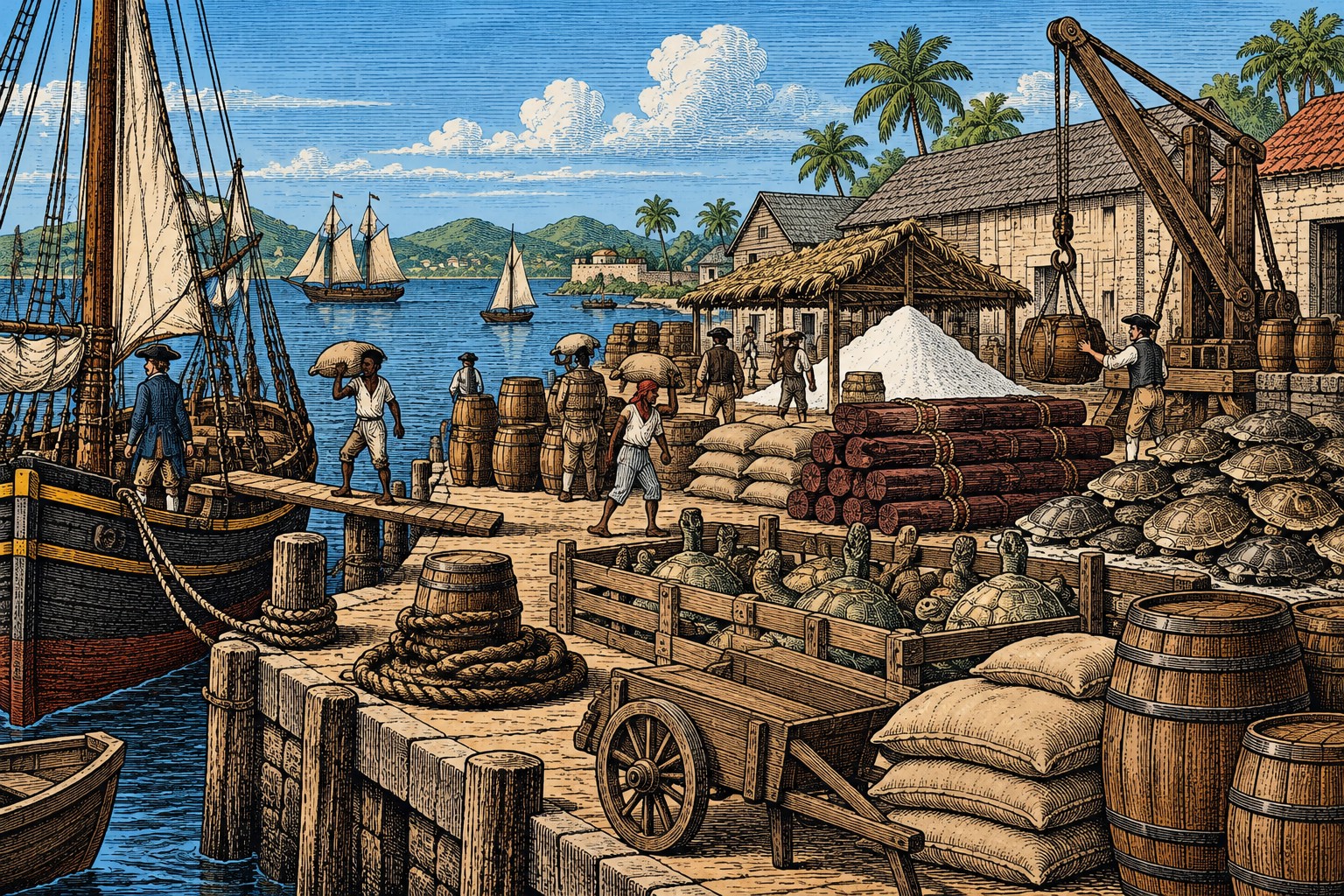


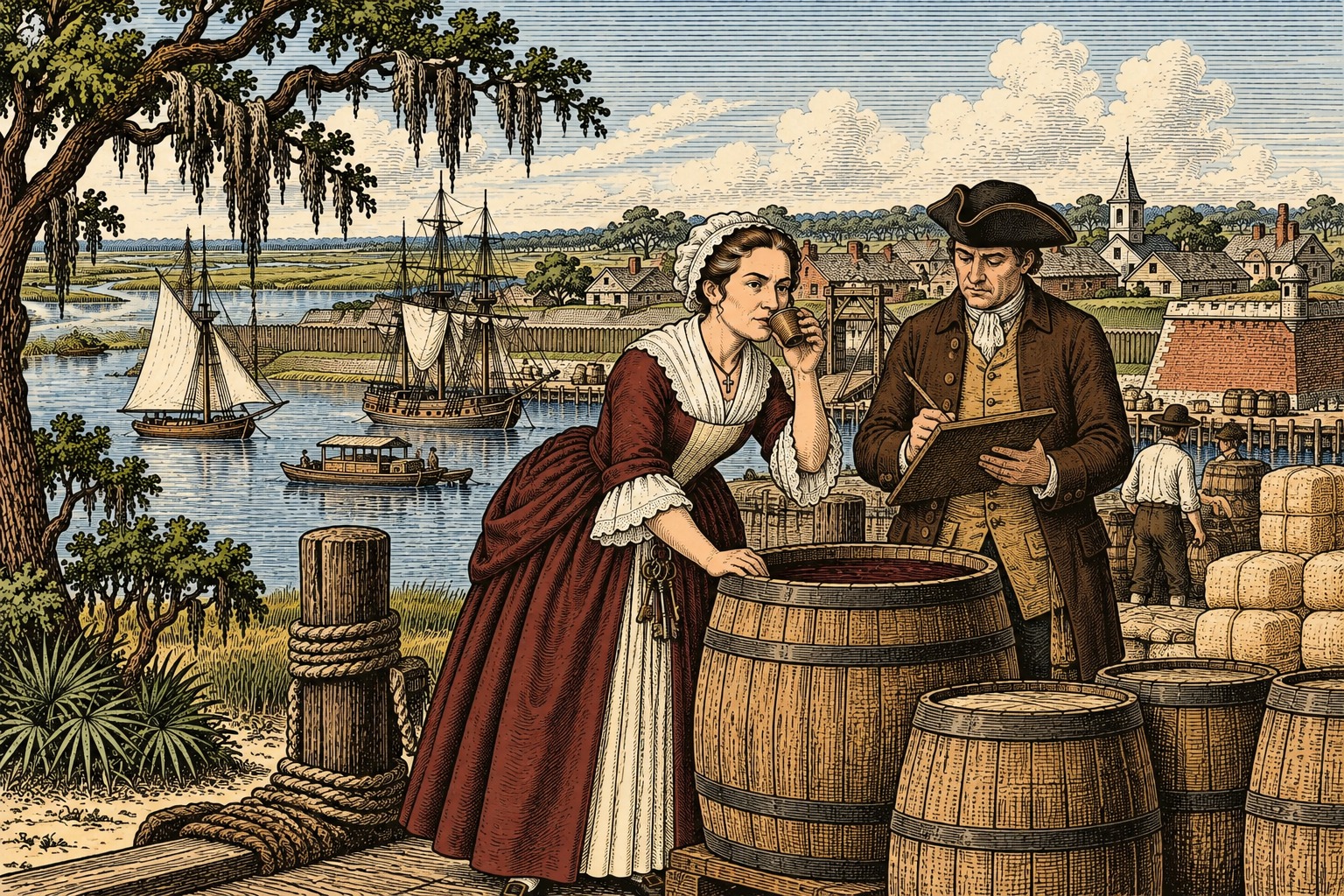 Daniell can issue a private man-of-war commission naming an enemy. Captured prizes still require court condemnation before sale (Era Rules, Law at Sea and Ashore). Stretching an anti-pirate commission to attack a friendly flag is piracy, a distinction Charles Town understands well.
#### Law and Trouble
Vice-Admiralty judges condemn prizes; Admiralty commissioners try pirates, as in Bonnet's 1718 case. The commission court has Fair Disposition in 1716 and Hostile after the 1718 blockade. Apply Infamy Attitudes to a recognised Name: Wary 1 at Infamy 1 or 2, Hostile 2 at 3 or more (Era Rules, Infamy). Commissioned captains are Neutral. Slave codes make an enslaved person's testimony against a white defendant Closed 3.
War has emptied the treasury and made strangers suspect. December 1716 accusations that St Augustine supplied Yamasee raiders give officials particular reason to watch Spanish Companies.
Carolina connections bring business. Kinsella's Charles Town Jacobite agent needs passage for two exiles (Pregenerated Characters). A merchant tracking the Company's Nassau prizes may offer better than the beach's fence rate for its next cargo, while asking which captain lost it.
On 18 June 1718 Johnson reports Teach offshore with a 40-gun ship and over 400 men. The council supplies the demanded medicine chest. That autumn Nicholas Trott presides over Bonnet's trial.
### Ocracoke


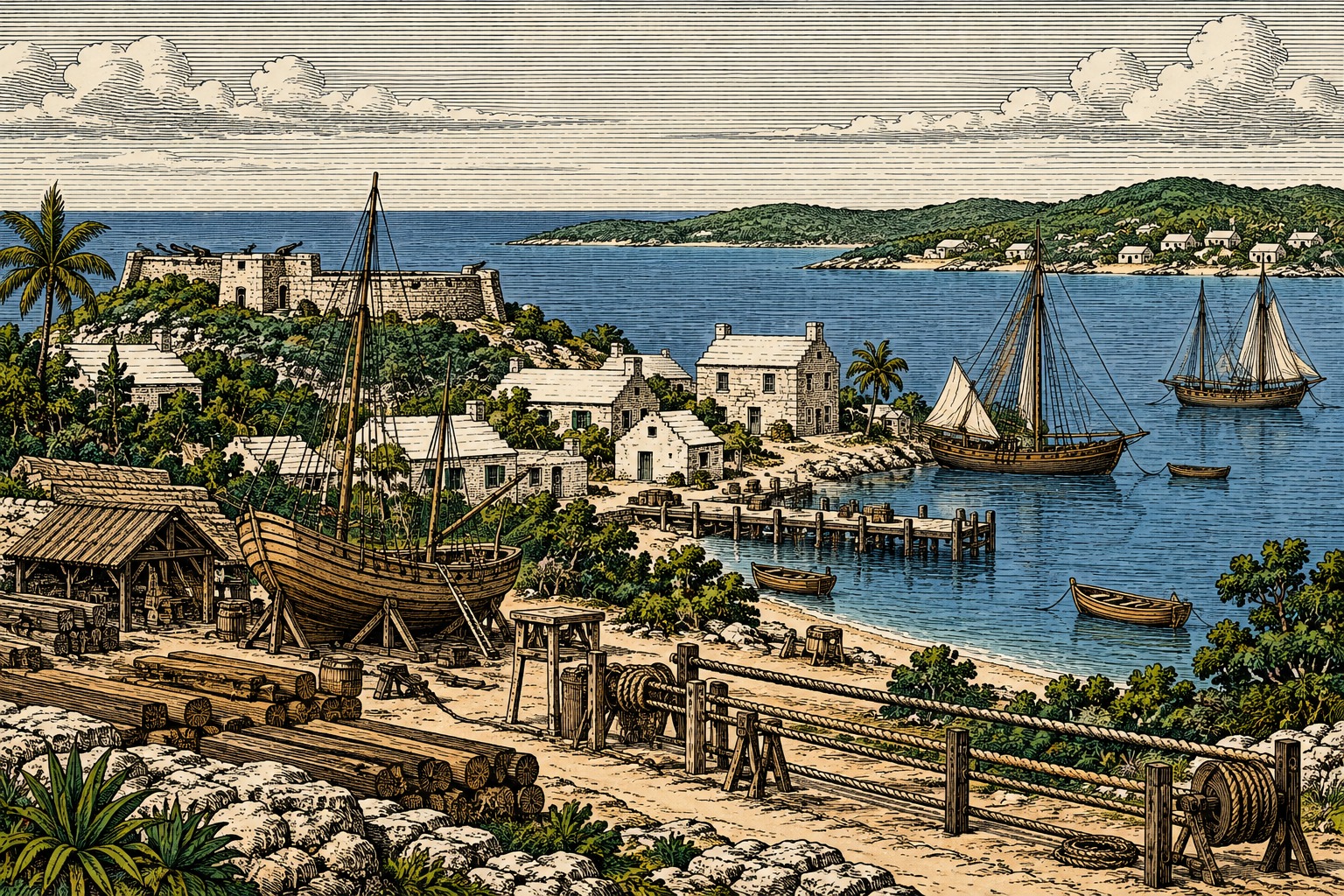 #### The Place
Bermuda lies north of the Bahamas on the homeward Atlantic route, building the cedar, single-masted fore-and-aft sloops described in Ships. St George's is its capital; the Crown took over from the Somers Isles Company in 1684 (Historical Reference). Cedar-covered hills shelter the sound. Whitewashed limestone cottages, a few tall plain stone houses, a headland fort and a timber quay line the shore. Shipwrights shape timber beside sloops on stocks and at anchor.
Salt drives Bermudian commerce. Rakers have worked the Turks Islands since the 1670s (Salt Tortuga and the Turks). By 1700 Bermuda already had about sixty sloops. Merchant houses on the American coast and in Newfoundland buy salt to cure cod. The same ships carry grain, cocoa, brandy and wine to the West Indies. Raiding is only one use of these working traders.


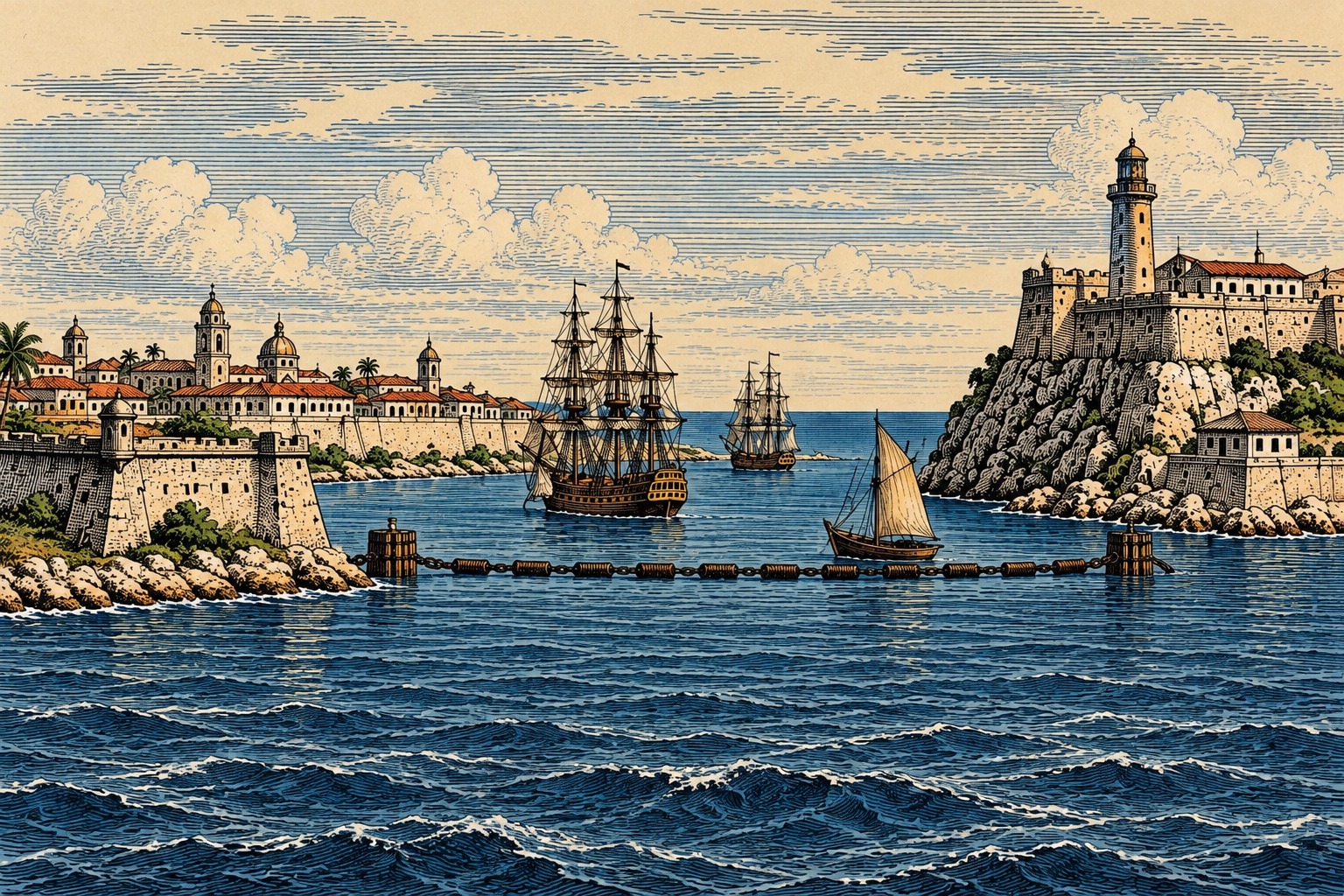 ### St Augustine


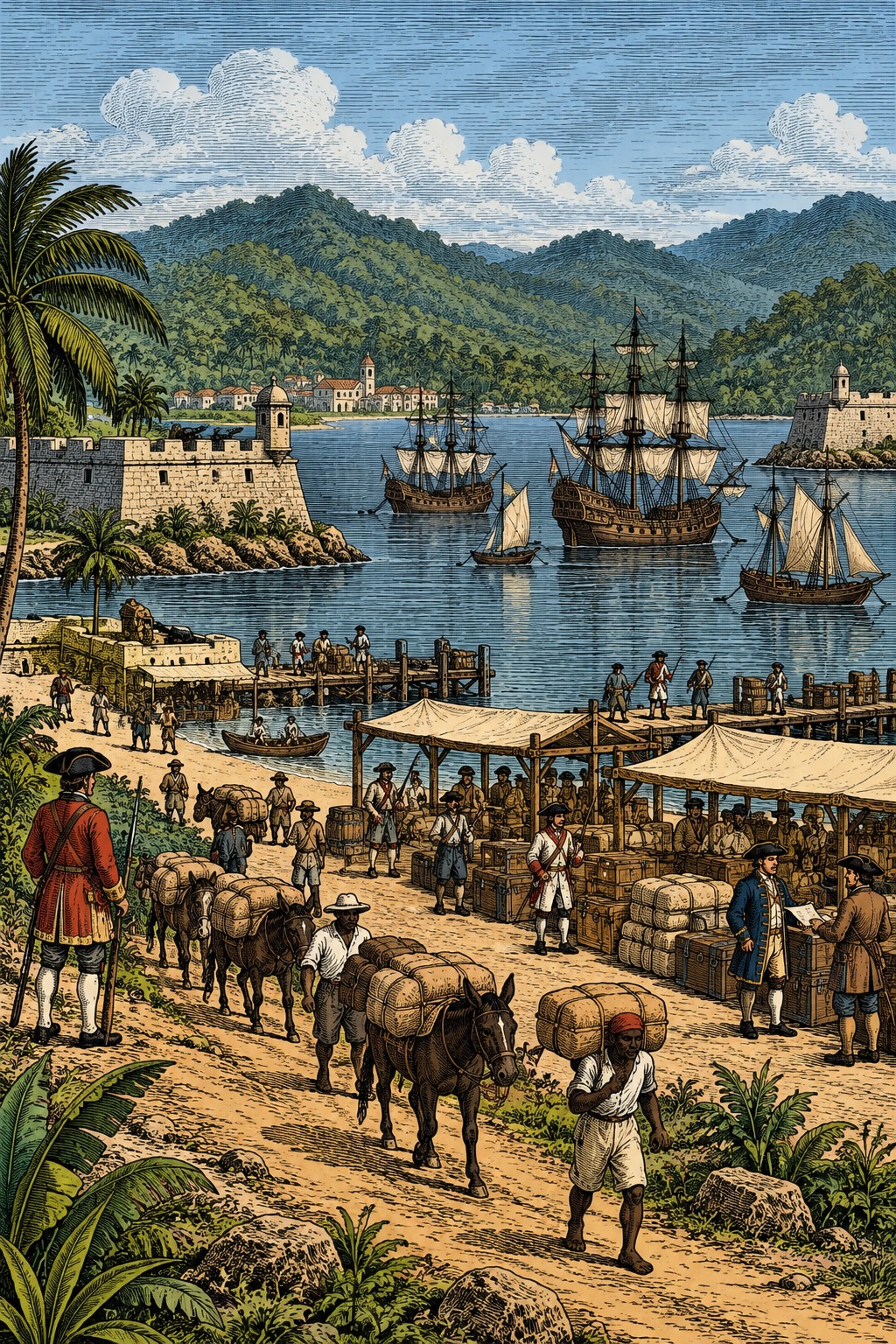


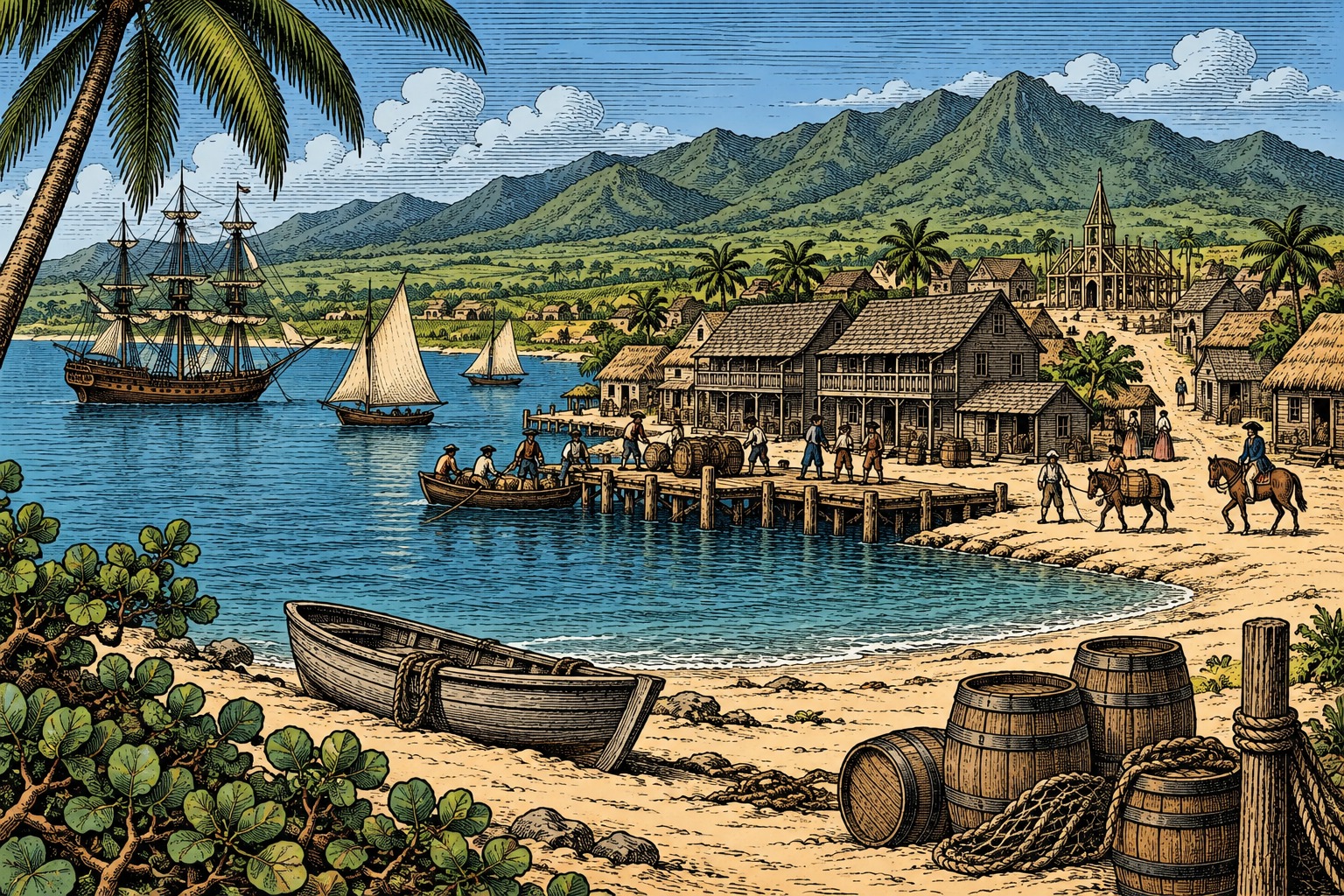


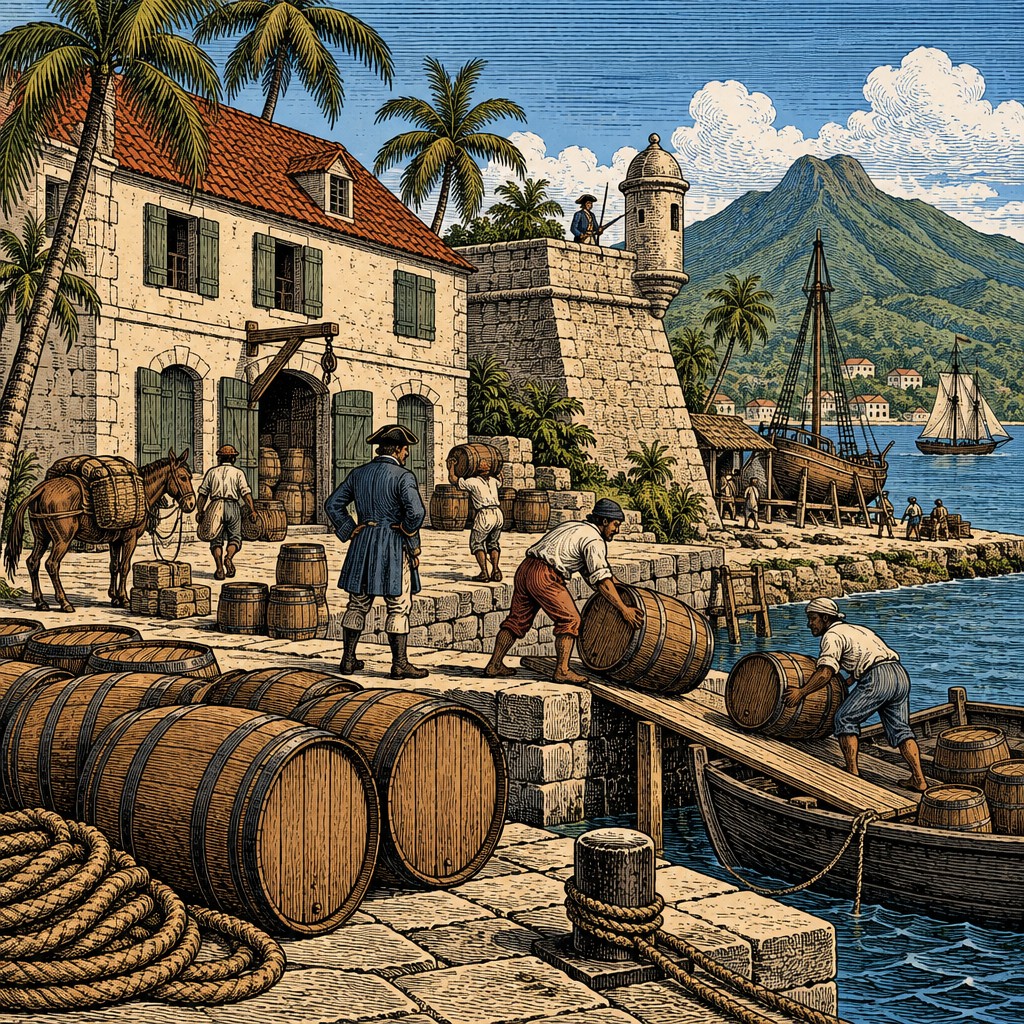 ## The Dutch and Danish Ports
Commercial harbours give Dutch and Danish companies influence despite scant naval strength. Curaçao holds legal free-port status from 1674; St Thomas opens its harbour on 16 August 1716 (Trade and Shipping, The Free Ports and the Pirate Harbours). Both buy widely. Duties, fees and inspection purchase the Company's access to willing markets.
### Willemstad