# Running the Era
*Black Flag, An Exodus NDS Era Book, the Caribbean, 1660 to 1730, mapped in 1716. Source: https://exodusnds.com/era-books/black-flag/running-the-era*
GM guidance follows: running a Company afloat and ashore, using historical figures and portraying the fictional cast. Consult Era Rules and Sail Combat for mechanics, and Places and Campaign Tools for locations and campaign resources.
## The GM's Approach
### What the Game Is About
The players belong to a **Company** that writes articles, votes and divides plunder, subject to its own authority and the threat of the gallows. Four questions drive play: **who leads** (the Vote and dual executive), **what the crew takes** (the Prize and Fence Loop), **who pursues it** (Infamy, navy and pardon), and **where the money goes** (Spree, Base or savings).
Build sessions around these questions. By the end, the Company should have gained or lost wealth, attracted notice or developed divisions.
### Accuracy and Rolls
Era Rules translates the historical frame into procedures. Apply them as written. Roll only for uncertain outcomes whose failure has a cost: pursuit, boarding, bribery, fencing or illness. Routine steering, reefing, gun loading and sail repairs require no check.
Legend boxes identify uncertain history. When play needs an unrecorded detail, choose what serves the scene and continue. Historical uncertainty need not interrupt the session.
### Ordinary Competence in Practice
Assume professional competence aboard. Reefing a topsail in a gale is a sailor's work. Save dice for consequential moments: capturing a prize, choosing a captain or defending a life before a court.
### Pressure and Consequences
Defeat can end a career without killing the character. Other losses include:
- **A Company that breaks:** Morale at 0 and the crew deserts, mutinies or votes its captain out (Era Rules, Crew and Articles).
- **A name that burns:** Infamy rises until a navy ship comes (Era Rules, Infamy).
- **A turned pardon:** a pardon taken and then spoiled by a prize (Era Rules, Rewards and the Pardon).
- **A debt called:** a Master's creation Debt or a tavern's credit, collected (Era Rules, The Prize and Fence Loop).
- **A marooning, a capture, a trial:** the end of a character's career, not always of the character.
Spending, Company politics and court proceedings can threaten a career as much as combat. A fight seldom settles everything.
## Campaign Modes
Choose a campaign direction at the outset and change it when the table wishes. These six modes share the Era Rules.
### Mode One: A Pirate Company
**Premise.** A sloop or brigantine's Company follows its own articles from Nassau (Beach at Nassau frame, Places and Campaign Tools). **Pressure.** Fewer prizes and approaching naval force. **Loop.** All seven steps. **Scenes.** A Chase for a prize, a pardon Vote, a Nassau fence or a Spree that loses a friend.
### Mode Two: The Privateer
**Premise.** A letter of marque commissions the Company against a named wartime enemy. Available wars include 1664 to 1667 against the Dutch, joined by France from January 1666; 1672 to 1674 against the Dutch; 1689 to 1697; 1702 to 1713; Spain from December 1718 to 1720; and undeclared war in 1727 to 1729 (Historical Reference). **Pressure.** Prizes require condemnation; attacking neutral shipping makes a pirate. **Loop.** Intelligence, Chase, Appraisal and prize court (Law at Sea and Ashore). **Scenes.** Bribed commissioners, neutral colours or mutinous prize crews.
### Mode Three: The King's Commission
**Premise.** An undermanned naval vessel or privateer hunts pirates under Whitcombe's orders. **Pressure.** Sick crews, bought governors and resourceful quarry. **Loop.** Sail Combat followed by trial and execution. **Scenes.** Night pursuit, a turned pardon or commissioners demanding a verdict.
### Mode Four: Port Intrigue
**Premise.** Characters work ashore at Nassau, Port Royal or Charles Town as tavern keepers, clerks, fences or surgeons. **Pressure.** Trading names and collecting debts or unpaid shares. **Loop.** Intelligence, Fence and Spree. **Scenes.** Exchanging rumours, meeting a governor's agent or hearing a careless captain.
### Mode Five: The Rum Trade
**Premise.** A merchant Company carries rum and wine between ports, using Lacoste's house, a brigantine and its accounts. **Pressure.** Customs duties, naval patrols and competitors. **Loop.** Appraisal, Fence and Base. **Scenes.** Becalmed cargo, a collector's demands or a tavern keeper's offer.
### Mode Six: The Last Cruise
**Premise.** After the pardon, a Company sails towards Guinea as Roberts's world closes around it (Closing Net frame, Places and Campaign Tools). **Pressure.** Closed ports and naval ships at every station. **Loop.** Base and Navy (Era Rules, The Prize and Fence Loop), ending in trial (Law at Sea and Ashore). **Scenes.** Careening behind a bar too shallow for warships, or facing commissioners at Cape Coast.
## Real People at the Table
Historical Reference covers Teach, Rogers, Hornigold, Vane, Bellamy, Roberts, Bonny, Read and Ogle, with biographies in Part One and dated events in Part Four. None has a stat block or becomes a player character here.
Keep historical figures mainly offstage, encountered through names, distant sails, letters and rumours. Voice the fictional cast directly (Running the Cast). If the party encounters Rogers, his authority arrives with soldiers, a commission and a proclamation; use his letters for his words and let players respond. Challenging a famous pirate means confronting a vessel through a Chase rather than a personal stat block.
## Alternate-History Cautions
Keep recorded events on their dates unless player action changes them. Warn the table before an action that would alter history.
- The hurricane that wrecks the plate fleet.
- The King's proclamation offering the pardon.
- Rogers's arrival, which closes Nassau.
- Teach's death.
- Roberts's death and the Cape Coast trials.
Find these dates in Historical Reference.
Players can alter the fate of ships, Companies and ports without removing the Royal Navy from the world. If a historical figure dies differently, adapt through another captain or a later event while retaining the pressure.
## Scenes and Encounter Frameworks
##### TERMS: THE SCENE CARD
I Define a **scene** as a stretch of play with an objective, an obstacle and a conclusion. Prepare it on a five-line card.
| Line | What it says |
|:--|:--|
| **Setting** | Where and when: the deck, the beach, the court, the day and the wind |
| **Stakes** | What the Company wins or loses |
| **Opposition** | The figures, the Company and the ship (Adversaries; Ships) |
| **Pressure** | What gets worse each round: the navy, the fever, the Vote, the tide |
| **Exit** | How the scene ends: a strike, a bargain, a pardon, a gallows |
II **Types.** Common scenes include **Chase** and **Boarding** (Sail Combat); **Vote** (Era Rules); **Parley** with captains or governors (Prejudice); **Fence**; **Trial** (Law at Sea and Ashore); **Careening**; and **Sickroom** (Scurvy and Fever). Unless noted otherwise, procedures are in Era Rules.
##### EXAMPLE: A SCENE CARD
**Setting.** Dawn aboard Salazar's sloop, Fair wind, a sail upwind at Long Distance. **Stakes.** Fair merchant cargo, with a naval sixth rate approaching astern. **Opposition.** A merchant Master with 25 Green hands; Whitcombe's sixth rate if the Chase fails. **Pressure.** Winning a Chase round brings the sixth rate one band closer. **Exit.** Merchant surrender, the warship's arrival or escape into shoals.
### People Held Aboard and the Tavern's Trade
**People held aboard a prize.** Resolve a slave ship's hold through a scene and Company Vote (Era Rules, The Prize and Fence Loop, People Held Aboard). Options include leaving the ship, offering voluntary service as hands (a share after a month, by a Vote), landing captives or selling them where the articles permit. Apply consequences through Morale, articles and shares; never reduce the people below to stats or equipment prices.
**The tavern's trade.** Calloway deals in rented rooms, earnings, debts and the information customers bring. Resolve business and intelligence with Charm or Streetwise; sexual acts stay behind closed doors.
## Pacing a Session
Plan roughly four hours around five beats. Skip uneventful sailing days to reach the consequential hour.
| Beat | What happens | About |
|:--|:--|:-:|
| **In port** | The Company meets its fence, its creditor and its rumour; at the first session the table writes its articles (Era Rules, The Articles); a Vote sets the next cruise | 45 minutes |
| **The voyage** | Days at sea, a day's run, a sail sighted (Places and Campaign Tools) | 30 minutes |
| **The action** | A Chase, a gun duel or a boarding | 90 minutes |
| **The aftermath** | A prize, a quarter, a Quartermaster's court | 30 minutes |
| **The shares** | The prize is fenced and the Spree begins; Morale and Infamy move | 30 minutes |
For shorter sessions, omit the voyage; for longer ones, add a Trial.
Ship Cabin
## Running the Cast
Seven fictional people make up the Era Cast: five playable profiles in Pregenerated Characters and two opponents in Adversaries. Let their aims guide their voices.
| Figure | Wants | Voice | Use |
|:--|:--|:--|:--|
| **Honora Kinsella**, Irish pirate captain | A crew that stays, a hold that pays and the exiles of the Rising safe | Level and quiet; she does not shout and counts a crew by their faces | A captain by the vote, not by right; a rival or an employer |
| **Rodrigo Salazar**, Spanish pirate captain | His word kept and his crew paid; a safe port | Unhurried and courteous; he gives his word sparingly | The narrator of the opening: once of the coast guard that watched the salvage camps the English stripped, now a captain for himself |
| **Cuffee**, surgeon and healer | A share, a vote and nobody's chain | Quiet and exact; he watches before he speaks | Salazar's surgeon, with a share and a vote; a healer whose past has teeth |
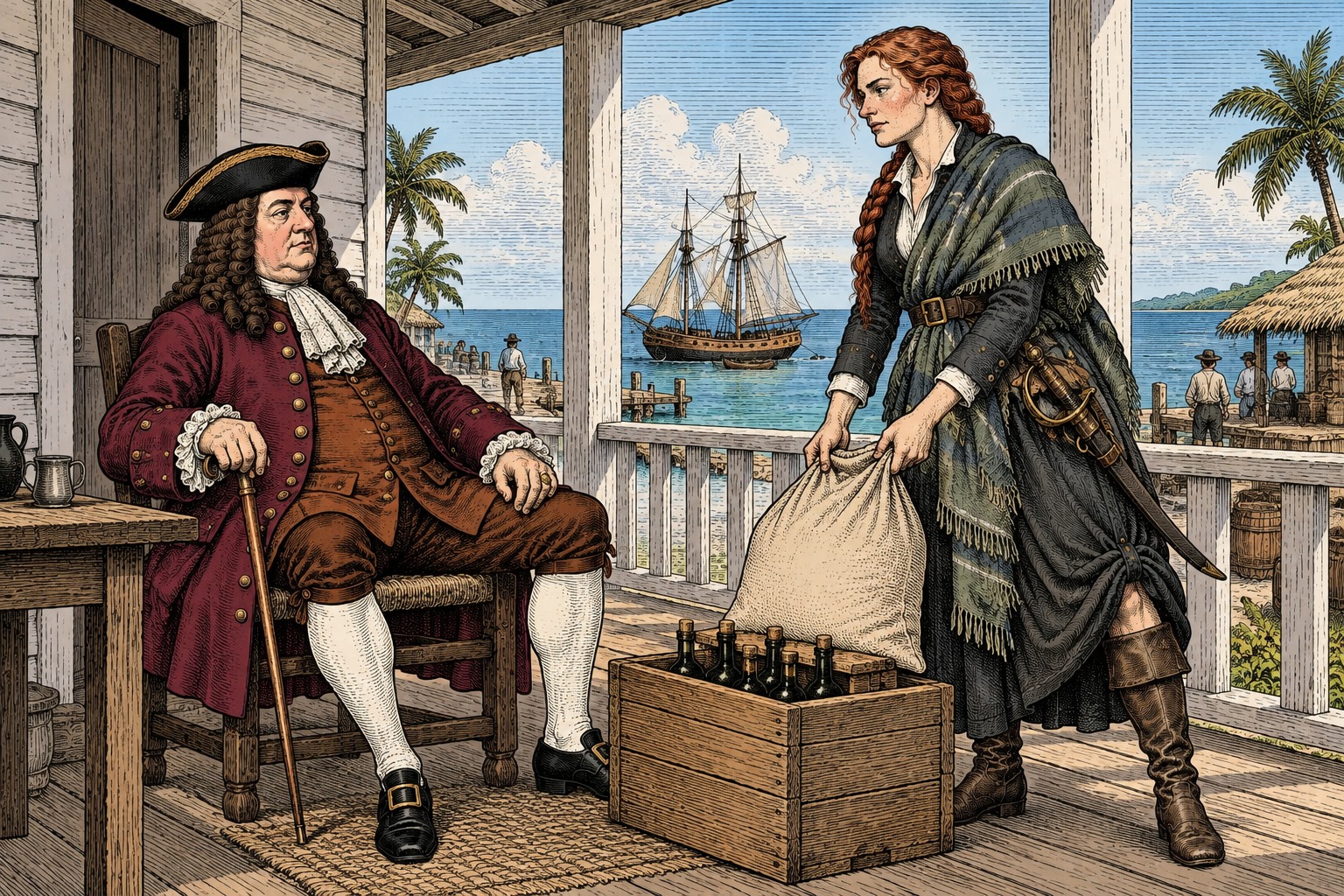
| **Dinah Calloway**, tavern keeper, sex worker and broker | News, debts and a living | Warm, quick and watchful; she remembers every debt | The port's information; the Governor's dispatches and the pirates' supper |
| **Madeleine Lacoste**, Bordeaux merchant | A new line of rum and a fair price | Precise and pleasant; she tastes before she haggles | The trade's honest face; she does not buy people |
| **Sir Edmund Haldane**, Governor of Harbour Island | A quiet island and a good report to London | Measured and formal; he writes more than he speaks | A patron, a customer, an enemy; his weakness is the ledger |
| **Captain Josiah Whitcombe**, Royal Navy | The names on his list hanged | Correct and cold; he does not curse | The main uniformed opposition; honest, short of men and unbuyable |
## What the Stories Get Wrong
Later fiction and theatre supply many familiar pirate images. Use the historical accounts below by default. Tables can add favourite clichés without making them part of the record.
| The cliché | The record |
|:--|:--|
| Walking the plank | The word does not appear in the 1724 history. Prisoners were thrown overboard, marooned or put ashore |
| Buried treasure and treasure maps | There is one documented case, the cache William Kidd left with the Gardiner family on Gardiners Island in 1699, recovered by the governor of New York, whose committee inventoried it at Boston on 25 July 1699 at 1,111 ounces of gold and 2,353 of silver; pirates spent plunder rather than burying it (Era Rules, The Prize and Fence Loop). Teach joked that only he and the Devil knew where his money lay |
| Parrots, wooden legs and eyepatches | No pirate in the main sources is described with any of them |
| "Yo ho ho" and "arr" | Not in the sources. "Yo hope" is a heave-ho in a crew's talk |
| Pirate captains as tyrants | Elected, deposable and given few privileges: "the Captain himself not being allowed a Bed" (Rediker) |
| Many women pirates | Two among 521 in Rediker's file of Anglo-American pirates, 1716 to 1726 |
| A black flag means quarter and a red flag means none | Not in the main sources. Quarter was the Company's choice; the black flag is documented, and so is the red English ensign |

 ## What the Stories Get Wrong
Later fiction and theatre supply many familiar pirate images. Use the historical accounts below by default. Tables can add favourite clichés without making them part of the record.
| The cliché | The record |
|:--|:--|
| Walking the plank | The word does not appear in the 1724 history. Prisoners were thrown overboard, marooned or put ashore |
| Buried treasure and treasure maps | There is one documented case, the cache William Kidd left with the Gardiner family on Gardiners Island in 1699, recovered by the governor of New York, whose committee inventoried it at Boston on 25 July 1699 at 1,111 ounces of gold and 2,353 of silver; pirates spent plunder rather than burying it (Era Rules, The Prize and Fence Loop). Teach joked that only he and the Devil knew where his money lay |
| Parrots, wooden legs and eyepatches | No pirate in the main sources is described with any of them |
| "Yo ho ho" and "arr" | Not in the sources. "Yo hope" is a heave-ho in a crew's talk |
| Pirate captains as tyrants | Elected, deposable and given few privileges: "the Captain himself not being allowed a Bed" (Rediker) |
| Many women pirates | Two among 521 in Rediker's file of Anglo-American pirates, 1716 to 1726 |
| A black flag means quarter and a red flag means none | Not in the main sources. Quarter was the Company's choice; the black flag is documented, and so is the red English ensign |