# Gear and Prices
*Rome DCCIV AUC, The Edge of the Republic, Rome and the provinces in 50 BC. Source: https://exodusnds.com/era-books/rome/gear-and-prices*
Find the prices for arms, armor, animals, medicine, keep, services, bribes and enslaved people here. The essential gear table gives the cited books' stat lines. The Source Book Map lists what 50 BC allows. For coin values, Stakes, credit and interest, use Era Rules, Money and Credit.
Treat these prices as a guide. A seller can ask for more or less. No price list survives from this decade. An unmarked figure comes from a period source with place and year given. **~** marks either a converted sourcebook price or this book's estimate where the record is silent.
## Money in This Chapter
Read prices in **sestertii (HS)** and use The Moneychanger's Table in Era Rules, Money and Credit, for coin values. Bronze change runs short in 50 BC because little was struck from the 80s BC to Caesar's issue of 45 BC. Gold is so rare that an ordinary character never handles an aureus.
## Sourcebook Units
**Modifies** *The Fantasy Armory*, Reading a Weapon Entry (Rescaling prices to your Universe). The cited books share one price unit, which you convert at either of two rates.
##### TERMS: CONVERTING A SOURCEBOOK PRICE
I **Arms, armor, tools and drugs.** 1 unit = **~1 HS**.
II **Animals, tack and vehicles.** Convert each unit to **~3 HS**. Use this rate for upkeep and other animal grades in *The Stable*, Training and Keeping.
III **Stat lines do not change.** Take the stats from the owning book. Convert only the price, and treat the result as approximate.
IV **The sling.** Keep the sourcebook rates even when they put the Shepherd's Sling (155) above the Shortsword (90). A sling made from cord at home costs nothing.
##### EXAMPLE: SEPTIMIUS REPLACES HIS MAIL
Septimius loses his lorica hamata crossing a river. On leave in Rome, he replaces it with a Mail Shirt from *The Armourer*, 400 units or ~400 HS. Of his 675 HS Stake, 275 HS remains. He wants a Mule too. At 200 units in *The Stable* and 3 HS per unit, it costs ~600 HS. He borrows the missing 325 HS within his credit limit (Era Rules, Money and Credit).
## Wages and Income
**Adds.** Use the recorded figures below to value wages, gifts and shares. For handling pay and cash at the table, see Era Rules, Money and Credit (Stakes).
| Pay | Amount | In HS | Place and year | Source |
|:--|:--|--:|:--|:--|
| A legionary's year, after Caesar doubled the pay | 225 denarii, about 10 asses a day | 900 | Caesar's legions; Suetonius gives no year (usually put about 51 to 49 BC) | Suetonius, Julius 26.3 (the doubling); the sum is the usual modern reckoning |
| A legionary's year at the old rate | 2 obols a day, about 120 denarii | about 480 | about 150 BC | Polybius 6.39 |
| A centurion | twice the legionary | | about 150 BC | Polybius 6.39; no figure survives for Caesar's army |
| A cavalryman's day | 1 drachma (1 denarius) | 4 | about 150 BC | Polybius 6.39 |
| Deductions from army pay | corn, clothing and extra arms, at a fixed price | | about 150 BC | Polybius 6.39 |
| Caesar's gift to each soldier at the start of the civil war | 2,000 HS | 2,000 | 49 BC | Suetonius, Julius 38.1 |
| Caesar's triumph, each veteran foot soldier | 24,000 HS (Suetonius) or 5,000 drachmae (Appian) | 24,000 or 20,000 | Rome, 46 BC | Suetonius, Julius 38.1; Appian, Civil Wars 2.102 |
| Caesar's triumph, each citizen of the plebs | 1 Attic mina (100 drachmae) | 400 | Rome, 46 BC | Appian, Civil Wars 2.102 |
| Pompey's eastern gift, the smallest soldier's share | 1,500 drachmae | 6,000 | 61 BC | Plutarch, Pompey 45 |
| A hired laborer's or a ship's hand's day | | ~3 | Rome and the ports | Set by this book; no wage survives for this decade |
| A field hand's grain on an estate | 4 modii of wheat a month in winter, 4.5 in summer | | Cato's estate, about 160 BC | Cato, On Agriculture 56 |
| A bailiff's (vilicus's) grain, and the housekeeper's, the overseer's and the shepherd's | 3 modii of wheat a month | | Cato's estate, about 160 BC | Cato, On Agriculture 56 |
| A haruspex's consultation for a private client | | ~10 | | Set by this book; no fee is securely known |
| A public scribe's (scriba's) salary, a year | | ~1,200 | Rome | Set by this book; no salary survives for this decade |
Deduct expenses from the listed legionary pay to find the smaller sum the soldier takes home. Pompey's and the Senate's legionaries take the rate their commander sets.
## Living Costs
**Adds.** Charge a free character for keep when a Role, patron or household leaves him to feed himself, such as on the road, between jobs or lodging in a strange city. Skip days covered by a patron (Era Rules, Patronage and Rank, Calling In). Daily prices from this decade do not survive, so use the book's approximate tiers.
| Keep | Per day | Per 30 days | What it buys |
|:--|--:|--:|:--|
| Poor | ~1 HS | ~30 HS | A bed in a popina at 2 asses and two meals at 1 as each |
| Modest | ~2 HS | ~60 HS | A single room in an insula at ~480 HS a year, two meals and a bath |
| Comfortable | ~8 HS | ~240 HS | A flat at the ordinary tenant's ceiling of 2,000 HS a year, better food and wine, a bath |
| Grand | | | A house and its people; kept in the house's own accounts, not by the day |
At the poor rate, a month's keep costs 30 HS. Add a 40 HS culter and the total is 70 HS, within the 75 HS Wage Stake (Era Rules, Money and Credit, Stakes).
##### EXAMPLE: KALLIAS WAITS ON THE SENATE
While his embassy waits for a hearing in Rome, Kallias rents one room in an insula and eats at a popina. At the modest rate of ~2 HS a day, thirty days cost ~60 HS. A better flat at the comfortable rate puts the month at ~240 HS.
## What the Record Gives
**Adds.** Use the recorded food, rent and property figures for comparison. A price from elsewhere or another year gives the scale for Rome in 50 BC.
| Thing | Price | Place and year | Source |
|:--|:--|:--|:--|
| A public bath | 1 quadrans | Rome, 56 BC | Cicero, Pro Caelio 62; Quintilian 8.6.53 |
| Bed and board at an inn | half an as a day, a price Polybius calls extraordinarily low | the Po plain, about 150 BC | Polybius 2.15 |
| Wheat at market | 2 HS the modius, at most 3; the Senate's valuation 4; Verres took 3 denarii (12 HS) | Sicily, 73 to 71 BC | Cicero, Verrines 2.3.188 to 194 |
| Wheat from the state | 6⅓ asses the modius | Rome, 123 BC | Livy, Periochae 60 |
| Wheat from the state | free: 5 modii a month to a registered citizen | Rome, from 58 BC | Cicero, Pro Sestio 55 |
| Rent of an ordinary tenant | 2,000 HS a year or less in Rome; 500 or less in Italy | 48 BC | Suetonius, Julius 38.2 |
| Rent of a fashionable Palatine flat | 30,000 HS a year, as the prosecution claimed; 10,000, as Cicero answered | Rome, 56 BC | Cicero, Pro Caelio 17 |
| A senator's town house on the Palatine | 3,500,000 HS | Rome, 62 BC | Cicero, Letters to Friends 5.6.2 |
| Damages for razed houses: the Palatine house; a villa at Tusculum; a villa at Formiae | 2,000,000 HS; 500,000 HS; 250,000 HS | Rome, 57 BC | Cicero, Letters to Atticus 4.2.5 |
| A roof tile | 1 HS | about 160 BC | Cato, On Agriculture 14 |
| An oil mill, fitted and delivered | 629 HS near Suessa; 724 HS from Pompeii | about 160 BC | Cato, On Agriculture 22 |
| Carrying a mill by ox with six men for six days | 72 HS | about 160 BC | Cato, On Agriculture 22 |
| A dinner in Lucullus's Apollo room | 50,000 drachmae (200,000 HS) | Rome, first century BC | Plutarch, Lucullus 41 |
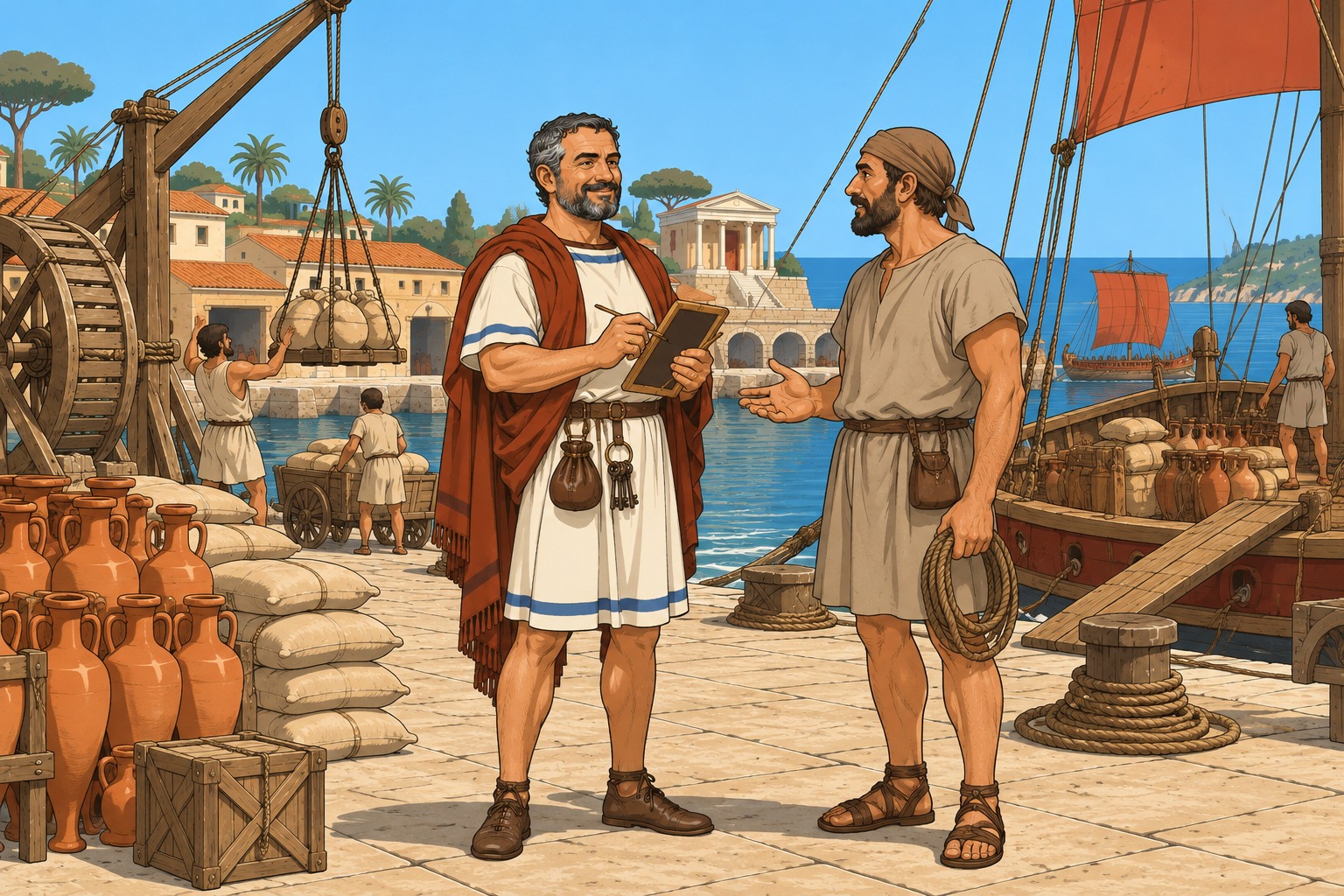 ## Goods and Services the Record Does Not Price
**Adds.** Use the approximate figures below where ordinary prices from the decade do not survive.
| Item or service | ~HS | Note |
|:--|--:|:--|
| Toga | ~120 | Wool, for a citizen; the praetexta, with its purple border, for a magistrate |
| Tunic | ~16 | Free and enslaved dress alike |
| Cloak | ~30 | |
| Calcei (town shoes) | ~12 | |
| Caligae (hobnailed army boots) | ~20 | Issued to a soldier |
| Lamp, clay | ~2 | |
| Oil, a sextarius | ~1 | For a lamp or the table |
| Wax tablets and a wooden stylus | ~6 | An iron stylus is a weapon: see the Shiv |
| Papyrus, a roll | ~10 | |
| A copied book | ~30 | |
| Abacus | ~8 | |
| Strongbox | ~60 | |
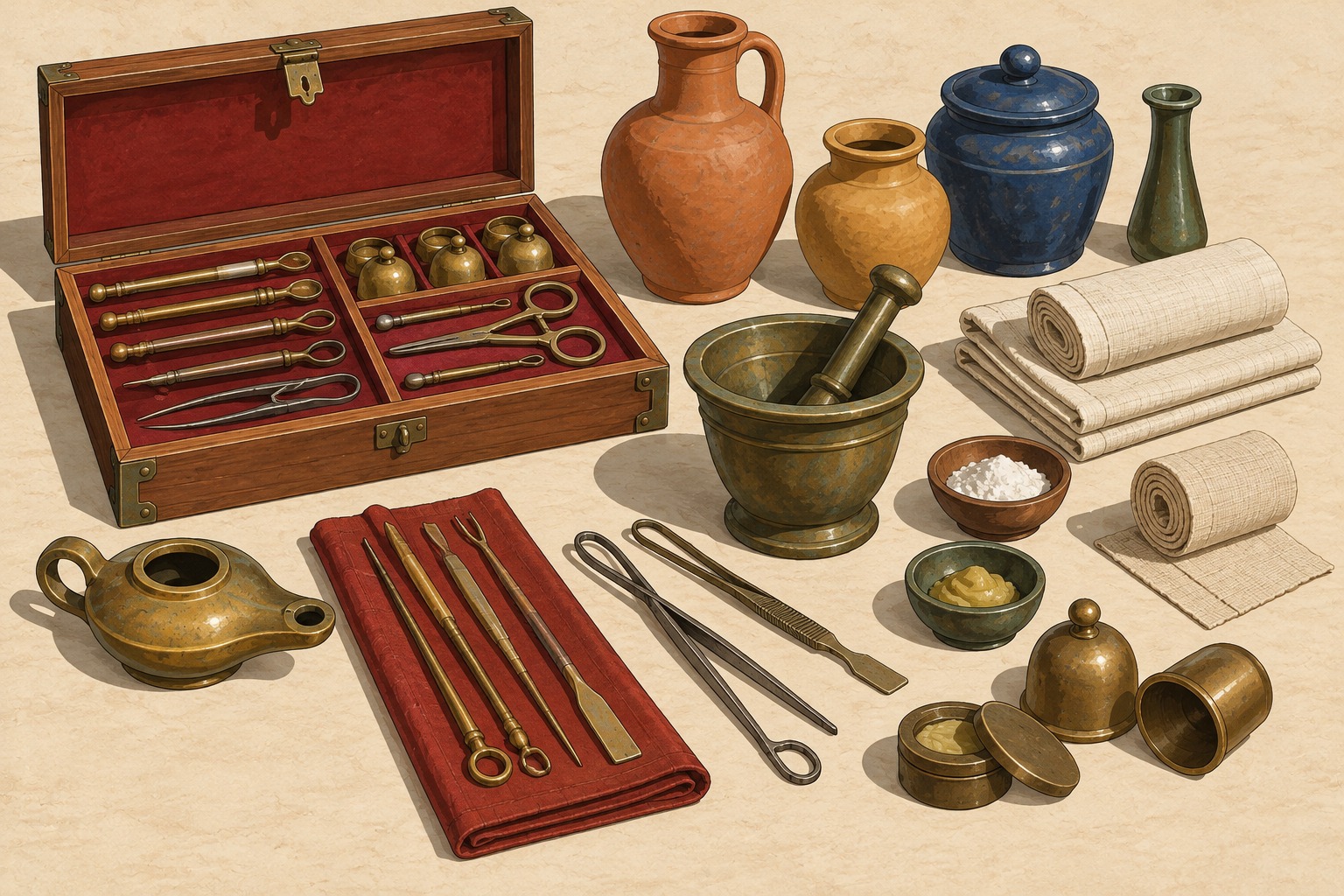
| Surgeon's kit (scalpel, forceps, probe, bone lever, cupping vessel) | ~150 | No stat line; used by Hippocratic Training (Skills and Talents) |
| Cart (plaustrum) | ~200 | *The Stable* gives vehicles no price; this book sets it |
| Wheat in Rome, off the free list | ~3 the modius | |
| A loaf; a cup of ordinary wine; a meal at a popina | ~1 as each | |
| A bed in a popina | ~2 asses a night | |
| A single room in an insula | ~480 a year | |
| A litter and bearers, for a day | ~8 | |
| A physician's visit | ~20 | |
| A tutor, a month | ~25 a pupil | |
| Sea passage, Brundisium to Dyrrachium | ~40 | Season and risk are in Era Rules, Travel |
 ## Bribes by Office
**Adds** approximate costs for bribery. Use Era Rules, Patronage and Rank (Bribery), for dice and exposure. The book sets these figures because monthly sums do not survive.
| Office | One bribed month | Four months |
|:--|--:|--:|
| Quaestor | ~10,000 HS | ~40,000 HS |
| Tribune of the plebs | ~10,000 HS | ~40,000 HS |
| Aedile | ~25,000 HS | ~100,000 HS |
| Praetor | ~50,000 HS | ~200,000 HS |
| Consul | ~100,000 HS | ~400,000 HS |
For a month at the voting enclosure, pay the gang's leader as much as you would spend on bribes.
##### EXAMPLE: THE PRICE OF A PRAETORSHIP
When Fabia's father runs for praetor (Era Rules, Patronage and Rank), his agents spend ~50,000 HS buying votes in month one. In month two he pays Papirius ~50,000 HS for men to hold the enclosures. Total: ~100,000 HS. This NPC has land of his own. A player character would need a loan well beyond the Senatorial credit limit (Era Rules, Money and Credit).
## Purchased People
**Adds** prices for enslaved people. Use Era Rules, Slavery, for purchase, ownership, sale and freedom. The GM gives each person bought a name, skills and aims, and plays him as an NPC.
A Roman household with money buys people and land. Captives from Gaul go first to the army's auction at the front and then to the dealer's stand in Rome. These sales feed a slave economy. The labels below give the **basis** of each price:
- **Recorded:** a source of the period gives prices of this size.
- **Partly recorded:** reconstructed around recorded prices of the period.
- **Reconstructed:** drawn from records of the first and second centuries AD, scaled to the heavier coin of 50 BC.
- **Unattested:** no ancient source gives the range.
| Person | Low HS | High HS | Basis | What the record gives |
|:--|--:|--:|:--|:--|
| A war captive at the army's sale, at the front | 20 | 500 | Unattested | One recorded point: a man for 4 drachmae (16 HS) in Lucullus's camp in Pontus, 72 BC, told as a marvel (Plutarch, Lucullus 14) |
| A child, about 3 to 10 years old | 250 | 800 | Reconstructed | Sale contracts from Roman Egypt, first and second centuries AD |
| An unskilled adult, man or woman: field hand, porter, laborer | 800 | 2,500 | Partly recorded | An untrained slave worth under 1,000 HS (Cicero, Pro Roscio Comoedo 28, about 76 BC); a household slave bought for 500 drachmae, 2,000 HS (Horace, Satires 2.7.43, about 30 BC) |
| A skilled adult: craftsman, cook, vinedresser, musician, literate house slave | 3,000 | 8,000 | Recorded | Cato never paid more than 1,500 drachmae, 6,000 HS (Plutarch, Cato the Elder 4); a trained house boy offered at 8,000 HS (Horace, Epistles 2.2, about 19 BC) |
| A specialist: physician, grammarian or teacher, trained actor, fine cook, secretary | 20,000 | 150,000 and up | Recorded; the low end reconstructed | The actor Panurgus, worth more than 150,000 HS once trained, as Cicero pleaded in court (Cicero, Pro Roscio Comoedo 28 to 29) |
| A gladiator, bought or hired | | | | The Arena and the Games, The Editor |
Use the same table for men and women, since the record does not separate their prices. Treat record sales as exceptional. Pliny calls the 700,000 HS paid for the grammarian Daphnis around 100 BC the highest price for a household-born slave (Natural History 7.128).
### The Price of Freedom
**Adds** purchase costs for manumission. Find the four routes to freedom, tax and owner's right to refuse in Era Rules, Slavery (Freedom).
##### TERMS: THE PRICE OF FREEDOM
I **The owner's price.** The owner chooses a price within the range for the person's skill. For a gladiator use the lanista's price (The Arena and the Games, The Ludus and the Lanista).
II **The vicesima.** Add the treasury's manumission tax to the price. The *vicesima*, or twentieth, is 5 in 100 of the person's value.
| Person | Price | With the vicesima |
|:--|--:|--:|
| Unskilled adult | 800 to 2,500 HS | 840 to 2,625 HS |
| Skilled adult | 3,000 to 8,000 HS | 3,150 to 8,400 HS |
| Specialist | 20,000 to 150,000 HS | 21,000 to 157,500 HS |
III **The peculium.** Save for the price in the peculium (Era Rules, Slavery, Status). Add money only when paid in play, as with a tip, a fee a patient presses on a physician, a share of trade the owner allows or a gladiator's purse.
##### EXAMPLE: CHRYSEIS'S PRICE
As a physician, Chryseis takes the specialist range. Fabia's father asks 20,000 HS, the bottom of it. Add the vicesima to reach 21,000 HS. She starts with 25 HS. At ~20 HS a visit, she would need roughly 1,050 grateful patients. She has a better chance with a petition (Era Rules, Slavery, Chryseis Asks for Her Freedom).
##### EXAMPLE: EROS BUYS A CLERK
Eros visits a Roman dealer for a clerk who can keep Greek accounts. The dealer asks 6,000 HS for a literate house slave, a skilled adult, and declares that the man once fled. Eros pays 5,000. Give the clerk a name and aims of his own, with Greek and Latin. Eros is both owner and patron (Era Rules, Slavery, Buying and Selling). Manumission at the same value adds 250 HS in tax.
**Failure states.** You fall short of the price. The owner refuses (Era Rules, Slavery). The dealer conceals past flight, illness or theft.
## The Essential Gear Table
**Scopes** the owning books' entries to the Roman names below. Use the master-table stats unchanged. Find other legal entries in the Source Book Map. These rows serve character creation and the starter adventure. Prices use the Sourcebook Units rates and are approximate.
 ### Arms (*The Fantasy Armory*, Master Weapons Table)
| Weapon | Roman name | Dmg | Crit | Range | Enc | Unit | Avail | Type | Qualities | HS |
|:--|:--|:-:|:-:|:--|:-:|--:|:--|:--|:--|--:|
| **Shortsword** | gladius Hispaniensis; the Thraex's sica | +2 | 3 | Engaged | 1 | 90 | Common | Thrusting, Cutting | Accurate 1 | ~90 |
| **Dagger** | pugio | +1 | 3 | Engaged | 1 | 70 | Common | Thrusting, Cutting | Pierce 1, Concealable 1 | ~70 |
| **Knife** | culter | +1 | 3 | Engaged | 1 | 40 | Common | Thrusting, Cutting | — | ~40 |
| **Shiv** | stylus (iron) | +1 | 3 | Engaged | 0 | 20 | Common | Thrusting | Concealable 2, Inaccurate 1, Fragile 2 | ~20 |
| **Javelin** | pilum; iaculum | 4 | 3 | Medium | 1 | 40 | Common | Thrusting | Pierce 1, Limited Ammo 1 | ~40 |
| **Short Spear** | hasta | +3 | 3 | Engaged, Short | 2 | 90 | Common | Thrusting | Reach, Brace 2 | ~90 |
| **Winged Spear** | lancea (Gallic spear) | +3 | 3 | Engaged, Short | 3 | 100 | Military | Thrusting, Cutting | Reach, Brace 2, Sweep 1 | ~100 |
| **Boar Spear** | venabulum | +3 | 3 | Engaged, Short | 3 | 100 | Military | Thrusting | Reach, Brace 3 | ~100 |
| **Arming Sword** | Gallic long sword | +3 | 3 | Engaged | 2 | 160 | Common | Cutting, Thrusting | Defensive 1 | ~160 |
| **Cudgel** | fustis; the centurion's vine stick | +2 | 4 | Engaged | 2 | 30 | Common | Crushing | Disorient 1 | ~30 |
| **Quarterstaff** | baculum | +2 | 5 | Engaged | 2 | 70 | Military | Crushing | Defensive 1, Disarming 1, Guarded 1 | ~70 |
| **Sharpened Stake** | sudis (the legionary's palisade stake) | +1 | 4 | Engaged, Short | 2 | 5 | Common | Thrusting | Reach, Inaccurate 1, Fragile 2 | ~5 |
| **Hatchet** | securis | +2 | 3 | Engaged | 1 | 90 | Common | Cutting | Vicious 1, Sunder | ~90 |
| **Maul** | malleus | +5 | 4 | Engaged | 6 | 375 | Rare | Crushing | Pierce 2, Knockdown, Cumbersome 5, Awkward 1 | ~375 |
| **Garrote** | laqueus | +0 | 2 | Engaged | 0 | 50 | Restricted | Crushing | Concealable 3, Ensnare 2, Awkward 3 | ~50 |
| **Net** | rete (a hunting net) | — | — | Engaged, Short | 2 | 35 | Common | — | Ensnare 3, Limited Ammo 1, Inaccurate 1 | ~35 |
| **Buckler** | parma | +0 | 5 | Engaged | 1 | 35 | Common | Crushing | Defensive 1, Disarming 1 | ~35 |
| **Round Shield** | clipeus; aspis | +1 | 5 | Engaged | 2 | 80 | Common | Crushing | Defensive 1, Deflection 1 | ~80 |
| **Kite Shield** | scutum; the Gallic oval shield | +1 | 5 | Engaged | 3 | 100 | Military | Crushing | Defensive 1, Deflection 2, Cumbersome 3 | ~100 |
Use the Javelin line for a pilum and add the shield-binding rule in Legion Battles (The Pilum). Hunters and fishers use nets. Arena kits omit nets and tridents (The Arena and the Games, Gladiators and Their Kit).
### Armor (*The Armourer*, Master Tables)
| Armor | Roman name | Resistance | Melee Def | Ranged Def | Enc | Unit | Avail | Qualities | HS |
|:--|:--|:-:|:-:|:-:|:-:|--:|:--|:--|--:|
| **Padded Jack** | linothorax; padded under-armor | +1 | 0 | 0 | 2 | 40 | Common | Deflecting 1 (Crushing), Vulnerable 1 (Thrusting) | ~40 |
| **Leather Jerkin** | leather jerkin | +1 | 0 | 0 | 1 | 50 | Common | Deflecting 1 (Cutting) | ~50 |
| **Mail Shirt** | lorica hamata; a general's bronze muscle cuirass | +2 | 0 | 0 | 3 | 400 | Common | Deflecting 1 (Cutting), Vulnerable 1 (Crushing) | ~400 |
| **Open Helm** | Montefortino or Coolus helmet | +0 | 0 | 0 | 1 | 60 | Common | Helm 1 | ~60 |
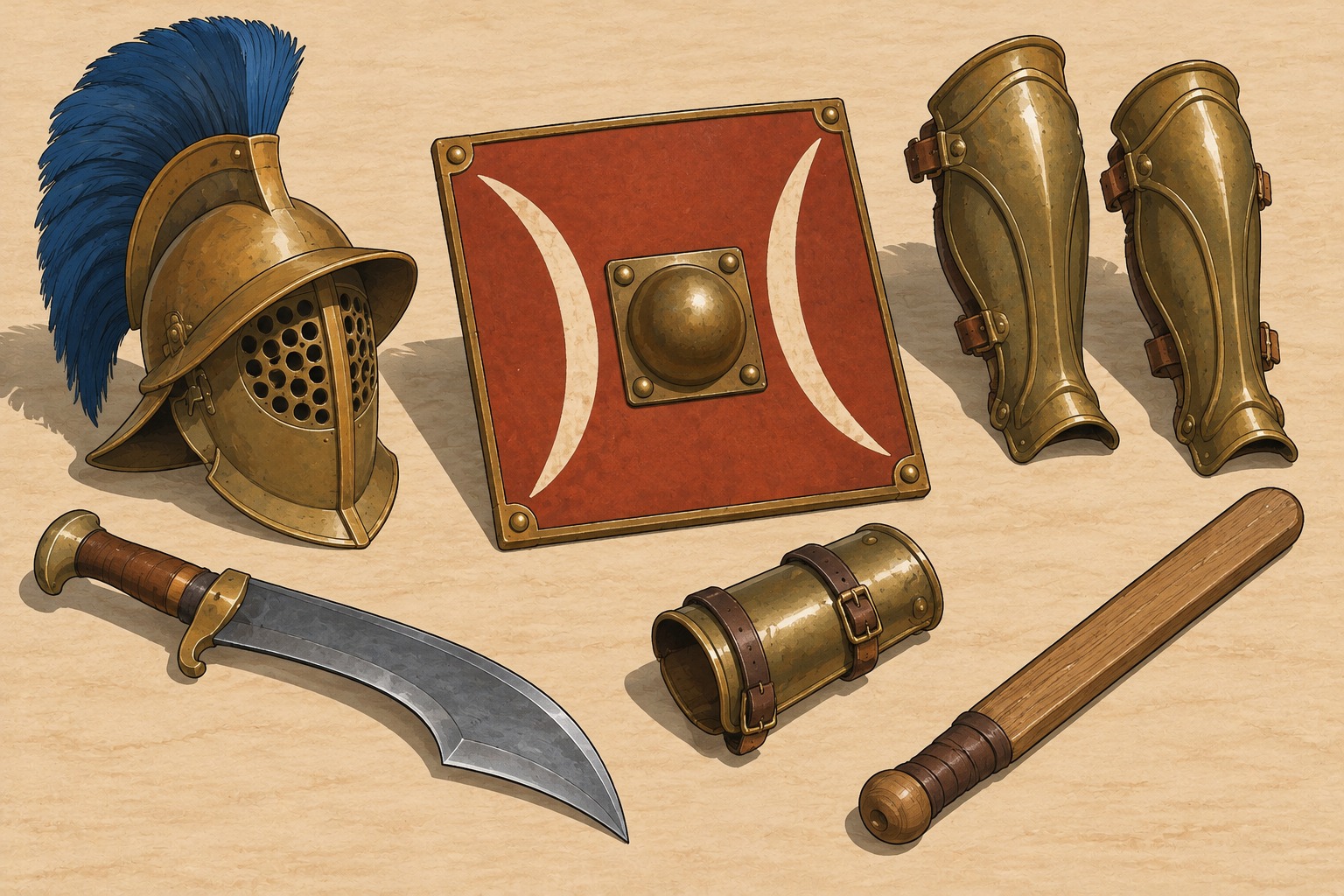
Charge a legionary's issued mail against his pay on the quaestor's account (Wages and Income). Use Mail Shirt unchanged for the bronze muscle cuirass of a tribune or general, which differs in appearance. Find the matched helmet and greaves in The Arena and the Games (Gladiators and Their Kit).
### Bows and Slings (*The Ranged Armory*, Master Weapons Table)
| Weapon | Roman name | Dmg | Crit | Range | Enc | Unit | Avail | Type | Qualities | HS |
|:--|:--|:-:|:-:|:--|:-:|--:|:--|:--|:--|--:|
| **Shepherd's Sling** | funda | 4 | 4 | Medium | 0 | 155 | Common | Crushing | Knockdown, Concealable 2, Scavenged, Inaccurate 1, Prepare 1 | ~155 |
| **Short Bow** | arcus | 6 | 3 | Medium | 1 | 200 | Common | Thrusting | Cumbersome 2, Point Blank 1 | ~200 |
| **Composite Bow** | composite bow (Cretan, Syrian) | 8 | 3 | Long | 1 | 650 | Common | Thrusting | Accurate 1, Fragile 1, Cumbersome 3, Point Blank 2 | ~650 |
| **Horse Bow** | Parthian bow | 7 | 3 | Medium | 1 | 625 | Common | Thrusting | Accurate 1, Fragile 1, Cumbersome 2, Point Blank 1 | ~625 |
 ### Animals (*The Stable*, Master Tables)
| Mount | Scale | Speed | Wounds | Res | Def | Carry | Travel | Unit | Avail | Barding | Traits | HS |
|:--|:-:|:-:|:-:|:-:|:-:|:-:|:-:|--:|:--|:--|:--|--:|
| **Donkey** (asinus) | 1 | 1 | 8 | 0 | 0 / 0 | 10 | 20 | 80 | Common | Equine, Light | Sure-Footed, Pack Animal, Temper 1 | ~240 |
| **Mule** (mulus) | 2 | 1 | 10 | 2 | 0 / 0 | 16 | 20 | 200 | Common | Equine, Medium | Sure-Footed, Pack Animal, Steady, Temper 1 | ~600 |
| **Riding Horse** (equus) | 2 | 2 | 11 | 2 | 0 / 0 | 16 | 30 | 300 | Common | Equine, Medium | Swift, Temper 1 | ~900 |
| **Light Warhorse** (cavalry horse) | 2 | 2 | 12 | 2 | 0 / 0 | 18 | 30 | 1,500 | Military | Equine, Medium | Battle-Trained, Swift | ~4,500 |
| **Ox** (bos) | 2 | 1 | 12 | 2 | 0 / 0 | 22 | 12 | 150 | Common | Bovine, Light | Draft 2, Steady, Slow | ~450 |
### Tack and Vehicles (*The Stable*, Tack, Harness, and Platforms)
| Item | Roman name | Enc | Unit | Avail | Effect | HS |
|:--|:--|:-:|--:|:--|:--|--:|
| **Bridle and bit, or halter** | bridle | 0 | 10 | Common | Needed to ride. Without it, add 2 Bane Dice to Riding checks | ~30 |
| **Riding saddle** | ephippium (saddle cloth) | 2 | 90 | Common | The ordinary saddle. Riding bareback adds 1 Bane Die to Riding checks and to any check to stay mounted | ~270 |
| **Pack saddle** | clitellae | 2 | 50 | Common | The animal's Carry is 4 higher for baggage and it cannot be ridden | ~150 |
| **Harness and collar** | iugum (yoke harness) | 2 | 40 | Common | Needed to draw a vehicle. One for each animal in the team | ~120 |
| Vehicle | Roman name | Scale | Speed | Handling | Armor | Hull | Sys | Crew | Team | Notes | HS |
|:--|:--|:-:|:-:|:-:|:-:|:-:|:-:|:--|:--|:--|--:|
| **Cart** | plaustrum | 2 | 1 | -1 | 0 | 5 | 3 | 1 | 1 draft animal | Carries 60 Encumbrance | ~200 |
Use the yoke harness line unchanged for a neck or dorsal yoke with a girth. There are no padded collars, stirrups or horseshoes in 50 BC (Source Book Map).
### Medicine (*The Apothecary*, Master Tables: The Apothecary's Shelf and The Industrial Pharmacy)
| Substance | Roman name | In brief | Onset | Lasts | Limit | Tags | Unit | Avail | HS |
|:--|:--|:--|:--|:--|:-:|:--|--:|:--|--:|
| **Healing Salve** | emplastrum | Recover 2 more Wounds from a night's rest | — | 1 day | 1 | — | 20 | Common | ~20 |
| **Poppy Tincture** | poppy draught | Recover 3 Strain; ignore one Critical Injury's penalty | 10 minutes | 4 hours | 2 | Habit 2 | 30 | Common | ~30 |
| **Strong Drink** | wine; posca; cervesia | 1 Boon Die against fear; 1 Bane Die to Agility and Intellect | 10 minutes | 2 hours | 2 | Habit 1 | 2 | Common | ~2 |
| **Emetic** | emetic | Purges a swallowed poison during its Onset | None | — | — | — | 5 | Common | ~5 |
| **Theriac** | mithridatium | General antidote: 2 Boon Dice against one poison | 1 round | 1 day | 1 | — | 100 | Restricted | ~100 |
| **Antiseptic** | wine, vinegar and honey for wounds | 1 Boon Die to Medicine checks to heal Wounds | — | — | — | — | 5 | Common | ~5 |
Add a surgeon's kit (Goods and Services the Record Does Not Price) to the physician's supplies. Use Era Rules, Medicine and Illness, for Care and the illness clock. Give poppy as a draught in wine, since 50 BC has no spirit tincture. Keep the stat line.
 ## The Source Book Map
**Scopes** the cited books to 50 BC. **Legal** means use the entry as written with its Roman name. **Modified** can change a name, material or availability word. **Excluded** means the item had yet to exist or never reached the region. Keep all stats from the owning book.
| Sourcebook | Families used | Legal in 50 BC | Echoed in this chapter | Roman names and changes |
|:--|:--|:--|:--|:--|
| *The Fantasy Armory* | Unarmed; Daggers and Knives; Swords; Axes and Cleavers; Impact; Spears; Flexible; Thrown; Shields | Hand Wraps, Cestus; Shiv, Knife, Dagger; Shortsword, Arming Sword, Sabre; Meat Cleaver, Hatchet, Hand Axe, Falx, Executioner's Axe; Cudgel, Quarterstaff, Mace, Great Club, Maul; Sharpened Stake, Short Spear, Winged Spear, Boar Spear, Trident, Pike, Lance; Garrote, Whip, Net; Javelin, Harpoon; Buckler, Round Shield, Kite Shield, Pavise. Every other entry is Excluded | 19 rows (Arms) | himantes (Hand Wraps), caestus, kopis or machaira (Sabre), culter lanii (Meat Cleaver), rhomphaia (Falx), the lictor's securis (Executioner's Axe), clava (Great Club), sudis (Sharpened Stake), sarissa (Pike), kontos (Lance), flagrum (Whip), pluteus (Pavise). Mace: Rare outside the east. Trident: fuscina, a fishing spear, Rare |
| *The Armourer* | Medieval Armor; Helms; Weapons Against Armor (rules) | Padded Jack, Leather Jerkin, Hide Armor, Mail Shirt, Mail Hauberk, Scale Coat, Lamellar, Open Helm. Brigandine, Coat of Plates, Half-Plate, Full Plate, Great Helm and all Modern Armor Excluded | 4 rows (Armor) | Mail Hauberk: long mail, for cavalry only. Scale Coat: lorica squamata, Rare, eastern or Hellenistic. Lamellar: Parthian or Armenian, Rare west of Syria. The matchup tables are read in 50 BC terms (mail against the pilum, the bronze helmet) |
| *The Ranged Armory* | Slings and Throwing Aids; Bows; Crossbows; Siege Engines; Ammunition | Shepherd's Sling, Kestros, Amentum; Short Bow, Longbow, Composite Bow, Horse Bow; Gastraphetes (Rare); Scorpion, Ballista, Polybolos (Rare), Perrier, Onager; River Stone, Fired Clay Shot, Cast Lead Glans, arrow heads, Bodkin, Quarrel, Poisoned Dart, Blunt, Engine Munition. Staff Sling, every hand and medieval crossbow, Carroballista, trebuchets, Naphtha Siphon, blowguns and air weapons Excluded | 4 rows (Bows and Slings) | kestrosphendone (Kestros), long self bow (Longbow), scorpio (Scorpion), catapulta (Ballista: the Republic's bolt-thrower), ballista (Perrier and Onager: the stone-thrower; "onager" is a later word), glans (Cast Lead Glans), iron square head (Bodkin), bolt (Quarrel), the Gallic hunting arrow (Poisoned Dart) |
| *The Stable* | Horses and Their Kin; Beasts of Burden and War; Barding; Tack, Harness, and Platforms; Riding; Mounted Combat | Donkey, Mule, Pony, Riding Horse, Courser, Desert Horse, Draft Horse, Light Warhorse, Heavy Warhorse, Mountain Horse; Camel, Hill Camel, War Camel, Ox, Elephant, War Elephant; Caparison, Padded, Leather, Mail, Scale and Lamellar Barding, Chanfron, Howdah Shields; bridle, Riding saddle, Pack saddle, Saddlebags, War saddle, Bow case and quiver, Small-rider saddle, Howdah, War howdah, Harness and collar, Driver's hook and goad; light and heavy Chariots, Cart, Wagon, Heavy freight wagon, Coach, War wagon. Stirrups, Horseshoes, Lance bucket, Plate Barding, Water Buffalo, Yak, Reindeer, Llama, Sled Dogs, the Sled and every fabled, air, water and Dort mount Excluded | 5 mounts, 4 tack rows, 1 vehicle | Numidian horse (Courser), cataphract horse (Heavy Warhorse: Rare in the west), Bactrian camel (Hill Camel), turris (Howdah Shields, Howdah, War howdah), essedum, biga or quadriga (Chariot, light), scythed chariot (Chariot, heavy: Rare, Pontic and Armenian), raeda or carpentum (Coach), the Gallic wagon-fort (War wagon). Draft Horse: a light draught horse; heavy hauling is by ox and mule. Mail, Lamellar and Chanfron barding: eastern and Rare |
| *The Heavy Armory* | Ancient engines, ships and structures; siege and escalade rules | Battering Ram, Bore, Galley Ram, Harpax, Fire Ship, Siege tower, Cart and War wagon, Longship or small galley, War galley, Cog or carrack; palisade, earth rampart, stone wall and tower, timber bridge, castle gate, brick or stone house. Every gun, mortar, rocket, torpedo, mine, bomb, tank and aircraft, the Corvus and every medieval or later entry Excluded | none; Legion Battles cites the engines | aries (Battering Ram), terebra (Bore), rostrum (Galley Ram), manus ferrea or harpago (Harpax: the named harpax is 36 BC), turris (Siege tower), liburna (small galley), navis oneraria (Cog or carrack), porta (castle gate) |
| *The Apothecary* | Natural Poisons and Venoms (Old World); The Apothecary's Shelf; Smoke, Quicklime, Bad Air; exposure, treatment and habit rules | Viper, Cobra, Spider, Wolfsbane, Hemlock, Nightshade, Death Cap, Inheritance Powder, Sleeping Draught, Blade Venom; Healing Salve, Poppy Tincture, Strong Drink, Emetic, Theriac, Antiseptic, Dreamsmoke (Rare), Activated Charcoal; Mercury Salts; Smoke, Stink Smoke, Poison Smoke, Quicklime, Bad Air. Foxglove, Ergot, Deathfeign, Chewing Leaf, Watchman's Tea, Berserker Draught, Smelling Salts, Antivenom, Bezoar and every industrial, modern, stellar, gas and chemical entry except Antiseptic Excluded | 6 rows (Medicine) | aspis (Cobra), phalangium (Spider), aconitum (Wolfsbane), cicuta (Hemlock), arsenic (Inheritance Powder), mandrake or poppy (Sleeping Draught), charcoal (Activated Charcoal), quicksilver (Mercury Salts). Every poison is Restricted: poisoning is a capital crime under the lex Cornelia of 81 BC |
| *The Black Powder Armory*, *The Modern Armory*, *The Stellar Armory*, *The Starship Armory*, *The Chrome Market* | none | Excluded | none | |
##### TERMS: RIDING WITHOUT STIRRUPS OR SHOES
I **No stirrups.** Follow *The Stable*, Tack (Stirrups), for an age without them. Gain no charge bonus and add 1 Bane Die to mounted archery. Ignore a lance's Momentum on horseback.
II **The war saddle.** Use *The Stable*'s war saddle for the Gallic horned saddle (Encumbrance 3, Military, ~750 HS). Its date is uncertain, so a table can omit it. **Modifies** *The Stable*, Tack (War saddle). Keep 2 Boon Dice to stay mounted. Ignore "Needed to couch a lance" in 50 BC, when nobody couches a lance.
III **No horseshoes.** **Modifies** *The Stable*, Tack (Horseshoes). Exclude the entry and ignore its laming clause. Horses go unshod and roads do not lame them.
##### EXAMPLE: BANONA'S HORSE AND SWORD
Banona carries a Gallic long sword with the Arming Sword line from *The Fantasy Armory* (+3, Crit 3, Defensive 1), ~160 HS. Her Riding Horse (~900 HS), bridle (~30 HS) and horned war saddle (~750 HS) cost ~1,680 HS together. When she rides at a line with the Aeduan horse, she fights from the saddle with her sword and gains no charge bonus, since she has no stirrups.
### Gear with No Sourcebook Entry
Use the named line without changes if you use one of these as a weapon or armor. The items have no lines of their own.
| Item | Stat line | Where it is priced or ruled |
|:--|:--|:--|
| Caligae | none | Goods and Services the Record Does Not Price |
| Iron stylus | Shiv | Arms |
| Centurion's vine stick (vitis) | Cudgel | Arms |
| Thraex's sica | Shortsword | Arms |
| General's bronze muscle cuirass | Mail Shirt | Armor |
| Gladiator's greaves | none; the matched arena kit gives Resistance +1 | The Arena and the Games, Gladiators and Their Kit |
| The pilum's shield-binding | Javelin | Legion Battles, The Pilum |
| Surgeon's kit; wax tablets; abacus; strongbox; cart | none | Goods and Services the Record Does Not Price |
| The camp of ditch, rampart and stakes | none | Legion Battles, Camp and Siege Works |
| Every item in Role Kit with No Stat Line, below | none | Role Kit with No Stat Line |
| Litter (lectica) and sedan chair (sella) | none | Goods and Services the Record Does Not Price (a litter and bearers) |
| Silphium, the Cyrenaean resin | none | Rare; no price survives. Pliny says Caesar took 1,500 pounds of it from the treasury at the start of the civil war, 49 BC (Natural History 19.40) |
#### Role Kit with No Stat Line
**Adds** approximate replacement and later purchase prices for Role kit with no sourcebook entry. Take the kit free at creation. The book supplies these prices because none survive for this decade. The two leases use recorded rents from Living Costs (Suetonius, Julius 38.2; Cicero, Pro Caelio 17).
| Kit item | ~HS | Kit of |
|:--|--:|:--|
| Military belt (cingulum), with metal fittings | ~30 | Legionary |
| Pack on a forked carrying pole (furca), with mess tin, bag and cloak strap | ~15 | Legionary |
| Dolabra (the legionary's pick-axe) | ~30 | Legionary |
| Rations, a week: about a modius of wheat, with salt and sour wine | ~4 | Legionary; set against army pay (Wages and Income) |
| Greaves, a pair, bronze | ~40 | Centurion |
| Phalerae, a set of decorations | ~100 | Centurion; awarded by the general, never bought; the figure is the metal |
| Paludamentum (an officer's scarlet or white cloak) | ~150 | Officer |
| Tunic with the narrow purple stripe (angustus clavus) | ~60 | Equestrian House and Publicanus |
| Signet ring, iron with a cut stone | ~100 | Senator's House |
| Gold ring of the equestrian order | ~200 | Equestrian House and Publicanus |
| A case (capsa) of five rolls: law, Homer, the orators or the philosophers | ~160 | Advocate, Tutor and Philosopher |
| Account rolls, a set | ~40 | Equestrian House and Publicanus, Merchant and Moneylender |
| Kit item | ~HS | Kit of |
|:--|--:|:--|
| Account tablets of a house | as wax tablets, ~6 | Household Steward |
| Scales and weights | ~40 | Merchant and Moneylender |
| Iron tools of a farm: spade, hoe, sickle, pruning hook | ~60 | Farmer and Bailiff |
| Tools of a trade: a smith's, mason's, carpenter's or potter's | ~100 | Artisan and Builder |
| Ritual kit: libation bowl (patera), incense box, jug | ~80 | Priest and Diviner |
| Bronze model liver | ~100 | Priest and Diviner (a haruspex) |
| White stola | ~60 | Vestal Virgin |
| Woollen fillets (vittae) | ~10 | Vestal Virgin |
| Keys of a house or a store, on a ring | ~6 | Vestal Virgin, Household Steward |
| Silver vessel, about a pound of silver | ~400 | Vestal Virgin |
| Ink and a reed pen | ~2 | Scribe and Accountant |
| Seal, bronze or cut stone | ~20 | Scribe and Accountant |
| Writing set: ink, pens, papyrus and a seal box | ~25 | Envoy and Interpreter |
| A stock of letters | as papyrus, ~10 a roll | Senator's House, Entertainer and Courtesan; letters under seal are the sender's |
| Silver plate, a gift set of a few pounds | ~2,000 | Envoy and Interpreter; the sender's, not part of the Stake |
| Stock of wine and oil for a counter, a month | ~150 | Innkeeper and Shopkeeper |
| Tally board | ~2 | Innkeeper and Shopkeeper |
| Lease of a shop (taberna) in an insula, a year (set from the recorded rents, Suetonius, Julius 38.2) | ~800 | Innkeeper and Shopkeeper |
| Lease of a small house in the city, a year (set from the recorded rents, Cicero, Pro Caelio 17) | ~4,000 | Entertainer and Courtesan (a courtesan) |
| Hooks and picks | ~15 | Thief and Informer |
| Masks and a costume | ~60 | Entertainer and Courtesan |
| Lyre | ~100 | Entertainer and Courtesan |
| Tibia (a pair of pipes) | ~40 | Entertainer and Courtesan |
| Litter (lectica), to own; the bearers are people (Purchased People) | ~600 | Senator's House, Entertainer and Courtesan |
### Not Legal in 50 BC
These are later than the map year and never appear: segmented armor (lorica segmentata, earliest fragments Dangstetten, 9 BC); stirrups (centuries later); nailed horseshoes; the word spatha for a sword (first used of events about AD 50, by Tacitus); the carroballista; the word onager (fourth century AD); Agrippa's harpax (36 BC); the Corvus (a First Punic War device); the net and trident as arena kit; the Colosseum and everything built for it. Gunpowder in any form is excluded.