# Gods and Religion
*Rome DCCIV AUC, The Edge of the Republic, Rome and the provinces in 50 BC. Source: https://exodusnds.com/era-books/rome/gods-and-religion*
An election can end with a sign from the sky, and a festival closes the courts. The state asks its gods to favor Rome and in return sees that the proper men perform the rites on the proper days. The priests are senators, and the calendar is a means of governing. A character meets the same obligations close to home, in an oath, in a patron's invitation to attend a sacrifice and at the shrine by his own crossroads.
A curse, omen or rite has no supernatural effect in play. Its force is what people believe, measured through Lore (Rites) in Skills and Talents and Attitude in Era Rules, Patronage and Rank. For the rule that applies to a particular situation, see Religion at the Table at the end of the chapter.
##### In 50 BC
- **Rome is not marble.** The temples of the Forum are tufa and peperino under white stucco, with painted terracotta and tile roofs. Screen Rome's white marble is the city of Augustus and later.
- **Caesar is Pontifex Maximus** and holds the office in 50 BC, but he has been in his provinces since 58 BC. The college of pontifices does the work in Rome.
- **No priest of Jupiter.** The office of the Flamen Dialis has stood empty since 87 BC.
- **Not yet built:** the temples of Venus Genetrix, the Deified Julius, Apollo on the Palatine and Mars Ultor, and the Pantheon.
- **No Mithras.** Soldiers' Mithras worship belongs to the Empire.
- **The calendar runs ahead of the sun.** By the end of 50 BC the calendar's January falls in late autumn turning to winter (The Roman Year).
## The Gods of the City
A man at prayer calls the god by name and title, adding "or by whatever name you wish to be called" in case he has addressed the power wrongly. He begins with Janus and ends with Vesta. Jupiter, Juno and Minerva share the temple on the Capitol as the state's chief gods, the **Capitoline Triad**. The table lists the gods a character is likeliest to meet, where they are worshipped and what people ask of them.
| God | Asked for | Where in Rome | Day or festival |
|:--|:--|:--|:--|
| **Jupiter Optimus Maximus** ("Best and Greatest") | Oaths, victory, the safety of the state. Titles include Stator (who stops a rout), Feretrius and Lapis (the flint by which treaties are sworn) | The Capitol | Consuls sacrifice to him on taking office, 1 January; triumphs end at his temple; the Ludi Romani |
| **Juno** (Regina, Moneta, Lucina) | Women, marriage, childbirth, the state | Juno Moneta on the Arx of the Capitol, which houses the mint; the Capitol, beside Jupiter | |
| **Minerva** | Crafts, schools, strategy | The Capitol, beside Jupiter | The Quinquatrus, the craftsmen's and schoolmasters' holiday in March |
| **Mars** | War and the fields | The Campus Martius, his field and altar | The Salii's March; the October Horse, 15 October |
| **Venus** (Victrix, Erycina) | Love, luck, victory | Pompey's temple of Venus Victrix crowns the seating of his stone theater (The Arena and the Games) | |
| **Vesta** | The hearth and the fire of the state | The round temple in the Forum | The Vestalia, 9 June |
| **Ceres**, with Liber and Libera | Grain and the plebs | The Aventine, base of the plebeian aediles | The Cerealia in April |
| **Saturn** | Sowing; his temple holds the state treasury | The Forum, under the Capitol | The Saturnalia, 17 December |
| **Janus** | Doors and beginnings, first in every prayer | His temple, its doors open in war and shut in peace | January is his month |
| **Apollo** (Medicus) | Healing, prophecy, music | The Campus Martius, temple since 431 BC | The Ludi Apollinares in Quintilis |
| **Diana** | The hunt, women, childbirth | The Aventine; the grove at Aricia near Lake Nemi | |
| **Mercury** | Merchants, messengers, thieves | Temple by the Circus Maximus | The merchants' day, 15 May |
| **Hercules** (Victor, Invictus) | Strength, victory, a tenth of a trader's profit | The Ara Maxima and the round temple in the Forum Boarium | |
| **Fortuna** | Luck and chance | The great terraced sanctuary at Praeneste (whether built before or after Sulla's sack of 82 BC is argued) | Sulla called himself Felix, the lucky |
| **Bona Dea** | A goddess of women's rites | The house of a magistrate with imperium, for her December night rite | No man may be present |
| **Dis Pater**, **Orcus**, the **Di Manes** | The dead and the powers below | Family tombs outside the city | The Parentalia, February |
**Concordia** (Concord), **Pietas** (duty), **Victoria**, **Spes** (Hope) and **Salus** (Safety) have their own temples. **Fides** (Good Faith) guards oaths and treaties and the bond between patron and client. Her cult is one of the city's oldest. A client who betrays his patron has wronged her too.
## Priests and Colleges
A priesthood is a lifetime post that a senator can hold alongside his other offices. Caesar is Pontifex Maximus, Cicero and Pompey are augurs, and a consul may also be a pontifex. In the great colleges a vacancy goes to a vote. Since 63 BC, seventeen of the thirty-five tribes, drawn by lot, decide it. Marcus Antonius wins his augurate in 50 BC this way, with Caesar's backing. Men compete for these seats as they do for magistracies (Era Rules, Patronage and Rank).
| College | Number | What it does | In 50 BC |
|:--|:-:|:--|:--|
| **Pontifices** | 15 | Keep the calendar and the law of sacred things: the Vestals, funerals and the sacred side of wills | Caesar is Pontifex Maximus, elected in 63 BC over two former consuls. Suetonius says he won by bribery; Plutarch says he refused Catulus's money to withdraw. He lives in the Domus Publica in the Forum; the Regia is the pontiffs' office |
| **Augurs** | 15 | Mark out the *templum* of the sky and judge the auspices: whether the gods approve a thing now, not what will happen | Cicero (since 53 BC, in Publius Crassus's place), Pompey, Appius Claudius Pulcher (censor in 50 BC and author of a work on augural law), Antonius (elected 50 BC) |
| **Quindecimviri sacris faciundis** | 15 | Keep the Sibylline Books and consult them only on the Senate's order | The old Books burned with the Capitol in 83 BC; the college sent envoys to Erythrae, Samos, Ilium and Africa in 76 BC to gather the oracles again |
| **Epulones** | 7 | Lay the banquets of Jupiter at the games | |
| **Flamines** | 15 | Each serves one god: 3 major (Jupiter, Mars, Quirinus) and 12 minor | The Flamen Dialis's post is empty since 87 BC. Caesar was named to it as a youth and stripped of it under Sulla before he served |
| **Rex sacrorum** | 1 | Performs the sacred duties of the old kings | Barred from every office |
| **Salii** | 2 colleges of 12 | Patrician youths who dance through the city in March with the sacred shields | |
| **Fetiales** | 20 | Declare war and swear treaties | A formality by 50 BC |
| **Haruspices** | No Roman college | Etruscan experts who read entrails, lightning and prodigies; they answer the Senate in writing | Hired, consulted, and in 56 BC used by Cicero against Clodius |
| **Vestal Virgins** | 6 | Keep the fire of Vesta and the sacred store | See below |
##### LEGEND: PONTIFEX OR EXILE
Plutarch and Suetonius tell that on the morning of the election of 63 BC Caesar, deep in debt for his canvass, kissed his mother at the door and told her she would see her son that day as Pontifex Maximus or as an exile.
Much of the work falls to the magistrates. A consul takes the auspices, sacrifices and vows games. Aediles give the festival games and share responsibility for temples with the censors. In 50 BC those censors are Appius Claudius Pulcher and Lucius Calpurnius Piso Caesoninus. Appius invokes ancestral custom as he crosses senators off the roll.
Asking a pontifex for a ruling on a will or a funeral is a Petition like any other (Era Rules, Patronage and Rank, The Petition). Characters who hold or serve a priesthood use the Senator's House, Priest and Diviner and Vestal Virgin Roles (Character Creation and Roles).
### The Vestal Virgins
The fire of Vesta must never go out. **Six** Vestals tend it. The girls chosen for service are free-born, between 6 and 10, with living parents and sound in body and speech. The Pontifex Maximus "takes" a girl by the hand from her father's house and leads her to Vesta's. She spends ten years learning the rites, ten carrying them out and ten teaching. After thirty years she can leave and marry. Few do, and according to Plutarch those who did were thought unlucky.
Families entrust wills to the Vestals, and states leave treaties with them. A Vestal can make her own will, is free of her father's authority and has a reserved seat at the games. According to Plutarch, if a condemned man happens to meet a Vestal on the way to punishment, he is spared. See the Hearth's Custody talent in Skills and Talents.
Conviction for unchastity means burial alive near the Colline Gate. The Vestal is shut underground at the Campus Sceleratus with a little food, and her lover is beaten to death. In 114 BC the pontiffs condemned Aemilia and acquitted two other Vestals. A special court condemned the other two the following year. In 73 BC the Vestal Fabia, half-sister of Cicero's wife Terentia, was tried for unchastity with Catiline and acquitted. A charge like that gives a Roman house a way to strike at its rivals.
##### LEGEND: CRASSUS AND THE VESTAL
Crassus was acquitted of seducing the Vestal Licinia. In Plutarch's telling he wanted her villa outside Rome at a low price and kept visiting until she sold it.
##### LEGEND
Roman tradition says the inner store of Vesta (the *penus*) holds the Palladium, an image of Pallas carried from Troy, with other sacred objects no one may name, and that no man but the Pontifex Maximus may enter it. Livy and Plutarch tell it; no one outside the order can check it. In play, what is in the store is whatever the Vestals say it is.
##### Sulpicia Maxima, Vestal Virgin (fictional)
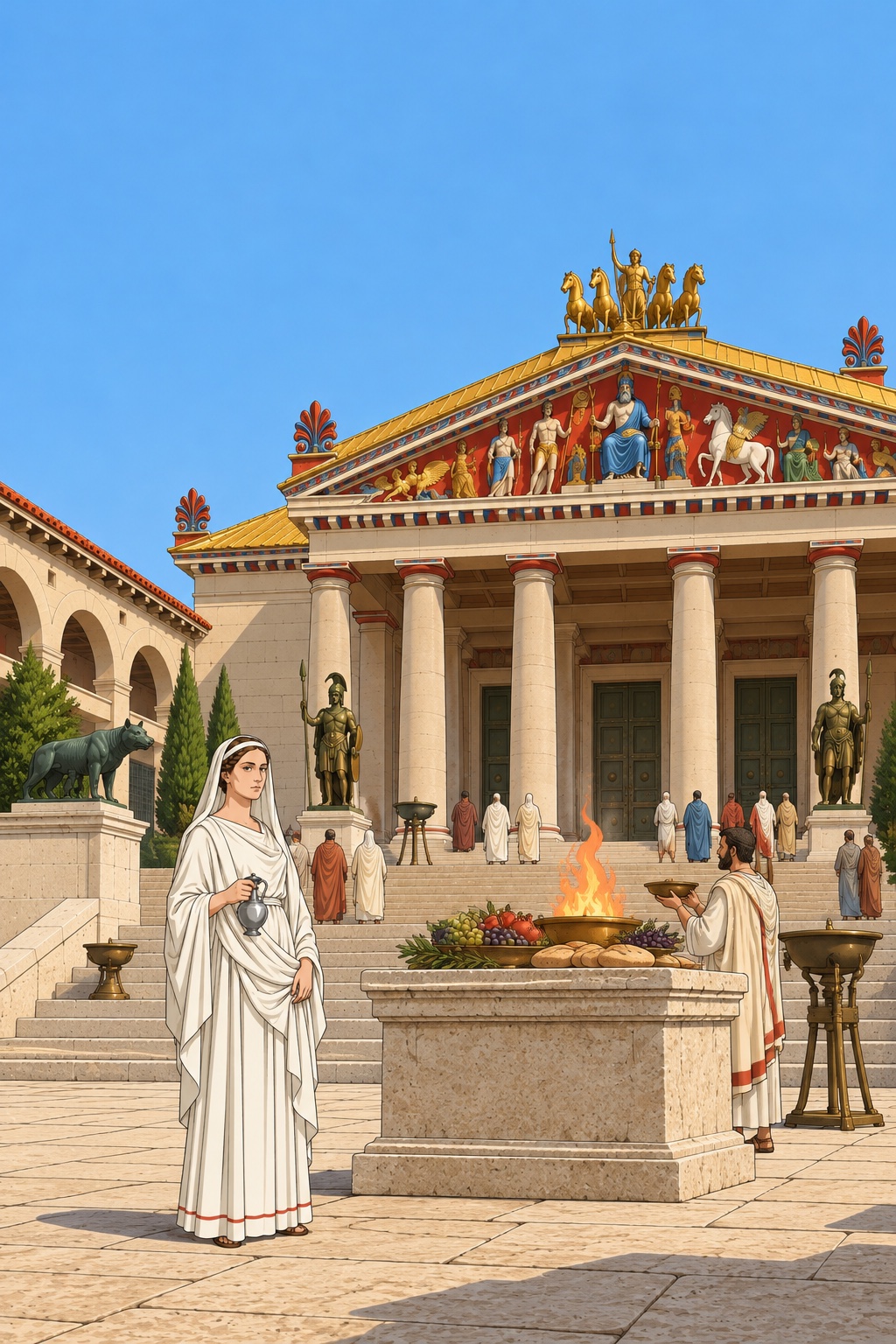
*Of a citizen family, chosen at seven. About 28. White stola and palla, the white woollen fillets of her order, the six braids of a bride. No color and no jewel.*
Sulpicia has tended the hearth for twenty-one years. She now teaches the girls who will take her place. She holds keys to the temple store and knows what families tell her when they leave their wills. She stands straight, speaks little and takes her time. No one touches her. Her name sounds like the title of the chief Vestal, but she does not hold that office.
In play she can hold a document a house cannot reach or bear witness when no one will call her a liar in public. Her duty to the hearth comes first, even when a friend asks. The Pontifex Maximus to whom she answers is beyond the Alps. Her player character sheet is in Pregenerated Characters.
## Temples and How They Work
An augur marks out a **templum** to take the auspices. That space can be in the open. An **aedes**, a god's house, stands on consecrated ground. A magistrate vows the building, often before a battle, and dedicates it under the vow or on the Senate's authority. It belongs to the god.
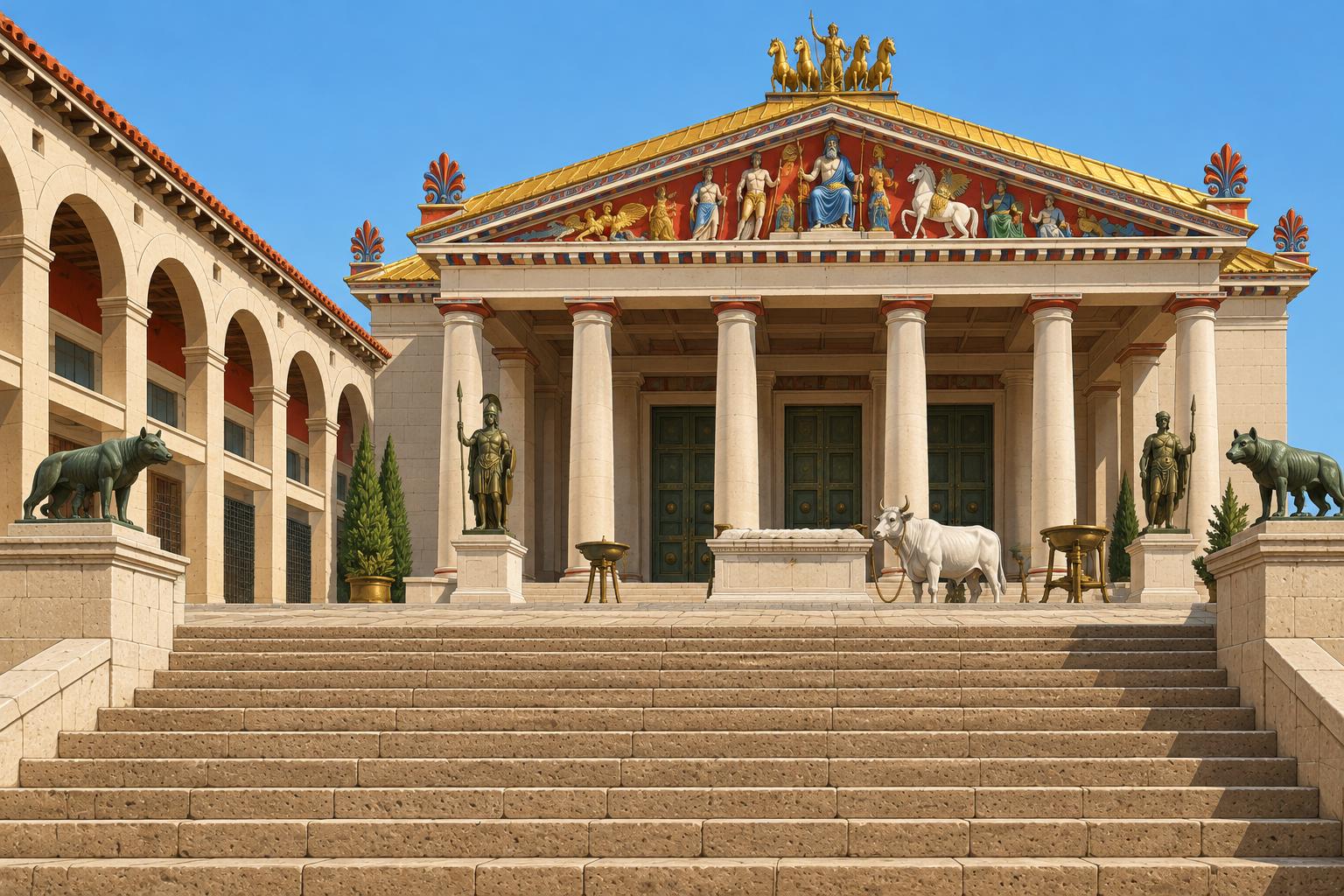
**The building.** Worshippers gather at the **altar outside**, at the foot of the temple steps, to watch a sacrifice. The steps climb the high podium to a deep *pronaos* or porch and the **cella**, where the cult statue stands. The statues are dressed and painted. Old temples have local tufa and peperino walls under white stucco. Wooden beams carry a tile roof and terracotta ornaments in red, ochre and white along the eaves and pediment. Rome's first marble temples date to the second century BC. Metellus built Jupiter Stator after his triumph of 146 BC. The round temple by the Tiber, usually taken for Hercules Victor's, dates to about 120 BC. In 50 BC most temples still use other materials.
**Who keeps it.** The *aedituus* keeps the keys, and public slaves clean, guard and serve. A temple can own property, slaves and offerings and lend money. The state farms out temple income. Aediles and censors see to repairs, and an urban praetor can award a contract. Temple holdings attract thieves. Verres stripped Sicilian temples of their statues between 73 and 71 BC.
**Who pays.** The treasury pays for the public rites, and a private worshipper buys his own victim and incense. What a priest or haruspex charges is not recorded; Gear and Prices sets a working figure.
**What happens there each day.** Little is recorded beyond Vesta's fire, tended day and night; other temples open for festivals, vows, prayer at the doors and state business.
**Temples as offices.** Rome keeps its money and records in its gods' houses.
- **Saturn** holds the state treasury (*aerarium*), run by the quaestors.
- **Castor and Pollux** holds the standard weights and measures; its high platform serves as a second speaker's stand.
- **Ceres** on the Aventine holds the plebeian records.
- **Juno Moneta** on the Arx is the mint.
The temples where the Senate meets are in Powers of the Republic, Where the Senate Meets.
**The pomerium.** The sacred boundary keeps out burials, armed men and military command. Foreign gods generally have temples outside the line, though the Great Mother on the Palatine is an old exception. A general who crosses the line forfeits his command unless the Senate has granted him a triumph and he crosses in procession. Sulla extended the boundary in 80 BC. A general waiting to celebrate stays outside it.
### The Sacred Places of Rome
The Forum, the hills and their streets are in Rome. These are the sacred places a character is sent to, with who is there and what they want.
**The Capitol and Jupiter Optimus Maximus.** On 6 Quintilis 83 BC the great temple burned with its old statue and the Sibylline Books. Quintus Lutatius Catulus rebuilt it on the same podium, about 55 by 60 meters, and dedicated it in 69 BC. A deep porch fronts the wide Tuscan temple. Painted terracotta figures stand against white stucco walls under a roof of gilded bronze tiles. Jupiter's cella is between Juno's on the left and Minerva's on the right. The seated Jupiter, in gold and ivory, was finished about 65 BC. Juno Moneta and the augurs' observation post are on the Arx, the northern summit. The single arcaded story of the Tabularium sits in the saddle.
*Who is there:* the keeper and his public slaves, magistrates with their attendants, priests with veiled heads, worshippers paying vows. *What they want:* a vow paid in public, where the right people see it.
**Vesta, the House of the Vestals and the Regia.** A ring of columns stands around Vesta's **round** cella in the Forum. Inside burns the fire in place of a cult statue. When the temple burned in 241 BC, a Metellus is said to have lost his sight carrying out the sacred objects. Its materials in 50 BC are unknown. Draw it in stucco and tile like its neighbors. Next door is the House of the Vestals. The pontiffs work nearby in the Regia, and Caesar's official residence is the Domus Publica.
*Who is there:* the six Vestals and their servants, pontiffs and their clerks, families bringing documents to lodge. *What they want:* the fire kept, the store guarded, and no scandal. A man may not enter the hearth (Era Rules, Patronage and Rank, Attitude: Closed 3).
**The Palatine and the Great Mother.** The temple of the Magna Mater, dedicated in 191 BC, burned in 111 BC and rebuilt, stands among the houses of the rich. It holds the black stone brought from Pessinus in 204 BC.
*Who is there:* her Phrygian priests, the Galli, and the noble families who give her festival dinners in April. *What they want:* alms during the procession and no interference from the Senate.
**The Aventine.** The temple of Ceres, Liber and Libera is the plebeian aediles' base and holds the plebs' records; Diana's old sanctuary stands nearby.
*Who is there:* the plebeian aediles, their clerks, grain dealers. *What they want:* a full grain supply and good Cerealia games.
**The Forum Boarium.** By the cattle market and the river stand the Ara Maxima of Hercules, where sacrifice is made in the Greek rite with the head bare, and the round marble temple of about 120 BC. Merchants pay Hercules a tenth of a profit here.
*Who is there:* cattle dealers, merchants, river men. *What they want:* the god's tenth paid in public, where other traders see it.
## Sacrifice, Vows and Oaths
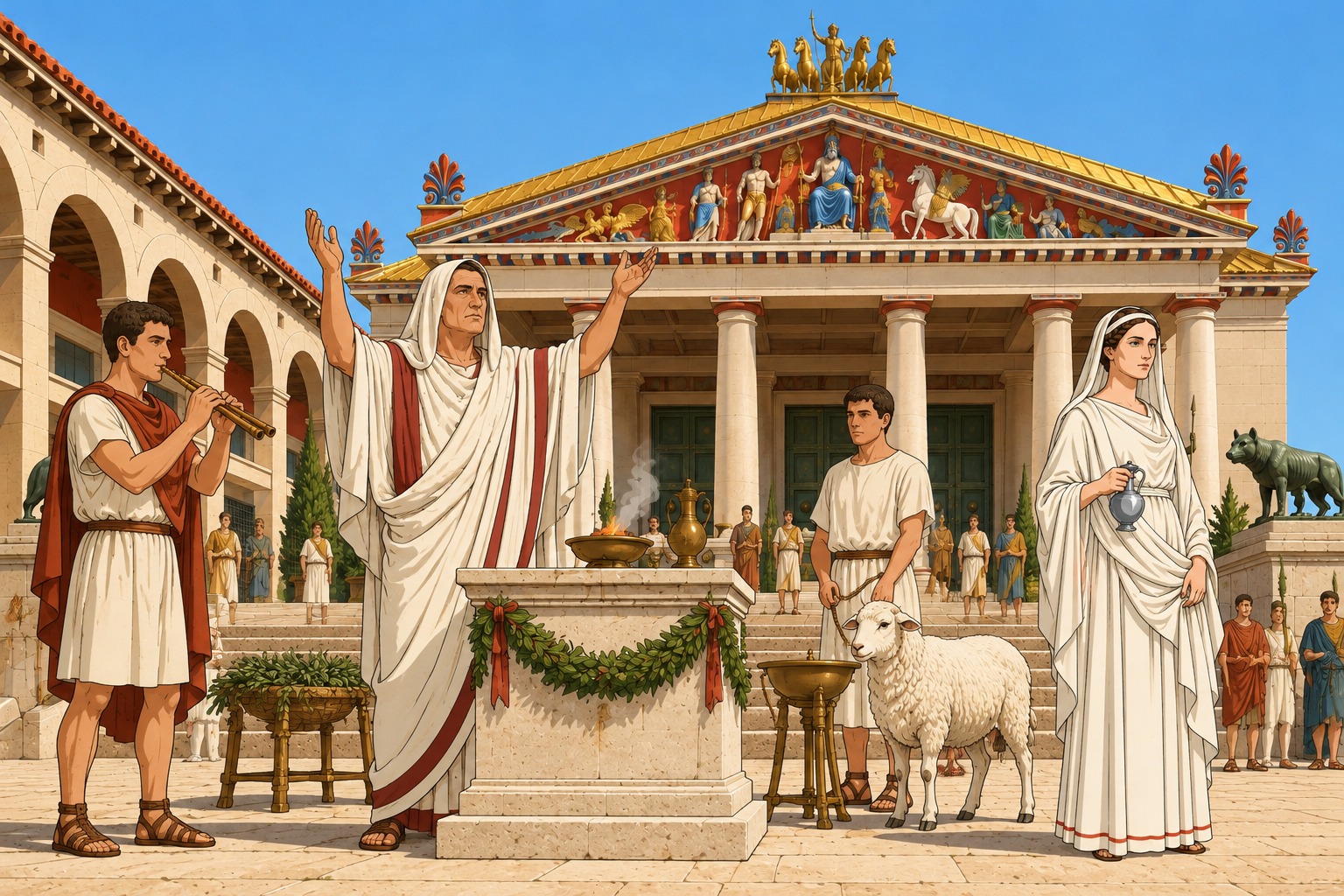
The attendants do the work of preparing a meal for a god. A magistrate, priest or the head of a household officiates. In the Roman rite he draws his toga over his head (*capite velato*). For Hercules at the Ara Maxima and for Saturn he sacrifices bareheaded in the Greek manner.
1. **Silence.** The rite opens with the call "*favete linguis*", "keep your tongues still". A flute player plays through the rite.
2. **Prayer and the first offering.** The officiant prays, beginning with Janus, and offers incense and wine.
3. **The victim consecrated.** He sprinkles the animal with *mola salsa* (spelled meal and salt), pours wine on its head and draws the knife along its back from brow to tail.
4. **The kill.** An attendant (*popa*) stuns it with a mallet; another (*cultrarius*) cuts its throat.
5. **The inspection.** The entrails (*exta*: liver, lungs, heart) are inspected by the officiant or a haruspex. If they are sound, the sacrifice is accepted (*litatio*) and the god's share, the *exta*, is burned on the altar. If not, a new victim is killed until the signs are clear.
6. **The meal.** The meat goes to the worshippers.
**Victims.** Worshippers buy an ox, sheep, pig or goat at the market price (Gear and Prices). They give males to gods and females to goddesses, white animals to the powers above and dark ones to the powers below. In a *suovetaurilia* the pig, sheep and bull go together to purify a field, farm, army or people. Cato records the prayer to Mars.
**Vows.** Before battle, a general may promise a temple or games if the god helps him. At Vercellae in 101 BC Catulus promised a temple to the Fortune of the Day. A worshipper pays a vow in public once the god grants his request.
**Public thanks and banquets.** At a *lectisternium* images of the gods lie on couches with a banquet before them. A *supplicatio* is public thanksgiving at the temples by decree of the Senate. Caesar's victories earned fifteen days of thanksgiving in 57 BC and twenty in 55 BC.
**Oaths.** Recruits swear the *sacramentum* one by one, promising to obey their commander and stay with the army. Treaties are sworn by Jupiter Lapis, the flint. Break an oath and the offense is against Fides as well as the other man. A reputation for breaking promises costs a Roman the trust of patrons and clients (Era Rules, Patronage and Rank).
## Signs, Omens and the Auspices
The gods do not explain themselves. They send signs, and Rome keeps experts to read them.
**The auspices.** An augur advises the presiding magistrate as he takes the auspices before an assembly, an election, a battle or an army's march. The magistrate looks for birds, thunder and lightning or signs in the way the sacred chickens feed. A bad sign stops proceedings, whether he sees it himself or another magistrate announces it (*obnuntiatio*). Bibulus said he was watching the heavens in 59 BC to block Caesar's laws. An assembly dissolves at a clap of thunder. To run an election or defend a law, find out who will be watching that day (Era Rules, Patronage and Rank, Elections).
**Prodigies.** A statue sweats, lightning strikes a temple or a calf is born with two heads. The magistrates tell the Senate, and the Senate asks the pontifices or haruspices which god is angry and what rite will appease him (*procuratio*). A rain of stones goes through the same channels. The haruspices give their reply in writing. In 56 BC Cicero took their answer to the Senate and made a speech of it against Clodius. The man who explains a prodigy has a hand in choosing who gets blamed.
**The Sibylline Books.** When a crisis comes, the Senate tells the quindecimviri to consult the Books. In 56 BC the question was whether to restore Ptolemy XII. The college reported that Rome should offer friendship if the king asked for help, but send no army.
**Rome's own human sacrifice.** During the crisis of 216 BC, Rome buried four people alive in the Forum Boarium, a man and woman from Gaul and a man and woman from Greece. Plutarch reports the same rite after the Vestal trials of 114 to 113 BC. The Senate banned human sacrifice in 97 BC. Scholars disagree about whether that included burial alive.
**The skeptics.** Cicero sees no power to foretell events in the auspices. He would keep them for the good of the state, and he remains an augur. He likes Cato's question about how one haruspex can meet another's eye without laughing. Among educated Romans there are Stoic believers and Epicurean doubters, including Lucretius.
### Divination and Magic
A Roman who wants a reading can seek out someone beyond the state's colleges. The powerful still consult **astrologers** ("Chaldaeans"), though according to the epitome of Valerius Maximus they were expelled in 139 BC. Publius Nigidius Figulus, praetor in 58 BC, studies the stars and Pythagoras. Rome also has **dream interpreters** of Isis. **Curse tablets** are thin lead sheets scratched with names and curses, then dropped into a grave or well. The Greeks have long used them. Latin tablets exist by the late Republic, though few survive from so early. An accusation of black magic can be used in court. In 56 BC Cicero accuses Vatinius of calling up the dead.
##### No Magic in the Rules
A rite, a curse or a reading has the effect people give it. A haruspex who reads a liver before a crowd uses Lore (Rites), and the Temple Rite talent can make the audience accept the sign he declares (Skills and Talents). A curse found under a man's threshold changes how his household and his neighbors treat him, which the GM sets as an Attitude (Era Rules, Patronage and Rank). The book gives no check that makes a god act.
##### LEGEND
Roman tradition says that one of the twelve shields the Salii carry fell from the sky in the reign of Numa, and that eleven copies were made so that no thief could tell which was the true one. Livy and Plutarch tell it; no one can check it. Told at the table, it is what Romans believe, not a fact the book confirms.
## The Roman Year
A Roman year is twelve months and **355 days**. The pontifices can insert an intercalary month to bring the calendar back into step with the seasons. Years of neglect and political manoeuvring leave the calendar well ahead of the sun by the 50s BC. Curio proposes an extra month in 50 BC and fails. The year runs without it.
**Counting days.** A Roman counts back from the next **Kalends**, **Nones** or **Ides**, as in "the third day before the Ides". The Kalends are always the first. In March, May, Quintilis and October, the Nones are the 7th and the Ides the 15th. In the other months they fall on the 5th and 13th.
**Kinds of day.** Courts can hear cases on *fasti*, and assemblies can sit on *comitiales*. There is no legal business on *nefasti*. A character who needs a hearing, a vote or a signature starts with the calendar. A rival who cannot beat him in court may still have a say in when the court sits.
##### Festival Dates in 50 BC
The dates below are the Romans' own day numbers. Macrobius says that when Caesar later reformed the calendar he put the added days at the ends of months, so festivals kept their day numbers: the Saturnalia is 17 December before the reform and after it. Because the calendar runs ahead of the sun, a festival in the calendar's spring may fall in the season's winter.
| Date | Festival | What happens | At the table |
|:--|:--|:--|:--|
| 1 January | New consuls | The consuls take office and sacrifice to Jupiter on the Capitol | A new year's politics begin with a procession |
| 13 to 21 February | Parentalia | Families visit their tombs with flowers, wine and bread; temples shut, no marriages | Business stops; a family can be found at its tomb |
| 15 February | Lupercalia | Young men in goatskins run round the Palatine striking women with strips of hide; goats and a dog are sacrificed at the Lupercal cave | Crowds line the route round the Palatine |
| March | The Salii | The Salii dance through the city with the twelve sacred shields | Processions through the streets for weeks |
| 19 March (five days by Ovid's time) | Quinquatrus | Minerva's festival; craftsmen and schoolmasters keep holiday | |
| 4 to 10 April | Megalesia (Ludi Megalenses) | Games for the Great Mother; the Galli process and beg; nobles hold dinners | Theater shows; a crowd that the Senate watches |
| 12 to 19 April | Cerealia (Ludi Ceriales) | Games of Ceres, given by the plebeian aediles | |
| 21 April | Parilia | Shepherds' festival of smoke and leaping fires; counted as Rome's birthday | |
| 28 April to 3 May | Floralia (Ludi Florales) | Flora's games; theater shows and bright dress; Valerius Maximus says Cato walked out of them in 55 BC so the crowd could have its show | |
| 9, 11 and 13 May | Lemuria | The head of the house drives off the restless dead at midnight | |
| 15 May | Merchants' day | Merchants honor Mercury | |
| 9 June | Vestalia | The store of Vesta stands open to women from 7 to 15 June; on 15 June the Vestals sweep it out and carry the sweepings to the Tiber | For the week the store is open, women of every house come to the Forum |
| 6 to 13 Quintilis | Ludi Apollinares | Games for Apollo, vowed in 212 BC | |
| 23 Quintilis | Neptunalia | Neptune's day | |
| 21 Sextilis | Consualia | Consus's day, with horse races | |
| 23 Sextilis | Vulcanalia | Fish thrown into the fire against house fires | |
| 5 to 19 September | Ludi Romani (Ludi Magni) | The oldest and greatest games, for Jupiter; the Banquet of Jupiter, with the Senate seated before his statue, on 13 September | The year's great crowd |
| 15 October | October Horse | A horse is sacrificed to Mars | |
| 4 to 17 November | Ludi Plebeii | The plebeian games, ending with the Banquet of Jupiter on 13 November | |
| December | Bona Dea | Women's night rite in the house of a magistrate with imperium; no man present | In 62 BC Clodius entered Caesar's house during it, disguised as a woman |
| 17 December | Saturnalia | Temple of Saturn's day; gifts of candles and clay figures, slaves feasted; the festivities run on for days | A household turned about; see Household Religion |
| Late December or early January | Compitalia | The crossroads festival; a moveable feast | See The Crossroads |
The festival games, their venues and their sponsors are in The Arena and the Games.
## Household Religion
The house has its own gods and a shrine, the *lararium*, by the hearth or in the atrium. The **Lares** keep the household safe and the **Penates** guard the storeroom and family wealth. Slaves swear by the **Genius** or life force of the *paterfamilias*, while the mistress of the house has her **Juno**. **Vesta** lives in the hearth.
At the Kalends, Nones and Ides, the head of the household leads family, slaves and freedmen in its rites. The Lar gets a garland, incense, a little wine or salt cake. Cato puts the bailiff's wife (*vilica*) in charge of this on his farm. The freedman owes his former owner a client's respect and treats him as patron in the rites. In a noble house the wax ancestor masks (*imagines*) stay in wooden cupboards in the atrium until a public sacrifice or funeral.
At **Parentalia** families bring food to their dead at the tombs. Ovid says the head of the house walks barefoot at midnight at **Lemuria**, throwing black beans over his shoulder nine times to buy off the restless dead. At **Saturnalia**, slaves are feasted and can speak freely. Cato gives his farm hands extra wine at Saturnalia and Compitalia. The fuller account of customs comes from Macrobius, four centuries later.
### The Crossroads
At every crossroads of the city stands a shrine to the **Lares Compitales**, the gods of the neighborhood. Their festival, the **Compitalia**, brings free people and slaves together with offerings; Roman writers say the woollen dolls and balls hung at the shrines replace an old human offering, which is a story, not a record. Each quarter has its crossroads college (*collegium compitalicium*).
The colleges are politics: Clodius's law of 58 BC restored them after the Senate's ban (Powers of the Republic, The Streets). In 50 BC a crossroads college is a street gang with a shrine, and the Compitalia is a muster of its men. Papirius and his like (Adversaries) hold their quarters through the shrine.
### Funerals
A nobleman's body lies in state in the atrium before his *pompa funebris* carries him to the Forum. Actors in the procession wear the wax masks of his ancestors. At the Rostra his son or a kinsman gives the *laudatio funebris*, the public speech in his praise. Burials and cremations take place outside the sacred boundary. The enslaved and the poor end up in communal pits outside the walls, including those on the Esquiline.
## Foreign Cults at Rome
Public order governs the Senate's treatment of foreign cults. Private worship can go on, but public shrines are barred inside the sacred boundary and secret societies are suppressed. In the **Bacchanalia** of 186 BC the Senate broke up the Bacchic societies of Italy. Livy puts the number implicated at 7,000, and a bronze copy of the decree survives. Small groups continued Bacchic worship with a license.
**The Great Mother.** Cybele, the Magna Mater, came from Pessinus to Rome in 204 BC, during the war with Hannibal, and has her temple on the Palatine. Her priests, the **Galli**, are eunuchs from Phrygia; a Roman citizen may not become one. In April they process through the city and beg alms, an exception the Senate allows them alone. Lucretius describes the procession about 55 BC. A Roman cult with a foreign priesthood, she is honored and kept at arm's length.
**Isis and Sarapis.** Egyptian gods have shrines in Italy, at Puteoli from at least 105 BC, and in Rome by the 80s BC. The record of the 50s is a running fight:
- **58 BC.** Tertullian, quoting Varro, says altars of Sarapis, Isis, Harpocrates and Anubis on the Capitol are thrown down by the Senate's decision; the crowd rebuilds them and the consul Gabinius forbids them.
- **Late 53 BC.** The Senate votes to pull down temples that private persons had built for these gods; Dio says the cult was then settled outside the sacred boundary.
- **50 BC.** Valerius Maximus tells that no workman would touch the temple of Isis and Sarapis, so the consul Lucius Aemilius Paullus took off his bordered toga, picked up an axe and struck the doors himself. The story comes through a later epitome, and its year is a modern placing.
The cult keeps coming back, and its priests interpret dreams. A worshipper of Isis before a Roman magistrate is a marker for Attitude (Era Rules, Patronage and Rank).
**The Jews of Rome.** A Jewish community lives in Rome from the second century BC; a late summary of Valerius Maximus says Jews were expelled in 139 BC with the astrologers; they came back. They send gold to the Temple in Jerusalem. In 59 BC Cicero defends Flaccus, a former governor of Asia, against charges over that gold; Cicero plays to the jury against the Jewish crowd at the trial.
## The Gods of the Provinces
Rome does not convert its subjects. Romans call foreign gods by Roman names, as Caesar does in Gaul. The places below are described in Alexandria and in Gaul and the Provinces; this section covers their gods.
### Gaul
What Rome reads about Gallic religion is mostly Caesar's account of the people he conquered. His readers know the gods by the Roman names he uses. He gives first place to **Mercury**, the inventor of arts, guide of roads and journeys and patron of trade. Caesar says Mercury has the most images. After him come **Apollo** against disease, **Mars** in war, **Jupiter** of the heavens and **Minerva** of crafts. The Gauls claim descent from **Dis Pater** and count time by nights.
The **druids**, by Caesar's account, conduct the Gauls' sacrifices; their order, their yearly council and the Aeduan druid Diviciacus are in Gaul and the Provinces.
The Gauls set treasure aside for their gods in sacred places and, Caesar says, leave it untouched. Suetonius says Caesar plundered Gallic shrines and temples for their gold. Sanctuaries are sacred groves and rectangular enclosures with timber posts, offerings and captured weapons on display.
##### LEGEND
Caesar describes criminals, and sometimes innocents, burned in great wicker figures, and captives sacrificed in payment of vows. Strabo and Diodorus repeat the account. **Teutates, Esus and Taranis** first appear in Lucan in the AD 60s. His later commentators ascribe grim rites to each. The names **Belenus, Epona** (of horses), **Lugus, Sucellus, Rosmerta** and **Cernunnos** come from Roman-period inscriptions and carvings. Excavated sanctuaries show evidence of violence and displayed skulls, but their rites are disputed. At the table, attribute the stories to the Romans who told them.
### Egypt
Egypt keeps its own gods and temples under its Greek kings: **Isis** of motherhood and magic, **Osiris** of the dead, **Horus** the falcon king at Edfu, **Amun** at Thebes, **Ptah** and the Apis bull at Memphis, **Hathor** at Dendera, **Sobek** the crocodile of the Fayum and Kom Ombo, and **Thoth** of writing at Hermopolis. **Sarapis** is the Ptolemies' own god, Osiris and Apis in Greek form; his temple at Alexandria was built by Ptolemy III (Alexandria). The great temple of Horus at Edfu was finished in 57 BC; Hathor's new temple at Dendera, begun in 54 BC, is a building site in 50 BC.
Egyptians hold some animals sacred. Diodorus, in Egypt about 60 to 56 BC, saw a crowd kill a Roman who had killed a cat by accident, though the king feared Rome.
### Judea and Syria
The Jews worship one God at the Temple in Jerusalem, which holds no image of him. The high priest is Hyrcanus II. In 63 BC Pompey entered the inner sanctuary, the Holy of Holies, and left its treasure untouched; in 54 BC Crassus took 2,000 talents in coin and much of its gold on his way to Parthia (Josephus).
Syria's gods are many, among them the Baal gods of its cities and **Atargatis**, the Syrian Goddess, whose temple at Hierapolis Crassus also plundered in 54 BC.
## Religion at the Table
| Situation | What happens | Rules |
|:--|:--|:--|
| The day of a trial, vote or contract | Check the calendar: no legal business on a *nefas* day, no assembly on a festival | The Roman Year |
| An assembly or election | The presiding magistrate takes the auspices; a bad sign, seen or announced, puts the business off | Era Rules, Patronage and Rank (Elections) |
| A sacrifice, reading or expiation before an audience | Lore (Rites) to perform it; the audience decides what the sign means | Skills and Talents (Fields of Lore; Temple Rite) |
| Recalling a rite, a god's day or a priest's rule | Lore (Rites) | Skills and Talents (Fields of Lore) |
| A patron's sacrifice, vow or funeral | Attending is a service; when he calls for it, it is a Favor called in | Era Rules, Patronage and Rank (Calling In) |
| A vow made in play | When the thing asked for is granted, the vow is paid in public at the character's cost | Gear and Prices |
| A ruling from a pontifex on a will or tomb | A Petition to a priest of high Ordo | Era Rules, Patronage and Rank (The Petition) |
| A will or treaty lodged with the Vestals | Out of reach of every check | Skills and Talents (Hearth's Custody) |
| A man at the hearth of Vesta | The door is shut | Era Rules, Patronage and Rank (Attitude) |
| A worshipper of Isis, a Jew, a druid or a Gallus before a Roman audience | The faith is a marker the GM sets | Era Rules, Patronage and Rank (Attitude) |
| Sacrilege: profaned rites, a robbed temple | A crime tried in court | Era Rules, Law and Courts |
| An oath broken in public | A client who refuses his patron loses standing | Era Rules, Patronage and Rank (Dignitas; Calling In) |
## Hooks
| Hook | Who | The offer |
|:--|:--|:--|
| The Will in the Store | A senator's heirs | A will lodged with Sulpicia's order names the wrong man; only the Pontifex Maximus can order it out, and a letter must reach Caesar beyond the Alps before the heirs act |
| Watching the Heavens | A tribune's agent | Announce an unfavorable sign on the morning of a vote; the other side has hired men to swear the sky was clear |
| The Axe at the Doors | A freedman of Isis | After the consul's axe, the cult needs a new shrine outside the sacred boundary, and a landlord who will not talk |
| The Sixth Victim | A magistrate paying a vow | Five victims in a row fail the inspection at a public sacrifice; someone at the market is selling sick animals, or someone wants the vow to fail in public |
| The Crossroads Muster | Papirius | The Compitalia is a week away and a rival college has taken the shrine at the corner; Papirius pays for the shrine back before the festival |
| What the Sibyl Said | Kallias of Alexandria | He wants the text of the oracle read to the Senate in 56 BC, and to know whether the college could be asked again |
| The Druid's Hearing | Banona | An Aeduan druid has come to Rome, as Diviciacus once did, and needs a patron and a hearing at Bellona's temple before the Senate forgets the Aedui |
| The Bona Dea Night | A matron of the house | The December rite is held in a praetor's house this year, and a man has been seen in the garden |
Sulpicia, a Vestal, at an altar before the Temple of Jupiter
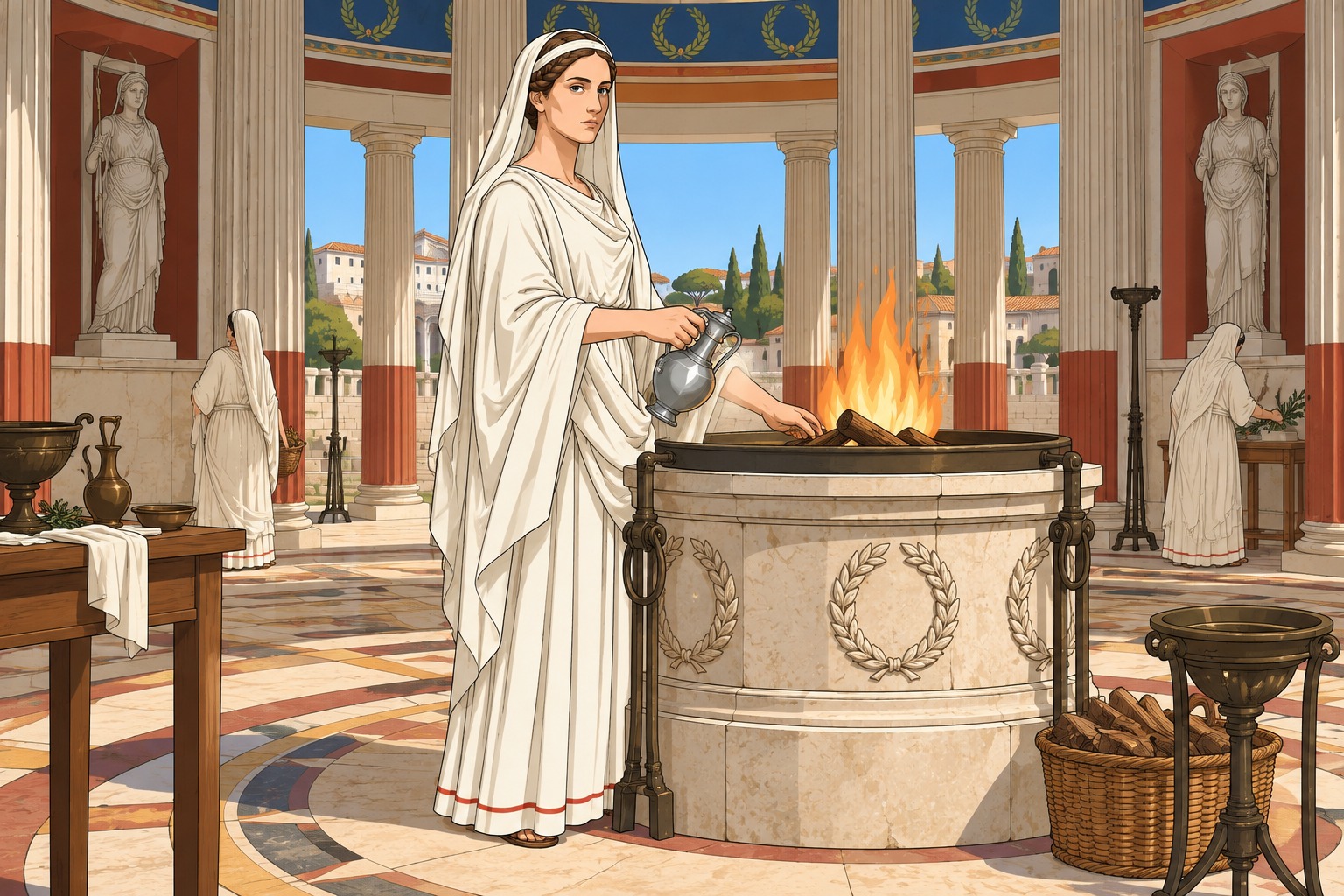
 **Vesta, the House of the Vestals and the Regia.** A ring of columns stands around Vesta's **round** cella in the Forum. Inside burns the fire in place of a cult statue. When the temple burned in 241 BC, a Metellus is said to have lost his sight carrying out the sacred objects. Its materials in 50 BC are unknown. Draw it in stucco and tile like its neighbors. Next door is the House of the Vestals. The pontiffs work nearby in the Regia, and Caesar's official residence is the Domus Publica.
*Who is there:* the six Vestals and their servants, pontiffs and their clerks, families bringing documents to lodge. *What they want:* the fire kept, the store guarded, and no scandal. A man may not enter the hearth (Era Rules, Patronage and Rank, Attitude: Closed 3).
**The Palatine and the Great Mother.** The temple of the Magna Mater, dedicated in 191 BC, burned in 111 BC and rebuilt, stands among the houses of the rich. It holds the black stone brought from Pessinus in 204 BC.
*Who is there:* her Phrygian priests, the Galli, and the noble families who give her festival dinners in April. *What they want:* alms during the procession and no interference from the Senate.
**The Aventine.** The temple of Ceres, Liber and Libera is the plebeian aediles' base and holds the plebs' records; Diana's old sanctuary stands nearby.
*Who is there:* the plebeian aediles, their clerks, grain dealers. *What they want:* a full grain supply and good Cerealia games.
**The Forum Boarium.** By the cattle market and the river stand the Ara Maxima of Hercules, where sacrifice is made in the Greek rite with the head bare, and the round marble temple of about 120 BC. Merchants pay Hercules a tenth of a profit here.
*Who is there:* cattle dealers, merchants, river men. *What they want:* the god's tenth paid in public, where other traders see it.
## Sacrifice, Vows and Oaths
The attendants do the work of preparing a meal for a god. A magistrate, priest or the head of a household officiates. In the Roman rite he draws his toga over his head (*capite velato*). For Hercules at the Ara Maxima and for Saturn he sacrifices bareheaded in the Greek manner.
1. **Silence.** The rite opens with the call "*favete linguis*", "keep your tongues still". A flute player plays through the rite.
2. **Prayer and the first offering.** The officiant prays, beginning with Janus, and offers incense and wine.
3. **The victim consecrated.** He sprinkles the animal with *mola salsa* (spelled meal and salt), pours wine on its head and draws the knife along its back from brow to tail.
4. **The kill.** An attendant (*popa*) stuns it with a mallet; another (*cultrarius*) cuts its throat.
5. **The inspection.** The entrails (*exta*: liver, lungs, heart) are inspected by the officiant or a haruspex. If they are sound, the sacrifice is accepted (*litatio*) and the god's share, the *exta*, is burned on the altar. If not, a new victim is killed until the signs are clear.
6. **The meal.** The meat goes to the worshippers.
**Victims.** Worshippers buy an ox, sheep, pig or goat at the market price (Gear and Prices). They give males to gods and females to goddesses, white animals to the powers above and dark ones to the powers below. In a *suovetaurilia* the pig, sheep and bull go together to purify a field, farm, army or people. Cato records the prayer to Mars.
**Vows.** Before battle, a general may promise a temple or games if the god helps him. At Vercellae in 101 BC Catulus promised a temple to the Fortune of the Day. A worshipper pays a vow in public once the god grants his request.
**Public thanks and banquets.** At a *lectisternium* images of the gods lie on couches with a banquet before them. A *supplicatio* is public thanksgiving at the temples by decree of the Senate. Caesar's victories earned fifteen days of thanksgiving in 57 BC and twenty in 55 BC.
**Oaths.** Recruits swear the *sacramentum* one by one, promising to obey their commander and stay with the army. Treaties are sworn by Jupiter Lapis, the flint. Break an oath and the offense is against Fides as well as the other man. A reputation for breaking promises costs a Roman the trust of patrons and clients (Era Rules, Patronage and Rank).
 ## Signs, Omens and the Auspices
The gods do not explain themselves. They send signs, and Rome keeps experts to read them.
**The auspices.** An augur advises the presiding magistrate as he takes the auspices before an assembly, an election, a battle or an army's march. The magistrate looks for birds, thunder and lightning or signs in the way the sacred chickens feed. A bad sign stops proceedings, whether he sees it himself or another magistrate announces it (*obnuntiatio*). Bibulus said he was watching the heavens in 59 BC to block Caesar's laws. An assembly dissolves at a clap of thunder. To run an election or defend a law, find out who will be watching that day (Era Rules, Patronage and Rank, Elections).
**Prodigies.** A statue sweats, lightning strikes a temple or a calf is born with two heads. The magistrates tell the Senate, and the Senate asks the pontifices or haruspices which god is angry and what rite will appease him (*procuratio*). A rain of stones goes through the same channels. The haruspices give their reply in writing. In 56 BC Cicero took their answer to the Senate and made a speech of it against Clodius. The man who explains a prodigy has a hand in choosing who gets blamed.
**The Sibylline Books.** When a crisis comes, the Senate tells the quindecimviri to consult the Books. In 56 BC the question was whether to restore Ptolemy XII. The college reported that Rome should offer friendship if the king asked for help, but send no army.
**Rome's own human sacrifice.** During the crisis of 216 BC, Rome buried four people alive in the Forum Boarium, a man and woman from Gaul and a man and woman from Greece. Plutarch reports the same rite after the Vestal trials of 114 to 113 BC. The Senate banned human sacrifice in 97 BC. Scholars disagree about whether that included burial alive.
**The skeptics.** Cicero sees no power to foretell events in the auspices. He would keep them for the good of the state, and he remains an augur. He likes Cato's question about how one haruspex can meet another's eye without laughing. Among educated Romans there are Stoic believers and Epicurean doubters, including Lucretius.
### Divination and Magic
A Roman who wants a reading can seek out someone beyond the state's colleges. The powerful still consult **astrologers** ("Chaldaeans"), though according to the epitome of Valerius Maximus they were expelled in 139 BC. Publius Nigidius Figulus, praetor in 58 BC, studies the stars and Pythagoras. Rome also has **dream interpreters** of Isis. **Curse tablets** are thin lead sheets scratched with names and curses, then dropped into a grave or well. The Greeks have long used them. Latin tablets exist by the late Republic, though few survive from so early. An accusation of black magic can be used in court. In 56 BC Cicero accuses Vatinius of calling up the dead.