# Historical Reference
*Rome DCCIV AUC, The Edge of the Republic, Rome and the provinces in 50 BC. Source: https://exodusnds.com/era-books/rome/historical-reference*
Use this chapter to check a date, look up an office or see where a story comes from. It covers people, Latin terms, calendars, coins and measures, events after 50 BC and questions the record leaves open.
##### NOTICE
I **Sources.** Every row rests on the ancient and modern works listed in Sources and Further Reading. Where the ancient writers disagree, the row names each figure with its author or says "sources differ".
II **Dates.** Dates are the Romans' own. Before 45 BC the civil calendar ran ahead of the seasons, so a date is a calendar day, not a season. The seventh and eighth months are Quintilis and Sextilis until they are renamed (The Calendar in 50 BC).
III **Real people.** Everyone named in this chapter is historical. No real person has a stat block or is playable, and the book never gives one words. The cast and every character a table makes up are fictional.
## The Historical Anchors
The Era gives the political timeline from 133 BC through 51 BC and the main events of 50 BC. The dates below fill in the landmarks that other chapters use, including the roads, aqueducts, temples, cults and arena.
### Before the Gracchi
| Date | Event |
|:--|:--|
| 312 BC | The Via Appia and the Aqua Appia are begun |
| 291 BC | The Temple of Aesculapius is founded on the Tiber Island |
| 272 BC | The Aqua Anio Vetus |
| 264 BC | The first recorded gladiator show, in the Forum Boarium (three pairs, by the count of the late writer Ausonius) at the funeral of Brutus Pera. A sundial taken at Catina is set up on the Rostra |
| 220 BC | The Via Flaminia runs north to Ariminum |
| 216 BC | Two Gauls and two Greeks are buried alive in the Forum Boarium |
| 204 and 191 BC | The Magna Mater is brought from Pessinus; her temple on the Palatine is dedicated in 191 BC |
| 187 BC | The Via Aemilia |
| 186 BC | The Senate suppresses the Bacchanalia |
| 159 BC | Scipio Nasica sets up a water clock under a roof |
| 144 to 140 BC | The Aqua Marcia |
| 139 BC | The written ballot comes to elections; astrologers and Jews are expelled from Rome |
### From the Gracchi to the Compact
| Date | Event |
|:--|:--|
| 125 BC | The Aqua Tepula |
| 121 BC | Opimius rebuilds the Temple of Concord |
| 118 BC | The Via Domitia links Italy to Spain through the old province |
| 117 BC | The Temple of Castor is rebuilt on its high podium |
| 114 to 113 BC | Vestal trials; three Vestals condemned |
| 104 BC | Marius makes the eagle the legion's only standard |
| 97 BC | The Senate decrees that no human being be sacrificed |
| 87 BC | The post of Flamen Dialis falls vacant when Merula kills himself |
| 6 Quintilis 83 BC | Capitoline Jupiter burns, and the Sibylline Books with it |
| 81 BC | Sulla's settlement: 20 quaestors, 8 praetors (some read ten), the pontifices raised to 15 |
| 78 BC | The Tabularium is built on the Capitoline slope |
| 76 BC | The keepers of the Sibylline Books send envoys to gather the oracles again |
| 73 BC | The praetor Glaber's 3,000 blockade the slaves' hill; the slaves climb down on ladders of wild vine, Plutarch says, and take his camp. Livy's summaries count 74 in the breakout |
| 73 BC | The Vestal Fabia is tried and acquitted |
| 69 BC | Catulus dedicates the rebuilt Capitoline temple and spreads the first awnings over a theater |
| 67 BC | The lex Roscia gives the equestrians the first 14 rows at the theater |
| 65 BC | Caesar as aedile gives 320 pairs of gladiators (Plutarch); Suetonius says fewer than he planned |
| 64 BC | The crossroads colleges are banned |
| 63 BC | Pompey enters the Holy of Holies at Jerusalem and leaves the treasure. The election of priests by 17 of the 35 tribes is restored |
| 21 October 63 BC | The Senate's final decree against Catiline |
| 3 December 63 BC | The Allobroges' envoys, seized at the Mulvian Bridge in the night, give Cicero the conspirators' letters; the conspirators are executed on 5 December |
| 62 BC | The Pons Fabricius |
| 60 BC | Faustus Sulla gives games for his father |
### Caesar's Command
| Date | Event |
|:--|:--|
| 59 BC | Bibulus watches the heavens against Caesar's laws. A third of the Asian tax contract is remitted |
| 58 BC | Clodius restores the crossroads colleges. The Isiac altars on the Capitol are thrown down. Scaurus builds a timber theater that Pliny says had 360 columns. Caesar's 4,000 horse are raised from the Province, the Aedui and their allies |
| 57 BC | The temple of Horus at Edfu is finished |
| 57 and 55 BC | The Senate votes thanksgivings of 15 and then 20 days for Caesar's victories |
| 56 BC | The haruspices answer the Senate on a prodigy, and the Sibylline Books are consulted on Ptolemy XII |
| 54 BC | Crassus takes the 2,000 talents in money that Pompey left in the Temple at Jerusalem and, Josephus says, its gold, valued at 8,000 talents. The temple of Hathor at Dendera is begun. The Tiber floods |
| 54 BC | Bribery doubles the rate of interest in Rome from 4 to 8 per cent from 15 Quintilis. Cicero and Oppius have paid 60 million sesterces for the land of Caesar's forum. The Basilica Julia is probably begun |
| 53 BC | Caesar crosses the Rhine again. Cicero is elected augur. Late in the year the Senate votes to pull down private temples of Isis and Sarapis |
| 19 January 52 BC | The day after Clodius is killed, his body burns in the Curia, and the Curia and the Basilica Porcia burn with it |
| 52 BC | Pompey takes Metellus Scipio as colleague for the last five months. With its own Curia burned, the Senate meets in Pompey's Curia and in temples. Curio's revolving wooden theaters |
| 52 BC | Of about 40,000 inside Avaricum, scarcely 800 escape. At Gergovia Caesar loses just under 700 soldiers and 46 centurions. An assembly at Bibracte confirms Vercingetorix as commander. Caesar winters at Bibracte |
| 51 BC | The consul Marcus Marcellus has a man of Novum Comum flogged. Bibulus arrives as governor of Syria. Ariobarzanes III becomes king of Cappadocia. On 29 September the Senate's decree on the provinces is passed in the temple of Apollo |
| 51 BC | A papyrus of late summer 51 BC carries Cleopatra's name alone |
| 31 Quintilis 51 to 30 Quintilis 50 BC | Cicero governs Cilicia |
### The Map Year
| Date | Event |
|:--|:--|
| 50 BC | Caesar visits Cisalpine Gaul, and its towns welcome him |
| 50 BC | Antony is elected augur by the tribes |
| 50 BC | Valerius Maximus tells that when no workman would touch it, the consul Paullus took an axe to the doors of the temple of Isis and Sarapis |
| 50 BC | The curule aedile Caelius writes to Cicero for panthers for his games |
| 50 BC | Faustus Sulla is rebuilding the Curia; Paullus's basilica is a building site |
| 24 November 50 BC | Cicero reaches Brundisium |
## After the Map Year, 49 to 27 BC
These events still lie ahead in 50 BC. If the campaign continues, follow a person or event here to the end of play in 44 BC or through to Augustus. For whether the table can change what happens, see Running the Era, The Approach of the Civil War.
### What Becomes of the Great Men
| Who | 49 to 27 BC |
|:--|:--|
| **Caesar** | On 1 January 49 BC his letter is read in the Senate; on 7 January the Senate passes its final decree against him. He crosses the Rubicon on 10 to 11 January 49 BC with the Thirteenth and holds Italy in about sixty days (Plutarch); he is briefly dictator late in 49 BC to hold the elections. He wins at Pharsalus (9 Sextilis 48 BC), at Zela (2 Sextilis 47 BC), at Thapsus (6 April 46 BC) and at Munda (17 March 45 BC). In 46 BC he celebrates four triumphs, over Gaul, Egypt, Pontus and Africa, and is made dictator for ten years; in 44 BC dictator for life. He is killed on the Ides of March (15 March) 44 BC |
| **Pompey** | Leaves Rome with the Senate and sails from Brundisium on 17 March 49 BC. Beaten at Pharsalus, he flees to Egypt and is murdered at Pelusium on 28 September 48 BC by the court of Ptolemy XIII |
| **Cato** | Kills himself at Utica after Caesar's victory at Thapsus, 46 BC |
| **Cicero** | In the Philippics he says he has received more than twenty million sesterces in inheritances. He is proscribed and killed on 7 December 43 BC |
| **Curio, Caelius and Quintus Cassius** | Flee to Caesar in January 49 BC, Antony with them on 7 January. Curio dies that year, and his widow Fulvia then marries Antony |
| **Antony** | At the Lupercalia (15 February 44 BC) he offers Caesar a diadem, which Caesar refuses. He is a triumvir from 43 BC, meets Cleopatra at Tarsus in 41 BC, proclaims the Donations of Alexandria in 34 BC, is beaten at Actium on 2 September 31 BC and dies by his own hand on 1 Sextilis 30 BC |
| **Brutus and Cassius** | Gaius Cassius, the man who held Syria after Carrhae, leads the conspiracy of 44 BC with Marcus Brutus: more than 60 conspirators, 23 wounds, in the Curia of Pompey. Both are beaten at Philippi in two battles (3 and 23 October 42 BC) and both die |
| **Octavian** | Caesar's will adopts him. He is 19 when he is made consul (19 Sextilis 43 BC). The Second Triumvirate (Antony, Octavian, Lepidus) is made lawful by the lex Titia on 27 November 43 BC, and the proscriptions follow. His admiral Agrippa wins at Naulochus and at Actium; he triumphs three times on 13 to 15 Sextilis 29 BC and receives the name Augustus in January 27 BC |
| **Lepidus** | Triumvir from 43 BC; stripped of his command in 36 BC |
| **Fulvia** | Marries Antony; with his brother Lucius she fights Octavian in the Perusine War, winter 41 to 40 BC |
| **Sextus Pompey** | Pompey's son is beaten at Naulochus on 3 September 36 BC |
### The City, the Calendar and the Gods
| Thing | What happens to it |
|:--|:--|
| The treasury | Caesar takes it from the Temple of Saturn in 49 BC after the tribune Lucius Metellus tries to block him. Plancus rebuilds the temple in 42 BC |
| The Senate | Caesar swells it to 900 by 45 BC (Dio) |
| The proscriptions of 43 BC | About 300 senators and 2,000 equestrians (Appian); Livy's summaries give 130 senators; sources differ |
| The grain list | In 46 BC, Suetonius says, a house-by-house count cuts the list from 320,000 to 150,000 names |
| Rents | In 47 BC Caesar remits a year's rent to tenants in Rome who pay 2,000 sesterces or less |
| Caesar's forum | Dedicated on 26 September 46 BC with the temple of Venus Genetrix, which he vowed at Pharsalus in 48 BC |
| The basilicas | The Basilica Julia is dedicated unfinished in 46 BC; Paullus's son dedicates the Basilica Aemilia in 34 BC |
| Shows | The first mock sea battle is Caesar's, in 46 BC. The first stone amphitheater in Rome is Statilius Taurus's, 29 BC by modern reckoning, 30 BC by Dio's placing; sources differ |
| Caesar's gladiators | In January 49 BC the consul Lentulus brings Caesar's gladiators at Capua into the town's forum, promises them freedom, and then scatters them among the households of the district |
| The calendar | Caesar's reform year, 46 BC, runs 445 days. The new calendar takes effect on 1 January 45 BC. Quintilis is renamed Iulius in 44 BC; Sextilis becomes Augustus in 8 BC |
| Isis and Sarapis | In 48 BC the haruspices advise razing their precincts |
| The Vestals | Caesar's will is lodged with them and opened after his death in 44 BC |
| The Flamen Dialis | The post stays empty until Augustus fills it |
| The Jews of Rome and Judea | Caesar protects Jewish rights from 47 to 44 BC and grants Hyrcanus II the title of ethnarch in 47 BC. Herod's rebuilding of the Temple begins about 20 BC |
| Crassus's lost standards | Parthia returns them to Augustus in 20 BC |
### Egypt, Gaul and the East
| Place or person | What happens |
|:--|:--|
| Cleopatra | By 49 BC the party round Ptolemy XIII drives her from Alexandria. The Alexandrine War leaves her on the throne in 47 BC with her brother Ptolemy XIV. Her son, called Caesarion, is born in 47 BC. She dies by her own hand about 10 Sextilis 30 BC |
| The Ptolemaic army | Caesar finds 20,000 men under Achillas in 48 BC, mostly the Gabiniani, with runaway slaves and 2,000 horse |
| The Library | Fire in the Alexandrine War of 48 BC burns books, 40,000 rolls by Seneca's figure; whether the Library itself burns is disputed |
| Egypt | Falls to Octavian on 1 Sextilis 30 BC and is governed by a prefect who answers to him |
| Massilia | Trebonius besieges it for Caesar in 49 BC; its defenders' great bolt-throwers shoot iron-tipped poles 12 feet long |
| Juba I | Beaten with the Pompeians at Thapsus, 46 BC |
| Pharnaces II | Beaten at Zela in 47 BC |
| Burebista | The king of the Getae and Dacians is killed about 44 BC |
## Truth and Legend
The tables compare accounts from *Rome*, *Spartacus* and ancient writers with the historical record. **TRUTH** means the record supports the story. **LEGEND** marks a later or doubtful report, or a screen story without support. **UNRESOLVED** means the evidence leaves the question open. See Sources and Further Reading, How This Book Handles Uncertainty.
### Spartacus
| The story | The record | Mark |
|:--|:--|:-:|
| Spartacus leads a breakout from a gladiator school at Capua | In 73 BC some 70 to 78 men break out of the school of Lentulus Batiatus with kitchen knives and take a cart of gladiators' arms | TRUTH |
| Spartacus is a chieftain or a king's son | The sources make him a Thracian; Appian and Florus report that he had served with the Romans and deserted | LEGEND |
| The house of Batiatus and its intrigues | Nothing is recorded of Batiatus but his name and his school | LEGEND |
| Gannicus is the school's champion | Gannicus is a rebel leader, destroyed with Castus in 71 BC | LEGEND |
| Spartacus dies on a cross | He is killed in battle in Lucania, and Appian says his body was never found. About 6,000 captives are crucified from Capua to Rome | LEGEND |
| Spartacus makes Roman captives fight at Crixus's funeral | Appian says he sacrificed 300 Roman prisoners to Crixus's shade; Florus and Orosius say they fought as gladiators; sources differ | UNRESOLVED |
| Crassus walls off the toe of Italy | Plutarch gives a ditch and wall 300 stades long at Rhegium; the length and the crossing are not confirmed | LEGEND |
| The slave army numbers 120,000 | Appian gives 70,000 and then 120,000 foot; Orosius 60,000; ancient estimates only | UNRESOLVED |
### The Arena
| The story | The record | Mark |
|:--|:--|:-:|
| Gladiators fight in the Colosseum | No Colosseum in 50 BC (The Arena and the Games, Games in 50 BC) | LEGEND |
| Rome has a stone arena | In Rome shows are fought in the Forum before timber stands. The oldest surviving stone amphitheater is Pompeii's, built about 70 BC | LEGEND |
| Capua has a stone arena | Capua's amphitheater is not securely dated, so the record cannot say whether it stands in 50 BC | UNRESOLVED |
| The crowd turns its thumbs down to kill | No Republican source shows a thumbs-down; the texts are later, and which way meant death is not proven | UNRESOLVED |
| The crowd alone decides who lives | The editor gives the verdict; the loser may appeal to him and to the crowd (The Arena and the Games, The Editor's Decision) | LEGEND |
| Every bout ends in a death | Mercy is possible and many fights are stopped; no Republican death rate survives | LEGEND |
| A net-man (retiarius) fights in 50 BC | The net-man and his chaser are Augustan at the earliest | LEGEND |
| The Thracian and the murmillo fight in 50 BC | Both are named in Cicero's Philippics of 44 to 43 BC; the Samnite and the Gaul are the older types | TRUTH |
| A seasoned gladiator costs 7,000 to 12,000 sesterces | No Republican price survives. The figures are caps from the Senate's decree of AD 177; the book's working prices are in The Arena and the Games, The Editor | LEGEND |
| A freed gladiator is given a wooden sword | Cicero (Philippics 2.74, 44 BC) and Horace, about 20 BC, know the wooden sword (rudis) as the sign of a gladiator's release | TRUTH |
| The Circus factions are Blue and Green | In this period the colors are white and red; green and blue come later | LEGEND |
### Caesar and the Great Men
| The story | The record | Mark |
|:--|:--|:-:|
| Caesar reports a victory in three words, "veni, vidi, vici" | After Zela, 47 BC: in a letter to a friend (Plutarch) or on a placard at the Pontic triumph (Suetonius) | TRUTH |
| Omens greet Caesar at the Rubicon | A herdsman who seizes a trumpet (Suetonius) and struck statues (Lucan) are reported after the fact | LEGEND |
| Caesar crosses on the night of 10 to 11 January 49 BC | The date is derived, not stated: modern scholars reckon it from Cicero's letters, and no ancient writer gives the day | UNRESOLVED |
| Caesar is killed in the Senate House in the Forum | He is killed in the Curia of Pompey on the Campus Martius, by more than 60 conspirators, with 23 wounds | LEGEND |
| Caesar wants a crown | At the Lupercalia of 44 BC Antony offers him a diadem, and he refuses it and sends it to Jupiter on the Capitol; whether the scene was staged to test the crowd, the ancient writers could not say | UNRESOLVED |
| The First Triumvirate is an office | The pact of 60 BC is private; "First Triumvirate" is a modern label | LEGEND |
| Caesar bought the consul Paullus for 1,500 talents | Plutarch and Appian report it; neither Caesar nor Cicero says so | LEGEND |
| Caesar owed 1,300 talents before he held office | Plutarch's figure; Appian gives 25 million sesterces; reported, not proven | LEGEND |
| Caesar bribed his way to Pontifex Maximus | Suetonius says lavish bribery; Plutarch says Catulus offered Caesar money to withdraw and was refused; sources differ | UNRESOLVED |
| Marius made the poor into soldiers in one stroke | The change came gradually; scholars doubt a single act | LEGEND |
| Romans of 50 BC speak of July | The seventh month is Quintilis until 44 BC | LEGEND |
##### LEGEND: POMPEY'S FOOT
Italian towns offered thanksgiving when Pompey recovered from grave illness at Naples in 50 BC, as Cicero remembers. In Plutarch's telling it went to Pompey's head. Someone asked where his troops were if Caesar marched. Pompey said he could stamp his foot anywhere in Italy and armies of foot and horse would rise.
##### LEGEND: CAESAR AND THE PIRATES
Cilician pirates took the young Caesar near Pharmacusa about 75 BC. According to Plutarch, he laughed at the ransom of 20 talents and promised 50. He joked that he would crucify his captors, then did so once ransomed. Suetonius adds that Caesar cut their throats first as a mercy. Velleius also tells the story.
##### LEGEND: THE HEAD OF CRASSUS
During a performance of Euripides' *Bacchae* before the Armenian and Parthian kings, says Plutarch, the actor playing Agave lifted Crassus's head in place of Pentheus's. In Dio's second-hand account the Parthians pour molten gold into the mouth to mock his greed. Plutarch was not a witness either.
### Cleopatra and Egypt
| The story | The record | Mark |
|:--|:--|:-:|
| Cleopatra rules Egypt alone in 50 BC | She rules jointly with her brother Ptolemy XIII under their father's will; she is about 19. A papyrus of 51 BC carries her name alone, so the mark is a judgment on the will, not a certainty | LEGEND |
| Cleopatra and Caesar are lovers before the civil war | Caesar first reaches Alexandria in 48 BC; Caesarion is born in 47 BC, on a day still disputed | LEGEND |
| Cleopatra dies by an asp's bite | The record has her die by her own hand about 10 Sextilis 30 BC; the means is not settled | UNRESOLVED |
| The Library is already lost | It stands in 50 BC; a fire of 48 BC burns books, and how much of the Library is lost is disputed | LEGEND |
| The Pharos is 100 to 140 meters high, in three stages | Strabo calls it a white tower of many stories; the height and shape come from much later descriptions | LEGEND |
| Egypt's grain feeds Rome in 50 BC | Rome's grain comes from Sicily, Sardinia and Africa; Egypt's comes under the emperors | LEGEND |
| Pompey's Pillar and Cleopatra's Needles stand in Alexandria | The pillar is Diocletian's, AD 298; the Needles and the Caesareum are later | LEGEND |
### The Vestals and the Gods
| The story | The record | Mark |
|:--|:--|:-:|
| Six Vestals, chosen as girls, serve thirty years | Six, chosen between 6 and 10 years old; ten years learning, ten serving, ten teaching | TRUTH |
| An unchaste Vestal is buried alive | In an underground room at the Campus Sceleratus by the Colline Gate; her lover is beaten to death | TRUTH |
| A Vestal met by chance can save a condemned man | Plutarch alone, writing about AD 100, says so | LEGEND |
| The Vestals guard the Palladium carried from Troy | Livy and Plutarch tell it; no man but the Pontifex Maximus may enter the inner store | LEGEND |
| Wills and treaties are lodged with the Vestals | Caesar's will is lodged with them | TRUTH |
| A priest of Jupiter (Flamen Dialis) serves in 50 BC | The post is empty from 87 BC until Augustus | LEGEND |
| Mithras has worshippers in Rome | Plutarch gives Mithras's rites to the Cilician pirates; Roman Mithraism is imperial | LEGEND |
| Rome never sacrificed people | In 216 BC Rome buried alive two Gauls and two Greeks; the Senate banned human sacrifice in 97 BC | LEGEND |
| A sacred shield fell from the sky under Numa | Livy and Plutarch tell it of the Salii's shields | LEGEND |
| The druids burn men in wicker figures | Caesar reports it, and Strabo repeats it; the archaeology is debated | LEGEND |
### Gaul and the Legions
| The story | The record | Mark |
|:--|:--|:-:|
| Vercingetorix is king of the Gauls | His own followers hail him king (Caesar, Gallic War 7.4); the assembly at Bibracte confirms him as commander of the war, not as king of the Gauls | LEGEND |
| Vercingetorix is killed after Alesia | He is held six years and put to death after Caesar's triumph in 46 BC | LEGEND |
| Gauls fight from chariots | Caesar meets war chariots among the Britons, not the Gauls of his day | LEGEND |
| The war kills a million Gauls and enslaves a million more | Plutarch's figures; Pliny gives 1,192,000 killed in all Caesar's battles outside the civil wars; round boasts, not counts | LEGEND |
| The Helvetii number 368,000 | Caesar's figure from tablets he says were found in their camp; historians think it inflated | UNRESOLVED |
| 80,000 shut in Alesia and a relief army of 8,000 horse and about 240,000 foot | Caesar's own claims, as he gives them; some editions read 250,000 | UNRESOLVED |
| The buyers counted 53,000 Aduatuci | Caesar reports the buyers' count; the figure is his alone | UNRESOLVED |
| Legionaries wear segmented plate and carry rectangular shields | In 50 BC it is mail and an oval scutum; segmented plate is later (Running the Era, The Anachronism Guard) | LEGEND |
| Pullo and Vorenus are real centurions | Caesar names them as rivals in Quintus Cicero's besieged camp in 54 BC; the rest of their screen story is invented | TRUTH |
| The eagle-bearer of the Tenth leaps into the surf off Britain | Caesar tells it, 55 BC | TRUTH |
| A centurion carries a vine stick | Firmly attested only in the Empire; Republican use is likely but unproven | LEGEND |
### The City
| The story | The record | Mark |
|:--|:--|:-:|
| The Senate meets in the Curia in the Forum | The Curia burned in January 52 BC and is being rebuilt; the Senate meets in Pompey's Curia and in temples such as Apollo's | LEGEND |
| Rome has the Pantheon and the imperial forums | Neither exists; nor do the Baths of Agrippa or the Theater of Marcellus | LEGEND |
| Rome has many aqueducts | Four in 50 BC: the Appia, the Anio Vetus, the Marcia and the Tepula; the Aqua Julia is 33 BC | LEGEND |
| The temple of Venus Genetrix stands in Caesar's forum | It is vowed in 48 BC and dedicated in 46 BC; in 50 BC the forum is cleared ground | LEGEND |
## Glossary
For each term in use, follow the pointer to the chapter that owns it.
| Term | Meaning | Owner |
|:--|:--|:--|
| *aedes* | A god's house: the temple building itself | Gods and Religion |
| *aerarium* | The state treasury, kept in the Temple of Saturn | Powers of the Republic |
| *ambitus* | Electoral bribery, a crime | Era Rules |
| as | The bronze coin; see Money and Measures | Era Rules |
| *atrium* | The hall of a house, open to the sky over a basin | The Era |
| *auctoratus* | A free man who signs on to fight as a gladiator | The Arena and the Games |
| auspices | The signs of the gods' approval, taken before public business | Gods and Religion |
| *caligae* | A soldier's nailed boots | The Era |
| *capite censi* | Citizens counted by head because they own nothing | Powers of the Republic |
| *catasta* | The dealer's platform at the slave market | Rome |
| *cena* | The main meal, from mid-afternoon | The Era |
| client | A man who owes a patron support and greeting in return for protection | Powers of the Republic |
| *collegium* (plural *collegia*) | An association: of a trade, a cult or a neighborhood | Powers of the Republic |
| *comitia* | The voting assemblies of the people | Powers of the Republic |
| *contubernium* | Eight soldiers who share a tent | Legion Battles |
| *cura annonae* | The command of the grain supply, given to Pompey in 57 BC for five years | Rome |
| *cursus honorum* | The ladder of offices | Powers of the Republic |
| Dignitas | A character's public worth in play | Era Rules |
| *domus* | The house of a family of means | The Era |
| editor | The man who gives a show and pays for it | The Arena and the Games |
| *equites* | The equestrian order: the wealthy men below the Senate, rated at 400,000 sesterces or more | The Era |
| *fasces* | The bundle of rods carried by a magistrate's lictors | Powers of the Republic |
| *fasti*, *nefasti*, *comitiales* | Days when the courts may sit, days with no legal business, days when the assemblies may meet | Gods and Religion |
| Gabiniani | Roman soldiers left in Egypt by Gabinius in 55 BC | Alexandria |
| *imperium* | The power to command an army and to judge | Powers of the Republic |
| *infamis* (plural *infames*) | A person under legal disgrace: gladiator, trainer, actor, brothel-keeper | The Arena and the Games |
| *insula* | A block of rented rooms over shops | The Era |
| Kalends, Nones, Ides | The three fixed days of a month; see The Calendar in 50 BC | Gods and Religion |
| lanista | The owner and trainer of a gladiator school | The Arena and the Games |
| *lararium* | The household shrine | Gods and Religion |
| *latus clavus* | The broad purple stripe on a senator's tunic | Powers of the Republic |
| lictor | An attendant who walks before a magistrate with the fasces | Powers of the Republic |
| *ludi* | State festival games on fixed days | The Arena and the Games |
| *ludus* | A gladiator school | The Arena and the Games |
| *mangones* | Slave dealers | Rome |
| *missio* | Release of a beaten gladiator alive | The Arena and the Games |
| *munus* (plural *munera*) | A gladiator show owed to the dead | The Arena and the Games |
| *nundinae* | The market day, every eighth day | Rome |
| *obnuntiatio* | Announcing bad omens to stop public business | Gods and Religion |
| *oppidum* | A walled Gallic hill town | Gaul and the Provinces |
| Ordo | A character's legal order in play | Era Rules |
| *palla* | A woman's shawl | The Era |
| *paterfamilias* | The oldest living man of a family, who holds power over it | The Era |
| *peculium* | The fund an owner lets an enslaved person hold | The Era |
| Peregrine | A free man or woman who is not a Roman citizen | Era Rules |
| *pilum* | The legionary's heavy throwing spear | Legion Battles |
| *pomerium* | The sacred boundary of the city | Gods and Religion |
| *publicani* | The companies that farm the state's taxes and contracts | Powers of the Republic |
| *quaestiones* | The standing jury courts | Powers of the Republic |
| *res repetundae* | Extortion by a governor, tried in its own court | Powers of the Republic |
| *rudis* | The wooden sword of training and of release | The Arena and the Games |
| *sagum* | A heavy cloak, of soldiers and Gauls | The Era |
| *salutatio* | The morning greeting of clients at a patron's door | Powers of the Republic |
| *scutum* | The legionary's long oval shield | Legion Battles |
| *senatus consultum* | A decree of the Senate; the *ultimum* is its final decree in an emergency | Powers of the Republic |
| *spectacula* | The timber stands put up for a show | The Arena and the Games |
| *stola* | A married woman's long dress | The Era |
| *supplicatio* | Days of public thanksgiving voted by the Senate | Gods and Religion |
| *tablinum* | The master's office off the atrium | The Era |
| *templum* | A space marked out by the augurs, where the Senate may meet | Gods and Religion |
| *toga* | The citizen's white wool mantle; *candida*, chalked for a candidate; *praetexta*, bordered in purple for a magistrate | The Era |
| *tresviri capitales* | Three junior magistrates who keep watch over the city with a few public slaves | The Era |
| *tribuni aerarii* | The third order of jurors under the lex Aurelia | Powers of the Republic |
| *verna* | A slave born in the house | The Era |
| *vicesima* | The tax of one twentieth of a slave's value on freeing him | Gear and Prices |
## Offices
For the number of men in each office, their powers and minimum ages, see Powers of the Republic, The Ladder of Offices. The list below gives their duties.
| Office | What he does | Owner |
|:--|:--|:--|
| Consul | One of two chief magistrates a year; commands armies, presides over the Senate, names the year | Powers of the Republic |
| Praetor | Holds imperium and runs the courts: the urban praetor for citizens, the peregrine praetor for foreigners, the rest for the jury courts | Powers of the Republic |
| Quaestor | Keeps the treasury, or the accounts of a governor in his province; the first step into the Senate | Powers of the Republic |
| Aedile | Keeps the markets, streets, water, grain and temples, and gives games | Powers of the Republic |
| Tribune of the plebs | A plebeian whose person is sacred; can veto any act and propose laws | Powers of the Republic |
| Censor | Elected about every five years for eighteen months; counts the citizens, enrolls the Senate, lets the state contracts | Powers of the Republic |
| Dictator | A magistrate with supreme command for a set task; to everyone alive in 50 BC the word means Sulla | Powers of the Republic |
| Proconsul, propraetor | A former consul or praetor sent to govern a province | Powers of the Republic |
| *Princeps senatus* | The senator at the head of the censors' roll; since Sulla the presiding consul asks the consuls-elect first | Powers of the Republic |
| Legate | A senator chosen by a general to command a legion or a detachment | Character Creation and Roles |
| Military tribune | One of six young officers in each legion | Character Creation and Roles |
| Centurion | Commands a century; the senior centurion of a legion is the *primus pilus* | Character Creation and Roles |
| Pontifex Maximus | Head of the college of pontiffs, keeper of the calendar and the Vestals | Gods and Religion |
| Augur | Judges whether the gods approve a public act | Gods and Religion |
| *Tresviri capitales* | Keep watch over the city with a few public slaves; Rome has no police | The Era |
## The Calendar in 50 BC
To a Roman, this is the year of the consuls Paullus and Marcellus. In Varro's reckoning from the founding of Rome, it is 704, or DCCIV. A year has 355 days. In alternate years the pontiffs may insert a month after 23 or 24 February, counted by the ancients as 22 or 23 days. Curio asks for one in 50 BC and is refused. Modern estimates put the civil date about five to seven weeks ahead of the sun. The precise gap has to be reconstructed. See Gods and Religion, The Roman Year for counting back from the fixed days and dating the festivals.
---
Each month opens on the Kalends. Markets (*nundinae*) come every eighth day. Romans divide daylight into twelve hours, longer in summer, and night into four watches.
| Month | Days | Nones | Ides | Later name |
|:--|:-:|:-:|:-:|:--|
| Ianuarius | 29 | 5th | 13th | |
| Februarius | 28 | 5th | 13th | |
| Martius | 31 | 7th | 15th | |
| Aprilis | 29 | 5th | 13th | |
| Maius | 31 | 7th | 15th | |
| Iunius | 29 | 5th | 13th | |
| Quintilis | 31 | 7th | 15th | Iulius (July) from 44 BC |
| Sextilis | 29 | 5th | 13th | Augustus (August) from 8 BC |
| September | 29 | 5th | 13th | |
| October | 31 | 7th | 15th | |
| November | 29 | 5th | 13th | |
| December | 29 | 5th | 13th | |
## Money and Measures
Look up money, stakes and credit in Era Rules, Money and Credit, and prices in Gear and Prices. The **Basis** column distinguishes source figures, values calculated from them and conventions for play.
| Unit | Worth or length | Modern equivalent | Basis |
|:--|:--|:--|:--|
| quadrans | a quarter of an as; the price of a bath | | Recorded |
| as | bronze; 4 quadrantes; a quarter of a sestertius | | Recorded |
| sestertius (HS) | 4 asses; the unit of account, seldom struck | | Recorded |
| denarius | silver, about 3.9 g; 4 sestertii or 16 asses | | Recorded |
| aureus | gold, rare; no fixed rate in 50 BC; reckon about 100 HS as bullion | | Book convention |
| drachma | the Greek silver coin of the East; counts as 1 denarius in Roman accounts | | Convention |
| Unit | Worth or length | Modern equivalent | Basis |
|:--|:--|:--|:--|
| talent | a weight of silver used as a sum; 6,000 denarii or 24,000 HS | | Derived |
| purse | the arena's unit of account; 800 HS (200 denarii); see The Arena and the Games | | Book convention |
| Roman foot | | about 296 mm | Recorded |
| pace | two steps, 5 Roman feet | about 1.48 m | Derived |
| Roman mile | 1,000 paces | about 1,480 m | Recorded |
| stade | the Greek measure of distance | the Heptastadion's seven stades are about 1.2 km | Recorded |
| modius | the grain measure; a working adult eats about one a week | no figure in this book | Recorded |
| hour | a twelfth of the daylight, longer in summer | | Recorded |
| watch | a quarter of the night | | Recorded |
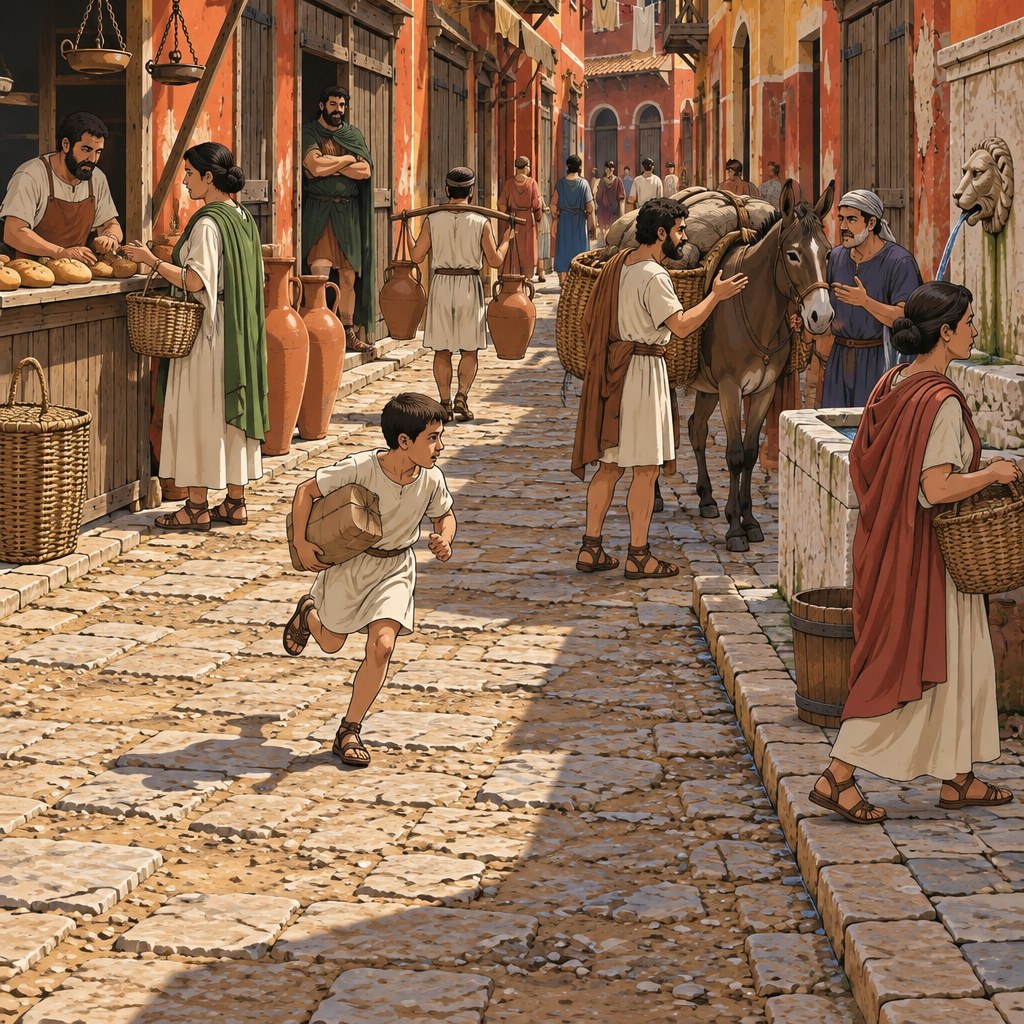
A crowded lane of the Subura at midday
## Who's Who
The book names these real people in third person, without stats or dialogue.
| Name | Who | Dates | Where in this book |
|:--|:--|:--|:--|
| Achillas | General of the Ptolemaic court | Commands 20,000 in 48 BC | Alexandria |
| Agrippa | Octavian's admiral | Naulochus 36 BC; Actium 31 BC | The Era |
| Ambiorix | Leader of the Eburones | Destroys Sabinus and Cotta, winter 54 to 53 BC | Gaul and the Provinces |
| Antipater the Idumaean | The power behind Hyrcanus II in Judea | In power in 50 BC | Gaul and the Provinces |
| Antony (Marcus Antonius) | Caesar's friend; augur and tribune-elect in 50 BC | Tribune from 10 December 50 BC; dies 30 BC | The Era; Powers of the Republic; Gods and Religion |
| Appius Claudius Pulcher | Censor of 50 BC who purges the Senate | Censor 50 BC | Powers of the Republic |
| Ariobarzanes III | King of Cappadocia, a client of Rome | King from 51 BC | Powers of the Republic; Gaul and the Provinces |
| Ariovistus | Leader of the Suebi and their allies, beaten by Caesar | 58 BC | Gaul and the Provinces |
| Bibulus (Marcus Calpurnius) | Optimate; Caesar's colleague as consul; governor of Syria | Consul 59 BC; Syria 51 to 50 BC | Powers of the Republic; Gods and Religion |
| Brutus (Marcus Junius) | Leader, with Cassius, of the conspiracy of 44 BC | Dies after Philippi, 42 BC | The Era |
| Burebista | King of the Getae and Dacians | Killed about 44 BC | Gaul and the Provinces |
| Caelius Rufus (Marcus) | Curule aedile of 50 BC, Cicero's correspondent | Aedile 50 BC | Powers of the Republic; The Arena and the Games |
| Caesar (Gaius Julius) | Proconsul of the Gauls and Illyricum, and head of the pontiffs | Killed 15 March 44 BC | Throughout |
| Caesarion | Son of Cleopatra, not yet born in 50 BC | Born 47 BC | Alexandria |
| Cassius Longinus (Gaius) | Crassus's quaestor, who held Syria after Carrhae | Beats the Parthians 51 BC; dies after Philippi, 42 BC | Powers of the Republic |
| Cassius Longinus (Quintus) | Caesar's friend, tribune-elect | Tribune from 10 December 50 BC | Powers of the Republic |
| Catiline (Lucius Sergius Catilina) | Conspirator of 63 BC | Killed near Pistoria, January 62 BC | The Era |
| Cato (Marcus Porcius) | Stoic, the hard line of the optimates | Praetor 54 BC; kills himself at Utica 46 BC | Powers of the Republic |
| Catulus (Quintus Lutatius) | Builder of the Tabularium and the new Capitoline temple | 78 and 69 BC | Gods and Religion; Rome |
| Cicero (Marcus Tullius) | Advocate; consul of 63 BC; governor of Cilicia in the map year | Augur from 53 BC. Killed 7 December 43 BC | Powers of the Republic |
| Cleopatra VII | Queen of Egypt with her brother | Joint ruler from 51 BC; dies 30 BC | Alexandria |
| Clodius (Publius Clodius Pulcher) | Tribune and street leader | Tribune 58 BC; killed at Bovillae 18 January 52 BC | Powers of the Republic; Rome |
| Crassus (Marcus Licinius) | The richest man of his day | Consul 70 and 55 BC. Killed after Carrhae, 53 BC | Powers of the Republic |
| Crixus, Oenomaus | Gauls who led the breakout with Spartacus | 73 BC; Crixus falls at Mount Garganus, 72 BC | The Era |
| Curio (Gaius Scribonius) | Tribune of the plebs in 50 BC | Dies 49 BC | Powers of the Republic |
| Deiotarus | King of Galatia, a client of Rome | In power in 50 BC | Powers of the Republic |
| Diviciacus | Aeduan noble named by Caesar; Cicero calls him a druid (*On Divination* 1.90) | In Caesar's war | Gaul and the Provinces |
| Domitius Ahenobarbus (Lucius) | Optimate leader | In the Senate in 50 BC | Powers of the Republic |
| Dumnorix | Aeduan noble | Dies 54 BC | Gaul and the Provinces |
| Faustus Sulla | Son of the dictator; rebuilder of the Curia | Games 60 BC; rebuilding in 50 BC | Rome; Powers of the Republic |
| Fulvia | Widow of Clodius, wife of Curio in 50 BC | Later wife of Antony | Powers of the Republic |
| Gabinius (Aulus) | Proconsul who restored Ptolemy XII | 55 BC | Alexandria |
| Gracchus (Tiberius and Gaius) | Tribunes and reformers | Killed 133 and 121 BC | The Era |
| Hyrcanus II | High priest at Jerusalem | Ethnarch only from 47 BC | Gaul and the Provinces |
| Juba I | King of Numidia, Pompey's friend and Curio's enemy | Beaten at Thapsus, 46 BC | Powers of the Republic |
| Julia | Caesar's daughter, Pompey's wife | Married 59 BC; dies in childbirth 54 BC | Powers of the Republic |
| Lentulus Batiatus | Owner of the school at Capua | 73 BC | The Era |
| Lepidus (Marcus Aemilius) | Triumvir with Antony and Octavian | 43 to 36 BC | The Era |
| Marcellus (Gaius Claudius) | Consul of 50 BC | Consul 50 BC | Powers of the Republic |
| Marcellus (Marcus Claudius) | Consul of 51 BC who moved to replace Caesar | Consul 51 BC | Powers of the Republic |
| Marius (Gaius) | General, seven times consul | Dies 13 January 86 BC | The Era |
| Metellus Scipio | Pompey's father-in-law and colleague | Consul 52 BC | Powers of the Republic |
| Milo (Titus Annius) | Clodius's rival, with gladiators of his own | Tribune 57 BC; in exile at Massilia from 52 BC | Powers of the Republic; Rome |
| Mithridates VI | King of Pontus | Massacre of 88 BC; dies 63 BC | The Era |
| Octavian | Caesar's great-nephew and heir | Consul at 19, 43 BC; Augustus 27 BC | The Era |
| Orodes II | King of Parthia | In power in 50 BC | Powers of the Republic |
| Paullus (Lucius Aemilius) | Consul of 50 BC and builder of a basilica | Consul 50 BC | Powers of the Republic; Rome; Gods and Religion |
| Pharnaces II | Holder of the Bosporan kingdom | Beaten at Zela, 47 BC | Powers of the Republic |
| Piso (Lucius Calpurnius Piso Caesoninus) | Censor of 50 BC | Censor 50 BC | Powers of the Republic |
| Pompey (Gnaeus Pompeius Magnus) | First man in Rome by rank | Consul 70, 55 and 52 BC. Killed 28 September 48 BC | Throughout |
| Pothinus | Chief minister of Ptolemy XIII | In power in 50 BC | Alexandria |
| Ptolemy XII Auletes | King of Egypt, restored by Rome | Restored 55 BC; dies early 51 BC | Alexandria |
| Ptolemy XIII | Boy king, joint ruler with Cleopatra | About ten when his father dies | Alexandria |
| Pullo (Titus) and Vorenus (Lucius) | Rival centurions named by Caesar | 54 BC | Gaul and the Provinces |
| Sallust | Historian; expelled from the Senate by Appius | Expelled 50 BC | Powers of the Republic |
| Spartacus | Thracian gladiator and leader of the slave war | 73 to 71 BC; killed in Lucania 71 BC | The Era; Powers of the Republic |
| Sulla (Lucius Cornelius) | Dictator | Dictator from 82 BC; dies 78 BC | The Era; Powers of the Republic |
| Surena | Parthian general at Carrhae | 53 BC; later put to death by Orodes | The Era; Legion Battles |
| Tiro (Marcus Tullius) | Cicero's secretary, freed by him | Freed before 50 BC | The Era; Powers of the Republic |
| Vatinius (Publius) | Author of the law of 59 BC; beat Cato to a praetorship | 59 BC | Powers of the Republic |
| Vercingetorix | Arvernian commander of the Gallic war | Surrenders at Alesia, 52 BC; put to death after Caesar's triumph in 46 BC | The Era; Gaul and the Provinces |
| Verres | Governor of Sicily, prosecuted by Cicero | 70 BC | The Era |
## Facts We Do Not Know
Where evidence fails or conflicts, use the marked working figures as needed. Leave the other questions to the GM.
| What is not known | Why | At the table |
|:--|:--|:--|
| How many people live in Rome | No ancient count survives; modern estimates run from about half a million to a million | A crowded city; Rome, The City in 50 BC |
| What share of Italy is enslaved | Modern estimates run from one in five to one in three | Enslaved people are in every house and field |
| What a gladiator costs | No Republican price survives | Use the working prices in The Arena and the Games, The Editor |
| How often a bout ends in death | No Republican rate survives | The Arena and the Games, Failure States |
| Which way the thumb turned for death | The texts are later and disagree | Leave the gesture out; the editor speaks |
| The gladiator's oath in the Republic | The wording is known only from later writers | Use the contract, not the words |
| When the provocator first fights | The first clear evidence is imperial | Keep to the Samnite, Gaul, Thracian and murmillo |
| Where gladiator shows began | Campania or Etruria | Either |
| How many the Circus seats | 150,000 (Dionysius) or 250,000 (Pliny), both questioned | A vast crowd |
| How many laps a race runs | Seven is the imperial rule; the Republican rule is not secure | The Arena and the Games, The Chariot Race |
| When Capua's amphitheater was built | Not securely dated | Assume none of stone in 50 BC |
| When Caesar's command ends | The optimates and Caesar read the laws of 55 and 52 BC differently; no historian can settle it | Every side has a lawyer; Powers of the Republic, In 50 BC: When Does Caesar's Command End? |
| Whether the exemption of 52 BC holds | Pompey added it after his law was engraved | As above |
| The exact drift of the calendar | Reconstructed, not recorded | About five to seven weeks ahead of the sun |
| When Sulla laid down the dictatorship | Late 81 to 79 BC, disputed | |
| When Sertorius was killed | 72 BC in most accounts, 73 BC by one argument | |
| The day of Carrhae | 9 June by Ovid; May by some reckonings | |
| The size of Spartacus's army | Appian 70,000 and 120,000; Orosius 60,000 | Tens of thousands |
| The proscription toll of 43 BC | 300 senators (Appian) or 130 (Livy's summaries) | |
| The day Caesarion is born | A disputed reading of a Memphis stela gives a day in June 47 BC by modern reckoning | |
| The day Octavian becomes Augustus | 13 or 16 January 27 BC, by calendar | |
| How Cleopatra dies | By her own hand; the means is not settled | |
| How many rolls the Library holds | The figures are later and disputed | A great many |
| How tall the Pharos is | Later descriptions only | Strabo's many stories |
| What the Temple of Saturn looks like in 50 BC | Nothing is known of the old temple's form | Tufa, stucco and tile |
| Who pays for a sacrifice | Not recorded | Gear and Prices sets a working figure |
| How common curse tablets are | Few Latin tablets this early survive | Rare but possible |
| How the Parthians worship | Poorly recorded | Keep it offstage |
| How many Helvetii marched | Caesar's 368,000, thought inflated | Use the scale, not the number |
| How many Gauls died in the war | Plutarch's and Pliny's totals are boasts | As above |
| Where Rome's slave dealers stand | Cicero places them near the Temple of Castor; the site is not certain | Rome, The Slave Market |
| What a centurion is paid | Not attested | Gear and Prices, Wages and Income |
| Whether a senator needs a property qualification | No Republican figure is attested | Powers of the Republic |
| Whether the centurion's vine stick is Republican | Firmly attested only in the Empire | Septimius carries one; treat it as rank, not proof |