# Powers of the Republic
*Rome DCCIV AUC, The Edge of the Republic, Rome and the provinces in 50 BC. Source: https://exodusnds.com/era-books/rome/powers-of-the-republic*
In 50 BC a character with a petition needs to know which man holds the office, how he got it and who can stop him. This chapter puts names and places to the offices of the Republic. Era Rules, Patronage and Rank and Law and Courts explains Ordo, Dignitas, favors, elections, bribes and trials.
**Reading the chapter.** Dates matter here. Where the ancient writers disagree, each account carries its source. Legend boxes give the table rumors the sources cannot establish. Real Romans exert power around the characters and appear in the third person, without invented dialogue. The hooks use fictional people.
## How the Republic Runs
Every year the citizens elect Rome's magistrates. Two or more colleagues share each office and can veto one another. The Senate advises, the assemblies pass laws, and at the end of the year the magistrates are meant to hand over their powers. An office with *imperium* gives its holder the power to command an army and judge. An office with *potestas* carries narrower powers. Rome has neither a king nor a permanent head of state. It has no police.
In 50 BC the consuls are Lucius Aemilius Paullus and Gaius Claudius Marcellus. They took office on 1 January, and Romans give the year their names. By the scholars' count it is the 704th year from the founding of the city (DCCIV).
A magistrate's **lictors** carry bundled rods, the *fasces*. They make a way for him and enforce his orders. A consul has 12, a praetor 6 (2 inside the city), a governor of praetorian rank 6 and a dictator 24. If a householder is robbed, he cannot call the lictors out as a watch. He sends his slaves, his clients or a hired gang.
### The Ladder of Offices
A man goes from quaestor to praetor to consul. Since Sulla's laws of 81 BC there must be two years between offices, a minimum age for each and ten years before he can hold the same one again. The order and age requirement of this *cursus honorum* go back to the lex Villia annalis of 180 BC. Sulla restated them. The ages below come from careers such as Cicero's, in which a man held office in the first year he qualified (*suo anno*). A man can take the aedileship or the tribunate along the way, or skip both. See Era Rules, Patronage and Rank (Elections) to run a canvass and determine who can stand.
One task, supreme imperium and, in theory, no more than six months. That was the office of **dictator**, which fell out of use after 202 BC. In 82 BC Sulla took it without a term set, "to write laws and set the state in order". His departure from office is disputed, between late 81 and 79 BC. Say dictator in 50 BC and a Roman thinks of Sulla's march on the city and the names on his lists.
| Office | Each year | Least age | Elected by | Power | What it means at the table |
|:--|:-:|:-:|:--|:--|:--|
| Quaestor | 20 | 30 | Assembly of the tribes | Keeps the treasury (*aerarium*) or is a governor's finance officer | The entry to the Senate. A quaestor abroad holds his governor's money chest and his accounts |
| Aedile | 4: two curule, two plebeian | — | Tribes (curule); plebeian assembly (plebeian) | Markets, streets, water, the grain supply, temples, the public games | Polices the markets and streets; gives the ludi from his own purse to buy popularity (The Arena and the Games) |
| Tribune of the plebs | 10, plebeians only | — | Plebeian assembly | Vetoes any act of a magistrate or the Senate; summons the plebs; proposes laws | His person is sacrosanct. One tribune can stop the whole state for a day |
| Praetor | 8 (some read Sulla's law as ten) | 39 | Assembly of the centuries | *Imperium*; runs the courts | The urban praetor hears citizens' suits, the peregrine praetor cases with foreigners, the rest preside over the standing jury courts |
| Consul | 2 | 42 | Assembly of the centuries | *Imperium* over Rome and Italy; commands armies; presides over the Senate | The two consuls hold the fasces in alternate months and give their names to the year |
| Censor | 2, about every five years, for 18 months | — | Assembly of the centuries | Takes the census; enrolls the Senate and the equestrians; lets the state contracts | Can strike a senator from the roll or a knight from his order, and decides who farms the taxes |
### Governors and the Provinces
A former consul can govern as **proconsul**, a former praetor as **propraetor**. Their imperium lasts as long as the Senate or the people extend it. In 53 BC the Senate decreed that five years must pass between a magistracy and a provincial command. Pompey made the gap law in 52 BC. Men who had held office and never taken a province are now being sent out. Cilicia was assigned to Cicero that way.
The provinces in 50 BC are Sicily; Sardinia and Corsica; Nearer and Further Spain; Transalpine Gaul (the old province on the coast) and Cisalpine Gaul; Illyricum; Macedonia; Africa; Asia; Bithynia and Pontus; Cilicia, with Cyprus attached since Rome annexed the island in 58 BC and Cato carried it out; Syria; and Crete and Cyrene. The lands Caesar has conquered beyond the old province are held by his army, not yet organized. The places are in Gaul and the Provinces.
A governor brings legates, a quaestor and friends (*comites*) for a year, often longer. He hears cases, raises troops and collects taxes through the companies. His allowance pays his way. The standing court for extortion (*res repetundae*) is his only check, and it hears the case in Rome after he returns.
##### At the Table: Provinces
- **The Salamis Loan.** A city council in Cyprus hires the characters to carry its petition to Rome before a Roman lender's agent collects at 48 per cent with the governor's cavalry.
- **The Quaestor's Chest.** A governor's quaestor dies on the road home; his accounts, and the chest that should match them, are with his freedman, who wants a patron before he talks.
- **The Extortion Case.** A Greek city wants to prosecute its last governor. It needs a Roman advocate, witnesses who will sail, and someone to keep them alive in Rome (Era Rules, Law and Courts).
## The Senate
Once a man has been quaestor, his seat in the Senate is for life, unless the censors strike his name from the roll. There are about 600 seats since Sulla added about 300 equestrians. The Senate advises the magistrates by decree (*senatus consultum*). It has no power to make laws, but its *auctoritas* gives it control of the treasury, foreign policy and the assignment of provinces. In 50 BC the quarrel is over who gets Caesar's command.
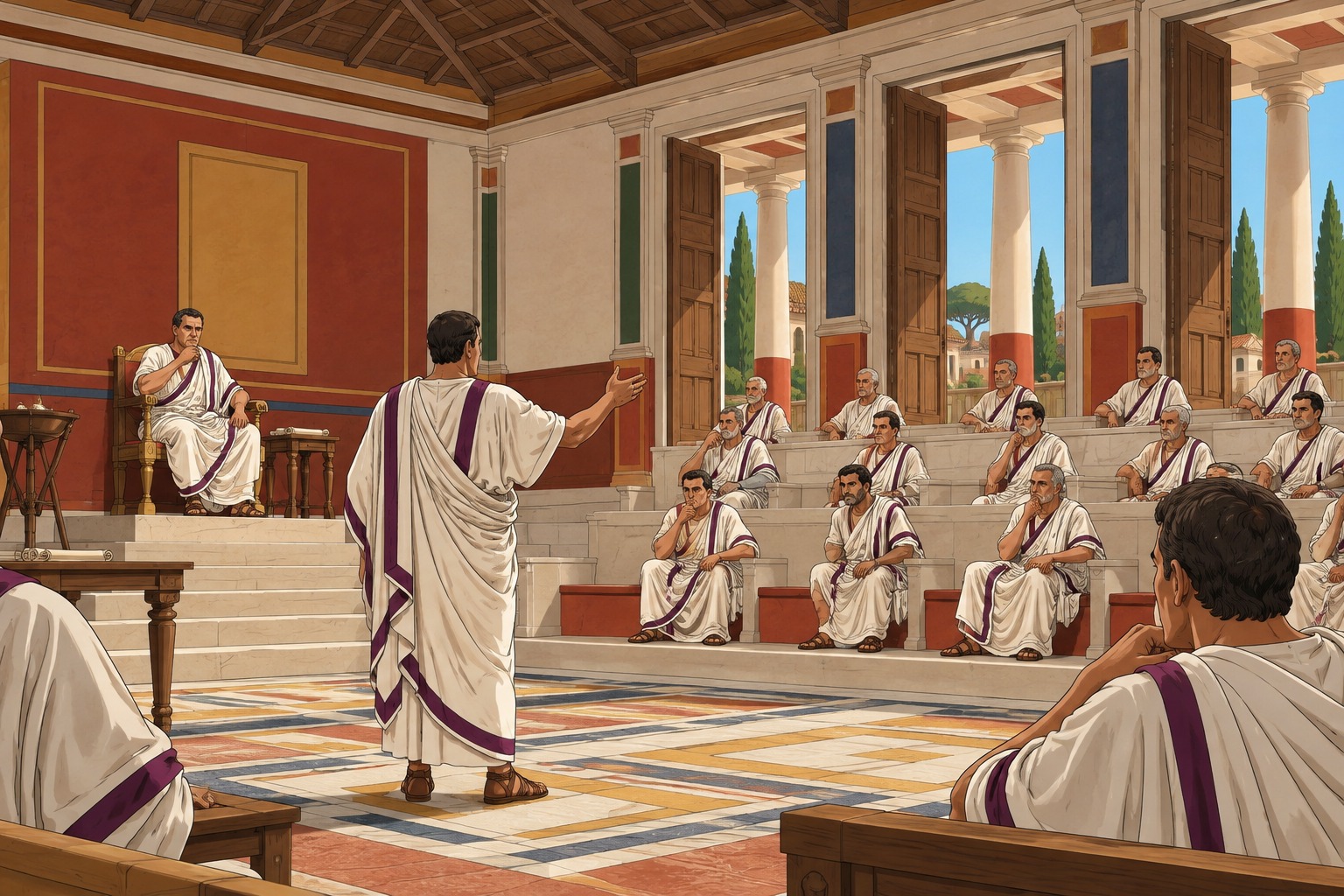
**Procedure.** Usually a consul puts the question. The *princeps senatus* speaks first, followed by the consulars, the praetorians and the rest in order of office. Senators vote by walking to one side of the chamber. A tribune can veto their decree. They can sit only between sunrise and sunset and only in a consecrated space, a *templum*.
**Dress.** The senator's tunic has a broad purple stripe (*latus clavus*). His shoes lace up (*calcei*). A magistrate wears the purple-bordered *toga praetexta*. The equestrian has a narrow stripe and a gold ring.
**The final decree.** By the *senatus consultum ultimum* the Senate asks the consuls to "see that the state suffers no harm". It first used the decree against Gaius Gracchus in 121 BC, then against Saturninus in 100 BC, Lepidus in 77 BC, Catiline on 21 October 63 BC and after the murder of Clodius in 52 BC. The decree has no force in law. Can a consul use it to kill citizens without trial? After debate in the Senate, Cicero had five of Catiline's men strangled in the Tullianum on 5 December 63 BC. Clodius drove him into exile in 58 BC.
 ### Where the Senate Meets
##### The Curia Hostilia
*The Senate house at the edge of the Forum, by the Comitium and the Rostra.*
Sulla enlarged and restored the Senate house about 80 BC. After it burned in the riot of 52 BC (The Streets), the Senate asked the dictator's son, Faustus Cornelius Sulla, to rebuild it. The work is under way in 50 BC. There is no record of its completion. Caesar's agents have bought the ground behind it for a new forum. See Rome for the site. **At the table:** Masons, contractors and the dictator's son all have business where the Senate is spending its money.
##### The Curia of Pompey
*A hall at the back of the colonnaded garden behind Pompey's theater, in the Campus Martius.*
In 50 BC senators can sit on tiered benches in Pompey's Curia or meet in a temple such as Concord, Capitoline Jupiter, Bellona or Apollo while the old house is being rebuilt. Pompey's Curia serves from 52 to 50 BC. He can attend there and stay outside the city boundary. The presiding magistrate sits in a curule chair. **At the table:** In Pompey's Curia the Senate debates in sight of his theater and the temple of Venus Victrix. For the theater see The Arena and the Games and Rome.
##### At the Table: The Senate
- **The Rebuilding Contract.** A contractor on the Curia is skimming stone money and wants the characters to buy his silence with the clerk of works before the censors look.
- **Order of Speaking.** A senator's client needs his patron to speak before a rival consular on a petition; the characters must find out when the consul will put the question and get him into the room.
- **The Envoy's Hearing.** A Gaulish or Greek envoy waits months for the Senate to hear his people; a senator who will raise the matter wants a service first (Era Rules, Patronage and Rank).
## The Assemblies
A citizen has to be in Rome to cast his vote with his group. For voters elsewhere in Italy that means making the journey. Since the 130s BC votes go on written tablets, which curb open intimidation. A vote can still be bought.
| Assembly | Who votes, and how | Elects | Other business |
|:--|:--|:--|:--|
| *Comitia centuriata* | All citizens, in 193 centuries weighted by wealth; the first class and the equestrian centuries vote first | Consuls, praetors, censors | Declares war |
| *Comitia tributa* | All citizens, in 35 tribes | Quaestors, curule aediles | Passes laws |
| *Concilium plebis* | Plebeians only, in the tribes | Tribunes, plebeian aediles | Passes plebiscites, which bind every citizen |
Voting groups are called in order. The count usually finishes before the poorest class or the *capite censi*, men with no assessable property, can vote. A freedman is assigned to one of four urban tribes, diluting his vote. Candidates canvass the Campus Martius for elections in a chalk-white *toga candida*. Assemblies can sit only on days set aside in the calendar. The auspices can stop one (Gods and Religion, Signs, Omens and the Auspices).
Since Clodius's law of 58 BC, a citizen registered in Rome gets grain free each month. The urban plebs crowd into rented flats and depend on the issue.
## The Courts
A praetor presides over a standing jury court (*quaestio*) for each kind of criminal case, including extortion, treason, bribery, murder, forgery and violence. Under the lex Aurelia of 70 BC, senators, equestrians and *tribuni aerarii* supply equal shares of jurors. An advocate owes his pleading to a client or friend. The lex Cincia of 204 BC forbids fees, but gifts, loans and legacies still pass between them.
A man can use a prosecution to get at a governor returning to Rome, a candidate just elected or a tribune at the end of his year. In 52 BC Milo went into exile at Massilia for the killing of Clodius. Cicero defended him but never gave the speech as he wrote it. To run a trial, see Era Rules, Law and Courts.
##### LEGEND: ABOVE SUSPICION
At Clodius's trial for the Bona Dea scandal Caesar would not testify against him; asked why he had divorced Pompeia, he is said to have answered that his wife must be above suspicion (Plutarch, Suetonius). Cicero wrote to Atticus that the jury was bought, and he hinted at whose money paid for it.
##### LEGEND: THE MULLETS OF MASSILIA
Dio says that Cicero sent the exile Milo the speech he had meant to give, and that Milo wrote back he was glad it had not been spoken, or he would not be eating such fine mullets at Massilia.
## The Equestrians and the Tax Companies
Bankers, shippers, landowners and contractors make up the wealthy equestrian order. The property qualification is usually given as 400,000 sesterces. Winning a quaestorship opens the Senate to an equestrian, though most never stand. Cicero was born into the order.
In 59 BC Caesar, as consul, took a third off the sum that the Asian tax-farmers owed the treasury. They remember. The **publicani** are equestrian companies that bid for taxes and state contracts, chiefly the Asian tithes. A company has partners, shareholders, agents in every province and friends among the jurors.
At Rome in the first half of 54 BC, the going rate for a loan was 4 per cent a year. Cicero says the bribery in Quintilis drove it to 8. Roman lenders can charge provincial cities as much as 48 per cent a year. See Era Rules, Money and Credit for the rules at the table.
##### LEGEND: WHAT THE GREAT MEN OWE
The sources give staggering debts, each from one or two writers. Plutarch says that before he entered upon any public office Caesar owed 1,300 talents. Appian says that leaving for Further Spain in 61 BC he needed 25 million sesterces just to be worth nothing, and Plutarch that Crassus then stood surety for 830 talents. Valerius Maximus puts Curio's debts at 60 million sesterces. Use them as the size of the rumor.
##### At the Table: Money
- **The Tithe Contract.** The censors are letting contracts; a tax company wants one of its rivals' sureties found unsound before the bids are opened.
- **Paper on Half a Street.** Eros holds the debts of a young senator who is about to be struck off by the censors; the debts are worth nothing if he falls and a great deal if he stays.
## Patrons and Clients
At dawn clients come to a patron's atrium for the *salutatio*. They bring him their votes, testimony and company on the walk to the Forum. He can give them legal help, protection, loans and letters of recommendation. Patronage reaches every free Roman below the top and extends to freedmen, cities and kings. Pompey has clients among the cities of Asia. Whole peoples have patrons in the Senate. See the ledger of favors, the Petition and Calling In in Era Rules, Patronage and Rank.
Tiro, Cicero's secretary, became Marcus Tullius Tiro on gaining his freedom. A freed slave takes his former owner's first two names and retains his slave name as a cognomen. He owes his patron respect and the agreed days of work. A magistracy is closed to him, though his son can hold one.
### Who Answers to Whom
| Who | Answers to | What holds him |
|:--|:--|:--|
| An enslaved person | His owner, or the owner's steward | The owner's power; no appeal against a magistrate (Era Rules, Law and Courts) |
| A freedman | His former owner, now his patron | The duties he owes; he can never hold office |
| A client | His patron | The patron's protection, lost if he fails him |
| A soldier | His centurion, the military tribunes and legates, then the general | The general's discipline in camp |
| A governor | The Senate | The extortion court, after he comes home |
| A magistrate | His colleague, the tribunes and, after his year, the courts | A colleague's or a tribune's veto |
| A tribune | No one during his year: his person is sacrosanct | Another tribune's veto; prosecution after his year |
| A senator | The censors | Expulsion from the roll at the next census |
| A woman of any rank | Her father, her husband or a guardian, for most legal acts | She holds no office, votes in no assembly and serves in no army |
How women of rank work through their men is in The Era, Women and the Family; Fabia, who keeps her father's letters, is the cast's example (Pregenerated Characters).
## The Streets
The Senate banned the neighborhood *collegia* in 64 BC. As tribune in 58 BC, Publius Clodius Pulcher revived them, organized armed bands, gave the plebs free grain and drove Cicero into exile. The tribune of 57 BC, Titus Annius Milo, brought his own gladiators and armed slaves into the streets. No police could put down the fighting. Milo's men killed Clodius on 18 January 52 BC at Bovillae on the Appian Way. The mob burned the Senate house as Clodius's pyre. To restore order, the Senate made Pompey sole consul.
Some men who led the street bands still sell their services in 50 BC. Papirius (Adversaries) is a fictional example. Once a fallen tribune's client, he now sells protection, loans and a crowd at a vote. See Gear and Prices, Bribes by Office for what a gang costs at election time.
##### At the Table: The Streets
- **The Crossroads Shrine.** A neighborhood *collegium* that marched for Clodius wants a new patron, and two senators' agents are bidding for it at its shrine.
- **The Grain Tokens.** A clerk at a grain porch is selling places on the roll to non-citizens; the plebs who lose their grain will riot when they find out.
- **Milo's Men.** Gladiators who fought for Milo are idle and unpaid since his exile; their lanista will hire them out for a canvass, or a riot.
## The Great Men in 50 BC
These are real people. Characters meet them, carry their letters, stand in their atria and fight in their quarrels; the book never gives them words. Each entry says where a character finds him in 50 BC.
##### Gnaeus Pompeius Magnus (Pompey)
*Consul three times; first man in Rome by rank.*
His pirate war, his eastern command and his third triumph are in The Era, The Timeline. He was given the grain command (*cura annonae*) in 57 BC, for five years. In 52 BC the Senate made him sole consul, and he took his new father-in-law, Metellus Scipio, as colleague for the last five months of the year; his wife is Cornelia, Scipio's daughter. He governs Spain through legates and stays outside the city boundary at the head of an army in waiting. In 50 BC he is the Senate's military arm against Caesar, and on 2 December the consul Marcellus puts the two legions at Capua in his hands. **Where:** outside the city boundary, at his theater and his Curia in the Campus Martius.
##### Gaius Julius Caesar
*Proconsul of the Gauls and Illyricum; Pontifex Maximus since 63 BC.*
Consul in 59 BC, Caesar holds Cisalpine Gaul and Illyricum by the lex Vatinia of that year, with Transalpine Gaul added by the Senate, and the lex Pompeia Licinia of 55 BC extended the command for five more years. By 51 to 50 BC he has ten or eleven legions, one of them, called by the Gallic name Alauda (the Lark), raised from Gauls at his own expense. Gaul is conquered and pays 40 million sesterces a year in tribute. In 50 BC he is the richest man in the Republic and the most dangerous to his enemies, and he visits Cisalpine Gaul, where the towns welcome him. He wants the consulship of 48 BC without first giving up his army. **Where:** with his legions in the Gauls; in Rome through his agents, his money and the tribune Curio.
##### Marcus Licinius Crassus (dead)
*Consul with Pompey in 70 and 55 BC; famous for his wealth.*
Crassus crushed Spartacus in 71 BC, was given the ovation, and made his fortune in property: Plutarch says he kept more than 500 builders of his own, bought burning houses and their neighbors cheap, and rebuilt them. He left Italy for Syria in November 55 BC. Crassus is defeated at Carrhae by the Parthian general Surena in 53 BC; his son Publius dies in the battle and Crassus is killed days later at a parley. With Crassus dead and Julia, Caesar's daughter and Pompey's wife, dead in childbirth in 54 BC, nothing stands between Pompey and Caesar. **Where:** nowhere. His freedmen, his debtors and his old clients are still in Rome, and the standards he lost are in Parthia.
##### Marcus Porcius Cato
*The hard line of the optimates.*
Cato is a Stoic, incorruptible, and he refuses every compromise with Caesar. He carried out the annexation of Cyprus in 58 BC. He was praetor in 54 BC, after losing the election held the year before to Vatinius, and he lost the consulship for 51 BC to Servius Sulpicius Rufus and Marcus Marcellus. He opposed the law of 52 BC that let Caesar stand for consul without coming to Rome. **Where:** the Senate and the Forum; his house is open to clients like any senator's.
##### LEGEND: CATO'S LOST ACCOUNTS
Plutarch says Cato brought nearly 7,000 talents home from Cyprus and kept two copies of his accounts. One went down in a wreck; the other burned in a fire in his camp at Corcyra. His enemies made the most of it.
##### Marcus Tullius Cicero
*Consul in 63 BC; the first advocate in Rome.*
Cicero was born an equestrian and reached the consulship as an advocate. As consul he broke Catiline's conspiracy; Clodius drove him into exile in 58 BC, and he returned in 57 BC. He has been an augur since 53 BC. His year in Cilicia and his return are in the sidebar In 50 BC: A Governor's Year. **Where:** abroad for most of the year, then on the road from Brundisium; his letters go everywhere.
##### Gaius Scribonius Curio
*Tribune of the plebs in 50 BC.*
Curio is a famous spender, reported deep in debt, and the husband of Clodius's widow Fulvia. Pliny says he gave funeral games for his father in two wooden theaters turned on pivots (The Arena and the Games). He opens his tribunate posing as a man of no side. He vetoes the decree to send Caesar a successor, proposes that Caesar and Pompey both give up their commands, and fails to get an intercalary month added to the year. Piso and the consul Paullus save him from the censor Appius's purge. On 1 December his motion that both men lay down their arms carries the Senate. **Where:** the Forum and the assemblies.
##### Marcus Claudius Marcellus
*Consul in 51 BC; a cousin of the consul of 50 BC.*
As consul Marcellus moved to send a successor to Caesar before his command ran out, and he had a magistrate of Novum Comum flogged, to show that Caesar's grant of citizenship to that town counted for nothing. Gaius Marcellus, his brother, is consul-elect for 49 BC; Dio calls the consul of 50 BC "a cousin or brother". **Where:** the Senate, among the consulars who speak first.
##### LEGEND: THE TRIBUNE'S CURSE
When Crassus left Rome for Syria in 55 BC, the tribune Gaius Ateius announced dire signs and, Plutarch says, cursed him at the city gate over a brazier of fire and incense. After Carrhae men said the curse had worked. In 50 BC the censor Appius, an augur himself, branded Ateius for falsifying the auspices. In Cicero's On Divination his brother Quintus says the censor was within his rights but no augur in blaming Ateius for the disaster (1.29 to 30).
| Others in 50 BC | Who he is | Where he stands |
|:--|:--|:--|
| Lucius Aemilius Paullus | Consul | Reported bought by Caesar (Legend below) |
| Gaius Claudius Marcellus | Consul; husband of Octavia, Caesar's great-niece | Hands Pompey the legions on 2 December |
| Appius Claudius Pulcher | Censor | Expels many senators and knights, the historian Sallust among them |
| Lucius Calpurnius Piso Caesoninus | Censor | Does not resist Appius; with Paullus, saves Curio |
| Lucius Domitius Ahenobarbus, Marcus Calpurnius Bibulus | Optimate leaders | Bibulus is governor of Syria for 51 to 50 BC |
| Marcus Antonius (Antony), Quintus Cassius Longinus | Tribunes-elect, Caesar's friends | Take office 10 December; Antony's augurate is in Gods and Religion, Priests and Colleges |
| Marcus Caelius Rufus | Curule aedile | Writes to Cicero for panthers for his games |
| Gaius Cassius Longinus | Crassus's quaestor | Held Syria after Carrhae and beat the Parthian raid of 51 BC |
| Titus Annius Milo | Exile | At Massilia since his trial in 52 BC |
##### LEGEND: CAESAR'S MONEY
Plutarch, Appian and Suetonius report that Caesar bought the consul Paullus; they and Dio report that he bought Curio by paying his debts. Plutarch and Appian give Paullus's price as 1,500 talents, which Paullus spent on the Basilica Aemilia. Neither Caesar nor Cicero states it as fact. Appian alone says that in December the consul Marcellus handed Pompey a sword.
## Meeting the Powerful
A character reaches a great man through his door, his clients or his letters. The rules for being heard, Attitude and The Petition, are in Era Rules, Patronage and Rank.
| Who | Where and when | What he can do for a character | What it costs him to help |
|:--|:--|:--|:--|
| A senator | His atrium at the dawn *salutatio*; then the Forum, with his clients behind him | A letter, a loan, a word to a magistrate, his defense in court | His standing if the character fails him |
| A consul | His house at dawn; the Senate, which he summons and presides over | Puts a question to the Senate; raises troops; enforces a decree | The goodwill of his colleague, who can veto him |
| A praetor | His tribunal in the Forum on court days | Grants or refuses a hearing; presides over a jury court | His reputation for fairness, which is his next election |
| A tribune of the plebs | The Forum and the assemblies he calls | Vetoes an act against a citizen; proposes a law | Prosecution when his year ends |
| An aedile | The markets, the streets and the games | A license, a fine remitted, a place at the games | Money: his games are paid from his own purse |
| A quaestor | The treasury in the Temple of Saturn, or a governor's camp | Releases a payment; finds a document | His career; he is at the bottom of the ladder |
| A governor | His province, on circuit through its cities or in his camp | A post on his staff, a judgment, an escort | Prosecution for extortion when he comes home |
| A tax company's agent | The provincial cities, the harbors, the customs posts | Lets a cargo through; waits for a debt | His share of the contract |
## The Last Year Before the War
Curio's proposal for an intercalary month fails, so 50 BC runs without one. Dates are given as the Romans dated them (Gods and Religion, The Roman Year). New consuls take office on 1 January, the tribunes on 10 December.
| When | What happens | At the table |
|:--|:--|:--|
| 1 January | Paullus and Gaius Marcellus take office | Every client in Rome attends the new consuls |
| 1 March | The optimates hold that Caesar's successor may now be named | Curio's veto is the only thing between Caesar and recall |
| During the year | Curio proposes that both Caesar and Pompey lay down their commands | Senators are asked to take a side in public |
| During the year | The censors purge the rolls; Appius expels senators and knights | A senator's or a knight's rank is at risk; so are the loans made to him |
| During the year | The Senate orders Caesar and Pompey each to send a legion for a Parthian war; Pompey asks back the legion he lent Caesar in 53 BC, so Caesar gives up two. The danger fades, and both legions are kept at Capua | Two legions that served under Caesar sit at Capua, and the Senate decides who commands them |
| During the year | Caesar visits Cisalpine Gaul and the towns welcome him | Envoys, contractors and petitioners ride north to find him |
| 30 Quintilis | Cicero leaves Cilicia | His staff, his freedmen and his letters are on the roads east |
| 24 November | Cicero reaches Brundisium | He asks the Senate for a triumph in a month with other business |
| 1 December | On 1 December 50 BC the Senate votes for mutual disarmament, 370 to 22 (Appian) | The majority's vote is set aside the next day |
| 2 December | The consul Marcellus goes to Pompey with the consuls-elect and gives him the two legions and the levy | Pompey begins to raise troops |
| 10 December | Antony and Quintus Cassius take office as tribunes | Caesar has two vetoes in Rome |
## Powers Beyond the City
Rome rules through its governors and through kings who owe it troops and money. Each of these powers has its own chapter or entry; the line below is where it stands with Rome in 50 BC.
| Power | Who rules in 50 BC | What it wants from Rome | See |
|:--|:--|:--|:--|
| Parthia | Orodes II, of the Arsacid house | Syria and a buffer in Armenia; it holds Crassus's captured standards | The Era; Legion Battles, Horse Archers and Locked Shields |
| Egypt | Cleopatra VII and Ptolemy XIII, joint heirs of Ptolemy XII, who died early in 51 BC | To stay a kingdom, to keep its grain, and to keep its Roman debts from being called | Alexandria |
| The Gallic peoples | Their own councils and nobles, under Caesar's army | To keep what Caesar's settlement of 51 BC left them; the Aedui and the Arverni were spared after Alesia | Gaul and the Provinces |
| Galatia, Cappadocia, the Bosporus | Deiotarus; Ariobarzanes III; Pharnaces II | Their thrones, guaranteed by Roman patrons | Gaul and the Provinces |
| Numidia | Juba I, a friend of Pompey and an enemy of Curio | A free hand in Africa | Gaul and the Provinces |
| Judea | Hyrcanus II as high priest, with Antipater the Idumaean as his chief minister | Peace under Rome; Crassus took the Temple's treasure in 54 BC | Gaul and the Provinces |
## Table Hooks
##### The Last Year
1. **The Legion at Capua.** A centurion of the Fifteenth, now held at Capua by the consul, wants word carried to his old general in Gaul that the men will not march against him.
2. **The Veteran's Land.** Septimius's discharge land depends on a law that has not been passed; a senator who could carry it wants Septimius's century at an election in return.
3. **The Censor's List.** A senator learns he is on Appius's list for expulsion. He needs proof of a rival's worse conduct before the census closes.
4. **Banona's Petition.** Banona's people want their lands back, and only the Senate can grant it; she needs a senator to raise the matter and an escort past men who were paid to keep her from the Forum.
5. **The Egyptian Debt.** Kallias needs a Roman banker's heir to stop pressing Egypt's debts until the joint rulers settle their own quarrel; the heir wants a favor from someone close to Pompey.
6. **Curio's Courier.** Letters between Curio and Caesar's camp go by road through Cisalpine Gaul. One courier has vanished, and both sides want the letters first.
7. **The Free Grain.** A tribune's bill would strike non-residents off the grain roll; Papirius's men want it stopped and will pay the characters to make the bill's sponsor look like a thief.
8. **The Augur's Sign.** An election is due on a comitial day; a magistrate who expects to lose will announce a bad sign unless someone proves he saw nothing.
9. **The Governor's Baggage.** A returning governor's baggage train lands at Brundisium with his accounts and a year's gifts. Three parties want to see the accounts before the extortion court does.
10. **The Vote of 1 December.** A senator who has promised his vote to both Curio and the consul must be got to the right side of the chamber, or kept away from it.