# The Arena and the Games
*Rome DCCIV AUC, The Edge of the Republic, Rome and the provinces in 50 BC. Source: https://exodusnds.com/era-books/rome/the-arena-and-the-games*
Run a gladiator bout with Core combat and one extra track, **Crowd Favor**. It helps decide whether the loser survives. Use this chapter to give a show, equip a gladiator, treat injuries, run a ludus, award the rudis, take bets or race at the Circus. Use Dignitas and patron Favors from Era Rules (Patronage and Rank). Keep Crowd Favor separate from Favors owed to patrons.
| Step | What it settles | Rule |
|:--|:--|:--|
| 1. The editor hires | Who fights, and what it costs | The Editor |
| 2. The bout | Who wins | The Bout; Crowd Favor |
| 3. The decision | Whether the loser lives | The Editor's Decision |
| 4. Afterwards | Wounds, purses, the rudis, the lanista's price | Injuries and Recovery; The Ludus and the Lanista |
| At the Circus | Who wins a race, and who wrecks | The Chariot Race |
| In the stands | Who collects | Bets |
## Games in 50 BC
Rome's first stone amphitheater is Statilius Taurus's, built in 29 BC. In 50 BC, who pays for a show depends on what it is.
- **Ludi** are state festivals a magistrate gives on fixed dates. The aediles usually supply their own money on top of the state grant. The urban praetor gives the Ludi Apollinares. Expect chariot races, plays and beast hunts. See Gods and Religion for dates.
- **A munus** is a gladiator show an heir owes a dead man, often given years later. The first on record takes place at a funeral in the Forum Boarium in 264 BC. Neither Livy's epitome nor Valerius Maximus gives a count. The three pairs come from Ausonius, a late writer.
### Venues
| Venue | What stands there in 50 BC | What it shows | At the table |
|:--|:--|:--|:--|
| Forum Romanum | Temporary timber stands (*spectacula*) built along the sides of the open Forum for the day | A funeral munus | The editor rents the stands and sells or gives the seats; the poor watch from the steps and the street |
| Curio's theaters | Two large wooden theaters on pivots, as Pliny describes them, built for Curio's funeral games for his father (about 52 BC) | Plays in the morning; turned to meet as one amphitheater for gladiators in the afternoon | A precedent any rich heir may copy, at ruinous cost |
| Campanian amphitheaters | Pompeii's, built about 70 BC by its duovirs Gaius Quinctius Valgus and Marcus Porcius and called *spectacula*; Capua's is older but not securely dated | Gladiators in a permanent oval of stone and earth | Capua is the home of the schools; a lanista hires his men to shows in both towns |
| Pompey's theater | Pompey dedicates his stone theater in 55 BC, in his second consulship, with the temple of Venus Victrix above it (its dedication is dated 55 BC by some sources and 52 BC by Gellius) | Plays; its dedication games were five days of beast hunts, in which elephants were matched against armed men | The one stone theater in the city; the Curia of Pompey beside it is where Caesar is killed in 44 BC |
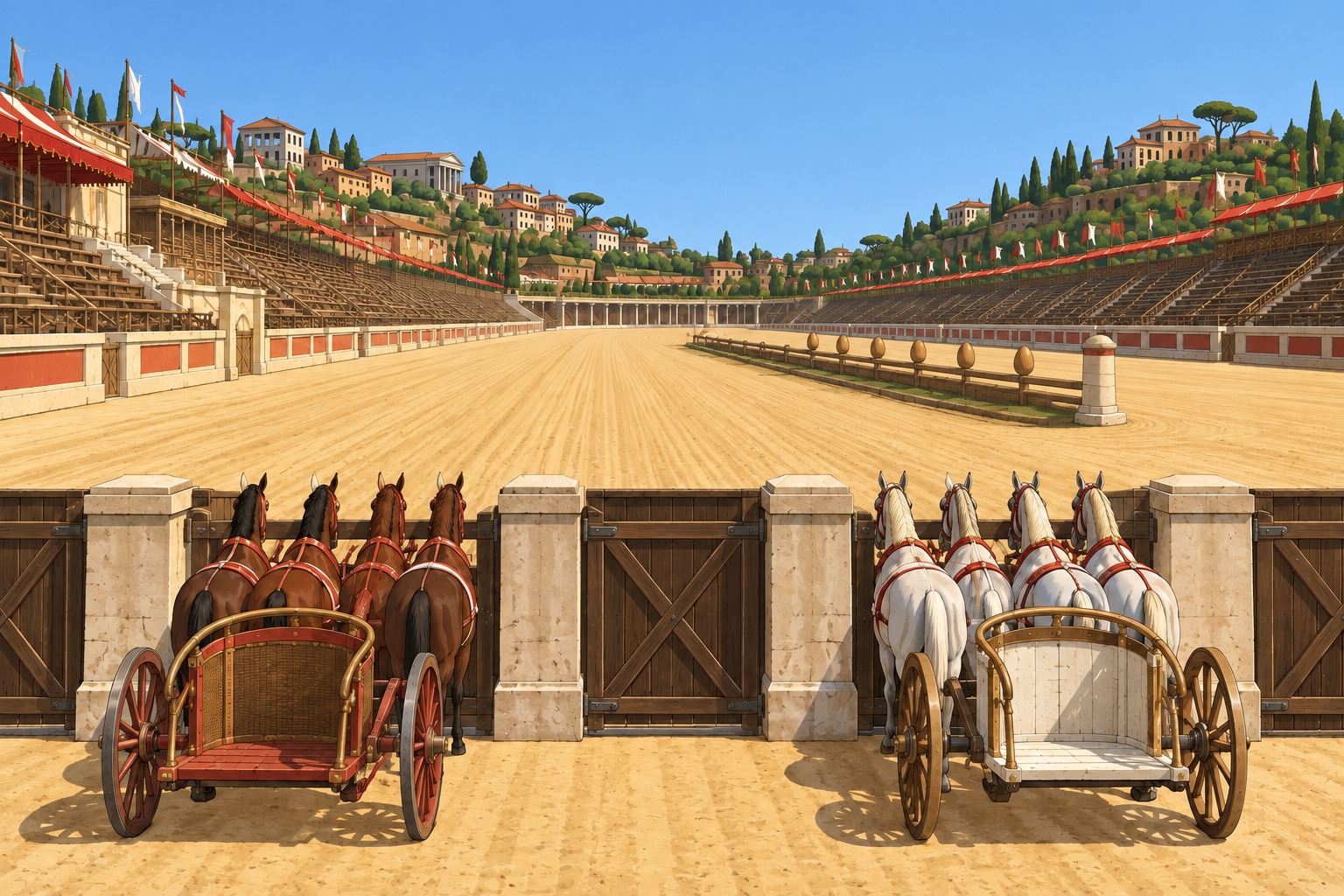
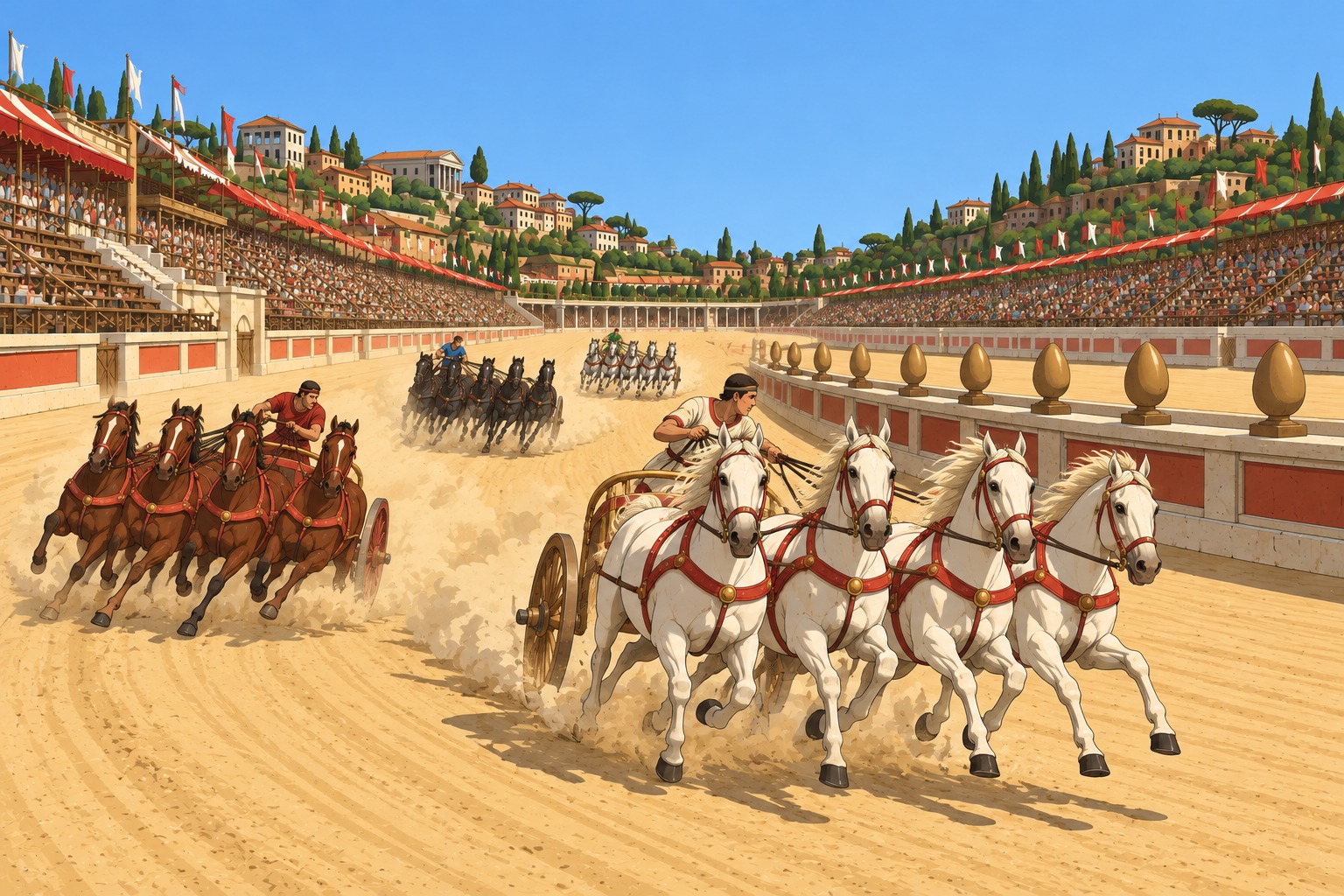
| Circus Maximus | A long sand track with timber seating and a low central barrier | Chariot races at the ludi, opened by a procession of the gods (*pompa circensis*) | Four-horse and two-horse teams race from a row of starting stalls (The Chariot Race) |
##### IN 50 BC
- **The crowd.** For Cicero, the cheers and hisses tell him what the people think more clearly than anything else. Men and women sit together at gladiator shows. At the theater, senators have reserved seats, and the equestrians have had them since 67 BC.
- **The aedile of the year.** The curule aedile, Marcus Caelius Rufus, brings up panthers for his games in almost every letter to Cicero in Cilicia. In April 50 BC Cicero writes back that he's sent hunters, but panthers are scarce. He jokes that the beasts resent being the only creatures in Cilicia anyone traps.
- **The scale.** Caesar's father has been dead about twenty years when, as aedile in 65 BC, Caesar puts 320 pairs in silvered armor on the sand. He intended more. His rivals feared having so many armed men in town. In 50 BC he still has a school at Capua.
### The Editor
**Adds.** The editor puts on the show, as heir at a munus or aedile at the ludi. He pays for stands, fighters, funeral meat and purses. At the end of a bout, he makes the decision.
##### TERMS: GIVING GAMES
I **Hiring.** If you give games, hire fighters from a lanista at the listed rates and pay winners their purses. Give a hired man the sword and you pay his purchase price instead of hire (The Editor's Decision).
II **Standing.** Adjust your Dignitas according to how you answer the crowd (The Editor's Decision). Use Era Rules, Patronage and Rank, for Dignitas.
III **The lex Tullia (63 BC).** Give a gladiator show within two years of an election and you cannot stand in it. Stand anyway and risk prosecution for electoral bribery (Era Rules, Patronage and Rank, Elections and Bribery; Law and Courts).
| Arena contract | Price | In sesterces | Basis |
|:--|:--|--:|:--|
| Hire of a team fighter, one show | 2 purses (range 1 to 2) | 1,600 (800 to 1,600) | Reconstructed: the Senate's caps of AD 177 |
| Hire of a single-combat fighter, one show | 4 purses (range 3 to 15) | 3,200 (2,400 to 12,000) | Reconstructed: the caps of AD 177 |
| A hired man given the sword | The lanista's price, in place of his hire | As below | Reconstructed: Gaius, about AD 161 |
| Purchase of a seasoned gladiator (the lanista's price) | 10 purses (range 3 to 15) | 8,000 (2,400 to 12,000) | Reconstructed: the caps of AD 177 |
| Purchase of a raw recruit | 1 to about 3 purses (3 purses is 2,400), as an unskilled adult slave | 800 to 2,500 | Partly recorded: slave prices of about 76 and 30 BC |
| A condemned man sold to a school | Under 1 purse | About 500 | Reconstructed: the caps of AD 177 |
| A free volunteer's signing sum | 2 purses | 1,600 | Reconstructed: the legal price of AD 177 |
| A famous veteran recalled for a great show | 125 purses | 100,000 | Recorded: Tiberius, late first century BC (Suetonius, Tiberius 7.1) |
| The winner's purse | 1 purse; 2 purses and a palm at Crowd Favor 5 or 6 | 800; 1,600 | Unattested: no figure survives |
Count 800 sesterces (200 denarii) per purse. Republican purchase and hire prices do not survive. **Reconstructed** figures use the Senate's caps of AD 177 and Gaius, scaled to the coin of 50 BC. **Partly recorded** figures are built around recorded prices. **Recorded** figures come from a period source. **Unattested** figures have no ancient source. If there is a range, the lanista sets the price and the first figure is usual for a proven man.
##### EXAMPLE: A MUNUS FOR A DEAD GRANDFATHER
Fabia's father owes his father a munus nine years after his death. The senator means to run again in three years. Fabia keeps his letters and checks the lex Tullia. Give the show this year and he can stand. Give it next year and he is barred.
From the Capua lanista he hires 8 team fighters (four pairs at 2 purses a man, 16 purses) and 2 single fighters (one pair at 4 a man, 8 purses). That's 24 purses or 19,200 sesterces, plus stands and winners' purses. If he gives one of the single fighters the sword, pay 10 purses for him instead of 4.
## Gladiators and Their Kit
**Scopes** the sourcebook lines to arena use without changes. **Adds** the matched kit. Use the entries in *The Fantasy Armory* (Shortsword, Buckler, Kite Shield) and *The Armourer* (Open Helm, Mail Shirt) as printed. Each book owns its stat lines.
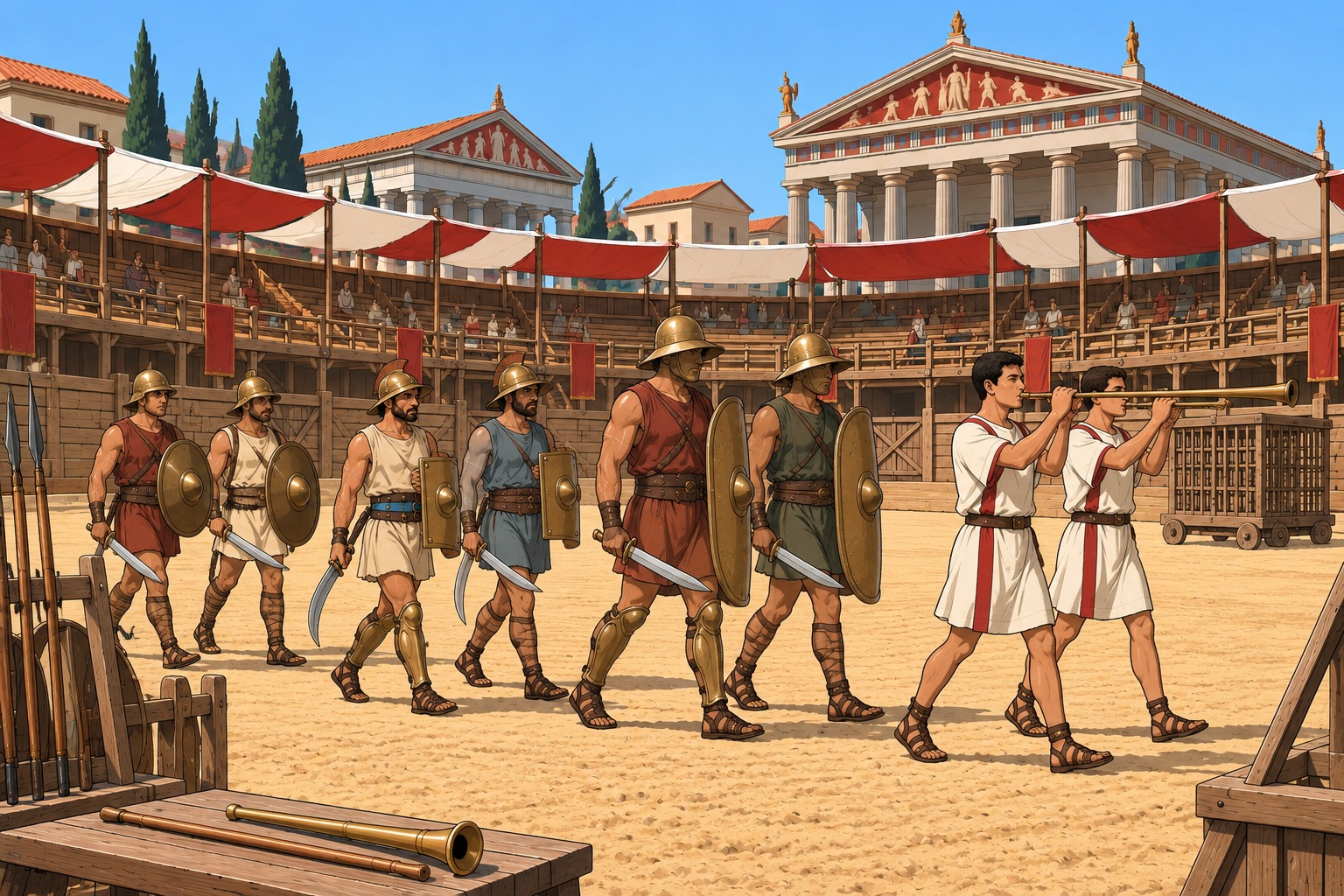
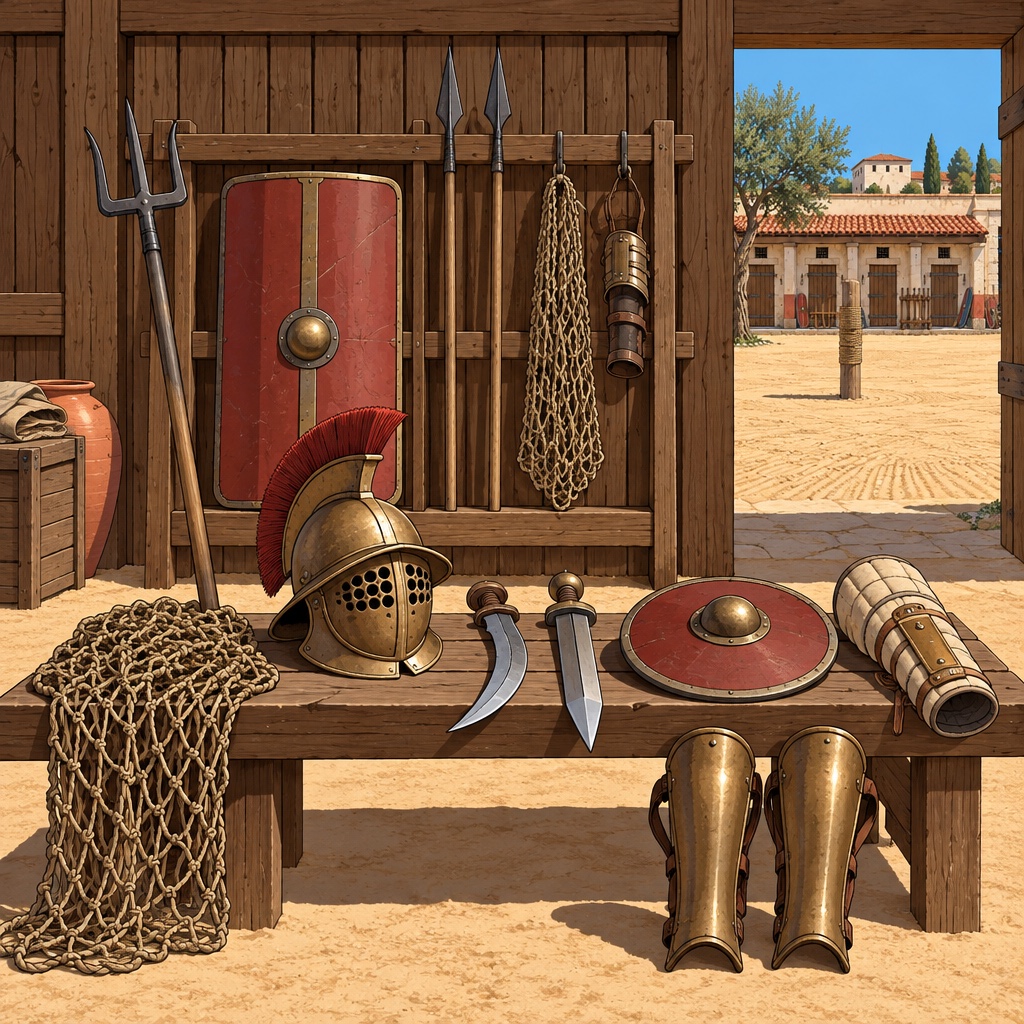
The **Samnite**, the principal Republican fighter, carries what Livy describes: a shield wide at the top, a chest guard, a greave on the left leg and a plumed helmet. The heavy **Gaul** wears the same kit as the **murmillo**, possibly his later name. The earliest mention of the murmillo and **thraex** is in Cicero's Philippics of 44 to 43 BC. Use both types across the play range.
##### TERMS: KITS
| Type | Weapon | Shield | Armor | Resistance added |
|:--|:--|:--|:--|:-:|
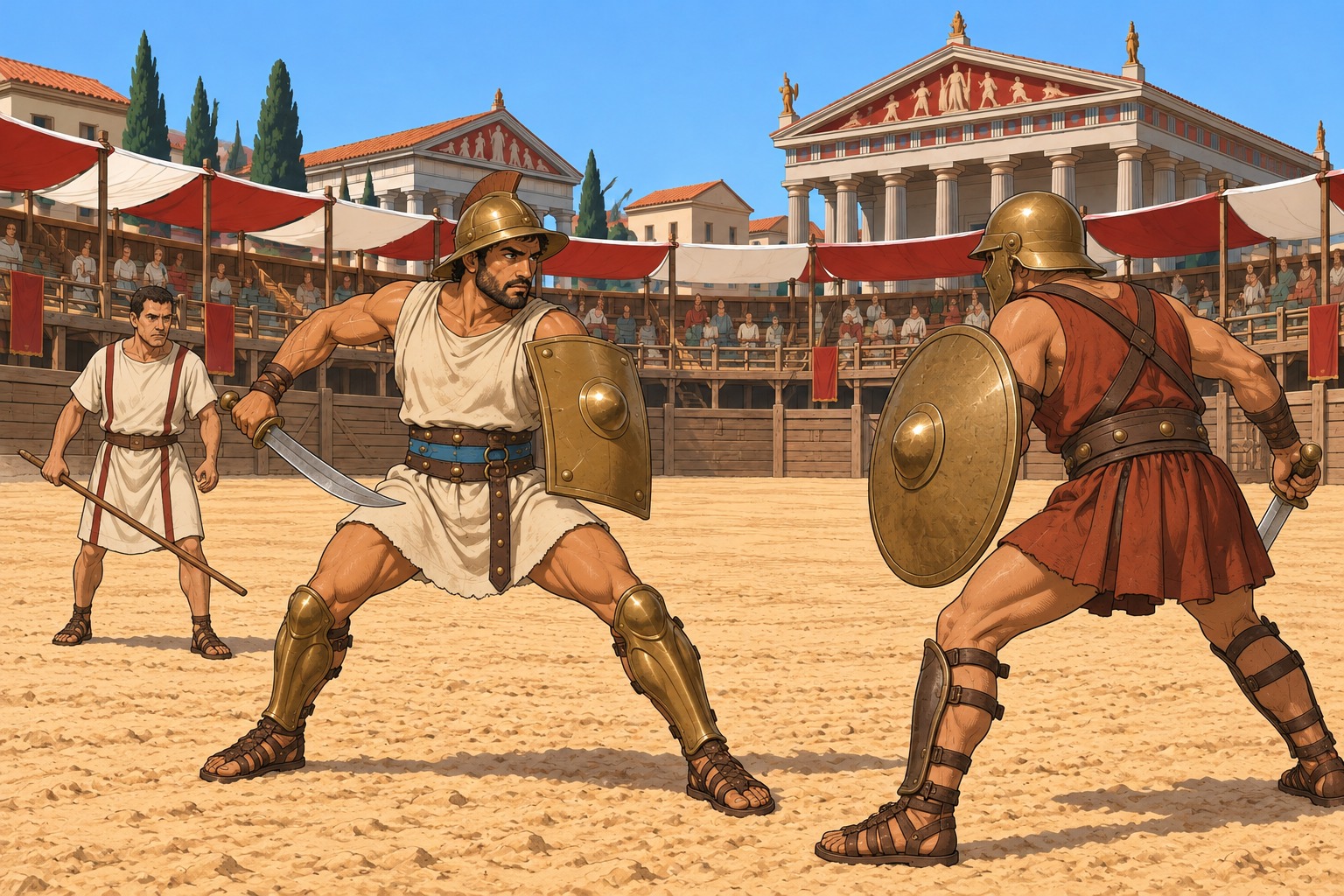
| Thraex | Sica, as the Shortsword (Might +2, Crit 3, Accurate 1) | Parma, as the Buckler (Defensive 1, Disarming 1) | Helmet (Open Helm, Helm 1) and two greaves | +1 (matched kit) |
| Murmillo or Gaul | Gladius, as the Shortsword | Scutum, as the Kite Shield (Defensive 1, Deflection 2, Cumbersome 3), not the Pavise that *The Fantasy Armory* also calls scutum | Helmet (Open Helm, Helm 1) and one greave | +1 (matched kit) |
| Samnite | Gladius, as the Shortsword | Scutum, as the Kite Shield | Helmet (Open Helm, Helm 1), greave and mail, as the Mail Shirt | +2 (Mail Shirt) |
I **The matched arena kit.** Wear the lanista's matched helmet and greaves together for Resistance +1. Use the printed Open Helm, including Helm 1, and no separate line for greaves (*The Armourer*). Apply the +1 as an Era rule. If you wear a Mail Shirt, use its Resistance +2 instead.
II **The Samnite's mail.** Keep the Mail Shirt's qualities. Add its Deflecting 1 (Cutting) Bane Die only against Cutting. A sica or gladius can cut or thrust. Declare which before rolling (*The Armourer*, Choosing the Type). A thrust bypasses the Deflecting die.
III **Prices.** The ludus owns the kit. Use the sourcebook prices in Gear and Prices if you buy your own.
##### EXAMPLE: BITHYS'S FIGHTING LINE
Bithys fights as a thraex. The examples in this chapter show him after one advance, at Melee 3 (the pregenerated sheet in Pregenerated Characters starts him at Melee 2). With Might 3 and Melee 3 he attacks with 3 Mastery Dice , plus 1 Boon Die for the sica's Accurate 1. A hit deals 5 damage (Might 3, +2) and each extra Success adds 1. His Resistance is 3 (half his Might, rounded up, is 2, and the matched arena kit adds 1), his helmet's Helm 1 takes 10 from every Critical Injury roll against him, and his Wound Points are 13.
Against a murmillo he rolls 2 Trial Dice for an Average melee attack and 1 Bane Die for the scutum's Defensive 1. Against a Samnite the same hit meets Resistance 4, so 6 damage becomes 2 Wounds instead of 3.
## The Bout
**Adds** yielding and Crowd Favor. **Modifies** Core Rules, Structured Play, to end a bout at a yield or second Critical Injury. **Modifies** Core Rules, Structured Play, Critical Injuries, to give the injured fighter a choice after his first Critical Injury. Keep the Default Critical Injury Table.
##### TERMS: THE BOUT
I **The pair.** Use Core structured play and start both fighters Engaged. Track **Crowd Favor** separately for each, from 0 to 6. Start at **2** or, if you are **Known** here with at least five wins in this city, **3**.
II **The yield.** At the start of your turn, you can lower your shield and signal the editor to concede. If you have a Critical Injury or have taken at least half your Wound Points in Wounds, yield honorably and keep your Crowd Favor. Otherwise use the unhurt yield penalty (Crowd Favor).
III **The first Critical Injury.** If you still have a turn this round, take it. At round end, apply Crowd Favor lines, then choose: **yield** honorably now rather than at turn start (II), or **fight on** and gain 1 Crowd Favor at once.
IV **The end.** Lose immediately when you take a second Critical Injury this bout or are incapacitated by Wounds or Strain. On a second injury, the editor's man parts the pair. Apply the round's Crowd Favor lines for both fighters before checking the loser's Crowd Favor (The Editor's Decision).
V **Old injuries.** Add +10 to Critical Injury rolls for an injury carried in from another bout (Core Rules, Structured Play, Critical Injuries). Count only new injuries toward this bout's first and second.
## Crowd Favor
**Adds** one track per fighter. **Modifies** Core Rules, Structured Play, Combat Boon Spends. When you hit, you can spend 2 Boons to **flourish** for the crowd.
##### TERMS: CROWD FAVOR
I At round end or when the bout ends early, apply all matching lines to both fighters. Keep Crowd Favor between 0 and 6.
| The crowd sees | Crowd Favor |
|:--|:-:|
| A Breakthrough on his attack | +2, in place of the flourish and Critical Injury line |
| A flourish, or a Critical Injury he inflicts | +1 |
| He fights on after his first Critical Injury | +1 |
| A Calamity on his attack (Era Rules, Calamity results) | -1 |
| Every second round in a row in which he neither hits nor is hit (the second, the fourth, and so on) | -1 |
| He yields unhurt (no Critical Injury, under half his Wound Points), unless his Crowd Favor is 5 or 6 | -1 |
II Talents that raise Crowd Favor or help a beaten fighter are in Skills and Talents.
##### EXAMPLE: BITHYS AT A FUNERAL MUNUS IN THE FORUM, 50 BC
The son of a dead consular gives a munus in the Forum, timber stands rented on both sides. Bithys has eleven bouts behind him and five victories in Rome, so he is Known: Crowd Favor 3. His opponent is a murmillo of another school (Might 3, Melee 2: 2 Mastery Dice and 1 Ability Die , Resistance 3, Wound Points 13), at Crowd Favor 2. The bookmakers' line is Bithys at 4 to 3 on (Bets).
**Round 1.** Bithys hits with 2 net Successes and 2 net Boons : 6 damage less Resistance 3 is 3 Wounds. He spends the 2 Boons on a flourish: Crowd Favor 4. The murmillo's answering attack fails.
**Round 2.** Bithys's attack fails, and the murmillo hits with 1 net Success and 3 net Boons, enough for the gladius's Crit 3: 5 damage less 3 is 2 Wounds, and a Critical Injury. Bithys rolls 54, less 10 for his helmet's Helm 1, for 44 on the Core table: Cracked Rib. He could yield honorably at Crowd Favor 4 and leave his life to a divided crowd; he fights on instead: Crowd Favor 5. The murmillo gains 1 for the Critical Injury: Crowd Favor 3.
**Round 3.** Bithys rolls a Breakthrough with 2 net Successes: 3 Wounds, and he spends the Breakthrough on a Critical Injury. The murmillo rolls 82, less 10 for his Helm 1, for 72: Damaged Leg. The Breakthrough gives Bithys +2: Crowd Favor 6. The murmillo fights on after his first Critical Injury: Crowd Favor 4.
**Round 4.** Both men miss. On the first round where neither lands or takes a hit, Crowd Favor stays put. Another such round would cost each man 1.
**Round 5.** Bithys hits with 1 net Success and 3 net Boons: 2 Wounds and a second Critical Injury. The murmillo rolls 47, +10 for the Critical Injury he already has and less 10 for his Helm 1, for 47: Wrenched Limb. The editor's man parts them: the murmillo has lost at Crowd Favor 4. The crowd is divided, and the editor grants missio, as most editors do rather than pay the lanista's price for a dead man. Bithys wins at Crowd Favor 6: a palm and two purses for his peculium, and the editor gains 1 Dignitas. With six victories in Rome and Crowd Favor 6, Bithys could be offered the rudis; this editor does not offer it.
**The odds.** Over 10,000 simulated bouts of these two men, in which each fighter yields after his first Critical Injury when his Crowd Favor is 4 or more and fights on below that, and a fighter past half his Wound Points yields at the start of his turn when one more hit would drop him, Bithys wins 52 in 100; over 100,000 bouts in which he always fights on, as he does here, he wins 67. The Bets line of 57 in 100 is for two men who start at the same Crowd Favor: Known, Bithys reaches 4 sooner and yields more often. The loser walks out under missio 36 times in 100 and goes to the editor's choice 58 times; the crowd calls for the sword 5.5 times in 100 and the editor gives it 4.1.
## The Editor's Decision
**Adds.** When a bout ends, the loser's Crowd Favor decides what the crowd calls for and what the editor does.
##### TERMS: THE EDITOR'S DECISION
I Read the **loser's** Crowd Favor.
| Loser's Crowd Favor | The crowd | The editor |
|:-:|:--|:--|
| 5 or 6 | Shouts for his release | Grants **missio**: the loser walks out alive |
| 3 or 4 | Divided | Chooses. Missio is the default, since a dead man costs the editor the lanista's price |
| 0 to 2 | Calls for the sword | Gives the sword, unless the appeal below succeeds |
II **The appeal.** At Crowd Favor 0 to 2, the loser or his lanista makes one **Hard Charm** check per bout. On success, the editor grants missio. On failure, the editor gives the sword and the loser dies.
III **The editor's standing.** An editor who grants missio while the crowd calls for the sword, or refuses it while the crowd shouts for release, loses 1 Dignitas. An editor moved by a successful appeal loses nothing. An editor whose games end with a winner at Crowd Favor 6 gains 1 Dignitas: this is the gain for giving games in Era Rules, Patronage and Rank (Dignitas V), not a second one, and it keeps that rule's limit of once a session. A player character who gives the games makes the editor's choice in the 3 or 4 band; for any other editor the GM makes it.
##### EXAMPLE: BITHYS AT POMPEII
Hired to a show at Pompeii, where he has no victories, Bithys starts at Crowd Favor 2. A Samnite champion lands a Critical Injury in the first round. Bithys's own attack misses, and at the end of the round he yields, honorably, at Crowd Favor 2. The crowd calls for the sword. Bithys makes his appeal: Charisma 2 and Charm 1 give 1 Mastery Die and 1 Ability Die against 3 Trial Dice . That pool succeeds 28 times in 100. He rolls 1 net Success , and the editor grants missio.
If Bithys had fought on, he would have risked a second Critical Injury. At Crowd Favor 3, a divided crowd would have left the decision to the editor.
## Injuries and Recovery
**Scopes** Core Rules, Recovery, to the arena. Use Recovering Wounds and Recovering Critical Injuries unchanged. The ludus supplies care. For illness, see Era Rules, Medicine and Illness.
##### TERMS: AFTER THE BOUT
I **Care.** The medicus treats each fighter the school sends out, whether he wins or loses. At the ludus, roll Medicine with proper supplies, time and a safe place. Use the injury's severity for difficulty (Core Rules, Recovery, Recovering Critical Injuries).
II **Rest.** Give a gladiator in the ludus a full night's rest each night. Recover Wounds by the Core Rules.
III **Fighting hurt.** If the lanista sends you out with an untreated Critical Injury, add +10 to every Critical Injury roll against you (Core Rules, Structured Play, Critical Injuries).
##### EXAMPLE: THE CRACKED RIB
After the Forum munus Bithys carries 2 Wounds and a Cracked Rib, a Moderate injury. A night's rest removes the 2 Wounds (he recovers Wounds equal to his Might, 3). Back at Capua, Nerva's medicus (Intellect 3, Medicine 2) treats the rib with an Average Medicine check: 2 Mastery Dice and 1 Ability Die against 2 Trial Dice , which succeeds 64 times in 100. He succeeds, and the Cracked Rib is removed before Bithys's next hire.
## The Ludus and the Lanista
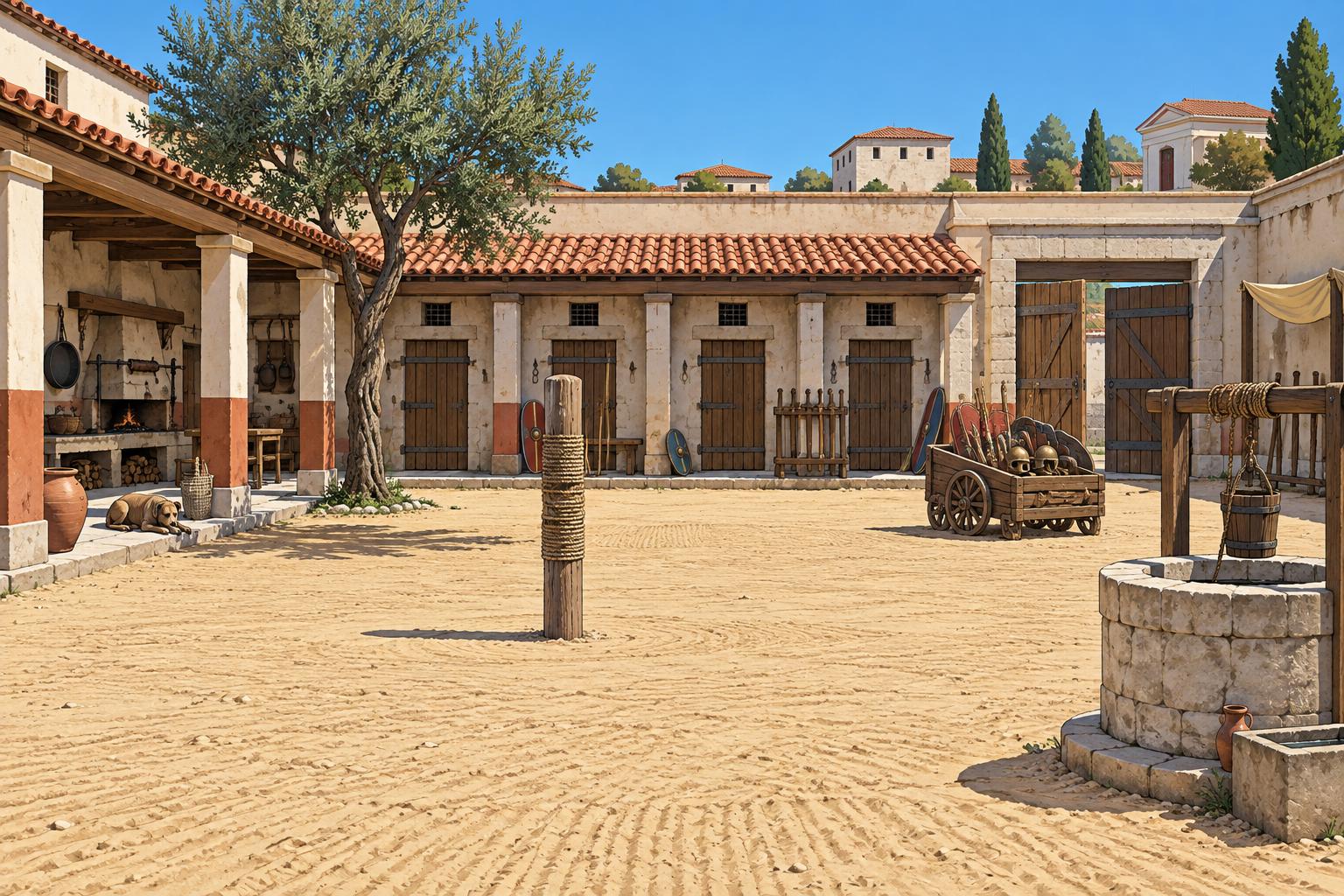
**Scopes** Era Rules, Patronage and Rank and Slavery, to the ludus. Gladiator and lanista count as *infames* and cannot sit on a town council.
##### TERMS: THE LUDUS
I **The lanista.** If enslaved, take your lanista as owner and patron (Era Rules, Patronage and Rank). He provides food, lodging, training and care. He can call a Favor for a bout, a hire in another town or a day training recruits.
II **Purses.** A gladiator's purses go into his peculium (Era Rules, Slavery).
III **The lanista's price.** Set a seasoned gladiator's price at 3 to 15 purses (The Editor), usually 10 for a proven man. Pay the same to buy him, kill him as editor or free him. If enslaved, you can offer the price from your peculium for manumission (Era Rules, Slavery).
IV **The free volunteer.** As a free man who signs on (*auctoratus*), take the signing payment. Fight the number of bouts in your contract. Until then, follow the ludus's rules like any other gladiator.
V **The rudis.** An editor can give the wooden sword, the **rudis**, to a winner at Crowd Favor 6 with at least five wins. After that, fight only by choice. If enslaved, you still belong to the lanista until manumission. Horace treats the sword as a sign of freedom. The Republic's record leaves its legal effect on slavery unclear.
##### WHAT THE RECORD SHOWS
The editor's prices draw on later evidence except where marked. The Republic leaves us no costs for purchase, hire or replacement. Suetonius (Tiberius 7.1) does record one near the map year. Late in the first century BC, Tiberius offered retired gladiators 100,000 sesterces each to return for a memorial show. Treat a prince's fee as the ceiling.
##### EXAMPLE: BITHYS'S PRICE
Bithys belongs to Nerva, the lanista in Capua, who bought him from Fabia's house. Later in play, with 2 purses saved, he fights the Forum munus; the palm and two purses bring him to 4. Nerva's price for him is 10 purses (8,000 sesterces), and the vicesima adds 400 (Gear and Prices, The Price of Freedom): 8,400 sesterces in all. At one or two purses a victory he needs four to seven more wins before he can offer it. When Nerva calls in a Favor and hires him to the show at Pompeii, Bithys has no choice but to fight there.
## Bets
**Adds.** Spectators bet on bouts and races among themselves.
##### TERMS: BETS
I **The line.** Use the odds below. The GM can shorten them for a popular fighter. The table starts both men at equal Crowd Favor. Each yields after a first Critical Injury at 4 or more and fights on at 3 or less. Past half Wound Points, each yields if another hit would drop him.
II **Reading the odds.** At "4 to 3 against," stake 3 to win 4. At "4 to 3 on," stake 4 on the favorite to win 3. A winner gets his stake back as well.
| Match | Better man wins | Odds against the other man |
|:--|:-:|:-:|
| Even | 50 in 100 | Evens |
| One Melee rank better | 57 in 100 | 4 to 3 |
| Two Melee ranks better | 65 to 73 in 100 | 2 to 1 |
| Heavier armor (a Samnite against a thraex), equal skill | 60 in 100 | 3 to 2 |
##### EXAMPLE: EROS BACKS THE THRACIAN
Eros backs Bithys at 4 to 3 on in the Forum. Bithys has one more Melee rank than the murmillo. Eros puts up 400 sesterces to win 300. When the pair separate, he collects 700 sesterces, his stake plus the win. If the murmillo had won, the bookmaker would have kept the 400.
## The Chariot Race
**Adds.** **Modifies** the Core Rules, Types of Checks, Extended Checks (chases): a race is three checks, not a chase. Every check in the race is an Operate check with the chariot's Handling (Core Rules, Vehicles, Operating a Vehicle). **Scopes** *The Stable*'s Chariot, light, to the race: a racing chariot, biga or quadriga, uses its line whatever the team, Speed is not used, and the wreck (III) **Replaces** the Core Rules, Vehicles, Vehicle Damage, for the race. The chariot has Handling +1: it adds 1 Boon Die to every leg check and every save, and the odds below include it. Horses and harness are in *The Stable*. Drivers use the Gladiator and Charioteer Role (Character Creation and Roles).
##### TERMS: THE CHARIOT RACE
I **The legs.** In the Circus Maximus, run the start and first turn, middle laps and last lap as three legs. Each driver rolls **Average Agility + Operate** per leg. Add net Successes as distance, or nothing if there are none. Greatest distance wins. If drivers tie for first, each rolls a plain six-sided die and the highest wins.
II **The inside line.** Before a leg, you may push for the inside at the turning post. Upgrade one Trial Die to a Crisis Die and add 2 Boon Dice .
III **The wreck.** Roll an **Average Agility + Operate** save on a Calamity from a pushed leg's Crisis Die or a Peril Point, or on at least 3 net Banes . Fail and wreck. Take one hit for damage 6 less Resistance, gain no distance this leg and drop out.
IV **The factions.** Tertullian (about AD 200) names the Whites and Reds for this period. Start the four-horse *quadrigae* and two-horse *bigae* from a row of stalls. The Imperial circus has twelve.
| Driver (Agility, Operate) | Wins, careful | Wins, pushing every leg | Wrecks, careful | Wrecks, pushing every leg | Fair odds against |
|:--|:-:|:-:|:-:|:-:|:-:|
| Favorite (3, 3) | 46 in 100 | 44 in 100 | 1 in 100 | 7 in 100 | 6 to 5 |
| Contender (3, 2) | 35 in 100 | 34 in 100 | 1 in 100 | 8 in 100 | 2 to 1 |
| Outsider (2, 2) | 11 in 100 | 13 in 100 | 2 in 100 | 11 in 100 | 8 to 1 |
| Novice (2, 1) | 8 in 100 | 10 in 100 | 3 in 100 | 12 in 100 | 11 to 1 |
V **One driver pushing.** If you push each leg and everyone else drives carefully, win 50 times in 100 and wreck 8 times in 100.
##### EXAMPLE: EROS AND THE RED DRIVER
At the Ludi Romani Eros backs the Reds' contender (Agility 3, Operate 2) at 2 to 1 against, staking 200 sesterces, because he has heard the driver means to push at every turn. The field is a favorite (3, 3), the contender, an outsider (2, 2) and a novice (2, 1); the others drive carefully.
**Leg 1.** The contender pushes: 2 Mastery Dice , 1 Ability Die and 3 Boon Dice (2 for the push, 1 for the chariot's Handling) against 1 Trial Die and 1 Crisis Die . He takes 2 net Successes; the favorite takes 1.
**Leg 2.** He pushes again and rolls 0 net Successes and 3 net Banes. His save (Average Agility + Operate, no push, 1 Boon Die for Handling) succeeds with 1 net Success, so he stays in the race, but the leg adds no distance. The favorite takes 2 more: 3 to the contender's 2.
**Leg 3.** He pushes a third time for 2 net Successes and finishes on 4; the favorite takes 0 on the last lap and finishes on 3, and the outsider and the novice finish behind him. The Reds win, and Eros collects 600 sesterces: his 200 and the 400 he won.
## Failure States
- **A lost bout.** At Crowd Favor 0 to 2, the loser gets one Hard appeal. On failure, the editor gives the sword.
- **Injuries carried out.** Keep Wounds and Critical Injuries until rest and the medicus remove them (Injuries and Recovery).
- **An unhurt yield.** It costs Crowd Favor and moves the loser toward the sword.
- **The editor's standing.** Lose 1 Dignitas for defying the crowd unless a successful appeal moved you. Pay the lanista's price if you give a hired fighter the sword.
- **A wreck.** The driver takes a hit and is out of the race.
- **A lost bet.** The stake goes to the man who took it.
##### HOW OFTEN THE SWORD FALLS
Over 10,000 simulated bouts for each pairing, under the rules in this chapter, with each fighter yielding after his first Critical Injury at Crowd Favor 4 or more and fighting on below that, and a fighter past half his Wound Points yielding at the start of his turn when one more hit would drop him: between two equal ordinary fighters (Melee 2), the crowd calls for the sword in 12 bouts in 100 and the editor gives it in 8.6. Between two novices (Melee 1) the figures are 22.6 and 16.4. Between Bithys and a Known Samnite champion they are 0.1 and 0.1. A Critical Injury happens in 70 to 93 bouts in 100, depending on the pairing.
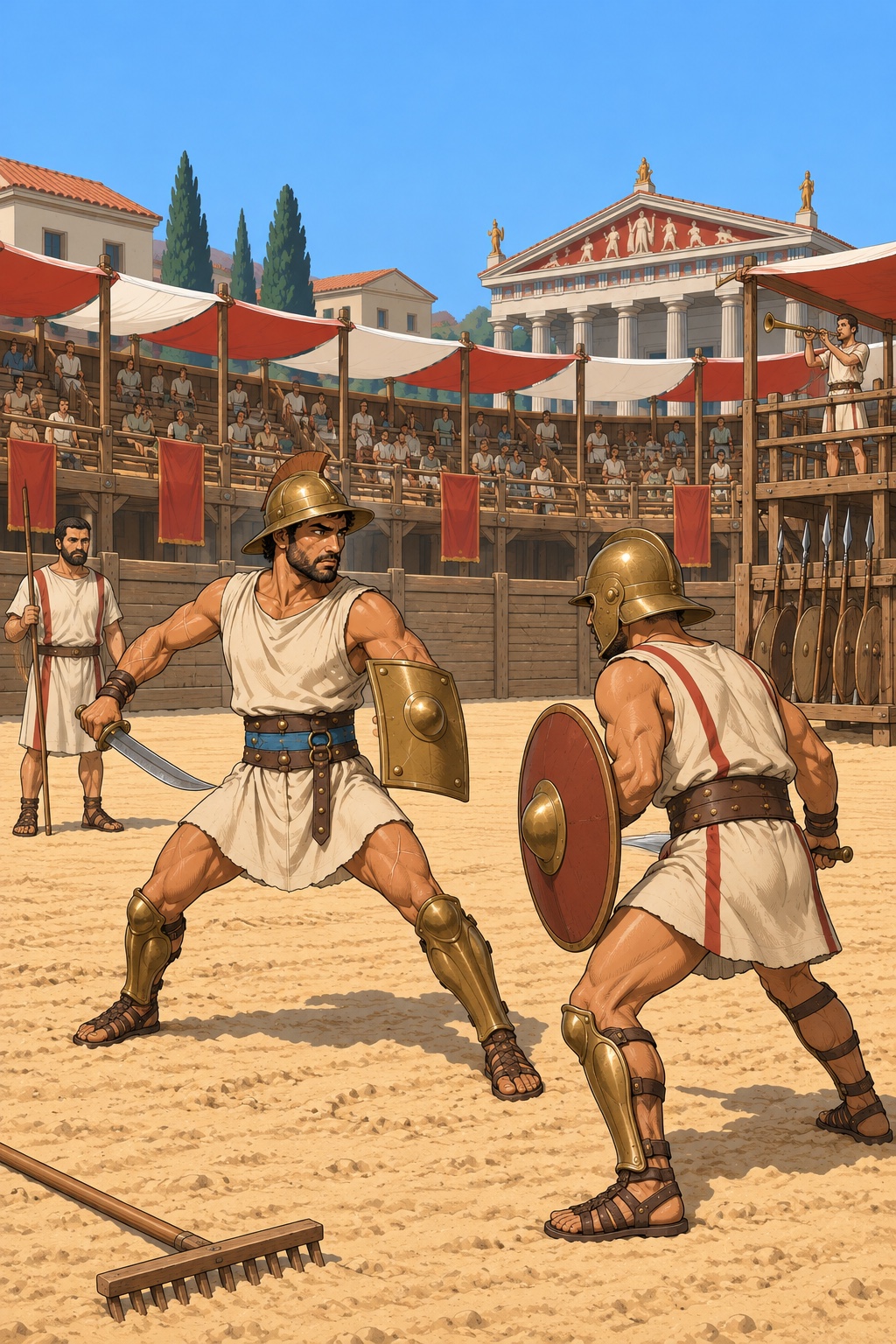
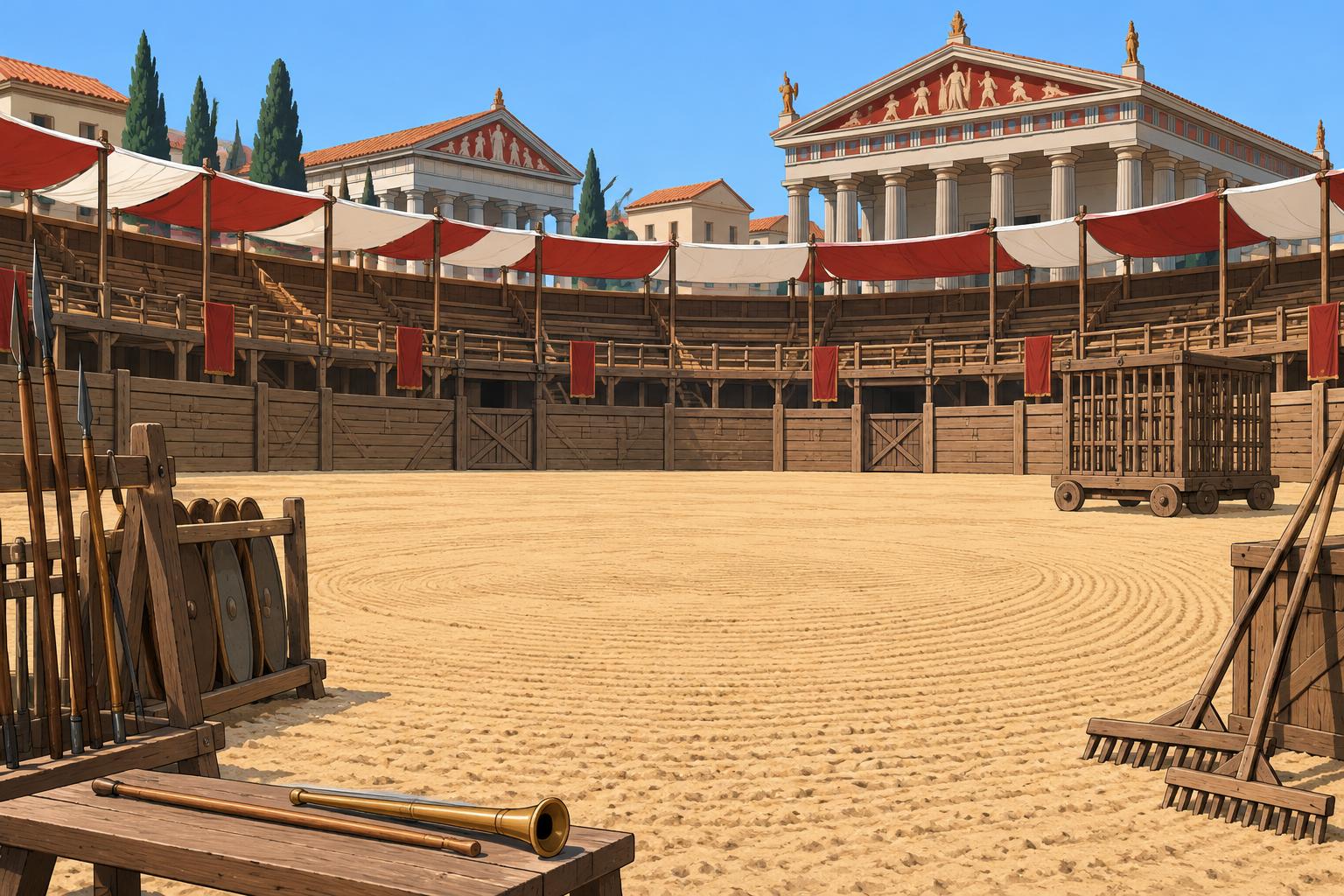
Bithys fights a bout on the sand of a wooden arena
 ### The Editor
**Adds.** The editor puts on the show, as heir at a munus or aedile at the ludi. He pays for stands, fighters, funeral meat and purses. At the end of a bout, he makes the decision.