# Weapon Qualities
*The Ranged Armory, Forty Launchers and a Quiver System for Exodus NDS. Source: https://exodusnds.com/sourcebooks/ranged-armory/weapon-qualities*
Damage and range tell you how hard a weapon hits and how far. Qualities tell you what it is *for*.
This book uses twenty-eight qualities. **Fourteen come from the Exodus NDS core rules or published Universe equipment chapters** and work exactly as written; they are listed for reference only. **Fourteen are defined in this book** and are given in full below.
## How Qualities Work
**Passive** qualities are always on. They require no activation and no dice are spent. Silent, Arcing, and Point Blank are passive.
**Active** qualities must be triggered, almost always by spending Boon from a successful attack. Bleed and Sunder are active. An active quality that is never triggered does nothing at all.
**Ranked** qualities have a number after the name, and the number sets the magnitude. Where the same quality appears more than once, ranks add together unless the entry says otherwise.
**Drawback** qualities are marked as such. They make the weapon worse, they are not optional, and they are a substantial part of why some very effective weapons cost very little. Chapter 8 is almost entirely drawbacks.
### Qualities never replace the universal Boon spends
Every combat option in the core rules remains available with every weapon in this book. No quality here duplicates one of those, and no quality here duplicates one another. Where two qualities touch the same ground they *change the terms*: **Prepare** and **Slow-Firing** both delay a second shot, and they charge different currencies for it. See Chapter 2.
## Core and Universe Qualities Used in This Book
These appear in the Exodus NDS core rules or in published Universe equipment chapters, and are used here without change. The summaries are reminders, not rules text.
| Quality | Ranked | In brief |
|:--|:--:|:--|
| **Accurate** | Yes | Add Boon Dice to attacks |
| **Auto-Fire** | No | Add a Trial Die to the attack; on a hit, spend 2 Boons per extra hit at full weapon damage, on the original target or one nearby |
| **Blast** | Yes | Spend Boons to damage everyone Engaged with the target |
| **Burn** | Yes | Spend Boons to set the target alight for a number of rounds |
| **Disorient** | Yes | The target suffers Bane Dice on its checks for a time |
| **Ensnare** | Yes | Immobilises the target |
| **Guided** | Yes | Removes Trial Dice from the attack pool |
| **Inaccurate** | Yes | Adds Bane Dice to attacks |
| **Knockdown** | No | Knocks the target Prone |
| **Limited Ammo** | Yes | A set number of shots before reloading or resupply |
| **Pierce** | Yes | Ignores that much Resistance |
| **Poison** | Yes | Ongoing Wounds ignoring Resistance until a Fortitude check |
| **Slow-Firing** | Yes | Cannot fire again for X rounds without spending an Action |
| **Vicious** | Yes | Increases the severity of Critical Injuries |
> **Auto-Fire is what a heavy shot punching through a rank looks like.** It is already in the core rules, so this book does not invent a second quality that does the same thing under another name. Where an earlier printing of this book used a locally-scoped `Burst X` quality, that name has been retired: the core rules now define this effect natively as unranked `Auto-Fire`, and every entry below has been updated to match.
## Qualities Defined in This Book
The first seven appear in *The Fantasy Armory* and are reprinted here in full, so that this book stands alone. They are identical in play. The remaining seven are new.
### Cumbersome X
Passive
Ranked
Drawback
The wielder needs **Might X** to use this weapon properly. A wielder whose Might is lower adds Bane Dice equal to the shortfall to every check made with it.
On a bow this is draw weight. A war bow built for a man who has shot since childhood does not become a lighter bow in weaker hands; it becomes a worse one.
### Prepare X
Passive
Ranked
Drawback
The weapon must be readied before it can be used. The wielder must spend X **Maneuvers** preparing it, after which it may be attacked with normally. It must be prepared again after being moved, stowed, or fired.
### Concealable X
Passive
Ranked
Add X Bane Dice to checks made to find this weapon when it is deliberately hidden on the wielder's person.
### Fragile X
Passive
Ranked
Drawback
If an attack made with this weapon generates a **Calamity**, the weapon is damaged: add 1 Bane Die to every check made with it until it is repaired with an Average (⬥⬥) crafting check.
At **Fragile 2 or higher**, the weapon breaks outright instead and cannot be repaired.
On a composite bow this is glue and damp. A laminated bow left strung in the rain is not a weapon the next morning.
### Bleed X
Active
Ranked
After an attack with this weapon inflicts **at least 1 wound**, spend 2 Boon. At the start of each of the target's turns, it suffers X wounds, **ignoring Resistance**, until the bleeding is treated.
A character may use an action to make an **Average (⬥⬥) Medicine** check to end all Bleed resulting from a single injury.
**Bleed does not stack with itself.** A second activation refreshes the effect at the higher of the two ratings rather than adding to it.
> **Bleed and Burn are separate qualities.** Burn deals the weapon's full base damage for a set number of rounds, and Resistance applies. Bleed deals a small fixed amount indefinitely, and Resistance does not.
### Stun Damage
Passive
All damage dealt by this weapon is applied to **Strain** rather than Wounds. A character whose accumulated Strain meets or exceeds their Strain Points from a Stun Damage weapon is incapacitated, unconscious or overwhelmed, rather than injured.
Resistance applies to Stun Damage as normal.
In this book Stun Damage arrives on the ammunition rather than the launcher. A blunt head turns any bow into a weapon for taking something alive.
### Sunder
Active
Spend 1 Boon to damage one item the target is carrying: a weapon, a shield, or a piece of armour. Spend 2 Boons instead to render that item unusable until it is repaired.
An item the GM judges to be of exceptional or reinforced construction cannot be affected.
Against a structure, a rope, or a sail rather than a person, the GM may allow Sunder to apply to the object directly. That is how a swallowtail head cuts rigging and how a siege engine takes a gate off its hinges.
### Arcing
Passive
Attacks with this weapon **ignore the Bane Dice imposed by Light cover**, because the shot drops onto the target rather than travelling into it. Heavy cover and total cover apply normally.
**This weapon cannot attack at Engaged range at all.** An arcing shot needs somewhere to go up.
Arcing is what a bow does that a crossbow does badly, and what an indirect-fire engine does that a ballista cannot do at all. A crew that cannot see the courtyard can still fill it.
### Point Blank X
Passive
Ranked
Drawback
Add X Bane Dice to attacks made with this weapon at **Engaged** range.
This is the mirror of the melee book's **Reach**, and it is the honest weakness of the whole category. A longbow is the best weapon on the field at two hundred paces and a poor club at two feet.
Point Blank is why an archer carries a knife, and why the two entries in this book that answer it rather than suffering it are worth their price.
### Silent
Passive
Attacking with this weapon **does not by itself reveal the shooter's position**. The target knows it has been hit. Nobody automatically knows where the shot came from.
The GM may still call for a check if the shooter is visible, if the target sees the shot in flight, or if the victim falls somewhere conspicuous. Silent removes the noise, not the consequences.
Silent is the stealth axis, and it is the reason Chapter 7 exists as a family rather than as a footnote about low-damage weapons.
### Crew X
Passive
Ranked
Drawback
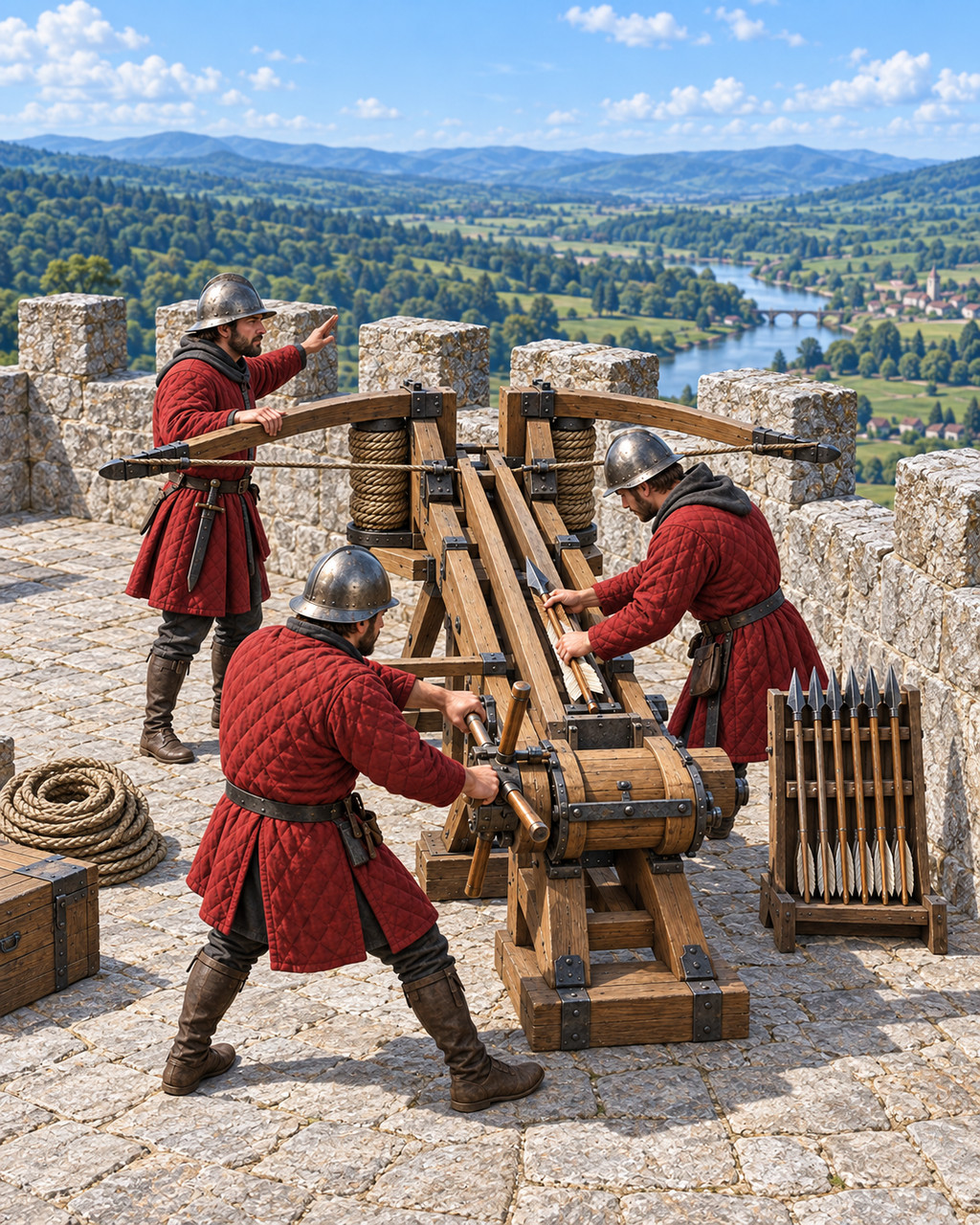
The weapon requires **X operators** to use at full effect. One of them makes the attack check; the rest are spanning, loading, laying, and hauling.
With fewer than X operators present and working, add Bane Dice equal to the shortfall to every check made with the weapon, and increase every **Prepare** and **Slow-Firing** rating by the shortfall as well.
Crew is the reason a ballista is not simply a large crossbow. A large crossbow is a purchase. A ballista is a purchase and four people.
> **See Target Zones, Chapter 8.** Crew doesn't only govern who is needed to fire the weapon. It governs who is needed to turn it.
### Emplaced
Passive
Drawback
The weapon **cannot be moved and fired in the same round**. Relocating it is not a maneuver but a task, taking minutes at best and a draught team at worst, and it must be prepared again wherever it lands.
Emplaced weapons print **no Encumbrance**. They are not carried by anybody.
Emplaced is separate from **Crew** and from **Prepare** because it does separate work. A fully crewed and prepared ballista still cannot chase a target that walks out of its arc, and a wall crossbow with one operator is still bolted to the wall.
### Scavenged
Passive
Ammunition for this weapon **costs nothing and is not tracked against Encumbrance** in any quantity a character could realistically carry. Riverbeds, walls, and ploughed fields all supply it.
A Scavenged weapon cannot use the shaft and head system in Chapter 9 while it is shooting scavenged ammunition. It is throwing a rock. Chapter 9 does list cast and fired shot for those willing to pay for consistency, and paying for it is the entire decision this quality creates.
> **Scavenged is worth more than it looks.** It is the only quality in the book that removes an ongoing cost rather than improving a roll, and it is why a shepherd's sling stays useful in a campaign that has left towns behind.
### Siege X
Passive
Ranked
This weapon's damage was built to answer things a body was never built to survive.
**Against a person**, multiply the weapon's total damage (the printed value plus any additional Successes) by X before Resistance is applied.
**Against a vehicle**, or anything else at vehicle scale, this weapon deals ⌊(damage × X) ÷ 10⌋ Hull Damage instead of wound damage, which is then reduced by the target's Armor. This is the same 10-to-1 conversion vehicle-scale weapons use against personal-scale targets, run in reverse. *The Heavy Armory* has the full procedure, and Armor and Hull Points for walls and gates.
**Against a structure**, see the **Breach Ladder** (Chapter 8). A weapon without Siege cannot advance the ladder at all, regardless of how much damage it deals.
Siege 10 is a ceiling rather than a target: at Siege 10, the vehicle formula stops discounting anything, and the weapon is simply a vehicle weapon that happens to be on the ground. Nothing built to kill people needs to go that high, which is why nothing in this book does.
> **Not every engine in this chapter carries Siege.** A weapon whose whole design is rate of fire against a line of soldiers, rather than payload against a wall or a hull, does its job without it. See the Polybolos.