Beyond Italy, a Roman magistrate usually holds a province for a year or more. A governor sent out from Rome can rule as far away as Spain or Syria. In 50 BC the old province in southern Gaul is Roman ground, and Caesar has conquered the country beyond it without making a province of it. The Rhine and the Euphrates mark where Rome's reach ends. For the choice of a governor and the limits of his powers see Powers of the Republic. Rome and Alexandria have their own chapters.
A free Gaul, Greek or Syrian without Roman citizenship counts as a Peregrine and has standing among his own people. The rules are in Era Rules, Patronage and Rank, and Character Creation and Roles, Ordo, Standing and Dignitas. Peoples here are named individually.
Gaul in 50 BC
In Caesar's account, the Belgae live in the north beyond the Alps, the Aquitani in the south-west and the Celts between them. Romans call that last people Gauls. By 50 BC Caesar has conquered all three regions, after eight years of fighting from 58 BC to the final sieges of 51 BC. Suetonius puts the tribute at 40 million sesterces a year. Beyond the old province there are no Roman towns, no governor and no Roman provincial law. The peoples keep their own law under the proconsul's will.
In 59 BC the lex Vatinia gave Caesar Cisalpine Gaul and Illyricum. The Senate added Transalpine Gaul. After Luca the lex Pompeia Licinia extended his command in 55 BC for another five years. Rome is headed for civil war over when those years end (Powers of the Republic). Early in 50 BC the towns of Cisalpine Gaul, south of the Alps, come out to welcome Caesar.

The Gallic War, 58 to 51 BC
Each row gives a year of the war and something it leaves behind in 50 BC. See The Era for the full timeline and Legion Battles to play Alesia.
| Year | The campaign | What it leaves in 50 BC |
|---|---|---|
| 58 BC | The Gallic War opens in 58 BC: Caesar defeats the Helvetii near Bibracte and Ariovistus's Germans, probably in Alsace. His 4,000 horse are raised from the Province, the Aedui and their allies. | The Helvetii back in their own hills; the Rhine as the line Caesar claims |
| 57 BC | In 57 BC Caesar fights the Belgae; the Nervii nearly destroy his army at the Sambre (Sabis). The Aduatuci are stormed and sold as slaves: Caesar says the buyers reported 53,000 heads. | The Belgic peoples broken; Caesar reports that of the Nervian council of 600 only 3 survived |
| 56 BC | In 56 BC Caesar fights the Veneti at sea, and Caesar, Pompey and Crassus renew their pact at Luca in April. | The Atlantic coast and its shipping under Roman watch |
| 55 BC | In 55 BC Caesar bridges the Rhine (in ten days, he says) and makes the first crossing to Britain. He destroys the Usipetes and Tencteri, Germans who had crossed the Rhine. | The Rhine bridged once and broken down; Britain seen, not held |
| 54 BC | Caesar's second expedition to Britain is in 54 BC. In the winter of 54 to 53 BC Ambiorix and the Eburones destroy a legion and five cohorts under Sabinus and Cotta. | A lost legion that the army has not forgotten |
| 53 BC | Caesar crosses the Rhine again and subdues the Eburones and the Treveri. | The north-east wasted |
| 52 BC | Gaul rises under Vercingetorix of the Arverni. Roman traders are massacred at Cenabum in the winter. Caesar takes Avaricum, fails at Gergovia and besieges Alesia. The siege of Alesia is in 52 BC; Caesar reports 80,000 Gauls shut inside Alesia with Vercingetorix, and the relief army at Alesia is 8,000 cavalry and about 240,000 foot (Caesar, Gallic War 7.71 and 7.76). Vercingetorix surrenders. | Every people that rose, the Aedui among them, has made its peace; Vercingetorix is a prisoner in Rome |
| 51 BC | The last sieges. Uxellodunum falls when Caesar cuts off its water; Hirtius, who finished Caesar's account, says the hands of those who bore arms were cut off. The Carnutes, the Bellovaci and the Eburones are put down. | Gaul quiet, garrisoned in winter quarters, and paying |
Avaricum and Gergovia. It took 25 days to raise a ramp against Avaricum's wall, 330 feet across and 80 feet high. Caesar reports that of about 40,000 people inside, scarcely 800 got out. The assault on the Arvernian hill-town of Gergovia failed. He lost just under 700 soldiers and 46 centurions.
Alesia. Excavators have found Caesar's ditches and forts at Alise-Sainte-Reine, the Mandubian hill-town. When supplies ran low, the Mandubii were turned out and Caesar refused them passage through his lines. Caesar stops there. Cassius Dio, writing more than two centuries later, says they died between the town and the camp. Vercingetorix surrendered after Alesia and was put to death after Caesar's triumph in 46 BC. In 50 BC Caesar is still holding him for that triumph.
LEGEND: THE LAST RIDE
In Plutarch's telling, Vercingetorix rides out of Alesia on a decorated horse in his best armor. He circles the seated Caesar, dismounts, throws down his armor and sits silent at Caesar's feet. In Dio he kneels. Caesar says the Gauls handed him over.
LEGEND
Plutarch reckons a million killed and a million enslaved in Gaul. Pliny gives 1,192,000 dead for all Caesar's battles outside the civil wars. Take these as boasts of scale. Caesar claims 368,000 people went on the Helvetian migration, counted on tablets in Greek letters that he says he found in their camp. Historians think his figure is inflated.
The Peoples of Gaul
A people of Gaul has its own territory, chief town, council and nobles, with allies and feuds among its neighbors. Caesar calls it a civitas. The peoples below appear in the places and hooks in this book. The map of Gaul gives their lands and approximate borders.
| People | Ground | Chief place | In 50 BC |
|---|---|---|---|
| Aedui | Between the Loire and the Saône | Bibracte | Rome's oldest friends in Gaul; rose with Vercingetorix in 52 BC and were spared |
| Arverni | The high country of the Massif Central | Gergovia | Vercingetorix's people; spared after Alesia, their captives returned |
| Sequani | The Saône and the Doubs, toward the Rhine | Vesontio | The Aedui's old rivals |
| Helvetii | The Swiss plateau, between the Jura and the Alps | No single town | Sent home after their defeat in 58 BC |
| Bituriges | The middle Loire, south of the Carnutes | Avaricum | Their town sacked in 52 BC |
| Carnutes | The Loire around Cenabum | Cenabum | Where the druids meet each year; put down in 51 BC |
| Mandubii | The hills north-west of the Saône | Alesia | Their town the site of the siege |
| Belgae (Remi, Nervii, Bellovaci, Suessiones, Treveri, Eburones, Atrebates) | The north, from the Seine to the Rhine | Many | Broken in 57 BC and again in 53 and 51 BC |
| Veneti | The coast of Brittany | Their sea-forts | Beaten at sea in 56 BC |
| Aquitani | Between the Garonne and the Pyrenees | Many | Counted by Caesar as a people apart from the Gauls |
| Allobroges | The upper Rhône, inside the old province | Many | Roman subjects since the last century |
The Aedui
Rome's oldest allies in Gaul are the Aedui of Bibracte. Their nobles rode with Caesar's cavalry in 58 BC and supplied him with grain for years. The brothers at their head went different ways. Diviciacus, a druid, backed Caesar and stayed with his friend Cicero. Dumnorix opposed Caesar and was killed in 54 BC. In 52 BC the Aedui joined the rising. The Gallic assembly came to Bibracte and confirmed Vercingetorix as commander. Caesar spared the Aedui after Alesia, gave back their captives and wintered in their capital in 52 to 51 BC.
Banona is in Rome because Aeduan houses that rose in 52 BC are bargaining for what they lost. Those that stood by Rome have the advantage. Who wants what: Rome's friends want the others' lands and clients. Their rivals need a Roman patron to ask for them back.
The Arverni
From Gergovia the Arverni hold the high country of the Massif Central. Their young noble Vercingetorix commanded all Gaul in 52 BC. After Alesia, Caesar spared the Arverni and returned their captives as he did for the Aedui. Who wants what: The nobles want Vercingetorix back. Caesar wants him at his triumph.
The Sequani and the Helvetii
In 58 BC Caesar's officers lost their nerve at Vesontio before marching against Ariovistus. It is the chief town of the Sequani, whose land includes the Saône valley and the road to the Rhine. Caesar blames their feud with the Aedui for first bringing Ariovistus's Germans across the Rhine. That same year the Helvetii took their families and wagons out of the hills to settle in western Gaul. Caesar beat them near Bibracte and sent them home.
The Belgae
Caesar's Belgae fight hardest and suffer most. The Remi come over to him at once, but the Nervii nearly destroy his army on the Sambre in 57 BC. He says he took a shield from a man in the rear and went forward to call the Twelfth's centurions by name. In the winter of 54 to 53 BC Ambiorix's Eburones destroy the legion under Sabinus and Cotta. Caesar has since laid waste to their country. Who wants what: The Remi want to lead the north, while the surviving Eburones want to be left in their forests.
The Veneti and the Atlantic Coast
Oak hulls, high sides, leather sails and anchors on iron chains make the Veneti's ships hard for Roman galleys to fight. A ram will not do it. In 56 BC Caesar's commander Brutus wins by cutting the rigging with hooks on long poles. The Veneti of Brittany once carried the coastal trade to Britain, and the Atlantic ports still carry it.
The Noble House
A noble counts his strength in kinsmen, sworn companions, clients and horsemen. The more he has, the greater he is. In Caesar's account only these nobles, his equites, and the druids carry weight. Common people scarcely rank above slaves, and debt or need of protection binds many to a noble. Rival houses lead factions among peoples, in villages and even within households. Marriages make alliances across borders. Dumnorix's mother married among the Bituriges, and his wife was a Helvetian. Each year the Aedui choose a chief magistrate with power of life and death, an office Caesar calls the vergobret.
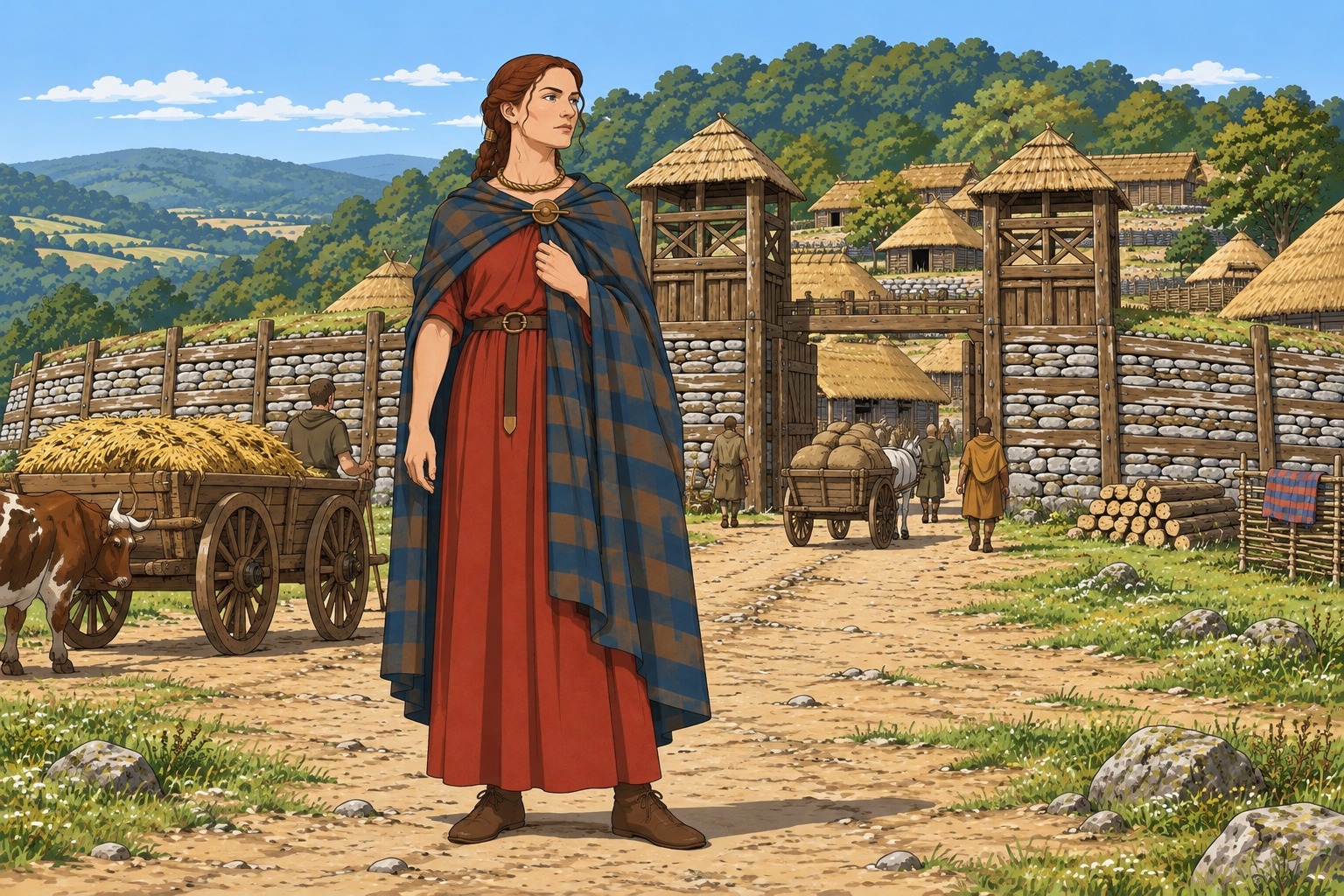
A Gallic noble can keep his cattle, horses, smiths and gold on his own land or live in a large house in an oppidum. Look for a gold torc, long hair, checked and colored cloth and a heavy sagum. Men wear moustaches and braccae, trousers. Caesar took sons and daughters of the noble families through the war. A hostage binds a house to Rome and may be kept in a camp or sent to Italy.
At the table a Gallic noble is a patron with clients of his own. A Peregrine character of a noble house takes his starting Dignitas from Character Creation and Roles, Ordo, Standing and Dignitas, and a Roman's word does not move a Gallic audience (Era Rules, Patronage and Rank, The Enslaved, the Freed and the Peregrine).
Banona of the Aedui
Aeduan noblewoman, hostage and envoy. About 30.
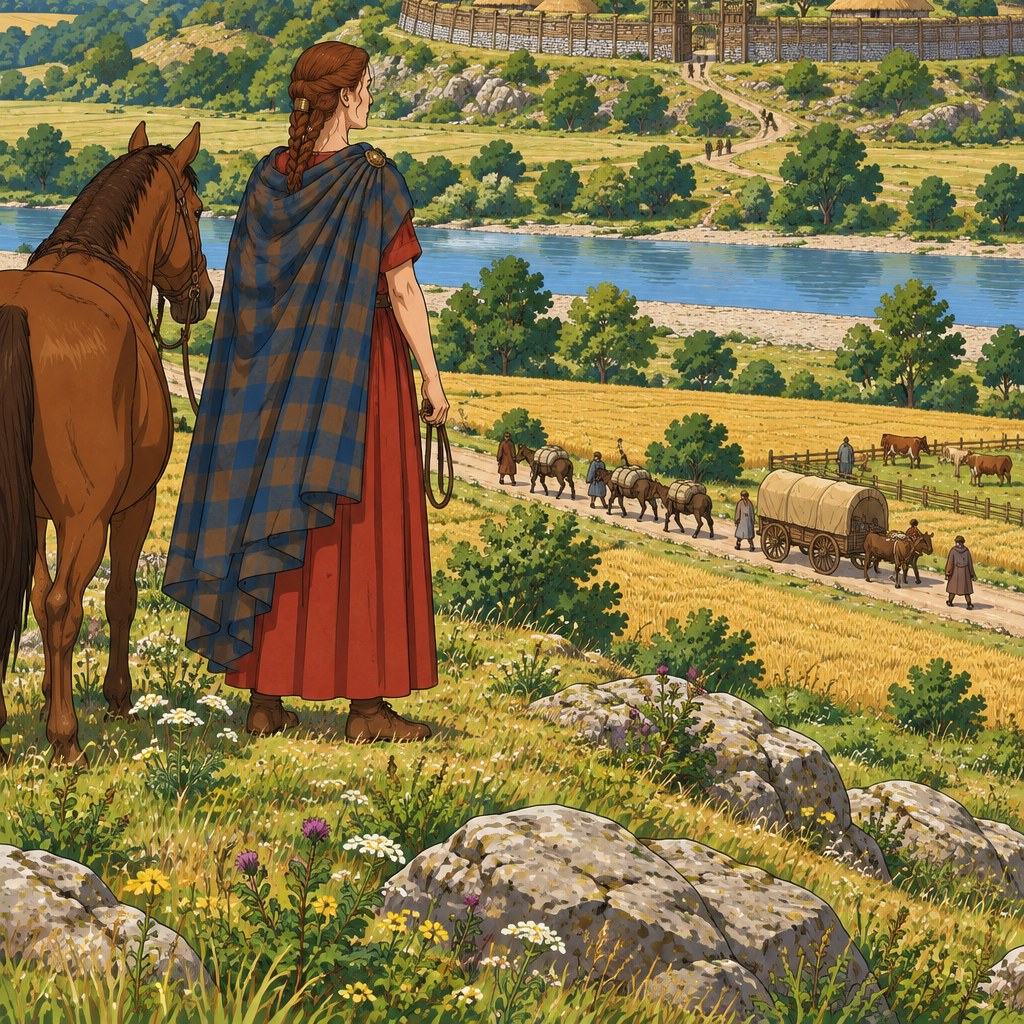
Banona's brother fought in the rising of 52 BC and her house lost its lands. She was born to Aeduan nobility at Bibracte. Now she is in Rome as a pledge of her people's alliance and to ask the Senate for the lands back. She wears her torc and checked cloak in the city, listens in Gaulish and answers Romans in Latin. Her sheet is in Pregenerated Characters. See Character Creation and Roles for her standing with each people.
Her name. Caesar names no Gallic woman. Gaulish women's names survive only in inscriptions of the Roman Empire, a century and more after 50 BC; Banona is one of them, written on a lead tablet in Gaulish. The book uses it as the right shape of name for her.
Use her as an envoy who carries a petition, as a patron's guest who needs an escort, or as the one person at a Roman table who knows what an Aeduan noble will accept.
Bibracte, the Oppidum of the Aedui
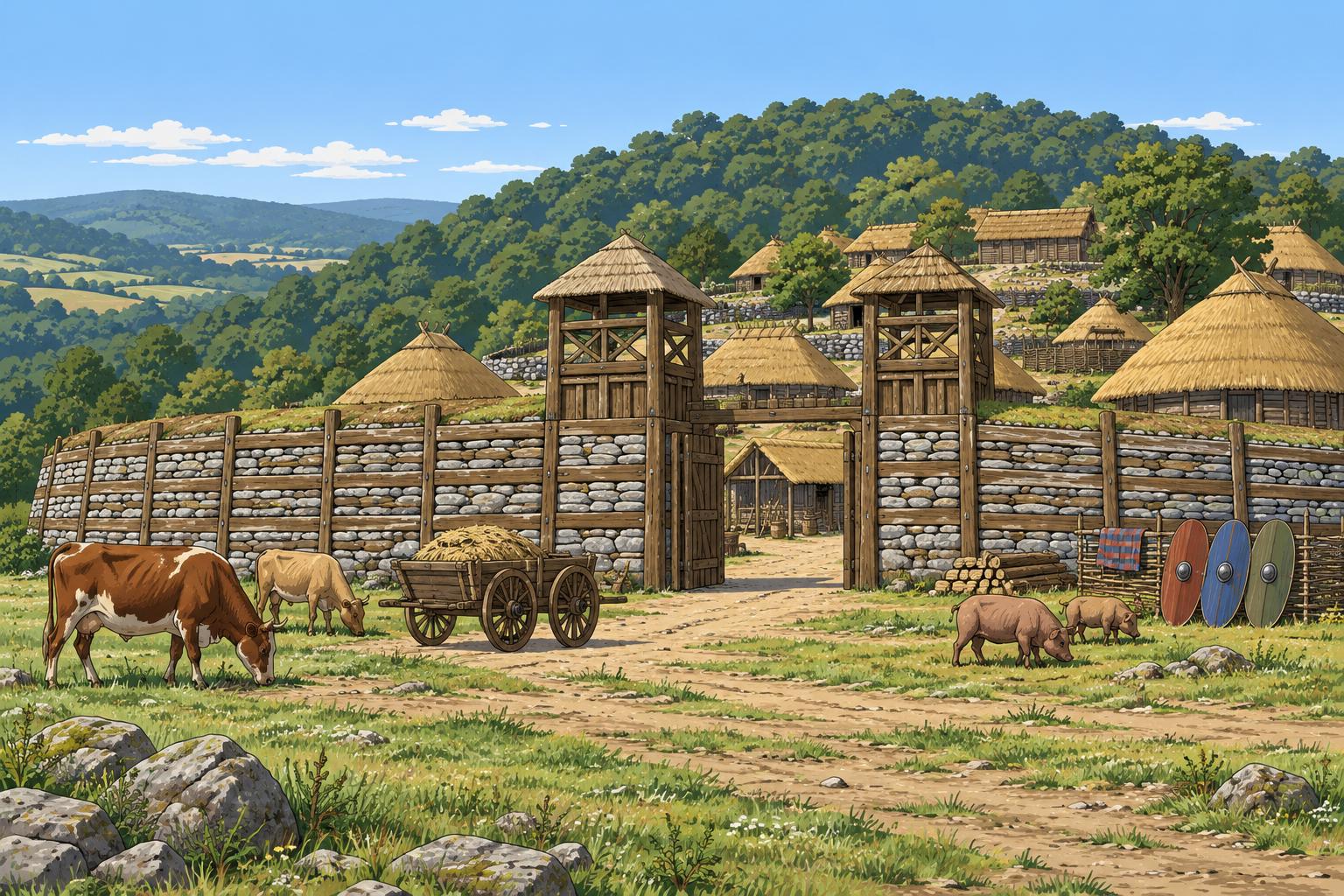
The wooded hill now called Mont Beuvray holds Bibracte, which Caesar calls a town of the greatest authority among the Aedui. Its walls make room for houses, shrines, markets, workshops and pasture. That is an oppidum, a fortified hill-town. In 52 BC the Gallic assembly meets here to confirm Vercingetorix as commander. Caesar winters here himself in 52 to 51 BC.
The walls. The inner rampart that stood in 52 BC encloses 135 hectares in about 5 km. The older outer ring, from the previous century, runs about 7 km around 200 hectares. Caesar describes beams two feet apart at right angles to the wall face, with earth in the gaps and large stones facing it in layers. Stone stands up to fire and timber to the ram. A road enters between the gate's wooden towers.
The town. Round and rectangular houses of plank and wattle stand under thatch along packed-earth streets. Late in Bibracte's life a few nobles set Mediterranean-style houses on stone footings. Carts share the road with pigs, horses and cattle. Under Roman peace, Bibracte does business as a market town behind its walls.
Who is here. Noble families and their councils, clients, smiths and farmers. Traders bring wine and goods from the Roman province. Envoys ride to and from the proconsul's winter quarters, while the houses that fought in 52 BC wait to learn what they can keep.
The Gate
The timber-towered gate where the road enters the inner rampart. Wagons queue, the gate guard knows every noble's man by sight, and the market spreads outside the wall below it. At the table: where strangers are seen first and news of them reaches the council before they do.
The Market Below the Gate
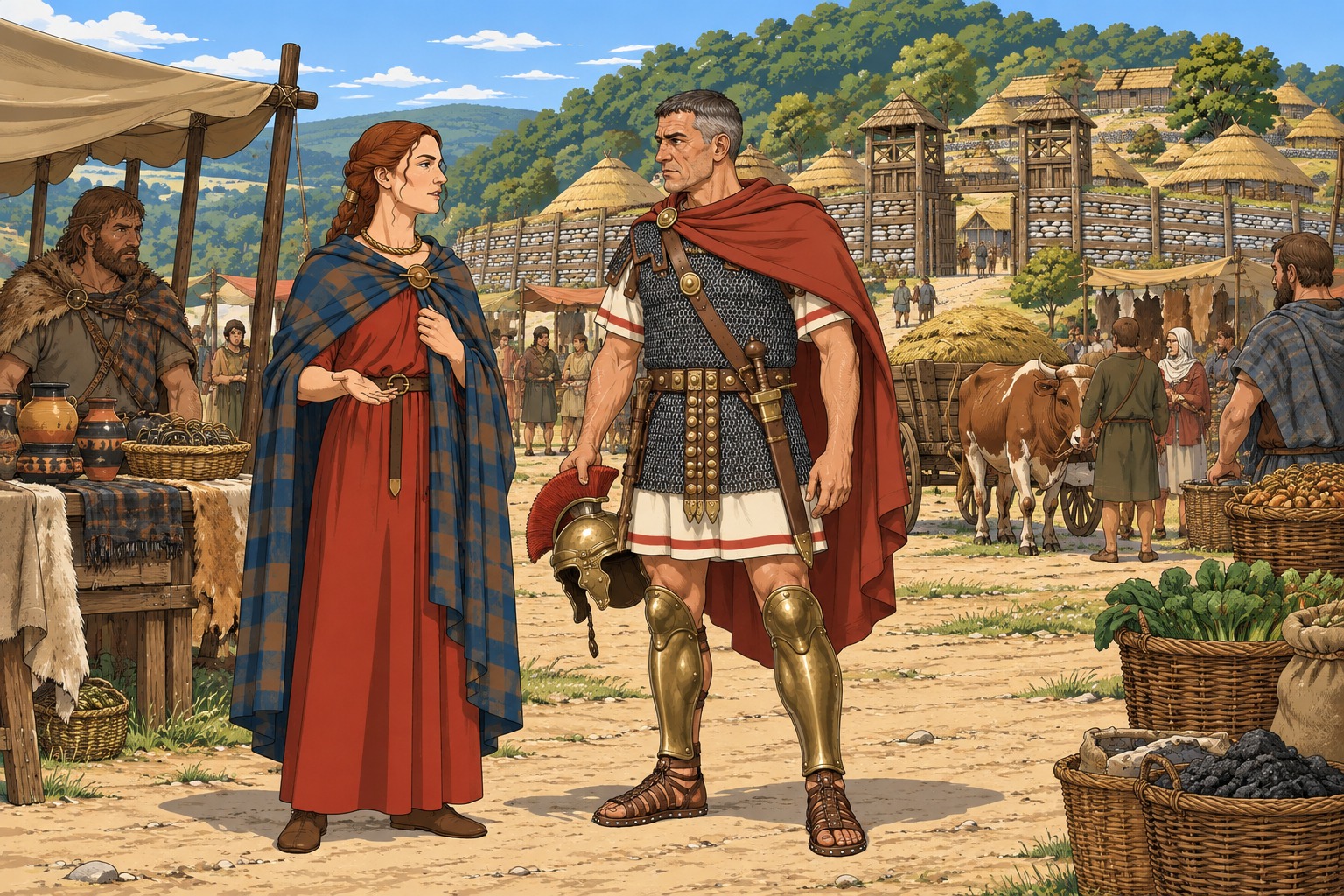
Wagons, cattle pens and traders' stalls on the road under the wall. Gallic and Roman traders deal in wine, salt, iron, cloth, horses and captives. At the table: where a Roman and a Gaul can talk in the open, and where both are watched.
A Noble's House
A large timber hall in its own yard, with stables and a smithy. The head of the house sits with his kinsmen and clients; guests eat by rank. At the table: where a petition is heard and a promise is made, and where a guest who insults the house is in danger.
Hooks at Bibracte
- The Lost Lands. The house of an Aeduan noble who kept faith with Rome now holds the fields of a house that rose in 52 BC. Its head will give them back for a Roman favor no one at Bibracte can grant.
- The Wine Debt. A Roman trader from Narbo sold wine on credit to an Aeduan noble before the rising, and his stores were burned. He wants the debt collected from a man with three hundred clients.
- The Hostage Home. A noble's son, held as a hostage since 52 BC, is to be returned under escort. His family wants him safe; his father's rivals want him to arrive late, or not at all.
The Druids and the Gods, as Caesar Reports Them
The druids teach and conduct sacrifices. In Caesar's account they settle nearly every public and private dispute, from murder to inheritance and boundaries. A man who rejects their verdict is barred from sacrifice and shunned. Each year the druids hear cases in the land of the Carnutes, at the center of Gaul, and one chief druid is elected over them. They pay no tax and owe no military service. Pupils can spend twenty years learning verses by heart, since the order keeps its teaching unwritten. At Rome the best-known druid is the Aeduan Diviciacus, Caesar's ally, who stayed with Cicero and spoke to him about omens.
The gods. Caesar gives the Gallic gods only Roman names: Mercury, the most honored, the god of trade, roads and every craft, then Apollo, Mars, Jupiter and Minerva; and he says the Gauls count their time by nights because they descend from Dis Pater. The Gauls' own names for their gods, and their shrines and offerings, are in Gods and Religion.
Sacrifice. Caesar reports that the Gauls offer men to the gods for victory or recovery, and that some peoples burn the condemned, and at need the innocent, in huge figures woven of wicker. Strabo repeats the wicker figures. It is a Roman report about an enemy; treat it as what the Romans believe.
Sanctuary gold. Caesar says the Gauls leave gold offered to the gods lying untouched in their sacred places. Suetonius says Caesar plundered the shrines of Gaul for that gold, so much that its price fell in Italy.
LEGEND
The Gold of Tolosa: the treasure taken from the sanctuaries of Tolosa by the consul Caepio in 106 BC, said to have brought ruin to everyone who touched it. "He has the gold of Tolosa" is said of a man whose luck has turned. A tale, not a record.
Trade and the Roads
From Massilia and Narbo, wine, oil and Italian goods go up the Rhône. Slaves, cattle, hides, iron, salt and grain come back down. The Via Domitia, built in 118 BC, crosses from the Alps through the old province toward Spain. The Veneti and other traders in the Atlantic ports trade with Britain. Pliny says western peoples brew a drink from soaked grain. Romans think of it as foreign.
Roman traders were already in Gaul before the legions. Killing them at Cenabum was the first act of the rising in 52 BC. Captives are the biggest trade after the war. Caesar sold the Aduatuci in 57 BC, and the Italian markets fill with people taken in Gaul (Gear and Prices, Purchased People). In Diodorus a Gaul will trade a slave for a jar of wine. Treat it as a traveler's tale.
A fast traveler can cross from Rome to Gaul in a week: Plutarch says Caesar reached the Rhône in seven days in 58 BC. Travel times, the roads and the sailing season are in Era Rules, Travel.
The Old Province: Narbonensis
The old province of Transalpine Gaul runs along the coast from the Alps to the Pyrenees, below the Cévennes. Later Romans call it Narbonensis. In 50 BC it is Roman ground under Caesar. The Allobroges and other peoples there have been subjects for two generations. In 63 BC envoys of the Allobroges handed Cicero the letters that exposed Catiline.
Narbo is the chief Roman town of the province, on the Via Domitia where the road turns toward Spain. Aquae Sextiae is the Roman station on the road from Italy. Roman traders, tax farmers and moneylenders work from both, and the province's farms supply the army in Gaul.
Who wants what: the traders want the new Gaul opened to them; the old province's nobles want the favor of the man who commands it; everyone wants to know what happens to Gaul if Caesar falls.
Massilia, the Free Greek City
Massilia was already a Greek city east of the Rhône mouth before Roman power reached Gaul. Rome's ally stands outside the province and keeps its laws, council, navy, language and gods. Its merchants have worked the Rhône trade for centuries. In a siege its walls carry ballistae large enough to shoot iron-tipped poles 12 feet long.
Who wants what: the city's council wants to stay free and stay rich, which means choosing the right Roman friend before the civil war comes. In 49 BC it will choose Pompey and be besieged by Caesar's legate Trebonius.
- The Quiet Letter. A member of Massilia's council wants a letter carried to a friend of Pompey's in Rome, unopened and unseen by Caesar's people in Narbo.
- The Greek Pilot. A Massiliote ship's master knows the Rhône and the coast to Spain. He will take the characters anywhere on it, for a price in Roman silver and a favor in Rome.
The Army in the Field
At the end of 50 BC Caesar has about ten legions, including the Thirteenth at Ravenna and eight in winter quarters. His veterans have fought for eight years. Allied peoples provide Gallic horse and he hires German horse across the Rhine. There are no standing auxiliary regiments. In 58 BC he raised 4,000 horse from the Province, the Aedui and their allies. In 52 BC he hired German riders and gave them his officers' mounts. Numidian and Cretan archers and Balearic slingers serve for pay. The army takes grain from its allies. In the winter quarters among the conquered, men wait for discharge and land.
Two of Caesar's legions were taken from Gaul in 50 BC for a Parthian war and are held in Italy at Capua (Powers of the Republic, The Last Year Before the War). Every soldier in Gaul knows it.
The legion's organization, kit and order of battle, the nightly marching camp and siege works are in Legion Battles; pay and the soldier's kit prices are in Gear and Prices. Septimius, the book's centurion, has served in Gaul since 58 BC.
Beyond the Rhine and Over the Ocean
The Germans
Across the Rhine the Suebi are the strongest of the German peoples. In 58 BC Ariovistus brought Suebi and others into Gaul, with their families in wagon camps behind the lines. Caesar drove them back over the river. The Usipetes and Tencteri crossed it in 55 BC and Caesar destroyed them. He bridged the Rhine on paired piles, in ten days by his account, and crossed again in 53 BC. The bridge site, near Koblenz or Neuwied, is disputed. Caesar hires German riders who fight with fast light foot at their sides. Who wants what: Chiefs across the Rhine want Gallic land and Roman pay. Gauls on the river want them kept out.
Britain
From the Belgic coast, Britain is across the Ocean. Caesar made landings in 55 and 54 BC, fought Britons using war chariots and went home. He says the eagle-bearer of the Tenth was first into the surf in 55 BC and called on his comrades to stand by their eagle. In 50 BC Rome holds nothing in Britain. Who wants what: British kings want Roman goods and Gallic allies, with no Roman soldiers. A Gallic exile can look for refuge here.
LEGEND: NO SILVER IN BRITAIN
Cicero wrote to Atticus in 54 BC that there was not a scrap of silver on the island and no hope of loot but slaves, and none of them, he supposed, trained in letters or music. Suetonius later said Caesar went for pearls. Rome is still deciding what Britain is worth.
The Provinces
A former consul or praetor usually governs a province for a year or more. He brings a quaestor, legates and friends. He hears cases, commands troops and collects taxes through the publicani. Back in Rome he can be tried for extortion. Powers of the Republic covers the offices and the court. The entries give a governor, a detail and a hook for each province or region in 50 BC. Egypt remains a kingdom. See Alexandria.
Cisalpine Gaul and Illyricum
- Governed by. Caesar, as part of his command, through his legates.
- Known for. The Po valley, rich farms and towns full of men Caesar has made or promised to make citizens. Its southern border with Italy is the river Rubicon. In 51 BC the consul Marcus Marcellus had a magistrate of Novum Comum flogged (Powers of the Republic, The Great Men in 50 BC).
- Hook. The flogged man's kin want proof of his citizenship written down and carried to Rome, and a patron who will use it.
Sicily, Sardinia and Corsica
- Governed by. A governor each year for Sicily, another for Sardinia and Corsica.
- Known for. Grain for Rome, and the memory of Verres, the governor whose exactions Cicero laid bare.
- Hook. A Sicilian city wants an advocate to bring its complaint against a former governor before the extortion court.
Hispania Citerior and Ulterior
- Governed by. Pompey, who holds both Spains and governs them through his legates while he stays near Rome.
- Known for. Near New Carthage, forty thousand miners bring in twenty-five thousand drachmae a day, if Polybius is right as quoted by Strabo. Diodorus describes men worked without rest until they die. Gades on the Ocean has a temple of Hercules, called Melqart by its people. Sertorius held Spain against Rome until he was murdered in the 70s BC.
- Hook. A mine contractor wants hands and buys them anywhere; a character's kinsman has been sold to him.
Africa
- Governed by. A governor sent from Rome. Carthage, destroyed in 146 BC, is still a ruin.
- Known for. Grain. Beyond it rule the kings of Numidia (Juba I, a friend of Pompey) and of Mauretania (Mastanesosus, it seems, until about 49 BC; then Bocchus II and Bogud). The Punic gods, Baal Hammon, Tanit, Melqart and Eshmun, are still worshipped (Gods and Religion).
- Hook. A Numidian prince's horse dealer wants an escort for a string of horses to the coast, and Juba's men are watching the road.
Macedonia and Greece
- Governed by. The governor of Macedonia, at Thessalonica, whose charge runs south over the Greek cities.
- Known for. The Via Egnatia across the Balkans to the Aegean. Athens, the school of the Mediterranean (below); Delphi, whose oracle still answers, though much reduced; Eleusis and its Mysteries each autumn, which Cicero joined.
- Hook. A Roman's son studying at Athens has run up debts with a moneylender of the city; his father wants him home before the lender writes to Rome.
Asia
- Governed by. A governor sent from Rome.
- Known for. Rome's richest province came by the will of Attalus III of Pergamum in 133 BC. At Ephesus, the temple of Artemis stands near a harbor on a silting river. The city pays heavy tax to the publicani. Mithridates ordered the Romans and Italians across Asia killed on one day in 88 BC. Ancient counts give 80,000 or 150,000 dead. The cities remember.
- Hook. A tax company's agent needs men to collect from a city that has already paid once this year to someone else.
Bithynia and Pontus, and the Kings of Asia Minor
- Governed by. A governor in Bithynia and Pontus. Around it, the client kings of Pompey's settlement: Deiotarus of Galatia, Ariobarzanes III of Cappadocia (king from 51 BC), and Pharnaces II on the Bosporus, each owing troops to Rome.
- Known for. Kings who rule by Rome's leave and need Roman friends to keep it.
- Hook. Deiotarus wants a Roman advocate to speak for him in the Senate, and pays in gold and horses.
Cilicia and Cyprus
- Governed by. Cicero, until 30 July 50 BC, then the man he leaves in charge; his year as governor is in Powers of the Republic, Governors and the Provinces. Cyprus is attached to Cilicia (The Era, The Timeline, 133 to 50 BC).
- Known for. Mountains and old pirate coasts. The aedile Caelius writes to him in almost every letter for panthers for his games.
- Hook. Caelius still wants panthers, and Cilician hunters will not work for a Roman; whoever brings him a cage of them earns a patron in Rome.
LEGEND: THE PANTHERS HAVE LEFT
Cicero answered Caelius's pleas that the hunters were at work, but panthers were scarce: they complained, he wrote, that they were the only creatures in his province anyone set traps for, and had decided to move to Caria.
Syria
- Governed by. Bibulus, Caesar's old colleague in the consulship, for 51 to 50 BC; his two sons are killed in Alexandria in 50 BC (Alexandria, Rome in Egypt). Before him Gaius Cassius held the province after Carrhae and beat back the Parthian raid of 51 BC.
- Known for. Antioch, its Greek capital; the caravan roads; the temple of Atargatis at Hierapolis, which Crassus plundered in 54 BC. It is Rome's front line against Parthia.
- Hook. A survivor of Carrhae, enslaved in Parthia and escaped, reaches Antioch with news of where the lost eagles are kept.
Judea
- Governed by. Hyrcanus II, high priest, with Antipater the Idumaean as the power behind him; the province of Syria oversees the land. Gabinius divided it into five councils in 57 BC and left Hyrcanus the Temple and the priesthood.
- Known for. Jerusalem and its Temple, where God is worshipped without an image (Gods and Religion). Pompey took Jerusalem in 63 BC, entered the Holy of Holies and left the treasure; Crassus took that treasure in 54 BC (Josephus).
- Hook. A Judean merchant of Alexandria wants the Temple's due carried safely to Jerusalem, past a governor who needs money.
Crete and Cyrene
- Governed by. Crete, and Cyrene, often under one governor; whether they formed a single province before 27 BC is disputed.
- Known for. Cretan archers, who serve in Rome's armies for pay.
- Hook. A recruiter for the legions in Gaul wants twenty Cretan archers signed and shipped before the sailing season closes.
Thrace
- Governed by. Its own kings and peoples, north of Macedonia. Thrace is not a province.
- Known for. Horsemen, fighters and captives. Thracian captives are sold to the gladiator schools, and the arena's thraex fights in their arms; Bithys is one (The Arena and the Games).
- Hook. A Thracian prince in Rome wants word sent home that he lives, and a kinsman bought out of a ludus at Capua.
Dacia
- Governed by. Burebista, king of the Getae and Dacians on the Danube, a rising power beyond Rome's reach.
- Known for. A king who has gathered the Getae and Dacians of the lower Danube under one rule.
- Hook. A Greek city of the coast sends an envoy to Rome asking for help against Burebista, and needs someone to make the Senate listen.
Athens and the Greek Cities
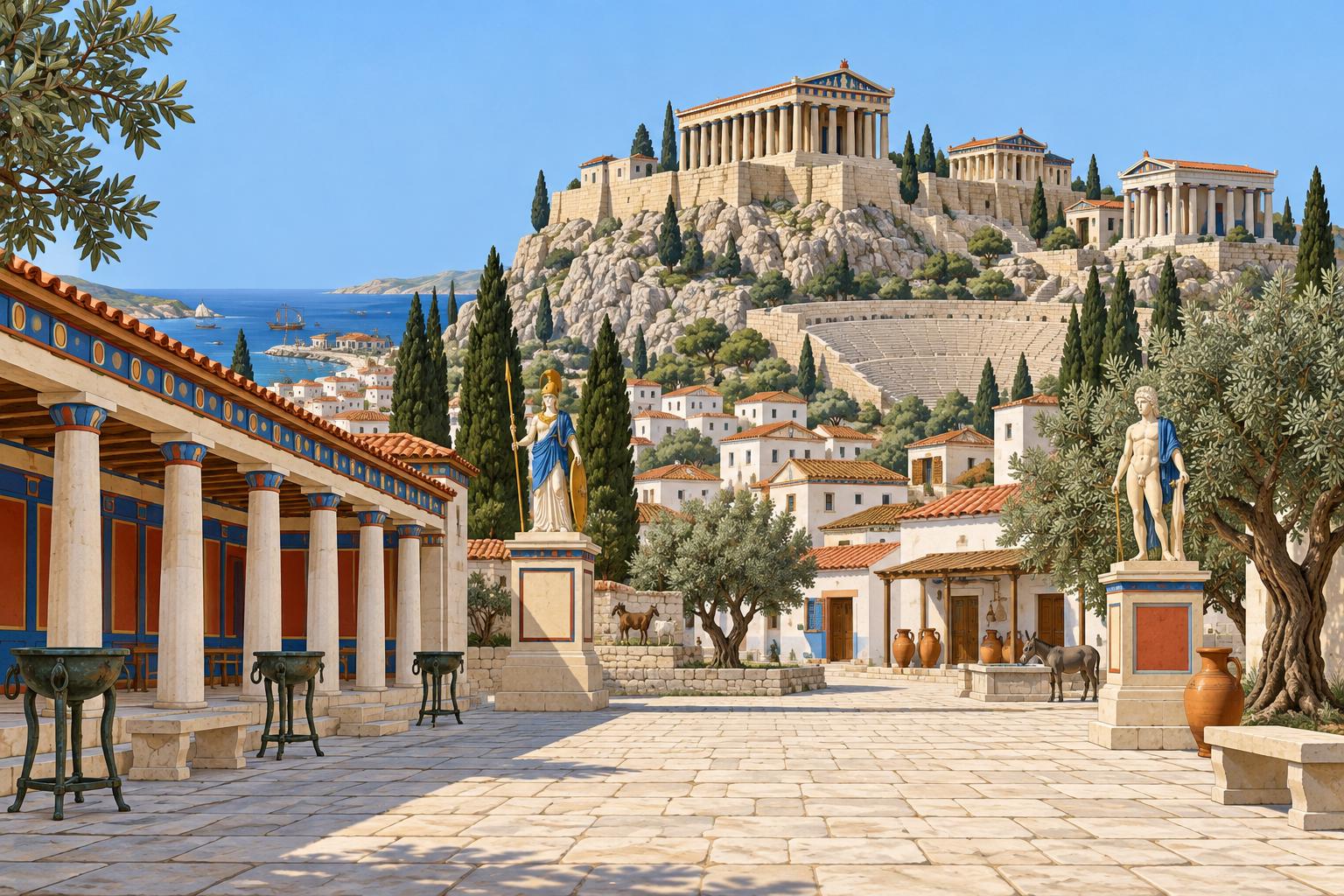
The Greek cities are the old civilization of the East: Athens, Rhodes, Massilia, Ephesus and Pergamum, Antioch, Alexandria. Greek is the language of the East and of every learned Roman, and the cities' leading men are patrons to the governors who rule them. A Greek city keeps its own council and its own laws under Rome, and its agora (the market square) is its forum, ringed by colonnades (stoas), temples and law courts.
Athens is the school of the Mediterranean. Sulla sacked it in 86 BC and it is still recovering, but it is still the place where a Roman's son goes to hear the philosophers and the teachers of rhetoric, and where Cicero stopped in 51 BC on his way to Cilicia. Above the city the Acropolis carries the Parthenon; below it the Agora has the Stoa of Attalos and the temple of Hephaestus. Greek temples and statues are painted, in blue, red and gold, not bare white stone.
Who is here. Philosophers and their students; Roman young men with allowances and tutors; Greek merchants and moneylenders; priests of the city's gods; envoys of kings; Roman officials passing through. Kallias of Alexandria knows these colonnades.
- The Borrowed Tutor. A Roman patron wants a Greek teacher of rhetoric brought from Athens to his house in Rome. The teacher will come only if his debts in Athens are paid first.
- The Copied Book. A philosopher's school will let a rich Roman's scribe copy a rare book in its keeping, for a gift the school chooses, and a rival school wants the copy spoiled.
The Eastern Frontier: Parthia
East of Syria, beyond the Euphrates, lies the empire of the Parthians, ruled by King Orodes II. Crassus was defeated at Carrhae by the Parthian general Surena in 53 BC: the Parthian horse archers, armored lancers and a camel train of arrows destroyed seven legions in the open desert. At Carrhae about 20,000 Romans die and 10,000 are captured (Plutarch); Crassus was killed at a parley and the eagles were lost. Orodes then executed Surena. In 51 BC Parthian horse raided Syria and Cassius beat them back, and in 50 BC Rome expects a greater invasion. The lost standards are in Parthia, and the captives with them.
Armenia, under Artavasdes II, lies between the two powers. Parthia itself, its court and its aims are in Powers of the Republic; fighting horse archers is in Legion Battles, Horse Archers and Locked Shields.
Hooks in Gaul
| Hook | Who | The offer |
|---|---|---|
| The Tribute Wagons | The quaestor of the army in Gaul | Carry a people's share of the tribute through the Sequani's country to the winter quarters, with an escort too small for the road |
| The Captive in Narbo | A Belgic noble family | Their son, taken in 51 BC, is in a dealer's pen at Narbo waiting for a ship to Italy; buy him back before the ship sails |
| The Druids' Judgment | Two Aeduan houses | Their quarrel over a boundary goes to the druids' yearly meeting among the Carnutes; a Roman officer wants the verdict to go one way |
| The German Horse | A legate | Cross the Rhine with silver and bring back two hundred German horsemen and their light foot before the spring |
| The Venetic Ship | A trader of Narbo | Buy an oak ship with leather sails from a Venetic master and sail it to Britain for whatever the British kings will sell |
| The Discharge | Septimius and his men | Their discharge is due and their land depends on a man in Rome; carry the century's petition to him before the civil war decides it |
| The Prisoner's Kin | An Arvernian noble | Get a message to Vercingetorix, held in Rome for Caesar's triumph, and bring back proof he lives |
| The Lost Legion | A centurion who survived the winter of 54 BC | Ambiorix's people still hold something taken from Sabinus and Cotta's camp; find it in the Eburones' forest |
| The Hostage's Return | An Aeduan noble house | Their daughter, held as a hostage in a Roman camp since 52 BC, is to be sent to Italy; win her release before the convoy leaves |