In Rome the consuls give their names to the year. In 50 BC, the 704th year from the city's founding (DCCIV AUC), they are Lucius Aemilius Paullus and Gaius Claudius Marcellus. The maps show their world in that year. A campaign can begin as early as Caesar's command in Gaul in 58 BC or run to the Ides of March in 44 BC. The history behind the game stretches from the Gracchi to Augustus, about 133 to 27 BC.
The Year 50 BC
The last strongholds in Gaul fell in 51 BC. Caesar has fought there since 58 BC, and he now governs the Gauls and Illyricum as proconsul. He has ten or eleven legions and enough spoils to pay for a party in Rome. Pompey, who was sole consul two years ago, governs Spain through his legates and keeps an army within reach of the city. He has overseen Rome's grain supply under the five-year command he received in 57 BC. The ties between the two men have come apart. Julia, Caesar's daughter and Pompey's wife, died in childbirth in 54 BC. Crassus, who once stood between them, died after Carrhae the following year.
The question of the year is Caesar's command. His opponents say the Senate can name a successor to his provinces as early as 1 March 50 BC. Caesar insists he can keep them until he stands for the consulship of 48 BC. If he goes straight from one office to the next, he spends no time as a private citizen open to prosecution. In 52 BC the ten tribunes gave him permission to stand without coming to Rome. Pompey's law on candidates, passed that same year, seemed to undo the grant. Suetonius and Dio say Pompey added an exemption after the law was already engraved. The Senate argues over what the laws of 55 and 52 BC settled. Historians still do.
On 1 December 50 BC the Senate votes for mutual disarmament, 370 to 22 (Appian). The proposal is Curio's. The tribune, whose debts Caesar reportedly paid, vetoes every motion to replace Caesar and calls for both generals to give up their armies. Earlier in the year the Senate had ordered each general to send one to Syria against Parthia. Pompey called back the legion he lent Caesar in 53 BC, so Caesar gave up both that legion and his own Fifteenth, and both stayed at Capua once the threat passed. On 2 December Marcellus meets Pompey outside Rome and puts the two legions and the levy at his disposal to defend the state. On 10 December Caesar's allies Mark Antony and Quintus Cassius Longinus take office as tribunes. Meanwhile, Paullus spends on the Basilica Aemilia what Plutarch and Appian say was a 1,500-talent payment from Caesar. The censor Appius Claudius Pulcher strikes senators and knights off the rolls, including Sallust. Cicero returns from Cilicia in hope of a triumph and finds war close (Powers of the Republic, In 50 BC: A Governor's Year). Caesar ends the year at Ravenna in Cisalpine Gaul with the Thirteenth, while eight more legions winter beyond the Alps. Italy is a short march from Ravenna. Rome's houses are taking sides.
| Hook | Who | The offer |
|---|---|---|
| The Two Legions | A centurion at Capua | His men were sent home from Gaul for a war in Syria that never came; both generals' agents are buying their loyalty, and he wants an honest broker |
| The Debts of a Tribune | A banker in the Forum | Curio's notes have been paid by someone; whoever proves who paid them can sell the proof to either side |
| Struck from the Roll | A senator expelled by the censor | He wants a witness, a document or a favor that will put him back before the next census |
| The Governor's Baggage | Cicero's freedmen at Brundisium | A chest of letters and accounts from Cilicia must reach Rome before the Senate sits on his triumph |
The Mediterranean in 50 BC

From Spain to the Euphrates, the map shows the Mediterranean before the civil war, in 50 BC. The scale uses the Roman mile of 1,000 paces, about 1.48 km.
Reading the key. Look for Italy in deep red. South of the Po, every free man has been a citizen since the Social War. The provinces are lighter red: Sicily, Sardinia and Corsica, the two Spains, Transalpine Gaul (the old Province), Cisalpine Gaul, Illyricum, Africa, Macedonia with Greece, Asia, Bithynia and Pontus, Cilicia with Cyprus, Syria, and Crete with Cyrenaica. The hatching covers Caesar's conquests of 58 to 51 BC. That part of Gaul pays tribute and has yet to become a province. Gold shows the kingdom of Ptolemaic Egypt and brown the Parthian empire. In gray-blue are Rome's clients and allies, who owe troops and obedience: Numidia, Mauretania, Galatia, Cappadocia, Judea, Nabataea and Rhodes. Since Carrhae, Artavasdes II of Armenia has sided with Parthia. Dacia and the Thracian kingdoms are green. Beyond these powers, the map leaves lands such as Britain and the Germanic country across the Rhine untinted.
Symbols. Rome and Alexandria are the large red roundels. Ordinary dots mark cities. A ring around a dot marks a port, a square marks an oppidum such as Bibracte or Alesia, and a dashed ring marks a destroyed city still in ruins, such as Carthage or Corinth. The red lines follow the main roads. Blue dashes give the general routes of the grain ships from Africa and Alexandria to Italy.
Boundaries are approximate. Where a ruler has only a loose hold on the country, the tint gives the extent of his influence. Inland provincial borders are approximate enough for the GM to use in play.
At the table. The local ruler decides where a complaint is heard and who taxes the cargo. Distance tells the GM how long a letter, a legion or a grain ship takes (Era Rules, Travel). A nearby border can matter more than either. Germanic raiders cross the Rhine and Parthia lies across the Euphrates. Just north of Ariminum, a river too small to draw divides Caesar's province from Italy.
Who Holds Power
The table gives each power's position in 50 BC. For its leaders, resources and aims, see Powers of the Republic.
| Power | Who leads in 50 BC | What it holds | What it wants |
|---|---|---|---|
| The Senate | Consuls Lucius Aemilius Paullus and Gaius Claudius Marcellus; censors Appius Claudius Pulcher and Lucius Calpurnius Piso Caesoninus | Decrees, the treasury, the provinces, embassies, the right to declare a state of emergency | Order, and an end to Caesar's command on the Senate's terms |
| Pompey (Gnaeus Pompeius Magnus) | Himself, outside the city with imperium | Spain through his legates; the grain command of 57 BC, if it has not lapsed; the two legions from December | To remain the first man in Rome and the Senate's sword |
| Caesar (Gaius Julius Caesar) | Proconsul of the Gauls and Illyricum; Pontifex Maximus since 63 BC | Ten or eleven legions, the spoils of Gaul, a tribune in his pay and, it is reported, a consul | To pass from his command to a second consulship without standing trial |
| The Optimates | Cato, Domitius Ahenobarbus, Bibulus, the Marcelli | The hard line in the Senate and the courts | To break Caesar before he reaches the consulship |
| The tribunes | Gaius Scribonius Curio; from 10 December, Mark Antony and Quintus Cassius Longinus | The veto and the people's assemblies | For Curio, both generals disarmed; for Antony and Cassius, Caesar protected |
| Equites and publicani | The tax companies and the bankers | Tax contracts in Asia, loans to cities and kings, a third of every jury | Contracts honored and the provinces quiet |
| The people of Rome | The plebs and their neighborhood associations (collegia) | Votes, crowds, free grain since 58 BC | Grain, games and a patron who delivers |
| Egypt | Cleopatra VII and Ptolemy XIII, joint rulers since early 51 BC | The Nile's grain, Alexandria, Roman soldiers left behind in 55 BC | To stay a kingdom and not become a province |
| Parthia | King Orodes II | Mesopotamia to the Euphrates, and the standards taken from Crassus | Syria and the buffer of Armenia |
| The Gallic peoples | The Aedui of Bibracte, Rome's old allies; the Arverni, whose Vercingetorix is Caesar's prisoner | Their lands, under a tribute of 40 million sestertii a year (Suetonius) | To keep what Caesar left them |
| The client kings | Deiotarus of Galatia, Ariobarzanes III of Cappadocia, Juba I of Numidia, Hyrcanus II as high priest in Judea | Troops owed to Rome | A Roman patron on the winning side |
Law and Money at a Glance
Law. A magistrate's punishment leaves a citizen one recourse, the right of appeal. Peregrines and enslaved people have no such right. Praetors preside over standing jury courts for criminal cases. Buying votes is a crime and candidates do it anyway. The three tresviri capitales see to executions and keep watch with a few public slaves. A robbed householder has to find the thief or ask his patron for help, and a burning house depends on whoever owns enough slaves to fight the fire (Powers of the Republic, Marcus Licinius Crassus). See Era Rules, Law and Courts for trials, penalties and appeals, and Patronage and Rank for rank and standing.
Money. Accounts are in sestertii (HS), while silver denarii and bronze asses change hands. Gold is scarce in circulation. Era Rules, Money and Credit covers interest, credit and coins. Gear and Prices lists wages, rents, food, arms, horses, bribes and what it costs to buy a person.
Travel at a Glance
The Via Appia (312 BC) leaves Rome for Capua and reaches Brundisium, the port for Greece and the East. Northbound traffic takes the Via Flaminia (220 BC) across the Apennines to Ariminum. The Via Aurelia hugs the west coast and the Via Aemilia (187 BC) crosses the Po plain. On the Via Domitia (118 BC), travelers reach Spain by way of the old Province of Transalpine Gaul. Milestones count Roman miles. Paving gives way to gravel away from towns, and inns on the main roads have a name for bad wine and thieves.
A ship is faster until the sea closes for winter. Pompey cleared the pirates in 67 BC, but brigands still wait on hill roads. Rome has no state post. A household sends a letter with an enslaved tabellarius, a tax company with its messenger, and a governor with his own men. For distances, travel times, sailing months and winter risks, see Era Rules, Travel. The Stable covers mounts and their care.
| Hook | Who | The offer |
|---|---|---|
| The Letter-Carrier | A senator's tabellarius | He has been robbed on the Appian Way of a letter both factions want; he will lose his back if he comes home without it |
| Last Ship of the Season | A shipmaster at Puteoli | He will sail for Alexandria after the sea has closed if someone pays the risk and keeps the cargo dry |
| The Milestone Inn | An innkeeper near Capua | Travelers who sleep in his upstairs room are found robbed on the road the next day, and he wants it stopped before the aedile hears |
How People Live
The Orders
In the eyes of the law, the senatorial order includes senators and their families (Powers of the Republic, The Senate). Below them stand the equestrians, among them lenders, shippers, landowners and the partners who farm the taxes. A citizen without rank belongs to the plebs, whether he farms or carries loads on the docks. Freedmen have citizenship and cannot hold office. Their sons can. Free people without citizenship include Gauls, Greeks from cities without the grant, Egyptians and Syrians. The enslaved stand below all these orders. For a character's Ordo, see Era Rules, Patronage and Rank.
At dawn clients gather at a senator's door to greet him and accompany him to the Forum. The rules for the favors they trade are in Era Rules, Patronage and Rank.
Houses
A visitor to a wealthy domus walks down an entrance passage to an atrium, open to the sky above a basin. Beyond are the master's tablinum and a garden court. In the house are wooden shrines for the wax masks of ancestors who held office. The family wears the masks at funerals. The poor rent rooms in an insula, a tall block of brick, rubble and timber with shops at street level. An upper room has no running water and often no kitchen. No law limits the height yet, and the blocks catch fire or fall. Before he became Pontifex Maximus, Caesar lived modestly in the Subura, the crowded valley between the Esquiline, Viminal and Forum. The rich also keep villas, both working farms and houses for pleasure on the Bay of Naples.
The Appia, Anio Vetus, Marcia and Tepula supply the public fountains. Wealth buys a private supply in lead pipes. After dark the streets are unlit, and a man who can afford it sends slaves ahead with torches.
Food and Drink
Wheat, emmer and barley go into bread and porridge. Olives and oil, cheese, beans, lentils and chickpeas, cabbage, leeks, onions and garlic, and figs, grapes, apples and pears round out the diet. The poor make puls, a grain porridge with vegetables, and get meat at sacrifices and feasts. Romans water their wine and take a man who drinks it neat for a drunkard or a barbarian. Falernian, Caecuban and Massic are the wines with names worth boasting about. Fermented fish sauce, garum, goes into almost everything. Honey and boiled-down grape must sweeten the rest.
At a dinner party guests recline on couches from mid-afternoon into the evening for the main meal, the cena. A lavish dinner calls Lucullus to mind.
Not on the table. A Roman has never seen a tomato, potato, ear of maize, chilli, orange or lemon, or tasted cane sugar, coffee or tea. Pliny credits Lucullus with bringing the cherry tree to Italy after the war with Mithridates. Romans think of beer as a foreign drink, brewed from grain in Gaul and Egypt.
Work
Most free people outside the cities farm. In town the plebs run shops, bake bread, full cloth, build houses and carry loads on the river docks. They compete with enslaved labor in every trade. Equestrians lend money, ship goods and farm the taxes. Women can own property and manage households and slaves. Poorer women work wool, trade in the market, deliver or nurse babies and serve in taverns. Character Creation and Roles gives the trades, pay and kits. Wages are in Gear and Prices.
Dress
A male citizen wears the toga, a wide half-circle of white wool, for business in the Forum. A man in exile or without citizenship cannot wear it. On ordinary days a man belts a tunic. A candidate chalks his toga white, a magistrate wears a purple border and a mourner wears dark wool. A married woman puts a long stola over her tunic and takes a palla for a shawl. The enslaved and the free poor wear the same tunics. Trousers are Gallic dress. Soldiers wear the nailed caligae and a heavy sagum cloak.
Women and the Family
Even a consul answers at home to the paterfamilias, the oldest living man of his family. A father keeps authority over his descendants and their property while he lives. A woman has no vote, public office, seat in the Senate or place in the army. By 50 BC, most wives stay with their father's family in law and keep their own property. Either spouse may end the marriage without a court. The great houses often marry daughters young to settle an alliance. Servilia, Clodia and Fulvia are names every senator knows. A woman of rank can deal through her father, husband or brothers, or use her own money.
The Day and the Year
Romans divide daylight into twelve hours and night into four watches. The hours stretch in summer and shorten in winter. In court a water clock measures how long a man may speak.
The calendar has drifted from the seasons. By modern estimates, Rome's civil dates in 50 BC are five to seven weeks ahead of the sun. The gap widens that year because no month is inserted. A harvest feast comes round while the crop is still in the ground. The exact gap has to be reconstructed. Romans call their seventh and eighth months Quintilis and Sextilis. See Gods and Religion, The Roman Year for day-counting, the year's length, markets and festivals, and The Arena and the Games for the games.
Medicine at a Glance
Most physicians in Rome are Greek and many are enslaved or freed. Anyone may practice medicine in Rome. In summer, fever threatens the low country, especially where the Appian Way crosses the Pomptine marshes south of Rome. Families carry the sick to Aesculapius's temple on the Tiber island. See Era Rules, Medicine and Illness for physicians, remedies and the illness clock, and Gear and Prices for drugs and prices.
| Hook | Who | The offer |
|---|---|---|
| The Fallen Insula | A widow in the Subura | Her block collapsed with her tenants inside; the owner says it was the gods, and she wants proof it was his cheap timber |
| Fever Season | A lanista's agent | His men must cross the Pomptine marshes in Sextilis for a show in Rome, and he will pay for a physician who keeps them on their feet |
| The Extra Month | A tax company's clerk | A pontifex will add an intercalary month, or not, for the right gift; a contract worth millions hangs on which |
The Slave Economy
Rome is a slave economy. An enslaved person may work in a school or an arena, a sickroom or a mine, a workshop, a household or a field. People are bought and sold in the ordinary course of business. There is no ancient count for Italy. Modern estimates range from one person in five or fewer to about one in three.
Where they come from. Dealers follow the army and buy most captives where they are taken. In 57 BC Caesar sold the Aduatuci of Belgic Gaul in one lot. The buyers reported 53,000 people. The next year he sold the Veneti of the Atlantic coast. Until Pompey's war of 67 BC, pirates and kidnappers supplied eastern markets. Strabo gives the saying at Delos as "Merchant, sail in, unload your ship, everything has been sold." The child of an enslaved woman is a slave. A slave born in the house is a verna. Debt cannot make a Roman citizen a slave, though it can enslave a foreigner.
What they do. A Roman household of rank may keep hundreds. Some carry a litter or take children to school, while others mind the door, the kitchen, the accounts or their mistress's hair. Enslaved overseers set gangs to work on estates, some in chains. Polybius counted forty thousand workers in the silver mines near New Carthage in Spain. Diodorus says the miners would rather die than carry on. Enslaved and freed teachers, scribes, physicians and craftsmen are common. Most gladiators are enslaved men sold to schools, and public slaves staff temples and keep the state's records.
How they are held. Roman law treats a slave as property. He cannot own property, marry in law or bring a suit, and a court takes his testimony under torture. An owner may sell parents and children separately. Cato the Elder advised selling old or sick slaves. Cicero cared for Tiro through illness and gave him his freedom. An owner may let a slave keep a peculium and buy his freedom with it. A freed slave becomes a citizen and owes obligations to his old owner as patron. On the street, slaves wear the tunics of the free poor, with no uniform or collar to mark them.
What Rome remembers. Spartacus's revolt of 73 to 71 BC and the Sicilian slave wars of 135 to 132 and 104 to 100 BC are still in living memory. Owners fear their own households. A slave who rebels or runs faces the cross.
Era Rules, Slavery covers sale, freedom and flight and the rules for enslaved and freed characters. See Gear and Prices, Purchased People for prices and Character Creation and Roles for the Enslaved and Freed Origins.
| Hook | Who | The offer |
|---|---|---|
| The Lot from Gaul | A dealer behind the army | He bought a column of Gallic captives as a single lot; one of them is the son of a noble the Aedui want back, and the dealer does not know which |
| The Runaway Scribe | A banker of the Forum | His enslaved accountant has fled with the books that show who borrowed from him, and the debtors want him found first |
| The Price of a Physician | An enslaved physician in a senator's house | Her peculium is almost enough to buy her freedom, and her owner's heir means to sell her before she can pay |
The Timeline, 133 to 50 BC
The timeline gives Roman civil dates. Before 45 BC those dates ran ahead of the seasons, so a battle dated to June might fall in spring. Where ancient figures differ, the timeline gives both with their sources.
From the Gracchi to Sulla
| Date | Event |
|---|---|
| 133 BC | The tribune Tiberius Gracchus proposes to share out the state's public land; senators led by Scipio Nasica club him and more than 300 followers to death (Plutarch). Attalus III leaves the kingdom of Pergamum to Rome by will; it becomes the province of Asia. |
| 123 to 121 BC | Gaius Gracchus, tribune in 123 and 122 BC, passes a grain law, a jury reform and colonies. In 121 BC the consul Opimius uses the Senate's first decree of emergency (senatus consultum ultimum); Gaius dies and 3,000 followers are reported killed. |
| 112 to 105 BC | The war against Jugurtha in Numidia. Sallust has Jugurtha call Rome "a city for sale". Marius, consul for 107 BC, takes the war, and Jugurtha is handed to Sulla in 105 BC. |
| 107 BC | Marius enrolls men with no property in his legions. The change came gradually, but from now on the poor look to their general for pay and land. |
| 105 to 101 BC | The Cimbri and Teutones destroy Roman armies at Arausio (6 October 105 BC); Marius beats the Teutones at Aquae Sextiae (102 BC) and, with Catulus, the Cimbri at Vercellae (30 Quintilis 101 BC). |
| 91 to 88 BC | The Social War: Rome's Italian allies revolt for citizenship and win it by law. Italy south of the Po becomes citizen land. |
| 88 BC | Mithridates VI of Pontus overruns Asia and orders the massacre of the Romans and Italians living there in a single day: 80,000 dead by Valerius Maximus and Memnon, 150,000 by Plutarch. Sulla, consul, marches his legions on Rome, the first general to do so. |
| 87 to 86 BC | Marius and Cinna take Rome with a massacre. Marius dies on 13 January 86 BC in his seventh consulship. |
| 82 to 79 BC | Sulla wins the civil war at the Colline Gate (1 November 82 BC), is made dictator and posts lists of the proscribed, whose lives and property are forfeit. He weakens the tribunes and enlarges the Senate (Powers of the Republic, The Senate). He lays the dictatorship down at a date still disputed, between late 81 and 79 BC, and dies in 78 BC. |
| 78 to 77 BC | Lepidus rises against Sulla's settlement; Pompey helps crush him. |
Pompey, Crassus and Spartacus
| Date | Event |
|---|---|
| 80 to 72 BC | Sertorius holds Spain against Rome until his own officers murder him at a banquet (72 BC in most accounts; some argue 73 BC). |
| 73 BC | Seventy-eight gladiators (Plutarch; Appian says about 70) break out of the school of Lentulus Batiatus at Capua with kitchen knives and seize a cart of gladiators' arms. Their leaders are Spartacus, a Thracian, and the Gauls Crixus and Oenomaus. |
| 73 to 72 BC | The slave army beats one Roman force after another and arms itself from Roman camps. Crixus's band is destroyed at Mount Garganus; Spartacus beats both consuls of 72 BC, and the governor of Cisalpine Gaul at Mutina, then turns south instead of crossing the Alps. |
| 72 to 71 BC | Crassus takes the war with six new legions and punishes a unit that ran by decimation, putting 50 of 500 to death by lot. Cilician pirates take Spartacus's money and fail to ferry him to Sicily. |
| 71 BC | Spartacus is killed in battle in Lucania; Appian says his body was never found. About 6,000 captured slaves were crucified along the Appian Way from Capua to Rome (Appian). Crassus was given the ovation and Pompey a triumph for 71 BC. |
| 70 BC | Pompey and Crassus are consuls. They restore the tribunes' powers and share the juries among senators, equestrians and the tribuni aerarii. Cicero prosecutes Verres, governor of Sicily, who flees into exile. |
| 70 to 69 BC | The census of 70 to 69 BC counted about 900,000 adult male citizens (Livy); Phlegon gives 910,000. |
Pompey, Cicero and the Compact
| Date | Event |
|---|---|
| 67 BC | The lex Gabinia of 67 BC gives Pompey the command against the pirates; he clears the western sea in forty days. |
| 66 BC | The lex Manilia gives Pompey the war against Mithridates, with Cicero speaking for it. |
| 64 to 63 BC | Pompey ends the Seleucid kingdom and organizes the East. He takes Jerusalem after a siege of about three months; Mithridates dies at Panticapaeum. |
| 63 BC | Caesar was elected Pontifex Maximus in 63 BC and holds the office in 50 BC. Catiline's conspiracy is in 63 BC, the year of Cicero's consulship. On 5 December five conspirators are strangled in the Tullianum prison after Cato argues for death and Caesar against it. |
| January 62 BC | Catiline is killed fighting near Pistoria, found far ahead of his men among the enemy dead. |
| December 62 BC | Clodius is caught dressed as a woman at the women's rites of the Good Goddess in Caesar's house. Caesar divorces his wife; Clodius is acquitted in 61 BC. |
| 61 BC | Pompey's third triumph is on 28 and 29 September 61 BC. |
| 60 BC | Caesar, Pompey and Crassus make a private pact. "First Triumvirate" is a modern label; Varro's pamphlet called the three the Tricaranus, the three-headed monster. |
| 59 BC | Caesar is consul. He passes a land law for Pompey's veterans and confirms Pompey's eastern settlement; his colleague Bibulus shuts himself in his house. Pompey marries Caesar's daughter Julia. The lex Vatinia gives Caesar Cisalpine Gaul and Illyricum for five years, and the Senate adds Transalpine Gaul. |
Caesar in Gaul
| Date | Event |
|---|---|
| 58 BC | Clodius, tribune, makes the grain dole free, revives the neighborhood associations and drives Cicero into exile; Rome annexes Cyprus, and Cato carries it out. The Gallic War opens in 58 BC: Caesar defeats the Helvetii near Bibracte and Ariovistus's Germans, probably in Alsace. |
| 57 BC | Caesar fights the Belgae; the Nervii nearly destroy his army at the Sabis. Cicero is recalled and enters Rome on 4 September. Pompey receives the command of the grain supply. |
| April 56 BC | Caesar, Pompey and Crassus renew their pact at Luca. Pompey and Crassus are to be consuls the next year, and Caesar's command is to run five years more. That year Caesar fights the Veneti at sea. |
| 55 BC | Pompey and Crassus are consuls, and the lex Pompeia Licinia extends Caesar's command. Pompey dedicates his stone theater, crowned by a temple of Venus Victrix; Gellius puts the temple's own dedication in 52 BC. Gabinius restores Ptolemy XII to Egypt with Roman troops. Caesar bridges the Rhine (in ten days, he says) and makes the first crossing to Britain. Crassus leaves Italy for Syria in November. |
| 54 BC | Caesar's second expedition to Britain. Julia dies in childbirth, and the tie between Caesar and Pompey loosens. Crassus plunders the Temple at Jerusalem. In the winter of 54 to 53 BC Ambiorix and the Eburones destroy a legion and five cohorts under Sabinus and Cotta. |
Carrhae, Clodius and Alesia
| Date | Event |
|---|---|
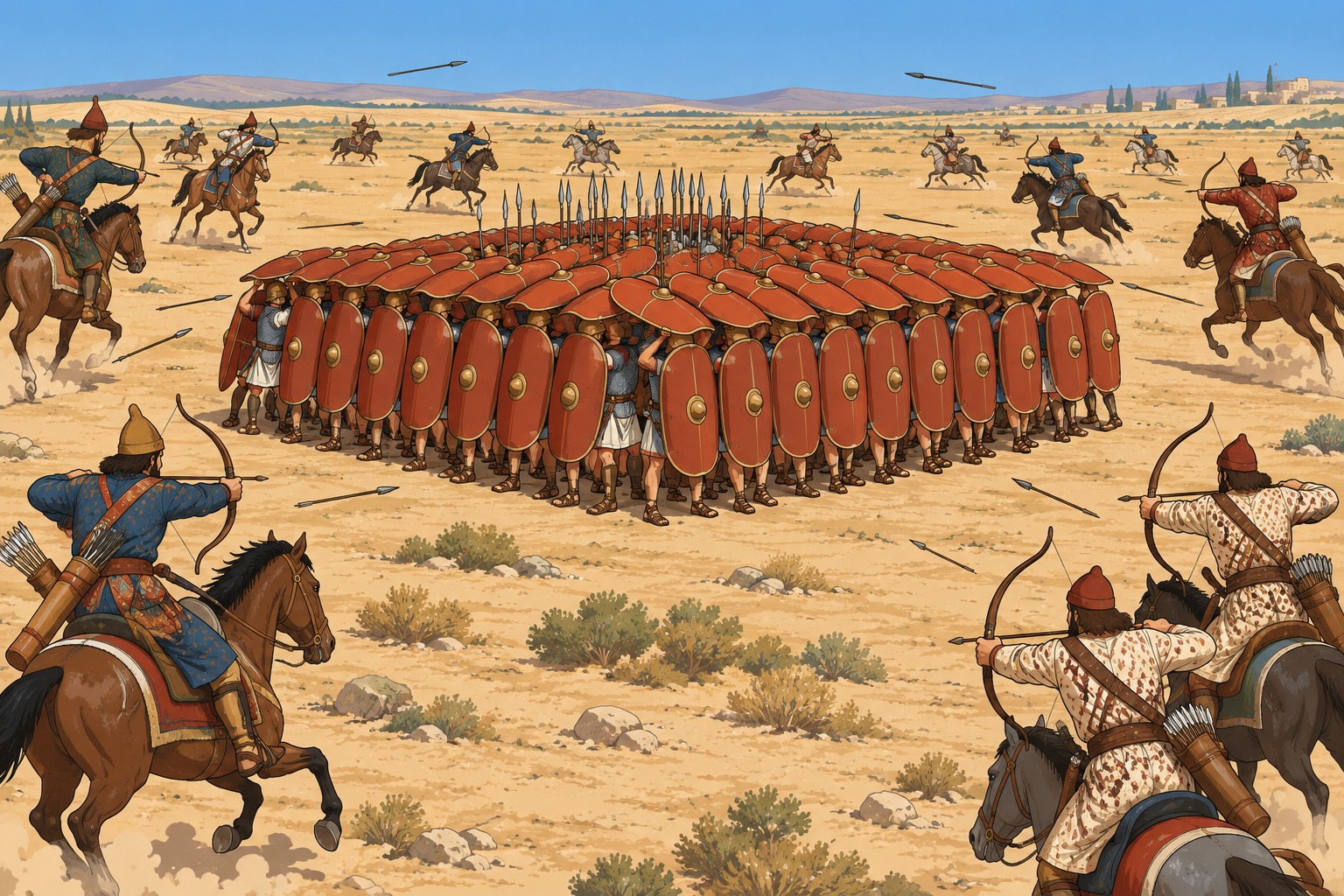
| 53 BC | Crassus is defeated at Carrhae by the Parthian general Surena. Ovid gives the day as 9 June; some modern reckonings put it in May. Surena's horse archers and mailed horsemen ride round seven legions; Crassus is killed days later at a parley. Plutarch counts about 20,000 Romans dead and 10,000 taken. Cassius leads the survivors back to Syria. |
| 18 January 52 BC | Milo's men kill Clodius, and riot follows (Powers of the Republic, The Streets). The Senate makes Pompey sole consul. |
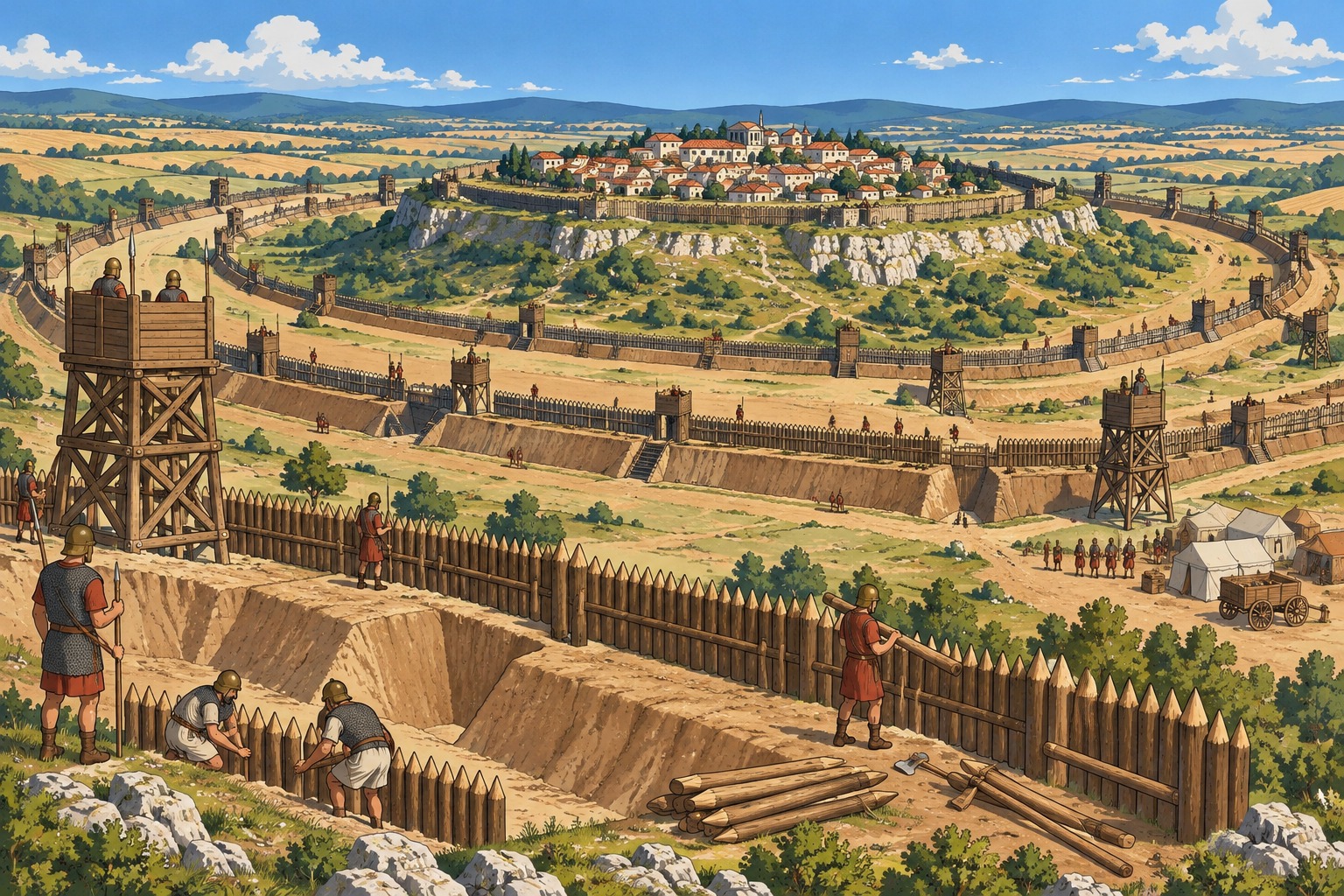
| 52 BC | Gaul rises under Vercingetorix of the Arverni. Caesar storms Avaricum, fails at Gergovia and besieges Alesia. Caesar reports 80,000 Gauls shut inside with Vercingetorix and a relief army of 8,000 cavalry and about 240,000 foot (Gallic War 7.71 and 7.76); his numbers are his own claims. Vercingetorix surrenders. |
| 51 BC | The last Gallic strongholds fall; at Uxellodunum Caesar cuts off the water and, Hirtius says, has the hands of those who bore arms cut off. The consul Marcus Marcellus moves to replace Caesar. Ptolemy XII dies early in the year and leaves Egypt to Cleopatra VII and Ptolemy XIII. A Parthian raid into Syria is beaten off by Cassius. |
The map year itself, month by month, is in Powers of the Republic, The Last Year Before the War.
The Record Beyond the Map Year
In January 49 BC the Senate passes its emergency decree and Caesar takes one legion over the Rubicon. Pompey and the Senate leave Rome. Pharsalus follows in 48 BC, Munda in 45 BC and Caesar's killing on the Ides of March 44 BC. His death sets up Actium in 31 BC and Augustus in 27 BC. In 50 BC all of this lies ahead.
See Historical Reference, After the Map Year, 49 to 27 BC for the people and events. Running the Era, The Approach of the Civil War explains whether the table can change that history.
| To find | Read |
|---|---|
| Each power's leaders, strength, aims and agents | Powers of the Republic |
| Gods, temples, priesthoods, sacrifice and the festival calendar | Gods and Religion |
| The city, its quarters and its people | Rome |
| Egypt's capital and the Ptolemaic court | Alexandria |
| The conquered country, the provinces and the frontiers | Gaul and the Provinces |
| Ordo, Dignitas, favors, law, illness, travel, slavery and money | Era Rules |
| Wages, rents, food, arms, bribes and purchased people | Gear and Prices |
| Gladiators, games and the Circus | The Arena and the Games |
| Legions and battles | Legion Battles |
| The people of the age, by name | Historical Reference |