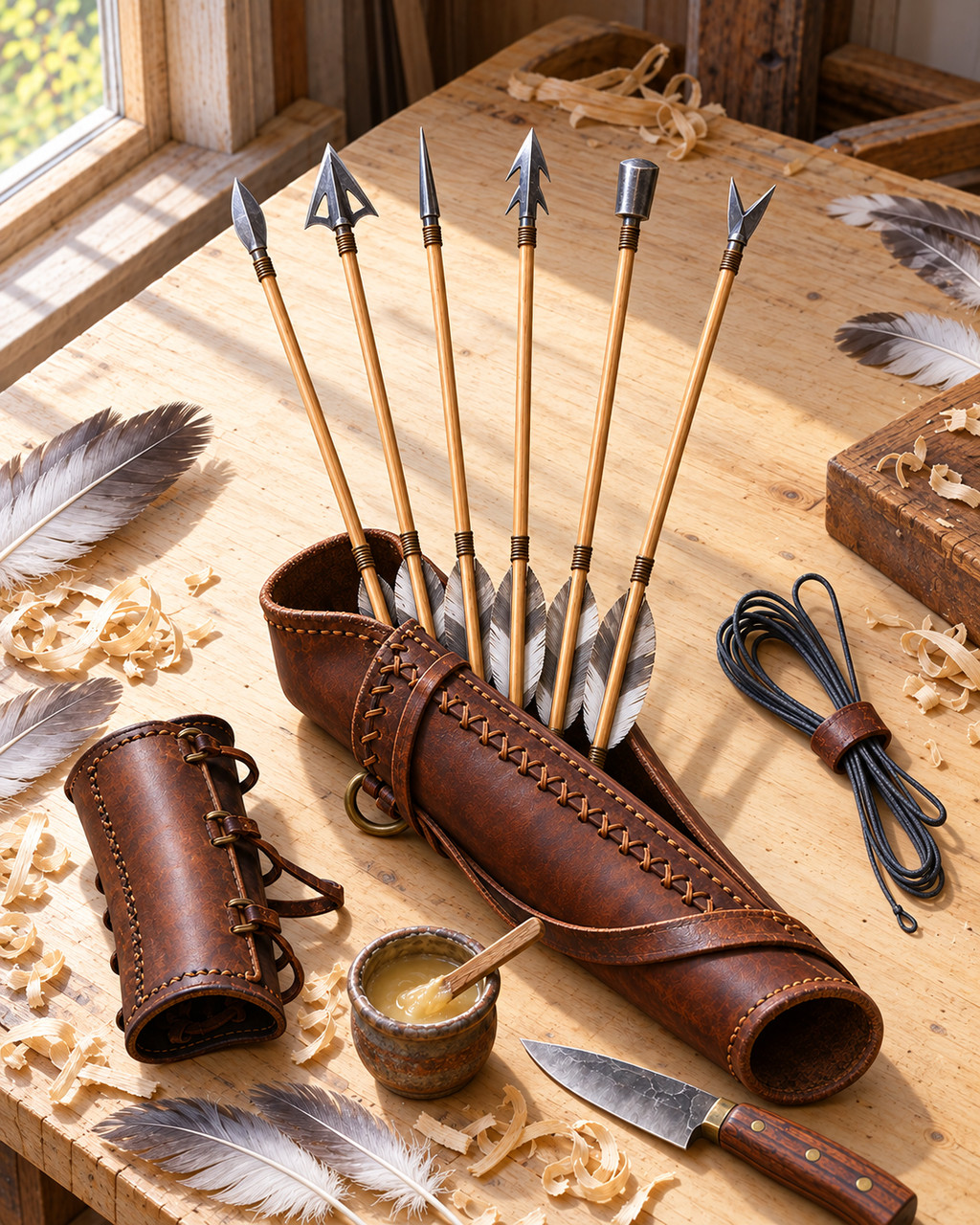
The Ranged Armory · Chapter 9
Ammunition
This is the chapter the book was written for.
Every launcher in Chapters 4 through 8 is half a weapon. The other half is bought here, changed independently, and swapped in the middle of a fight.
A quiver is a shaft plus a head.
The shaft decides which launcher it fits and what the projectile fundamentally is. An arrow, a quarrel, and a blowgun dart are not the same object at different sizes; they fly differently, they carry different loads, and they are not interchangeable between launchers.
The head is the modifier. It changes damage type, adds a quality, and usually takes one away. A head fits any shaft physically capable of carrying it, so a broadhead is defined once and works on arrows, quarrels, and atlatl darts alike.
Price is the shaft's base cost plus the head's modifier, for a unit of twenty.
The Two Rules
1. A quiver is one purchase, not one arrow. Buy twenty at a time. Track quivers. No table should ever be counting individual shafts, and no entry in this chapter is priced as though it will be.
2. Switching quivers is a maneuver. This is the decision the whole system exists to create. An archer who sees mail coming toward them can answer it, and answering it costs them the maneuver they were going to spend moving.
Recovery
Roughly half of spent shafts can be recovered after a fight, per the standing Ix rule, at the GM's discretion and given time to walk the field.
Two heads are marked cannot be recovered and mean it. Barbed heads are built not to come out and are destroyed removing them. Incendiary heads are consumed.
Scavenged weapons ignore this chapter entirely while they are shooting what the ground provides. A sling throwing river stone has no quiver, no cost, and no head. The cast and fired shot below exist for slingers who want to give that up in exchange for consistency, which is the only interesting decision the sling family has.
Compatibility
Each shaft lists which launchers it fits and which heads it accepts. Nothing else is legal.
| Shaft | Fits | Accepts |
|---|---|---|
| River Stone | Slings, Stonebow | no heads |
| Fired Clay Shot | Slings, Stonebow | no heads |
| Cast Lead Glans | Slings, Stonebow | no heads |
| Arrow | Chapter 5 bows | all nine heads |
| Quarrel | Chapter 6 crossbows | all except Whistling and Poisoned |
| Blowgun Dart | Blowgun, Long Blowgun, Sumpitan | Standard, Poisoned |
| Atlatl Dart | Atlatl, Amentum | Standard, Broadhead, Bodkin, Barbed |
| Majra Dart | Arrow-Guide Bow | Standard, Bodkin, Barbed |
| Engine Munition | Chapter 8 engines | Standard, Incendiary; bolt engines also Bodkin |
Heads do not stack. One head per shaft, chosen when the quiver is made up.
A launcher's printed damage type is what it does with a standard shaft. The head overrides it. A crossbow is Thrusting until a blunt quarrel makes it Crushing.
Shafts
River Stone
No modifier. Scavenged: free, and not tracked. — ∞
Slings and the Stonebow. No heads.
What the ground provides. Unequal in weight, unequal in shape, and the reason every sling in Chapter 4 carries Inaccurate 1.
Fired Clay Shot
Remove Inaccurate 1 from the launcher. 10 20
Slings and the Stonebow. No heads.
Moulded, dried, and fired to a consistent weight and diameter.
This is ammunition that repairs the weapon. Ten pieces removes the sling family's defining flaw, and it is the cheapest quality-removal in the book. It is also the moment a slinger stops being free to run.
Cast Lead Glans
Pierce 1, and the damage type becomes Thrusting. Remove Inaccurate 1. 30 20
Slings and the Stonebow. No heads.
Lead run into a two-part mould, almond shaped, dense enough to punch rather than batter.
It does everything clay shot does and adds Pierce 1 on top, turning a Crushing weapon into a Thrusting one. A slinger with a pouch of these threatens armour, which no sling otherwise does.
Roman glandes were routinely cast with insults moulded into the surface. This is not a rule. It is simply true, and the GM may do with it as they like.
Arrow
The baseline. No modifier. 10 20
All nine heads.
A fletched wooden shaft, self-nocked or horn-nocked, cut to the archer's draw.
The most versatile projectile in the book and the only one that takes every head. Anything in Chapter 5 shoots these, except the Arrow-Guide Bow.
Quarrel
Pierce 1. The launcher cannot use Arcing. 15 20
All heads except Whistling and Poisoned.
Short, thick, and heavy, with vanes of leather or thin wood rather than feather.
A quarrel is a worse projectile that arrives with more behind it. The mass buys Pierce 1 on any launcher that shoots them, and the stubby profile is why nothing shooting quarrels can loft a shot over cover.
The Pierce here stacks with a bodkin head, which is how a heavy crossbow reaches the highest penetration in the book.
Blowgun Dart
Silent. May carry a Poison payload. Cannot use any head but Standard or Poisoned. 5 20
Standard and Poisoned only.
A sliver of hardwood with a cone of kapok or thistledown at the base to seal the bore.
This is why the shaft and head are separate axes. A blowgun dart is not a small arrow. It weighs almost nothing, it cannot carry a steel head without losing all its range, and it does its work through what is smeared on the tip rather than through what it does on impact.
Atlatl Dart
The baseline for spear-throwers. No modifier. 20 5
Standard, Broadhead, Bodkin, Barbed.
A shaft between four and six feet long, flexible enough to bend around the throw and recover in flight.
Five to a bundle, not twenty. These are almost small spears, and a character carries a handful rather than a quiver.
Not a javelin. A javelin is thrown by hand and appears in The Fantasy Armory. An atlatl dart cannot usefully be thrown without the board.
Majra Dart
The baseline for the Arrow-Guide Bow. No modifier. 25 20
Standard, Bodkin, Barbed.
A shaft half the length of an arrow, running in a grooved guide strapped to the bow hand.
Costs more than an arrow and does the same thing, which is the price of the range band the Arrow-Guide Bow buys with it. An enemy who recovers these cannot shoot them back without a guide of their own.
Engine Munition
The baseline for Chapter 8. No modifier. Bolts are Thrusting; stones are Crushing. 40 10
Standard and Incendiary only. Bolt engines also accept Bodkin.
Spear-length bolts for the direct-fire engines, dressed stone for the indirect ones.
Bought by the cartload and priced accordingly. Ten shots is a morning's work for a crew, and a siege is measured in how many carts arrived.
A besieger who runs out throws whatever is available: masonry, dead animals, and the heads of messengers. All of these use this line and none of them are cheaper.
Heads
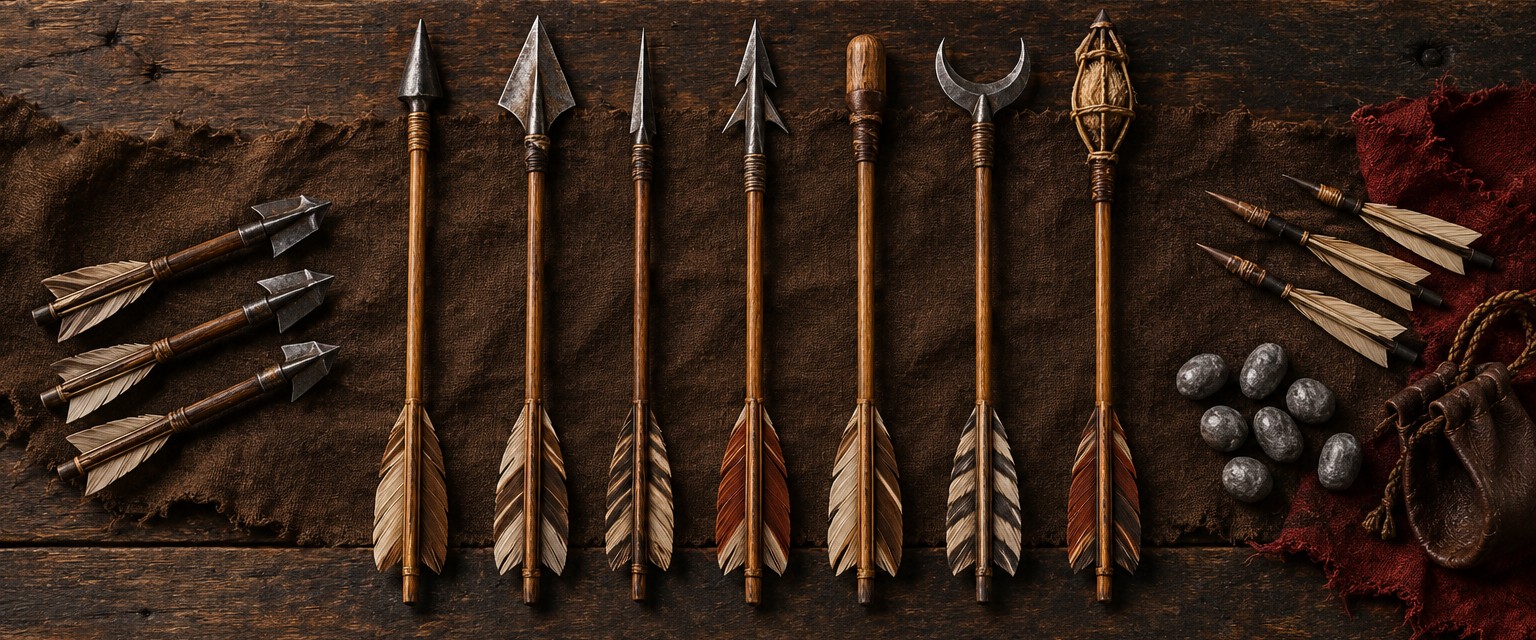
Nine heads. Each modifies the launcher's line and most take something away as well as adding.
Standard
No modifier. +0 20
A simple tapered point of iron or bone, or a fire-hardened tip on the cheapest shafts.
It does nothing, it costs nothing, and it is what is in the quiver unless a character has spent money on the question. A book about ammunition needs an entry that means "you did not think about this," and this is it.
Broadhead
Vicious 1. Damage becomes Cutting. Lose Pierce from the shaft. +5 20
A wide barbed blade, two or three edges, built to open a channel rather than punch a hole.
The hunting and anti-personnel head, and the cheapest upgrade in the chapter. Against an unarmoured target it is strictly better than standard. Against mail it is strictly worse, because the width that does the damage is the width that stops it going through.
Bodkin
Pierce 2. Lose Vicious. Cannot be used with Broadhead. +10 20
A long square-sectioned spike with no barbs and no edge at all.
This is the armour answer, and it is the cheapest one in the entire system. Ten pieces on top of a ten-piece quiver turns any bow in Chapter 5 into a weapon that ignores two points of Resistance.
Compare what the melee reader pays for the same capability: a second weapon, several hundred pieces, and the Encumbrance of carrying both. An archer answers armour for twenty and a maneuver. That asymmetry is deliberate and Chapter 2 explains why it is correct.
On a quarrel, the shaft's own Pierce 1 stacks with this for Pierce 3.
Barbed
Bleed 1. Damage becomes Cutting. Cannot be recovered. +15 20
Rearward-facing barbs behind the blade, sometimes loosely socketed so the head stays in when the shaft is pulled.
Bleed 1 ignores Resistance and does not stop, which makes this the head for a target that is going to run. A deer, a courier, a man on a horse.
Cannot be recovered is not a bookkeeping note. The head is designed to be destroyed coming out, and cutting one free is what the Bleed represents.
Blunt
Stun Damage. Knockdown. Damage becomes Crushing. Lose Pierce. +5 20
A wooden or horn cylinder over the shaft's end, or a padded knob. Called a judo point by fowlers.
Stun Damage sends the whole hit to Strain, which turns any bow or crossbow in this book into a weapon for taking somebody alive. Knockdown puts them on the ground while you do it.
It is also what a hunter shoots at birds and squirrels, because it does not ruin the meat and the shaft is easy to find afterwards. Both uses are the same head and the same five pieces.
Poisoned Dart
Poison 2. Cannot be recovered. +45 20
Blowgun Darts only.
The same dart, tipped and dried.
Poison 2 ignores Resistance entirely and continues until the target makes an Average Fortitude check at the end of its turn. On a weapon that does 2 damage, this is not a bonus, it is the weapon.
The rating above is a generic hunting preparation: Blade Venom in The Apothecary, which has the full poison rules and a catalogue of compounds to substitute.
Swallowtail
Sunder. Damage becomes Cutting. Lose Pierce. +10 20
Two backswept crescent blades on a forked head, sharpened on the inside edges.
Sunder against objects rather than people is what this is for. Rigging, bowstrings, tent ropes, banners, and the straps holding a shield to an arm. A naval archer with a quiver of these can take a ship's mobility away without hurting anybody aboard.
Against a person it is a poor broadhead that costs twice as much.
Incendiary
Burn 1. Cannot be recovered. Must be lit, which is a maneuver. +40 20
Tow and pitch bound behind the head in a wire cage, or a small sealed pot of the same mixture the siphon in Chapter 8 uses.
By far the most expensive head, and the only one with a firing cost. Lighting the quiver is a maneuver, and it is a maneuver spent before shooting rather than instead of it. An archer who wants to open with fire has committed a round to saying so, in front of everybody.
Burn 1 is small and it does not stop. This is not an anti-personnel head. It is for thatch, sails, tents, oil, powder stores, and anything that will do the real work once it catches.
Engines take an incendiary munition on the same principle at ten times the price.
Whistling
Disorient 1. No damage bonus. Arrows only. +10 20
A pierced bone or horn bulb behind the head that shrieks across the whole flight.
It is the only head in this chapter that does not try to hurt anyone, and the only one that is worth buying for reasons outside a fight. A whistling arrow signals across a valley, marks a target for a whole formation, opens a battle by agreement, and tells a camp that the scouts have found something.
Disorient 1 is what it does when it does arrive: a sound like that, arriving with an arrow, makes the next thing a person does worse.
Cannot be fitted to a quarrel. The bulb needs a long shaft behind a light head, and a crossbow bolt is the opposite of both.
Building a Quiver
Three examples, priced.
| Shaft | Head | Total | |
|---|---|---|---|
| Militia archer | Arrow 10 | Standard +0 | 10 |
| Hunter | Arrow 10 | Broadhead +5 | 15 |
| Answering mail | Arrow 10 | Bodkin +10 | 20 |
| Crossbow, armour | Quarrel 15 | Bodkin +10 | 25 |
| Taking one alive | Arrow 10 | Blunt +5 | 15 |
| Cutting rigging | Arrow 10 | Swallowtail +10 | 20 |
| Burning a roof | Arrow 10 | Incendiary +40 | 50 |
| Assassin | Blowgun Dart 5 | Poisoned +45 | 50 |
A well-equipped archer owns one bow and four quivers, and the four quivers cost less than the bow. That is the correct shape and it is the argument this book was written to make.
The character who spent 190 on a Heavy War Bow and shoots standard heads out of it is worse against an armoured target than the character who spent 30 on a Short Bow and 20 on bodkins.
The launcher decides how far and how often. The head decides what happens when it arrives.