
The Ranged Armory · Chapter 8
Siege Engines
Nothing in this chapter is carried, and nothing in it is bought by a character on their own account. These are unit assets: a purchase, a crew, a cart, and somewhere to put them.
Emplaced and Crew X are on almost every entry, and between them they are why a ballista is not simply a large crossbow. A large crossbow is a purchase. A ballista is a purchase and four people who cannot be doing anything else.
These prices are not a discount. They are the honest cost of a capital asset. A counterweight trebuchet costs more than most characters will ever hold at once because it is one: months of timber and ironwork, a trained crew, and a target worth the investment. The drawback stack (Crew, Emplaced, Prepare, Slow-Firing) is why these numbers are survivable at the table, not why they are cheap.
The chapter splits on trajectory, and the split decides everything about how an engine is used.
| Trajectory | Needs line of sight | Kills | Signature | |
|---|---|---|---|---|
| Direct fire | Flat | Yes | A person, through their armour | Pierce, Auto-Fire |
| Indirect fire | Arcing | No | A wall, a roof, a formation | Arcing, Blast |
Skill: Gunnery throughout.
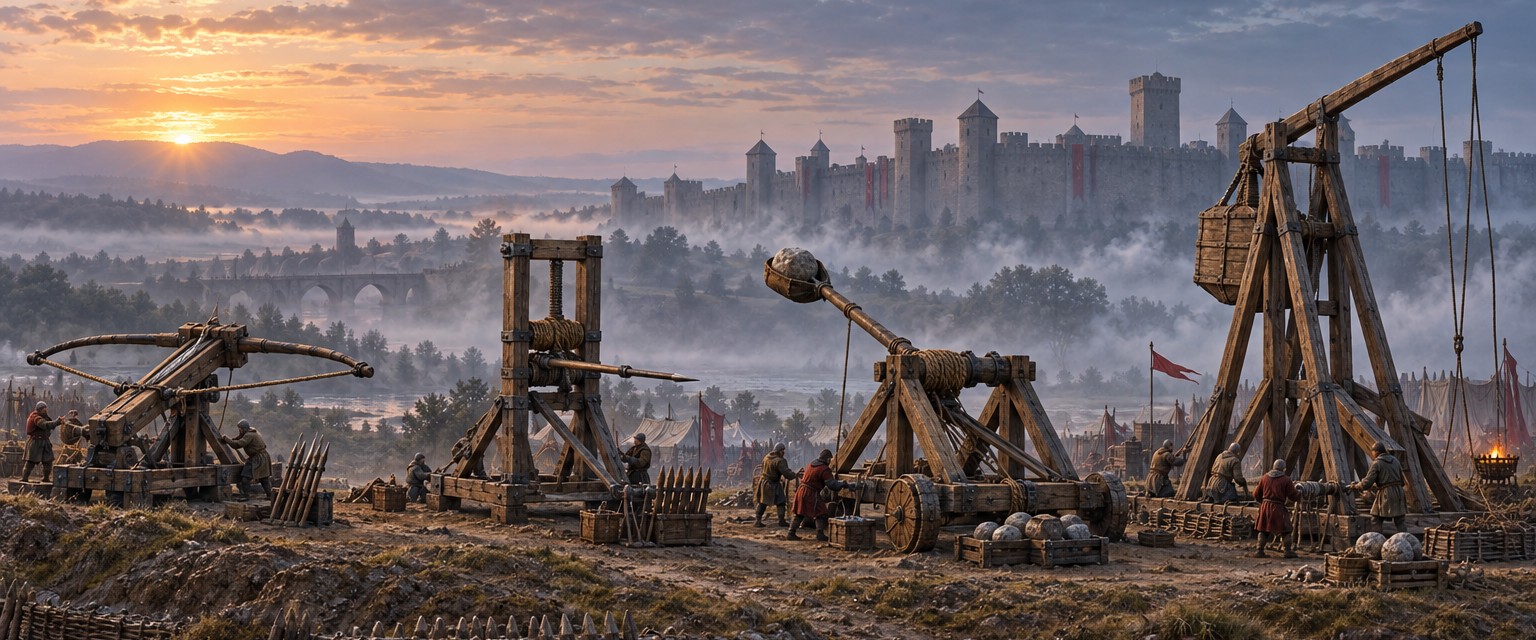
Target Zones
Every weapon in this chapter with the Crew quality is a maneuvering problem before it is an aiming problem. None of them track a moving target the way a bow does. Each is laid on a stretch of ground before the fight starts, and turning one to face somewhere else is not something a single crewman, or sometimes even the full crew, does in the time it takes an arrow to nock.
Rather than being aimed at a person, an engine covers a Zone: a short-range circle of ground the crew has already ranged and sighted before the encounter begins.
Firing into the Zone. An attack against the Zone itself, a group standing in it, an area effect such as Blast, or simply whoever is in it, uses the weapon's profile exactly as printed.
Firing at someone in the Zone. Picking out one specific person inside the Zone, rather than firing at it generally, adds 1 Bane Die to the attack. The crew is tracking a single resisting target instead of a fixed patch of ground it has already found.
Shifting the Zone. Moving the Zone anywhere else costs a number of Maneuvers equal to the weapon's Crew rating, spent among however many operators are on hand and working the weapon. This is spent in addition to the weapon's own Prepare or Slow-Firing requirement before a shot can be loosed into the new Zone.
No weapon in this chapter can shift its Zone and fire in the same round. Redirecting an engine is a visible, physical act: ropes hauled, a post levered around, a cart re-sighted. Readying a shot afterward is a separate undertaking. A crew mid-shift is an obvious thing to see happening, not a hidden threat.
Why this matters at the table. A Counterweight Trebuchet already laid on the section of wall the party is climbing is a foreshadowed threat: the players saw the engine, and the engine was already pointed there. A Counterweight Trebuchet swinging onto the party from across the yard is not a threat that resolves that round. It is the entire crew visibly abandoning whatever else they were doing to haul on the tackle, which buys the party the round, or several, it takes to get out of the new Zone before the weapon is ready to fire into it. These weapons can still kill a character outright. They cannot do it to someone who was watching the yard.
The Breach Ladder
Damage answers what a weapon does to a person. It does not answer what a weapon does to a gate. Structures track their own condition on a three-step ladder: Intact, Cracked, Breached. A door, a wall section, or a hull on Intact functions normally. Cracked shows the damage and gives a searching character something to find. Breached is an opening: something a person can go through, or a wall that no longer stands between two sides of a fight.
Only a weapon carrying Siege X can move a structure along this ladder, regardless of how much raw damage a non-Siege weapon deals. A hero can spend all day putting arrows into a castle gate and it stays Intact; that is not a rules oversight, it is the entire reason siege engines exist as a category.
A Breakthrough on an attack against a structure advances it ⌊X ÷ 5⌋ + 1 steps along the ladder. A Success without a Breakthrough may instead spend 3 Boon to advance it 1 step. Everything below Siege 5 cracks a gate on its best roll and needs a second hit to put it through; Siege 5 and above can open one in a single Breakthrough.
This is why the direct-fire weapons in this chapter are answered with time and a second volley, and the indirect throwers are answered with getting out of the way.
Direct Fire
A bolt on a flat trajectory at something the crew can see. These are anti-personnel weapons that happen to be enormous, and every one of them will kill an armoured man outright.
Wall Crossbow
Swivel Bow, Rampart Latch, Great Crossbow, Post Bow
9 3 Extreme —
Gunnery 575 Military Thrusting Pierce 2, Siege 2, Emplaced, Slow-Firing 2, Crew 2, Prepare 1
An oversized crossbow on a swivel post, spanned with a two-man windlass.
It is the bridge between Chapter 6 and this one. Two people, a post, and a weapon that is mechanically a crossbow in every respect except that it cannot be picked up.
The garrison weapon. Every gatehouse has one, most of them are older than anyone serving under them, and they work.
Scorpion
Scorpio, Bolt Thrower, Torsion Latch, Small Ballista
9 2 Extreme —
Gunnery 850 Military Thrusting Pierce 2, Siege 2, Accurate 1, Crew 2, Slow-Firing 2, Prepare 2, Emplaced
Two vertical skeins of twisted sinew, each holding one arm, driving a bowstring down a groove.
Crit 2 is the best in the book. Nothing else, carried or emplaced, kills as reliably on a good roll. Torsion delivers the same energy the same way every shot, and a scorpion crew that has ranged a gateway will hit that gateway all afternoon.
The sniper of the siege train. It is aimed at officers, not at walls.
Springald
Espringal, Skein Bow, Tension Engine, Wall Springald
10 3 Extreme —
Gunnery 800 Military Thrusting Pierce 3, Siege 3, Crew 2, Slow-Firing 3, Prepare 2, Emplaced
Inswinging arms driven by twisted rope, built compact enough to sit inside a wall embrasure and shoot through an arrow slit.
Pierce 3 matches the arbalest for noticeably less, and everything saved is paid back in Slow-Firing 3. Three Actions between shots is roughly one shot every four rounds. A springald crew gets two shots at a column crossing open ground and no more.
It is the fortification's answer to armour, and it is designed around the assumption that the crew is behind stone and can afford to be slow.
Ballista
Ballistae, Great Bolt Thrower, Euthytonon, Bolt Engine
13 3 Extreme —
Gunnery 2250 Military Thrusting Pierce 3, Siege 3, Auto-Fire, Crew 4, Slow-Firing 3, Prepare 2, Emplaced
The scorpion built to the largest size torsion will bear, throwing a bolt as long as a spear.
Auto-Fire is what this weapon is for. A ballista bolt does not stop at the first man in a column: spend Boon and loose again into the next one, at the cost of a wilder shot. Pierce 3 means the armour does not matter and damage 13 means the Resistance does not either.
Crew 4. Four people, all day, and the engine still cannot turn to face a flank.
Aimed down a road, a bridge, or a breach. Anywhere the enemy has to come in a line, which is why they were sited at gates.
Polybolos
Repeating Ballista, Chain Engine, Magazine Ballista, Dionysian Engine
8 3 Extreme —
Gunnery 400 Rare Thrusting Pierce 2, Limited Ammo 12, Crew 3, Prepare 2, Fragile 1, Emplaced
A flat chain drive turned by a windlass spans the bow, drops a bolt from a hopper, and looses it, over and over, as long as somebody keeps cranking.
This is the one engine in the chapter that does not carry Siege. Its logic is rate of fire against a line of soldiers, not payload against a wall, and a weapon built around that trade does not also need to be the answer to a gate.
No Slow-Firing. It is the repeating crossbow's logic at siege scale, and it is the only engine here that shoots at the rate of a hand weapon while still hitting harder than a hand weapon ever could.
Fragile 1 is the chain, and it is the reason the design never spread. A machine with that many moving parts under that much load is a machine that jams, and a jammed polybolos is a very expensive bench.
Twelve bolts, then several minutes of reloading the hopper.
Carroballista
Cart Ballista, Mule Engine, Field Scorpion, Wagon Bow
9 3 Extreme 12
Gunnery 575 Military Thrusting Pierce 2, Siege 2, Accurate 1, Crew 3, Slow-Firing 2, Prepare 2
A scorpion on a two-wheeled mule cart, laid and fired from the bed without ever coming off it.
It is the only engine in this chapter that is not Emplaced, and that is the entire product. Everything else here is sited before the battle and stays where it was put. This one follows the line, redeploys to a threatened flank, and leaves when the day goes badly.
It prints an Encumbrance rather than a dash because it genuinely has one. Twelve, and a mule to carry it.
Costs about what a stationary wall crossbow does and hits less hard than the ballista. Nobody buys it for raw numbers; they buy it for the wheels.
Indirect Fire
Stone on an arcing trajectory at something the crew cannot see. Arcing is on every entry below, which means Light cover is irrelevant to all of them, and none of them can attack at Engaged range at all.
These do not kill people efficiently. They kill roofs, gates, formations, and morale.
Perrier
Traction Sling, Hand Mangonel, Petrary, Light Stone Thrower
9 4 Long —
Gunnery 300 Common Crushing Arcing, Blast 2, Siege 4, Crew 3, Slow-Firing 2, Prepare 2, Inaccurate 1, Emplaced
A beam on a trestle with a sling on the long arm and three ropes on the short one. Three people pull down, the stone goes up.
It is the cheapest engine in the book and it is made of a tree. Three hundred buys the ironwork; the timber is cut where it is used and left behind afterwards. Any village can build one in a day with instructions.
This is the engine a peasant revolt has, and it is the reason a manor house with a wooden roof is not defensible against one.
Onager
Mangonel, Catapult, Wild Ass, Torsion Thrower
12 4 Extreme —
Gunnery 1600 Military Crushing Arcing, Blast 3, Siege 5, Crew 4, Slow-Firing 3, Prepare 3, Inaccurate 1, Emplaced
A single arm through a horizontal skein of rope, hauled back by winch and released to slam against a padded stop.
Torsion is what makes it expensive. Skeins of sinew or hair, correctly tensioned, are the most costly component in any engine here, and they are why an onager costs twice a traction trebuchet that throws the same stone.
They are also why it kicks. The whole frame jumps on release, which is the Inaccurate 1 and the reason it was named after a kicking animal.
Traction Trebuchet
Mangonel, Pulling Engine, Rope Trebuchet, Crew Sling
12 4 Extreme —
Gunnery 800 Military Crushing Arcing, Blast 3, Siege 5, Crew 8, Slow-Firing 2, Prepare 2, Inaccurate 1, Emplaced
The perrier at full scale: a beam thirty feet long with a sling at one end and forty ropes at the other.
Crew 8 is the highest in the book, and it is the whole trade. Where the onager buys its power with expensive twisted rope, this buys the same power with people, and people are cheaper than sinew.
A shorthanded crew is a slower and wilder engine, which is exactly what Crew models: every operator short adds a Bane Die and a point to both Prepare and Slow-Firing.
Faster to reload than an onager, because eight people hauling a rope beat one winch.
Counterweight Trebuchet
Trebuchet, Great Engine, Warwolf, Counterpoise
14 4 Extreme —
Gunnery 6325 Military Crushing Arcing, Blast 5, Siege 6, Accurate 1, Crew 6, Slow-Firing 3, Prepare 3, Emplaced
A hinged box of earth and lead falling twenty feet on the short arm of a beam, throwing a stone the height of a man.
Blast 5 is the largest effect in this book and 6,325 is the highest price. This is the wall-breaker, and everything else in the chapter is a personnel weapon by comparison.
It is also the only indirect engine that is not Inaccurate. A falling weight falls the same way every time, so a crew that has found the range will land the next stone where the last one went. That consistency is what made counterweight engines end the age of the high curtain wall.
Built on site over days, from a cartload of ironwork and whatever timber is nearby. When the siege lifts it is burned, because nobody moves one.
Naphtha Siphon
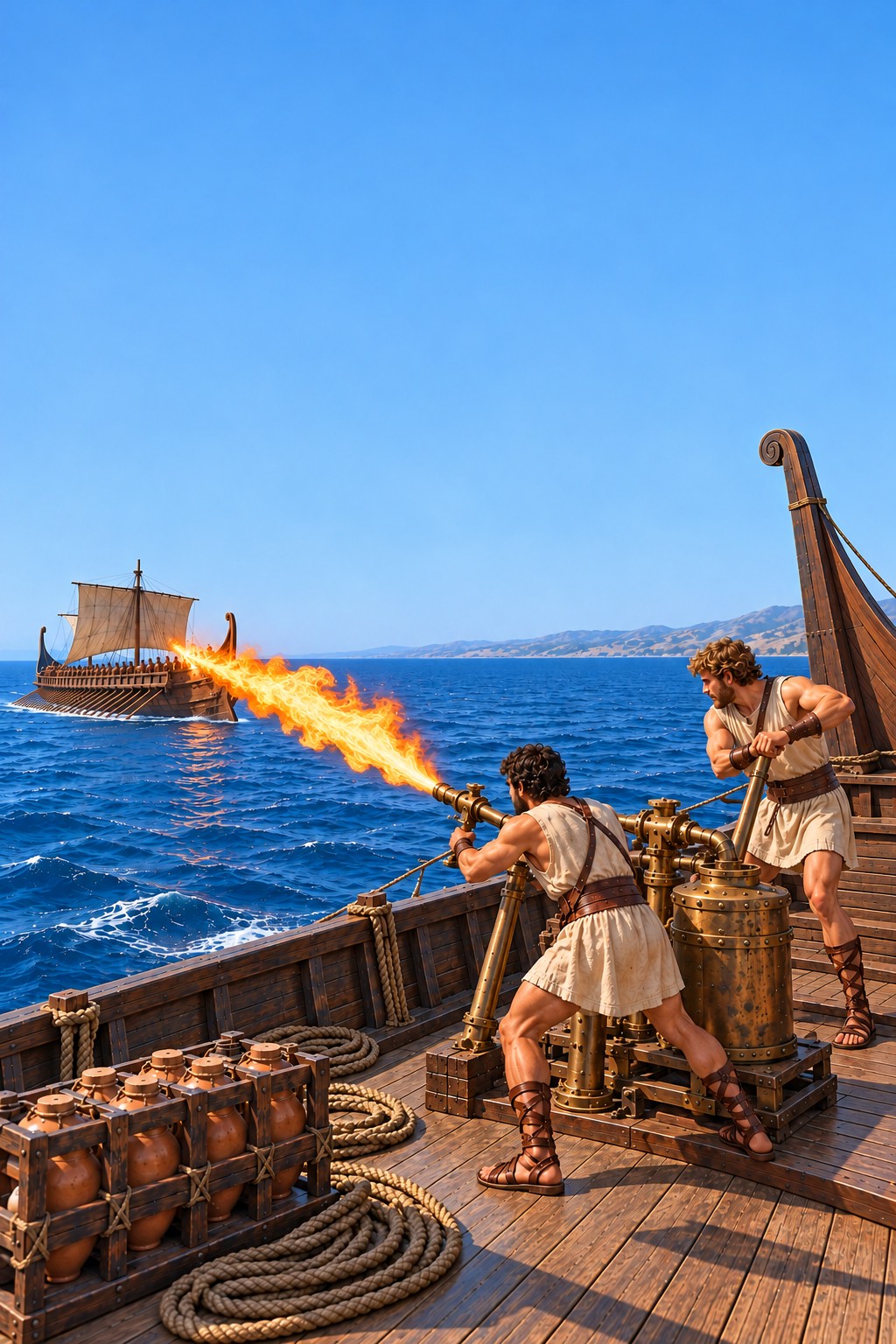
Fire Siphon, Greek Fire Projector, Pump Flame, Sea Fire
7 — Short —
Gunnery 725 Rare — Burn 3, Blast 2, Siege 2, Crew 3, Prepare 2, Limited Ammo 3, Fragile 1, Emplaced
A heated bronze reservoir, a force pump, and a nozzle, throwing a stream of burning liquid.
There is no projectile. That is why it is in this book at all: the line drawn in Chapter 1 excludes powder driving a shot, and this drives nothing. It is a pump.
Burn 3 is the highest in the book and it is the reason the weapon terrified everyone who met it. The damage is almost incidental; what matters is that everything it touches keeps burning, and that Blast 2 means it touches more than one person.
Fragile 1 on a pressurised vessel of burning liquid is not a note about equipment repair. The GM is invited to decide what a Calamity looks like on a crew of three standing next to it.
Three tanks, then the mixture has to be brewed again, and the recipe is worth more than the machine.