
The Heavy Armory · Chapter 1
Introduction
One person fires a rifle. Nobody fires a twenty-four-pounder. A gun captain gives the word, and seven other people have already done their part.
A heavy weapon is a crew, and the crew is the weapon.
That is true of a ballista, a carronade, a mortar, and a tank. It gives a group of player characters something to do together: one lays the gun, one loads, one spots, one keeps the enemy off the crew. This book is written so that each of those is a job with a rule.
What You Should Expect
One stat line for three thousand years. A bombard and a main battle tank gun are read the same way. Mount, Hull damage, Crit, Range, Crew.
Crews. Every crew weapon says how many people it needs and how many rounds it takes between shots. Chapter 3 says what happens when some of them are missing or dead.
Batteries and broadsides. Fourteen guns fired on one command are one attack. Chapter 3 has the rule.
Indirect fire. Mortars and howitzers hit what the crew cannot see. They need a spotter and a round or two to find the range.
Two scales, settled. One point from a great gun is ten from a musket. Chapter 4 gives the whole procedure, including what the heavy weapons of the other armories do to a wall or a tank.
Walls. Chapter 5 gives doors, gates, palisades, castle walls, bastions, and bunkers an Armor and a Hull, so that a siege can be played.
Things to shoot at. Chapter 13 has thirty-nine vehicles, ships, and aircraft, from a war wagon to a battleship.
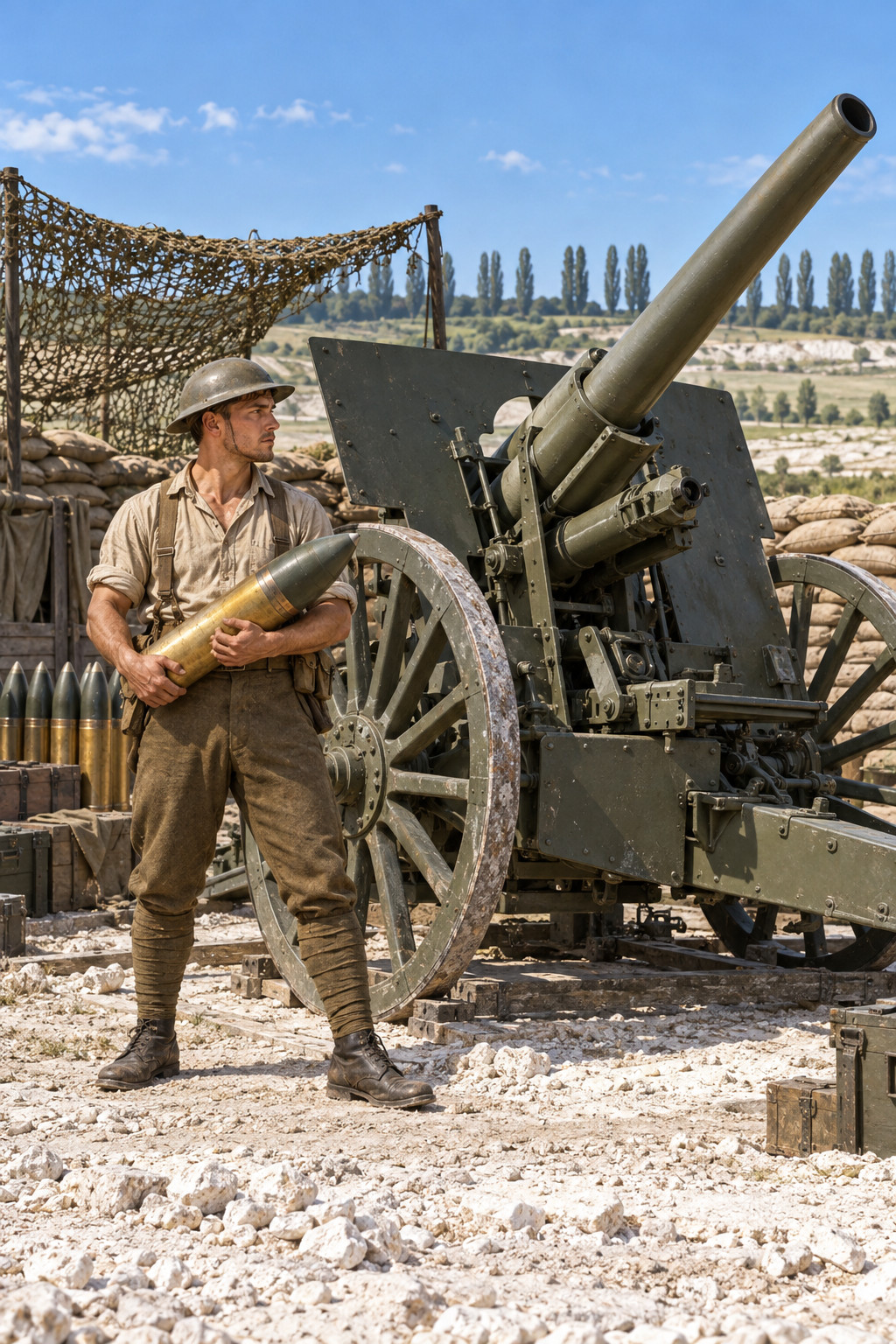
Four Periods
| Period | Years | The weapons |
|---|---|---|
| Ancient | To 1400 | Rams, bolt and stone engines, galley rams, the first bombards |
| Powder | 1400 to 1860 | Muzzle-loading guns on carriages, mortars, carronades, rockets |
| Industrial | 1860 to 1938 | Breechloaders, machine guns, trench mortars, turret guns, torpedoes |
| Modern | 1939 to today | Tank guns, automatic cannon, guided missiles, aircraft and naval weapons |
Every entry prints the first year or period in which it is found. Prices are by period too: each period uses the money of its own armory, as Chapter 2 explains, so a price in one period cannot be compared with a price in another. Old weapons stay in service for a generation or more after something better appears.
Using This Book in Your Universe
The names are generic. A Universe names its own guns.
A fantasy world uses the Ancient chapter with The Ranged Armory, and the Powder chapter if it has gunpowder. Nothing here assumes it does.
A pirate or musket game uses the Powder chapter with The Black Powder Armory.
A modern game uses the last four weapon chapters with The Modern Armory.
Space opera has its own book, The Starship Armory, built on the same stat line and the same two scales.
What You Need
The Exodus NDS core rules.