
The Heavy Armory · Chapter 5
Structures
A wall is a target with Armor and Hull Points, like a vehicle that does not move.
Attacking a Structure
The attack is Easy at any range from which the gunner can see it. Damage is the weapon's Hull damage plus Successes, less the structure's Armor and the weapon's Pierce. Personal weapons use Chapter 4.
A long wall is attacked one section at a time. A section is about as wide as a gate: room for two people abreast once it is down.
| The section has suffered | State | Effect |
|---|---|---|
| Less than half its Hull Points | Intact | None |
| Half or more | Cracked | Its Armor is 1 lower. People behind it lose one step of cover |
| All of them | Breached | A gap two people can pass abreast. The rubble is difficult ground |
These are the three steps of the Breach Ladder in The Ranged Armory. A table that does not want to count Hull Points may use that book's ladder as written: each step is half the section's Hull.
A structure does not suffer Critical Hits. Spend Boons equal to the weapon's Crit to deal 2 extra Hull Damage.
The Structures
| Structure | Armor | Hull | Notes |
|---|---|---|---|
| Interior door | 0 | 1 | A kick opens it: Average Athletics |
| Iron-bound door | 1 | 2 | A Petard or Breaching Charge opens it with no check |
| Wooden palisade, one section | 1 | 6 | Burns |
| Castle gate | 2 | 6 | With a portcullis behind it: Armor 3, Hull 4 more |
| Timber or wattle house | 0 | 6 | Burns |
| Brick or stone house | 2 | 10 | Gives heavy cover |
| Earth rampart or sandbag wall, one section | 3 | 12 | Blast is halved against it. It can be dug through, not knocked down |
| Stone curtain wall, one section | 4 | 20 | Vulnerable to guns: see below |
| Stone tower or keep | 5 | 30 | Vulnerable to guns: see below |
| Bastion of an artillery fort, one face | 5 | 40 | Low, thick, and earth-backed. Not vulnerable to guns |
| Timber-and-earth bunker | 3 | 10 | Indirect fire that hits ignores 1 Armor |
| Concrete pillbox | 6 | 16 | A hit through the firing slit ignores its Armor: add 3 Bane Dice |
| Reinforced concrete fortress, one block | 8 | 40 | Only Heavy and Capital weapons mark it |
| Bridge, wooden | 1 | 10 | Burns. Breached means impassable |
| Bridge, stone or steel | 4 | 24 | A demolition charge set on a pier counts double |
Vulnerable to guns. Tall medieval masonry was built to stop stones and ladders. Against gunpowder weapons of Standard mount or larger, a stone curtain wall, tower, or keep has 2 less Armor. This is why castles were replaced by low bastioned forts.
Burns. Wooden structures suffer Burn as wooden ships do: see Chapter 3.
Demolition
A charge placed against a structure uses the rules of its own book: an Average Craft check and the maneuvers in its Prepare rating, with no attack check. Its Hull damage comes from its Siege rating, by the table in Chapter 4.
Doors and gates. A Petard or a Breaching Charge opens the door or gate it is fixed to, as its entry says, with no arithmetic.
Charges set together add their Hull damage.
A mine. Sappers dig under a wall, prop the gallery, fill it with brush or powder, and fire it. Digging takes a day for each point of the wall's Armor, and an opposed Perception check each day against the defenders, who may dig a countermine. A fired mine deals 20 Hull Damage to the section above it and ignores its Armor.
Escalade, Towers, and Ladders
A wall that is not breached is climbed.
| Method | Check | Notes |
|---|---|---|
| Ladder | Average Athletics | One climber a round on each ladder. Defenders at the top add 2 Bane Dice |
| Siege tower | None once it reaches the wall | Its bridge puts four attackers a round onto the wall walk |
| Grapnel and rope | Hard Athletics | Silent. One climber a round |
A siege tower and a ram shed are vehicles in Chapter 13. They burn.
A Siege in an Evening
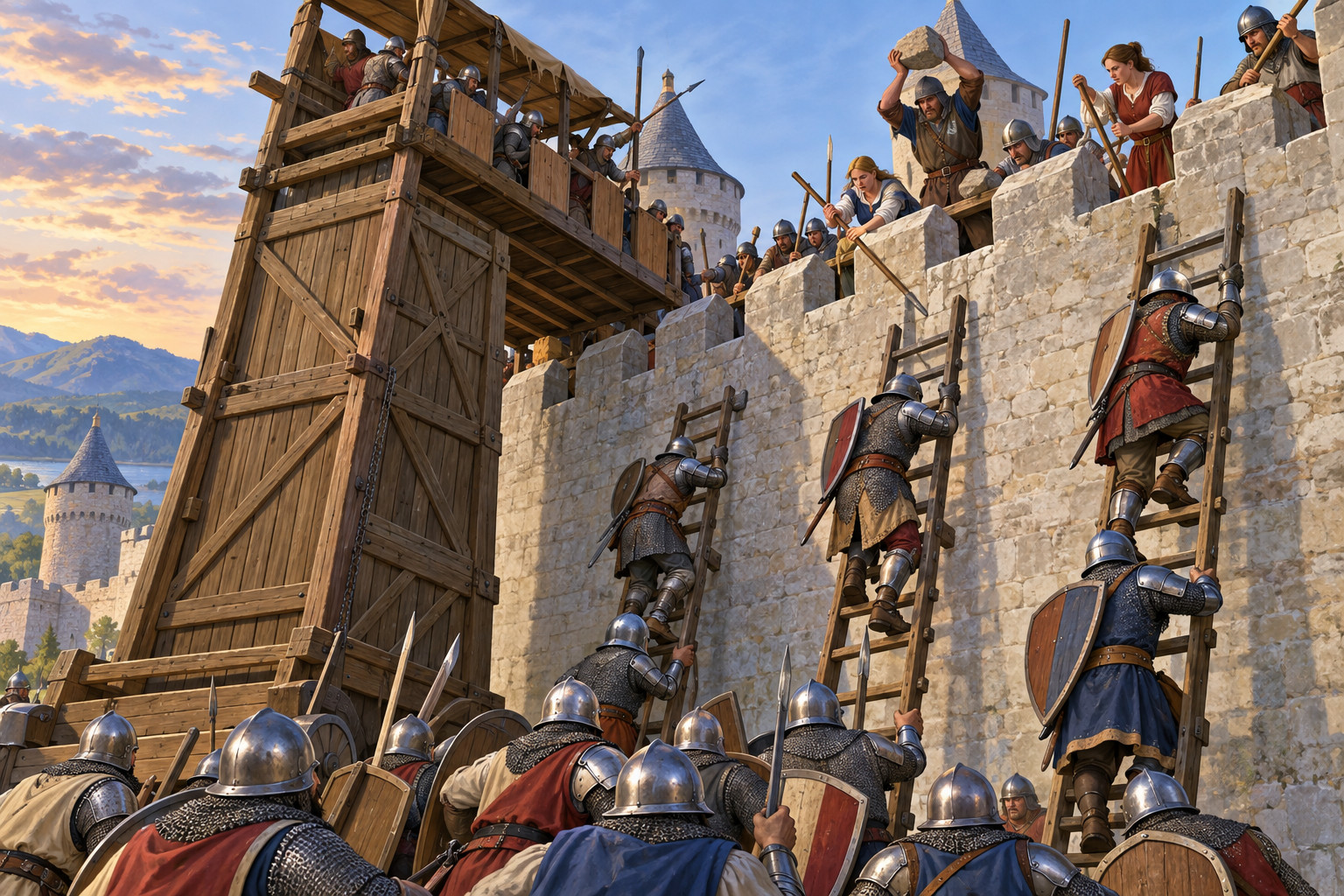
A siege takes weeks. A session should not.
Play the siege as three or four scenes. Each scene is one day or one week, at the GM's choice. In each, the besiegers' engines make one attack for each engine against the wall, and the defenders make one attack for each of theirs against an engine, a tower, or the camp. Then play one scene of the characters' own: a sortie, a night climb, a countermine, a parley.
When a section is Breached, play the assault.