Gear and Prices
Look up arms, armor, horses, medicine, keep, travel, services and hirelings here. The essential gear table supplies character creation and the starter adventure; the Source Book Map identifies other AD 1600 entries. For period-money conversions, Stakes and credit, see Era Rules, Money and Stakes.
Sellers may ask above or below these guide prices; no 1600 price list survives. Sourcebook prices are in Exodus. Apply this book's conversion and, when useful, read the period unit alongside it.
The Banners
- 武具 bugu (BOO-goo): arms and armor, a warrior's equipment.
- 米 kome (KOH-meh): rice, the measure of wealth.
- 銭 zeni (ZEH-nee): coin; the copper cash counted in mon.
Money in This Chapter
Scopes the Broker's Table (Era Rules, Money and Stakes). The table sets the rate: 1 ryo is 200 Exodus, 1 koku is 60, 1 momme is 4 and 20 mon are 1. At that rate 1 ryo is also 50 momme or 4,000 mon. In 1600 no rate was fixed, and the official rate of 1609 is later; here the rate is the book's, not the year's.
THE UNITS OF 1600
| Unit | What it is | In AD 1600 |
|---|---|---|
| Koku | A measure of rice, 180 liters or about 150 kg of brown rice (10 to, 100 sho, 1,000 go) | The measure of wealth. Fiefs, stipends and the great houses are counted in koku of assessed yield |
| Ryo | Gold | Gold circulates as oban, ingots and dust, weighed by the buyer. The Keicho koban, the 1 ryo coin of 17.76 g, is struck from AD 1601 (a later note) |
| Momme | Silver by weight, about 3.75 g | Silver is the staple of the west: Kyoto, Osaka and Sakai. Gold is the money of the east |
| Mon | Chinese copper cash, 1,000 to the kanmon | Everyday coin, strung on cords. The Eiraku coin of 1411 stays in use until it is demonetized in 1608 (a later note) |
Rice anchors value: a koku fetches 10 to 20 momme, or 800 to 1,600 mon or 0.2 to 0.4 ryo. This book takes the midpoint, 60 Exodus. The eighteenth-century equation "1 koku, 1 ryo" does not apply.
EXAMPLE: READING A SOURCEBOOK PRICE
The Arquebus costs 150 in The Black Powder Armory. At 20 mon to the Exodus that is 3,000 mon, or 37.5 momme, or 0.75 ryo. The record gives 0.3 to 1.5 ryo for a common military matchlock, so the sourcebook price is a fair one. The Powder horn and shot bag costs 10, which is 200 mon for thirty reloads. The record gives 240 to 600 mon for a hundred rounds of powder and ball, so the sourcebook's price is a little above it; use the sourcebook's.
Small goods. A price below 1 Exodus is not tracked. A character who can buy a meal, a pair of sandals or a night in a temple does so without spending from the Stake. Era Rules, Money and Stakes, Keep, says who pays for daily living; the tables below give the rates.
When the Sourcebook and the Record Part
Sourcebooks own all prices. Most checked items fit the recorded ranges, including swords, daggers, pikes, matchlocks, heavy armor, horses and salve. The three exceptions follow.
THE THREE OUTLIERS
| Item | Sourcebook price | Record, in Exodus | Difference |
|---|---|---|---|
| Yumi (The Ranged Armory) | 800 | 30 to 60 for a bow with twenty arrows | 13 to 27 times high |
| Short Spear, the yari (The Fantasy Armory) | 90 | 20 to 60 | 1.5 to 4.5 times high |
| Padded Jack, the munition armor of the foot soldier (The Armourer) | 40 | 60 to 200 for a cheap suit with helmet | one-fifth to two-thirds of the record |
Keep the sourcebook price. To bargain it down, roll Charisma + Negotiation against the Ask table (Era Rules, Money and Stakes, Haggling). Issuers absorb the Yumi and Padded Jack gaps; characters own the Short Spear.
Wages and Daily Costs
Adds Use the recorded wages to value work and keep. Rice, a laborer's day and a carpenter's day are RECORDED; the rest is RECONSTRUCTED, a figure scaled from recorded ones and not a price known for 1600. Every Exodus figure is a conversion at the book's rate.
WAGES, STIPENDS AND RATIONS
| Pay | Period figure | Exodus | Basis |
|---|---|---|---|
| A laborer's day | about 10 mon in good coin, or 1 to 2 sho of rice | about 0.5 | RECORDED |
| A skilled carpenter's day | 100 to 110 mon | about 5 | RECORDED |
| A porter's day | 10 to 30 mon | 0.5 to 1.5 | RECONSTRUCTED |
| A soldier's ration, a day | 5 go of rice, about 4 to 8 mon | under 0.5 | RECONSTRUCTED |
| A foot soldier's ration, a year | about 1.8 koku (ichinin-fuchi) | about 108 | RECORDED |
| A mounted retainer's stipend, a year | 100 to 300 koku | 6,000 to 18,000 | RECORDED, order of magnitude |
| A senior retainer's stipend, a year | 1,000 to 10,000 koku | 60,000 to 600,000 | RECORDED |
A stipend comes as a fief (chigyo) or granary rice (kuramai), supporting followers and retainer alike. It is committed to the household, not cash to sell. Only rice acquired in play as gift, reward or share can be sold at the broker's rate (Era Rules, Money and Stakes, Stipends II). Record stipend koku under the Role's Pay; never adjust the Stake with it. No hired foot soldier's wage survives from 1600; Hirelings and Pay sets one for play.
KEEP, LODGING AND TRAVEL
| Item | Period figure | Exodus | Basis |
|---|---|---|---|
| A cup of tea at a roadside stand | 1 to 3 mon | under 0.2 | RECONSTRUCTED |
| A bowl of noodles or a plain meal at a tea house | 3 to 9 mon | under 0.5 | RECONSTRUCTED |
| Sake, 1 sho (1.8 liters) | 20 to 30 mon | 1 to 1.5 | RECORDED, secondary |
| Salt, 1 sho | 5 to 10 mon | under 0.5 | RECORDED, secondary |
| A night in a temple, as an offering | 15 to 30 mon | about 1 | RECONSTRUCTED |
| A night in a roadside lodging, no food (kichin-yado) | 10 to 12 mon, as firewood money | about 0.5 | RECONSTRUCTED from a later Edo comparator |
| A night at an inn with two meals | 45 to 75 mon | 2 to 4 | RECONSTRUCTED from a later Edo comparator |
| A pack horse and handler, per ri | 6 to 12 mon | 0.3 to 0.6 | RECONSTRUCTED |
| A ferry over a river | 5 to 20 mon | under 1 | RECONSTRUCTED |
| A river boat or a short sea ferry, a passage of a day or less (the Yodo, Lake Biwa, Miya to Kuwana) | 40 to 120 mon | 2 to 6 | RECONSTRUCTED; set by this book (Places and Campaign Tools, Travel Days by Water) |
| Seagoing passage, such as Osaka to Nagasaki | 1 to 3 ryo | 200 to 600 | RECONSTRUCTED |
Charge Keep to free characters only when no patron, household or Role pays it (Era Rules, Money and Stakes, Keep). Monthly temple lodging costs about 20 to 45 Exodus, roadside lodging 15 to 20 and inns with meals 70 to 115. Wage's 60 Exodus buys a month of temple or roadside nights and most of a cheaper inn month.
Cloth, Writing, Tea and Services
Adds Use these rows for goods the sourcebooks do not carry. They are the record rebuilt from scaled rows; none is a 1600 price.
CLOTH, PAPER AND TEA
| Item | Period figure | Exodus | Basis |
|---|---|---|---|
| Straw sandals, a pair (waraji) | 1 to 2 mon | not tracked | RECONSTRUCTED |
| A sedge hat | 6 to 12 mon | under 1 | RECONSTRUCTED |
| Hemp cloth, one tan (about 10 m) | 60 to 120 mon | 3 to 6 | RECONSTRUCTED |
| Cotton cloth, one tan | 120 to 240 mon | 6 to 12 | RECONSTRUCTED |
| Plain silk, one tan | 0.3 to 0.6 ryo | 60 to 120 | RECONSTRUCTED |
| Brocade or imported damask | 1.5 ryo and up | 300 and up | RECONSTRUCTED |
| Paper, 100 sheets of writing grade | 9 to 18 mon | under 1 | RECONSTRUCTED |
| An ink stick and a brush | 15 to 60 mon | 1 to 3 | RECONSTRUCTED |
| An ordinary tea bowl | 30 to 90 mon | 2 to 5 | RECONSTRUCTED |
| A famous tea utensil, a named jar or bowl | told as 100 to 10,000 ryo, a castle in some tales | LEGEND |
Famous tea utensils commanded enormous sums, but the quoted prices are legend. They pass as lords' gifts and rewards; no kit or Stake includes one.
SERVICES AND THE SICK ROOM
| Service | Period figure | Exodus | Basis |
|---|---|---|---|
| A physician's visit (kanpo), ordinary | 100 to 300 mon, or an offering of rice | 5 to 15 | RECONSTRUCTED |
| A course of herbal medicine | 200 to 1,000 mon | 10 to 50 | RECONSTRUCTED |
| A night at the licensed quarter at Yanagimachi, lower rank | 0.1 to 0.5 ryo | 20 to 100 | RECONSTRUCTED |
| A night with a courtesan of top rank | 1 to 3 ryo | 200 to 600 | RECONSTRUCTED from a later Edo comparator |
| Ransom of a captured soldier, low rank | 5 to 50 ryo | 1,000 to 10,000 | RECONSTRUCTED |
| A funeral with temple rites, middling | 5 to 20 ryo | 1,000 to 4,000 | RECONSTRUCTED |
| Buying out a woman's contract from a licensed house (a bond-sale) | 1 to 10 ryo | 200 to 2,000 | RECONSTRUCTED; the practice is recorded, the prices are not |
| A school's teacher without a lord, for the right to buy a talent | Tier 3: a quarter ryo; Tier 4: half a ryo; Tier 5: a ryo | 50 / 100 / 200, paid when you buy the talent, or a service in its place | Set by this book |
This book scales teaching fees to the Bribes table (Era Rules, Money and Stakes, Bribes). Tiers 1 and 2 require no teacher (Era Rules, Schools and Popularity). If you cannot pay, owe the school 1 Duty. The contract's price is scaled; for its terms and a courtesan's play, see Character Creation and Roles, Entertainer and Courtesan.
Hirelings and Pay
Adds hire costs and contract terms. No 1600 wage list survives for hired soldiers or guards. These figures scale the wage rows above to Stakes and Bribes (Era Rules, Money and Stakes). Apply them both when hiring help and when accepting employment as a party.
PAY BY THE HIRE
| Hire | Pay (Exodus) | About | Basis |
|---|---|---|---|
| A porter, boatman, laborer or groom | 1 a day, or 20 a month | 20 mon a day | RECONSTRUCTED from the laborer's and porter's day |
| A guide over a pass, a runner with a letter, a watchman for a night | 2 a day | 40 mon | RECONSTRUCTED; the gate guard's line on the Bribes table |
| A craftsman, a clerk or an interpreter, by the day | 5 a day | 100 mon | RECONSTRUCTED from the carpenter's day |
| A foot soldier for a campaign, with spear or bow | 20 a month and his ration | 5 momme a month | RECONSTRUCTED; set by this book |
| A gunner with his own gun; a scout | 40 a month and his ration | 10 momme a month | RECONSTRUCTED; set by this book |
| A ronin swordsman, a warehouse guard, a ship's fighting man | 60 a month and keep | 15 momme a month, a Wage Stake | RECONSTRUCTED; set by this book |
| A guard captain, a physician or an interpreter kept by the month | 100 a month and keep | half a ryo | RECONSTRUCTED; set by this book |
| One task of a season, by the head: a band for hire, a shinobi contract, a party of player characters | 200, half before and half after | 1 ryo | Set by this book; the top line of the Bribes table |
| A school's master, a man of Name 4 or 5, a commander | Not for coin | A stipend, a gift or a Request | Era Rules, Name and Allegiance |
TERMS: THE HIRE CONTRACT
I What it is. Agree the work, term (day, month, campaign or task) and pay in speech or writing. A go-between, innkeeper, headman or captain arranges the hire for 10 Exodus. Hiring opens no Duty ledger and grants neither party a Request on the other (Era Rules, Name and Allegiance, Calling In VI).
II Paying. Settle daily hires at day's end, monthly hires in advance and tasks half before and half after. Cover the hire's Keep for the term. If blades are likely, double the pay; offers below that are refused.
III What a hire does. Use the appropriate Adversaries stat block for this GM character. He performs only the agreed work. He checks Nerve normally (Era Rules, Battle, Fire and Fear, Nerve); a failure takes him off the field.
IV Breaking it. An employer who does not pay loses the hire at once, and the go-between's town is Wary 1 to him for the season. A hire who walks off before the term returns the advance and loses 1 Name for the public shame (Era Rules, Name and Allegiance, Name V). A hire who takes the other side's coin during the term also makes the employer and his go-between Hostile 2 to him, and in a war camp the lord's officer treats it as desertion (Era Rules, Law and Justice).
V When the party is hired. Player characters accept these same terms. Add pay to the Stake on receipt (Era Rules, Money and Stakes, Stakes III). Employment grants no Allegiance: the employer pays Keep for the term and owes nothing afterward. Negotiate above-scale pay with Haggling, turning its tenth, quarter or half cut into a raise.
VI Who answers. An employer answers before the magistrate for what his hire does on the job (Era Rules, Law and Justice). A lord who hires a band owes it the pay agreed and no more.
EXAMPLE: FOUR SPEARMEN FOR A RICE CONVOY
Izumiya Tomi hires four foot soldiers for a month to walk a rice convoy from Sakai to Fushimi. The scale is 20 Exodus a head, 80 in all. Bandits are likely on the road, so the pay doubles to 160, and the innkeeper who found the men takes 10. She pays 170 of her 200 Exodus in advance and feeds the four on the road. They are Ashigaru Spearmen from Adversaries, they guard the convoy and nothing else, and a failed Nerve check sends them home with her silver.
Availability by Place and Standing
Adds Sourcebook availability is Common, Restricted, Military or Rare. Apply each tag according to your location and Standing. Where recorded practice conflicts with a tag, follow this section.
TERMS: HOW TO READ AVAILABILITY
I Common goods are sold in any castle town, post town or trade city to a buyer who pays. A village sells only what it makes, such as tools, cloth, straw gear and rice, and the odd weapon off a dead man.
II Restricted goods are sold in trade cities and in the better quarters of a castle town, and only to a buyer a seller knows. A Townsman of a trade city, a man of a house or anyone with a broker's introduction qualifies. Everyone else needs an introduction: a Small Ask of an Allegiance (Era Rules, Name and Allegiance, The Request), or a broker's fee of 10 Exodus.
III Military goods are sold to a man of Warrior House, Samurai, Foot Soldier or Ronin Standing, to a priest of a warrior temple, or to anyone a Standing holder buys for. In Sakai, Osaka and Nagasaki a merchant house sells to a buyer who has the silver. An issued item is not bought at all; it comes with service and goes back (Character Creation and Roles, Roles).
IV Rare goods are on no shelf. A maker builds them to order in a trade city and the order takes weeks, or a lord gives one. A buyer pays the list price and a broker's cut.
V The sword. The Longsword (the katana and the tachi) is tagged Rare in The Fantasy Armory, but the record puts a sword on every warrior's belt. For this book it is Common to Warrior House, Samurai, Foot Soldier and Ronin, and Military to everyone else. Who may carry one is not an availability question: see Era Rules, Law and Justice, Who bears arms.
Use Military for the Rare-tagged Yumi: trained samurai still shoot bows, though archers form a smaller share of armies than gunners and spearmen. Its price remains the outlier above. Women of households and temple guards buy the Military Glaive (naginata) as Common. A pilgrim's or traveler's Quarterstaff is also Common despite its Military tag.
EXAMPLE: A GRAPNEL AND A SWORD
Ono Kane is a Shinobi Agent with a Hand-to-Mouth Stake of 20 Exodus and no credit. Her kit holds a Grapnel and cord. If the cord and hook go into a river, a new Grapnel costs 25 in The Black Powder Armory, Common, sold in any market. She cannot buy it: 25 is more than her Stake of 20. A Role's kit is free to take at creation, but a replacement comes from the Stake, and a Stake of 20 replaces almost nothing. Sugiyama has a Wage Stake of 60 and a credit limit of 120, which together do not replace a lost Longsword at 410, about 2 ryo. A man who loses his sword in play needs a patron, a sale or a gift.
The Essential Gear Table
Scopes the owning books' entries to the Japanese names below. Use the master-table stats unchanged. The rows serve character creation, the Role kits and the starter adventure; the Source Book Map lists everything else that is legal. Prices are in Exodus; the last column gives the period unit at this book's rate.
An item's qualities apply to whoever uses the item: a player character, a pregenerated character or an adversary. Cumbersome, Awkward, Prepare, Deflecting, Vulnerable and the rest are read from the owning sourcebook and are counted in every pool and every printed example.
Arms (The Fantasy Armory, Master Weapons Table)
| Weapon | Japanese name | Dmg | Crit | Range | Enc | Price | Avail | Type | Qualities | About |
|---|---|---|---|---|---|---|---|---|---|---|
| Knife | kaiken; a sickle or hoe on the same line | +1 | 3 | Engaged | 1 | 40 | Common | Thrusting, Cutting | — | 0.2 ryo |
| Dagger | tanto | +1 | 3 | Engaged | 1 | 70 | Common | Thrusting, Cutting | Pierce 1, Concealable 1 | 0.35 ryo |
| Shortsword | wakizashi | +2 | 3 | Engaged | 1 | 90 | Common | Thrusting, Cutting | Accurate 1 | 0.45 ryo |
| Longsword | katana; tachi | +4 | 2 | Engaged | 3 | 410 | Rare | Cutting, Thrusting | Defensive 1, Versatile | 2 ryo |
| Short Spear | yari | +3 | 3 | Engaged, Short | 2 | 90 | Common | Thrusting | Reach, Brace 2 | 0.45 ryo |
| Winged Spear | jumonji yari | +3 | 3 | Engaged, Short | 3 | 100 | Military | Thrusting, Cutting | Reach, Brace 2, Sweep 1 | 0.5 ryo |
| Pike | nagae-yari | +4 | 4 | Short | 5 | 40 | Common | Thrusting | Reach, Brace 3, Cumbersome 3, Awkward 3, Prepare 1 | 0.2 ryo |
| Glaive | naginata | +4 | 3 | Short | 4 | 260 | Military | Cutting | Reach, Vicious 2, Guarded 1, Cumbersome 3, Awkward 2 | 1.3 ryo |
| Quarterstaff | bo; shakujo | +2 | 5 | Engaged | 2 | 70 | Military | Crushing | Defensive 1, Disarming 1, Guarded 1 | 0.35 ryo |
| Cudgel | bokuto, the wooden practice sword; a watchman's staff; a wrestler's stick | +2 | 4 | Engaged | 2 | 30 | Common | Crushing | Disorient 1 | 0.15 ryo |
| Hatchet | ono, the axe | +2 | 3 | Engaged | 1 | 90 | Common | Cutting | Vicious 1, Sunder | 0.45 ryo |
| War Fan | tessen, the iron-ribbed fan | +0 | 4 | Engaged | 0 | 50 | Rare | Crushing | Concealable 2, Defensive 1, Disarming 1 | 0.25 ryo |
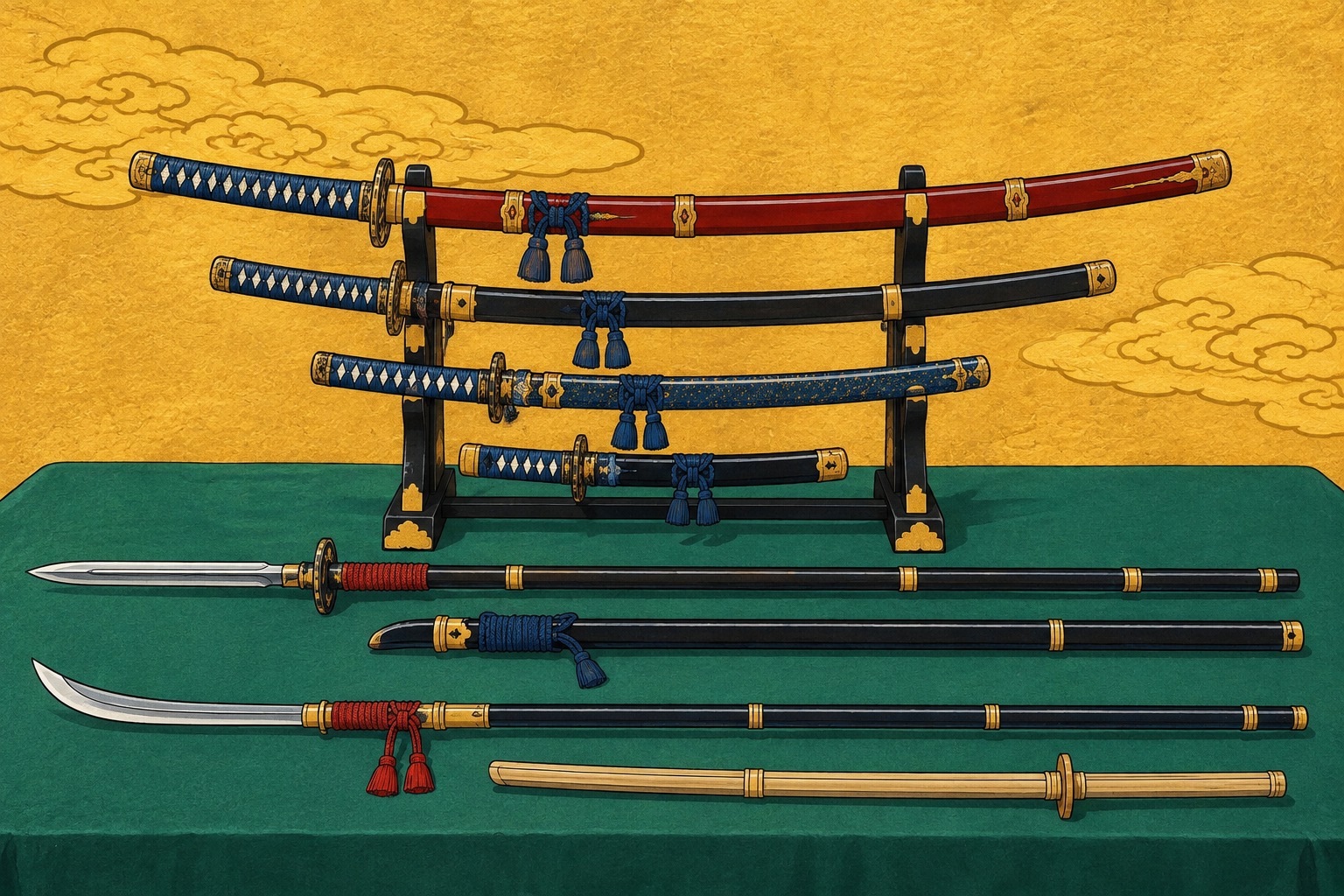
The Longsword and the Shortsword together are the daisho, the pair a warrior wears by custom; it is becoming standard and is not yet law. Use the Short Spear line for a bamboo spear and the Knife line for a sickle. The Winged Spear is the nearest entry to the cross-bladed spear of the Hozoin school (Schools of the Sword and Fist). The Pike and the Glaive make no attack at Engaged range, as their Range column shows. The Fantasy Armory lists the Katana and Tachi as names of the Longsword; the uchigatana, the sword most men wear in 1600, is the same line. The bokuto, the wooden sword nearly every school drills and fights its bouts with, uses the Cudgel line (Era Rules, Schools and Popularity, Teachers V); the leather-sheathed bamboo fukuro shinai of the Shinkage line, in use since the 1560s, is the same line under the Fukuro Shinai talent (Schools of the Sword and Fist). The armored sparring and the modern bamboo shinai are Edo inventions and are not used.
Bows and Arrows (The Ranged Armory, Master Weapons Table and Ammunition)
| Weapon | Japanese name | Dmg | Crit | Range | Enc | Price | Avail | Type | Qualities | About |
|---|---|---|---|---|---|---|---|---|---|---|
| Yumi | yumi, the asymmetric long bow | 8 | 3 | Long | 2 | 800 | Rare | Thrusting | Accurate 1, Fragile 1, Cumbersome 3, Point Blank 1 | 4 ryo |
| Arrow, Standard head | ya, a quiver of twenty | 10 | No modifier | 0.05 ryo |
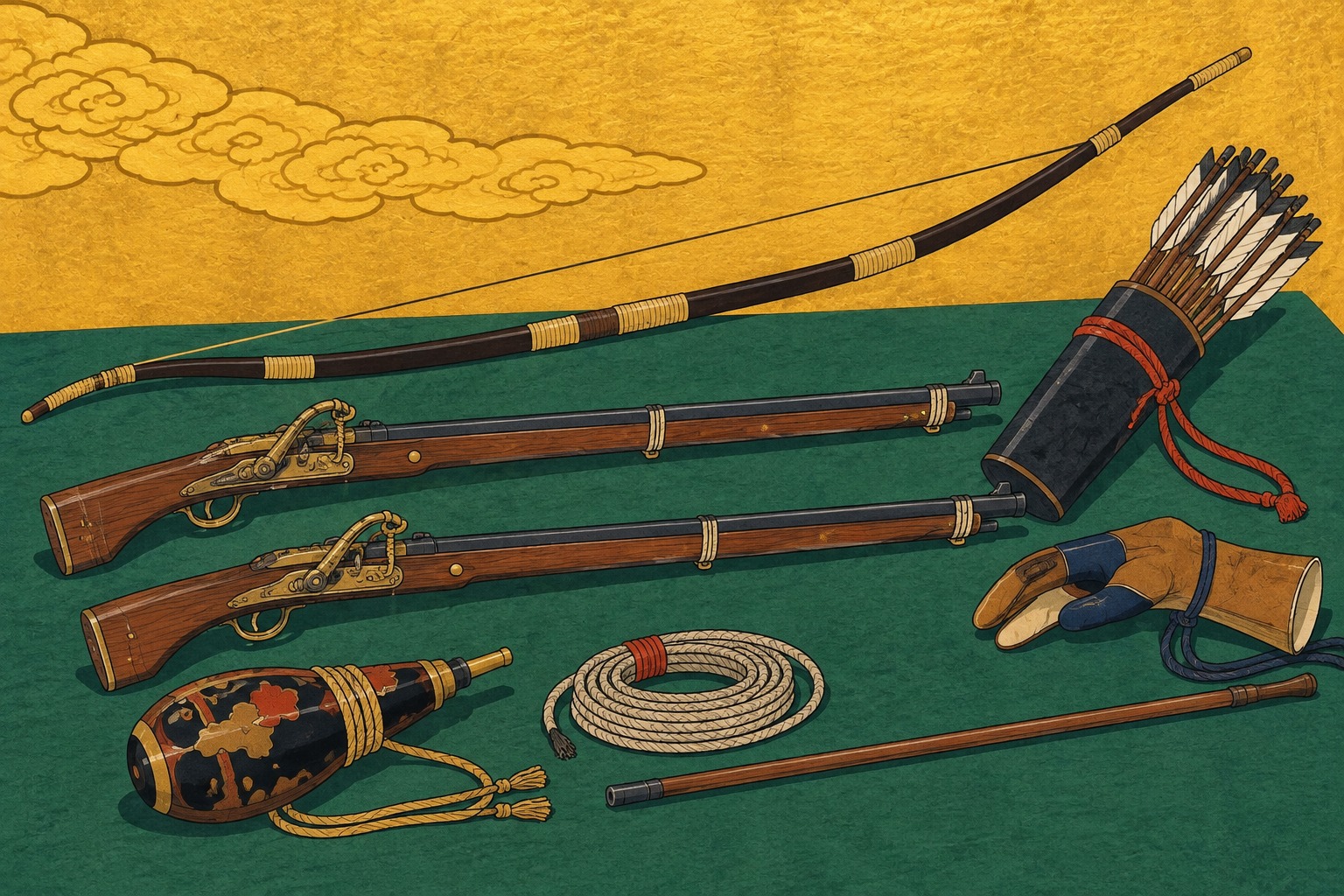
A quiver is a shaft and a head bought as one unit of twenty (The Ranged Armory, Ammunition). Standard is the head of every kit. Fire arrows for sieges are the Incendiary head. Read the Yumi's price against the outliers table above.
Matchlock and Loading (The Black Powder Armory, Master Tables; Reading an Entry for the horn)
| Weapon | Japanese name | Skill | Dmg | Crit | Range | Enc | Price | Avail | Qualities | About |
|---|---|---|---|---|---|---|---|---|---|---|
| Arquebus | tanegashima; teppo; hinawaju | Heavy Ranged | 7 | 3 | Medium | 3 | 150 | Common | Prepare 3, Slow Match, Unreliable | 0.75 ryo |
| Powder horn and shot bag | the gunner's powder and shot | 10 | Thirty reloads | 0.05 ryo | ||||||
| Grapnel | kaginawa, the hook and rope | Ranged | +1 | 5 | Short | 2 | 25 | Common | Ensnare 1, Limited Ammo 1 | 0.125 ryo |
Armor (The Armourer, Master Tables)
| Armor | Japanese name | Resistance | Melee Def | Ranged Def | Enc | Price | Avail | Qualities | About |
|---|---|---|---|---|---|---|---|---|---|
| Padded Jack | okashi gusoku; okegawa-do, the lord's munition armor | +1 | 0 | 0 | 2 | 40 | Common | Deflecting 1 (Crushing), Vulnerable 1 (Thrusting) | 0.2 ryo |
| Leather Jerkin | a chest guard | +1 | 0 | 0 | 1 | 50 | Common | Deflecting 1 (Cutting) | 0.25 ryo |
| Hide Armour | scavenged hide | +1 | 0 | 0 | 3 | 30 | Common | Deflecting 1 (Cutting), Deflecting 1 (Crushing), Cumbersome 2 | 0.15 ryo |
| Lamellar | tosei gusoku, of laced plates | +2 | 1 | 0 | 4 | 600 | Military | Deflecting 1 (Cutting), Deflecting 1 (Thrusting), Cumbersome 2 | 3 ryo |
| Coat of Plates | tosei gusoku, of solid plates | +3 | 0 | 0 | 5 | 700 | Military | Deflecting 1 (Cutting), Vulnerable 1 (Crushing), Cumbersome 3 | 3.5 ryo |
| Open Helm | kabuto; jingasa | +0 | 0 | 0 | 1 | 60 | Common | Helm 1 | 0.3 ryo |
Animals and Tack (The Stable, Master Tables; Tack, Harness and Platforms)
| Mount | Scale | Speed | Wounds | Res | Def | Carry | Travel | Price | Avail | Barding | Traits | About |
|---|---|---|---|---|---|---|---|---|---|---|---|---|
| Pony | 1 | 2 | 9 | 1 | 0 / 0 | 10 | 20 | 150 | Common | Equine, Light | Small Mount, Hardy | 0.75 ryo |
| Riding Horse | 2 | 2 | 11 | 2 | 0 / 0 | 16 | 30 | 300 | Common | Equine, Medium | Swift, Temper 1 | 1.5 ryo |
| Mountain Horse | 2 | 1 | 12 | 2 | 0 / 0 | 18 | 25 | 400 | Common | Equine, Medium | Sure-Footed, Hardy, Steady | 2 ryo |
| Light Warhorse | 2 | 2 | 12 | 2 | 0 / 0 | 18 | 30 | 1,500 | Military | Equine, Medium | Battle-Trained, Swift | 7.5 ryo |
| Ox | 2 | 1 | 12 | 2 | 0 / 0 | 22 | 12 | 150 | Common | Bovine, Light | Draft 2, Steady, Slow | 0.75 ryo |
| Tack | Enc | Price | Avail | Effect |
|---|---|---|---|---|
| Bridle and bit, or halter | 0 | 10 | Common | Needed to ride. Without it, add 2 Bane Dice to Riding checks |
| Riding saddle | 2 | 90 | Common | The ordinary saddle. Riding bareback adds 1 Bane Die to Riding checks and to any check to stay mounted |
| Pack saddle | 2 | 50 | Common | The animal's Carry is 4 higher for baggage and it cannot be ridden |
| Stirrups | 0 | 10 | Common | Part of any saddle where they are known. Where they are not, no charge bonus is possible and mounted archery adds 1 Bane Die |
The book prints no separate entry for the Japanese saddle (kura) and stirrup (abumi); use the generic rows. Do not give a Japanese horse the traits of a named breed. The Riding Horse is the general mount. The Light Warhorse is a gift of a great lord; the record says great horses were given, not sold in a market. Mounted samurai usually dismount to fight (The Realm in 1600).
Remedies (The Apothecary, Master Tables: The Apothecary's Shelf)
| Substance | In this book | In brief | Onset | Lasts | Limit | Tags | Price | Avail | About |
|---|---|---|---|---|---|---|---|---|---|
| Healing Salve | an herbal plaster | Recover 2 more Wounds from a night's rest | — | 1 day | 1 | — | 20 | Common | 0.1 ryo |
| Emetic | a bitter herbal purge | Purges a swallowed poison during its Onset | None | — | — | — | 5 | Common | 0.025 ryo |
| Smelling Salts | a pungent herb packet held to the nose | Wakes a sleeper or a faint | None | — | 1 | — | 10 | Common | 0.05 ryo |

The Matchlock and Its Supply
Scopes The Black Powder Armory to the Arquebus. The matchlock (tanegashima, teppo) is the leading missile weapon of 1600, and a daimyo's levy of the Korean campaigns shows guns and spears in about equal numbers. It reached the island of Tanegashima in 1543 by the Japanese record (1542 by the Portuguese), and Sakai and Kunitomo make it. The gunnery of the Inatomi line teaches how it is fired (Schools of the Sword and Fist).

TERMS: THE MATCHLOCK AT THE TABLE
I The sourcebook's rules. The Arquebus has Prepare 3, Slow Match and Unreliable. Reloading is in The Black Powder Armory, Reading an Entry, One Shot, Then Reload; the match, rain and misfires are in Misfires, Rain and Damp, and in Qualities under Slow Match and Unreliable. This book changes none of them, and they bind an adversary's gun as they bind a player character's.
II Carried loaded. A gunner on watch or on the march carries the gun loaded, so the first shot of a fight needs no reload. The match must still be lit.
III Supply. The match is part of the gunner's kit, and a coil for a week is priced in Goods Without an Entry. The Powder horn and shot bag carries thirty reloads. A gunner on campaign draws powder and ball from his company's stores, and the book does not count them; the GM says when a company runs short.
IV Bought and given. A gun is a lord's gift and a merchant's capital. A Sakai gunsmith finishes one for a house that ordered it, and the buyer owes the house, not the smith. The Craftsman and Gunsmith's stock gun is owed that way (Character Creation and Roles).
Small cannon appear in limited numbers at sieges. A castle piece uses The Heavy Armory's Light Gun. Keep it off the Sekigahara field: the record provides no substantial field artillery there.
Armor of 1600
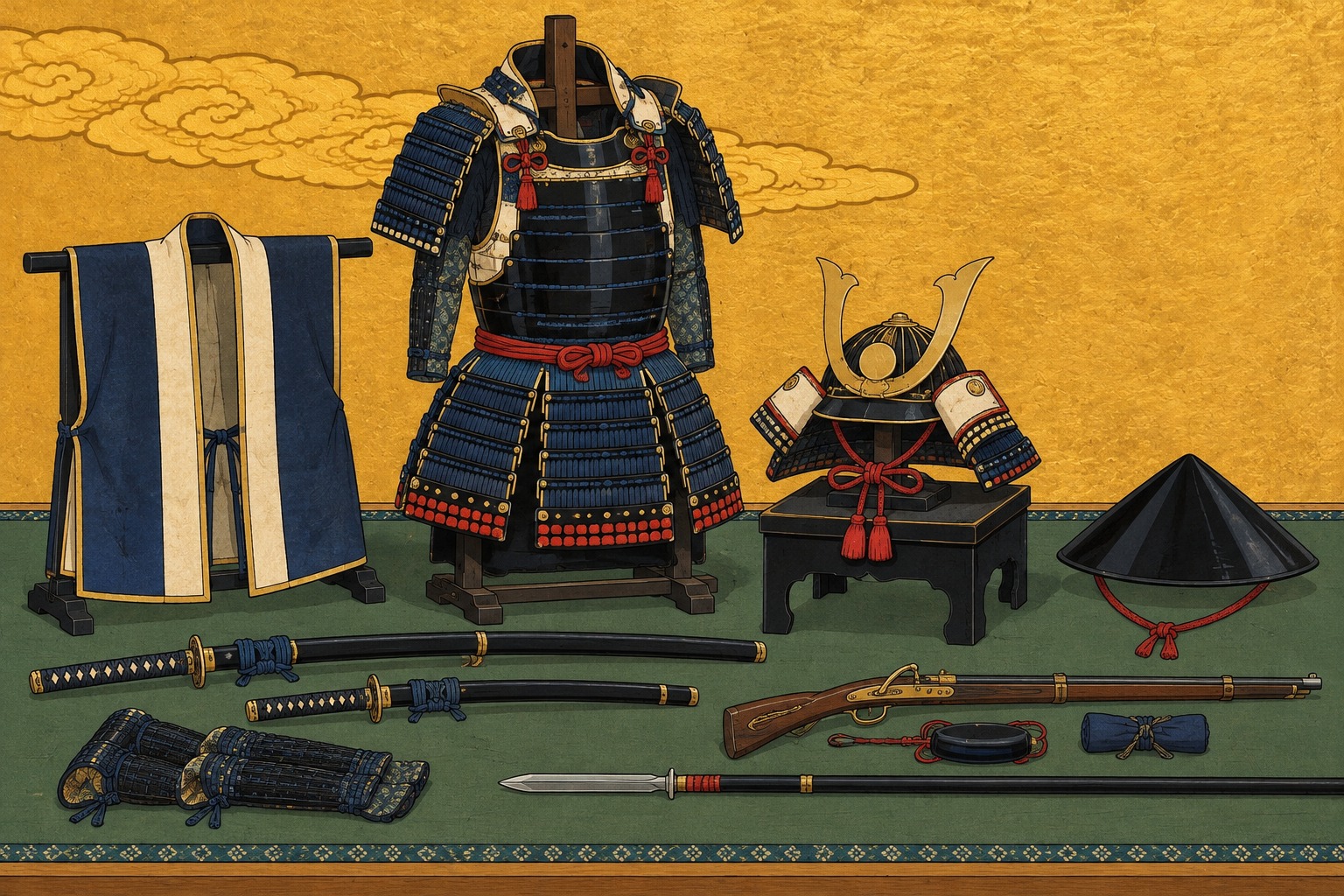
Tosei gusoku, or "modern armor", consists of laced or solid plates and a kabuto helmet. Lacking that named entry in The Armourer, use the following equivalents.
TERMS: THE ARMOR LIST
I Tosei gusoku. Use Lamellar for the laced type and Coat of Plates for the solid-plate type. Both are Military: a lord issues them to retainers, or a dealer sells to a man of Standing. The Armourer lists the older o-yoroi as a name for Lamellar. The great armor of the mounted samurai of earlier centuries is not the standard of 1600, and this book does not use the name.
II Munition armor. The cheap cuirass lent to ashigaru is Padded Jack (okashi gusoku, okegawa-do). It is lord-issued, with a crest on the breast, and returns with service. Its sourcebook price is low against the record; see the outliers above.
III Helmets. The Open Helm serves the kabuto of the issue and the conical jingasa, the ashigaru's hat. A commander's closed helm has no entry; the Great Helm is Held.
IV Light cover. A Leather Jerkin is a chest guard of a house officer, a temple's guard or a monk. Hide Armour is what a man scavenges.
Horses and Pack Animals
Scopes The Stable. Riders keep a horse; villages keep an ox. Use sourcebook prices. A fresh Riding Horse costs 300 in a castle town, as on Izumiya Tomi's stages (Era Rules, Travel). Horses are Common; warhorses are Military and gifts. Ponies, Oxen and Mountain Horses haul road baggage.
Recorded ranges are 60 to 200 Exodus for a pack horse or ox, 200 to 600 for a riding horse and 600 to 2,400 for a good warhorse. Sourcebook prices of 150, 300 and 1,500 fit. For a hired palanquin or litter (norimono, kago), absent from The Stable, charge the pack horse-and-handler rate (Keep, Lodging and Travel).
Medicine and Poisons
Scopes The Apothecary. Chinese-derived kanpo uses herbs, diet, acupuncture and moxa in 1600. A physician carries herbs, cased needles and moxa cones. Use Era Rules, Medicine and Illness, for treatment and the services table for fees. The essential table's three remedies give sourcebook effects through Japanese goods. The Misericordia keeps Nagasaki's mission hospitals; Funai's hospital fell with the town in 1586. No fee is recorded.
Two agents of The Apothecary, Natural Poisons and Venoms, are Legal. Wolfsbane is torikabuto, aconite: a root the Chinese pharmacopoeia lists as a drug, which kills in a larger dose. The Sleeping Draught is a sleeping drug with no period name. Use the sourcebook's entries unchanged. Both are Restricted: a physician or a drug seller in a trade city sells them to a buyer he knows, and a Shinobi Agent gets them through the league's go-between. They are the agents Poison in the Cup delivers (Schools of the Sword and Fist, Shinobi), and their qualities apply to whoever uses them. Every other poison and venom in the sourcebook is Held. Rumors of poisoning surround several deaths of the age and no account names the substance; the Bansenshukai, which gives recipes for poisons and sleeping drugs, is a later source. The smoke bomb is attested as a shinobi item only in Edo manuals and is Held.
Ships and Cannon
Scopes The Heavy Armory only as far as the starter adventure and Nagasaki need. The coasting ships of Japan are single-masted and square-sailed, and none could sail to Europe. The warships of the age come in three sizes. The atakebune is the largest: about 30 meters long in Hideyoshi's time, with 50 to 150 oars, a boxed wooden superstructure and a crew of 50 to 200 rowers with fighting men besides; Kuki Yoshitaka's great ship for the Korean war, which Hideyoshi named Nihon-maru, is given 100 oars and 180 men, and the Jesuit Organtino counted three cannon apiece on Kuki's ships of 1578. The sekibune is the middle class, fast, with about 30 to 40 oars, and the main strength of a sea lord's fleet; the kobaya is a lighter and faster boat of the same build. Cargo moves in coasting ships; the word sengokubune is later, and the book uses it only as a label.
SHIPS ON THE SOURCEBOOK'S SEA LIST
| Ship of 1600 | Sourcebook row (The Heavy Armory, Vehicles, Ships and Aircraft, Sea) | Note |
|---|---|---|
| A coasting cargo ship (later called a sengokubune) | Cog or carrack | the nearest sail row; strike its guns |
| The great oared warship (atakebune) | War galley | the nearest oared row; its two or three cannon are Light Guns, and it has no ram |
| The middle and small warships (sekibune, kobaya) | Longship or small galley | the nearest small oared row; a sekibune is the heavier end of it |
| The Portuguese nao, the great ship from Macau | Galleon | By name a carrack, but the record puts the Macau ship at over a thousand tons, and the sourcebook's Cog or carrack is a medieval hull of forty crew; the Galleon row, legal from 1500, is the nearer size |
| The Spanish San Felipe, wrecked in Tosa in 1596 | Galleon | A Manila galleon by the record |
| The Dutch Liefde | Cog or carrack | A ship of about three hundred tons with her own guns; the claim that they fought at Sekigahara is unproven |
Exclude the Sloop and all later rows, which postdate 1603. Most years, one great Macau ship brings Chinese silk and departs with Japanese silver. Seagoing passage costs 200 to 600 Exodus (Keep, Lodging and Travel). The ship sizes above are recorded; their sourcebook mappings are this book's. For a heavier sekibune than Longship allows, use War galley without its ram.
Goods Without an Entry
Adds kit and Role goods absent from sourcebooks. They have no stat lines and come with the Role. Replace losses at the listed price; ignore prices below 1 (Small goods). Where evidence is silent, the price is this book's.
KIT GOODS WITH NO SOURCEBOOK ENTRY
| Goods | Used by | Price (Exodus) | Basis |
|---|---|---|---|
| Straw cape (mino), deep straw hat (amigasa), sandals | Ronin, ashigaru, scouts, farmers, sailors, the Riverbed Trades | not tracked | the sedge hat and sandals are in the record; the cape is set by this book |
| A bundle, a bowl, a rice bag, a water gourd, a rope of hemp | Most Roles | not tracked; a long rope about 3 | set by this book |
| Slow match, a coil for a week | Gunners | about 2 | set by this book |
| A jinbaori, a surcoat without a crest | Mounted Retainer | 15 to 30 | scaled from the cloth rows |
| A banner pole and a war fan for signals | Mounted Retainer | about 10 | set by this book; the iron War Fan is in the table |
| A writing set, a seal and the house's keys | Household Officer, Interpreter | 2 to 5 | the ink stick, brush and paper rows |
| A robe, a white head cloth, prayer beads and a conch (horagai) | Warrior Monk, Mountain Ascetic, Priest | 5 to 20 together | set by this book; never sold in play |
| A medicine chest of herbs, needles and moxa | Physician | about 60 | set by this book |
| A counting board, ledgers, scales and weights | Merchant, Shopkeeper | about 15 | set by this book |
| A strongbox | Merchant | about 30 | set by this book |
| The tools of a trade | Craftsman, Riverbed Trades | 20 to 60 | set by this book |
| A carpenter's tools; a peddler's pack; a pilgrim's dress | Shinobi Agent's cover | 10 to 30 | set by this book |
| The six tools of the trade: hat, ink case, towel, flint, medicine and cord | Shinobi Agent | about 10 together | set by this book (Schools of the Sword and Fist, Shinobi, Six Tools) |
| An instrument, a fan, a performance robe, masks | Entertainer | 10 to 40 | set by this book |
| Tea utensils of modest make, brushes, ink, a traveling box | Tea Master | 20 to 60 | the tea bowl row, scaled |
| Letters under seal, a short cape, a book from the mission press | Interpreter | 3 to 15 | set by this book |
| Nets | Sailor, Boatman, Fisher | about 10 | set by this book |
| A fishing boat or river boat, with oars and sail | Sailor, Boatman, Fisher | 240; a quarter share is 60 | set by this book, scaled to seven weeks of a carpenter's pay |
| A coasting cargo ship | Merchant and Broker | 4,000; an eighth share is 500 | set by this book, scaled from the boat |
| A shop, tea house or lodging house in a town, a year's lease | Shopkeeper, Innkeeper | 120 | set by this book; the stock is the Stake |
| A workshop's bench, forge and fittings | Craftsman | 300 | set by this book |
| A town house bought outright | Merchant, Physician | 1,000 and up | set by this book |
For a share, lease or workshop acquired at creation, owe the listed price as a creation Debt to a named partner, landlord or master, due at the second month's end (Era Rules, Money and Stakes, Stakes II). Boat and warehouse-agent ship shares remain optional (Character Creation and Roles).
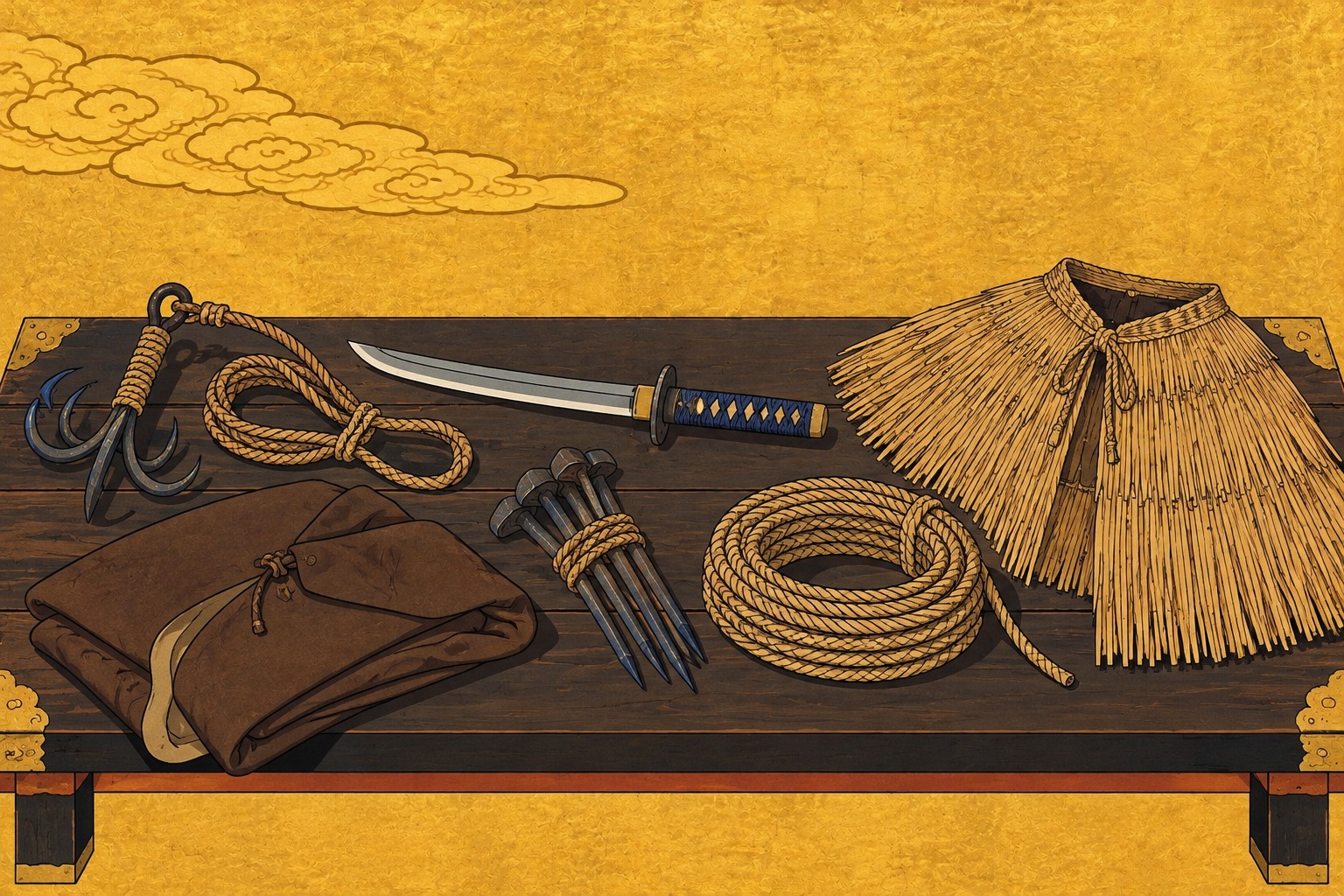
Shinobi dressed as peddlers, monks or farmers and used those trades' tools, without black suits, masked ninja swords or throwing stars. The Bansenshukai of 1676 illustrates hook and rope as climbing equipment; this later source does not make it their trademark. Their century's best-attested weapon is the matchlock.
Kits at a Glance
Scopes the Role kits of Character Creation and Roles to a price. The table lists each kit's sourcebook entries at their price, the part the character owns, the part a lord, temple or house issues, and the Stake the Role usually gives; the Role entry has the second Stake where a Role names two. A hired gunner who owns his gun moves the Arquebus and the horn, 160, to the owned column. No kit is bought from the Stake; the figure shows what a replacement costs against it.
KIT VALUE AGAINST STAKE
| Role | Owned (Exodus) | Issued (Exodus) | Usual Stake |
|---|---|---|---|
| Mounted Retainer | 1,070: Longsword, Shortsword, Dagger, Short Spear, Riding Horse, saddle, stirrups, bridle | 660: Lamellar, Open Helm | Stipend 200 |
| Foot Retainer and Household Officer | 590: Longsword, Shortsword, Short Spear | 110: Leather Jerkin, Open Helm | Stipend 200 |
| Ronin Swordsman | 500: Longsword, Shortsword | none | Wage 60 |
| Ashigaru Spearman | 70: Dagger | 140: Pike, Padded Jack, Open Helm | Wage 60 |
| Ashigaru Gunner | 70: Dagger | 260: Arquebus, horn and bag, Padded Jack, Open Helm | Wage 60 |
| Ashigaru Archer | 70: Dagger | 910: Yumi, arrows, Padded Jack, Open Helm | Wage 60 |
| Scout, Irregular and Bandit | 190: Short Spear line, Dagger, Hide Armour | none | Hand-to-Mouth 20 |
| Shinobi Agent | 115: Shortsword, Grapnel | none | Hand-to-Mouth 20 |
| Warrior Monk and Temple Guard | 330: Glaive, Quarterstaff | 50: Leather Jerkin | Stipend 200 |
| Mountain Ascetic | 160: Quarterstaff, Dagger, Healing Salve | none | Wage 60 |
| Priest, Nun and Shrine Attendant | 20 to 60: Healing Salve, Knife for a nun | none | Stipend 200 or Wage 60 |
| Physician | 95: two Healing Salve, Emetic, Smelling Salts, Knife | none | Stipend 200 |
| Merchant and Broker | 290: Shortsword, Pony, Pack saddle | none | Stipend 200 |
| Peddler, Shopkeeper and Innkeeper | 70: Knife, Cudgel | none | Wage 60 |
| Craftsman and Gunsmith | 130: Hatchet, Knife; a gunsmith's stock Arquebus 150 is owed | none | Wage 60 |
| Tea Master and Artist | 40: Knife | none | Stipend 200 |
| Farmer and Village Headman | 170: two Knife lines, Hatchet | 90: Short Spear | Hand-to-Mouth 20 |
| Entertainer and Courtesan | 40: Knife | none | Wage 60 |
| Wrestler | 30: Cudgel | none | Hand-to-Mouth 20 |
| Interpreter and Go-Between | 40: Knife | none | Wage 60 |
| Sailor, Boatman and Fisher | 65: Knife, Grapnel | none | Hand-to-Mouth 20 |
| Riverbed Trades | 70: Knife, Cudgel | none | Hand-to-Mouth 20 |
Hand-to-Mouth's 20 cannot replace a lost Knife at 40, let alone most kit goods. The Stake measures cash; the kit equips the Role. A Ronin's two swords account for 500 beside his 60 Stake. Scout and Farmer kits carry still more value relative to cash, 190 against 20 and 170 against 20.
The Source Book Map
Scopes the cited books to AD 1600. Legal means use the entry as written with its Japanese name. Modified changes a name, a material or an availability word and keeps the stat line. Excluded means the item is later than 1603 or the record contradicts it. Held means the item is not shown to be in Japan in AD 1600; the GM may allow one on a named source.
| Sourcebook | Families used | Legal in AD 1600 | Echoed in this chapter | Japanese names and changes |
|---|---|---|---|---|
| The Fantasy Armory | Daggers and Knives; Swords; Spears; Polearms; Impact Weapons; Axes and Cleavers; Flexible Weapons; Thrown Weapons | Knife, Dagger; Shortsword, Longsword; Short Spear, Winged Spear (Modified), Pike; Glaive; Quarterstaff, Cudgel (the bokuto); Hatchet; Kusarigama; War Fan; Throwing Knife (a swordsman's school item). Greatsword (the odachi), Military, is used by a few strongmen only | 12 rows (Arms) | kaiken, tanto, wakizashi, katana and tachi, yari, jumonji yari, nagae-yari, naginata, bo, bokuto, ono, tessen. The uchigatana is the Longsword. Held: Mancatcher, Weighted Chain, Maul, Iron Knuckles, Tonfa and every European sword and axe. Excluded: Main-Gauche (the jitte, Edo), Flail (the nunchaku, no 1600 evidence), Quarterstaff as the jo (c. 1605 to 1614), the Throwing Knife as a kunai or a shinobi tool, the tekko-kagi claw |
| The Ranged Armory | Bows; Ammunition; Silent Arms | Yumi; the Arrow with Standard head; the Incendiary head as the siege fire arrow | 2 rows (Bows) | yumi, ya. Held: Horse Bow and Short Bow, every other head, every crossbow and siege engine, the sling and the atlatl. Excluded: Blowgun and Long Blowgun (the fukiya, an Edo pastime) |
| The Black Powder Armory | Matchlocks and Wheellocks; Grenadoes, Fire and Powder; Blades and Boarding Weapons | Arquebus; Powder horn and shot bag; Grapnel (a hedged later source) | 3 rows | tanegashima, teppo, hinawaju, kaginawa. Held: Hand Gonne, Matchlock Musket, Wall Gun, Swivel Gun, Grenado, Fire Pot, Stinkpot, Powder Charge, Bandolier of charges. Excluded: every wheellock, flintlock, percussion arm, bayonet and the European armor (Buff Coat, Munition Cuirass, Pot Helmet) |
| The Armourer | Medieval Armour; Helms and Shields | Padded Jack, Leather Jerkin, Hide Armour, Lamellar and Coat of Plates (Modified, as the tosei gusoku), Open Helm | 6 rows (Armor) | okashi gusoku, a chest guard, tosei gusoku, kabuto and jingasa. The alias o-yoroi is not used. Held: Mail Shirt, Mail Hauberk, Brigandine, Scale Coat, Half-Plate, Full Plate, Great Helm and every shield. Excluded: all Modern Armour |
| The Stable | Horses and Their Kin; Beasts of Burden and War; Tack, Harness and Platforms; Mounted Combat | Pony, Riding Horse, Mountain Horse, Light Warhorse, Ox; Bridle and bit, Riding saddle, Pack saddle, Saddlebags, Stirrups, Bow case and quiver | 5 mounts and 4 tack rows | uma, the horse. Held: Draft Horse, Heavy Warhorse, Donkey, Mule, Barding, War saddle, Lance bucket. Excluded: Camel, Elephant, every fabled and Dort mount |
| The Heavy Armory | Great Guns; Vehicles, Ships and Aircraft | Light Gun (siege pieces and a ship's own guns); Longship or small galley, War galley, Cog or carrack, Galleon (Modified, as the Japanese and foreign ships above) | 6 ship rows by name only | Held: Medium Gun, Bombard, Mortar, every other gun, every siege engine. Excluded: Sloop and every later ship, every entry of the industrial and mechanized ages |
| The Apothecary | The Apothecary's Shelf; Natural Poisons and Venoms | Healing Salve, Emetic, Smelling Salts (Modified), Strong Drink, Watchman's Tea; Wolfsbane and Sleeping Draught (Modified names, Restricted; Medicine and Poisons) | 3 rows | an herbal plaster, a bitter purge, a pungent herb packet, sake, tea, torikabuto, a sleeping drug. Held: every other poison and venom, Poppy Tincture, Theriac, Antivenom, Bezoar, Smoke, Stink Smoke, Quicklime, Chewing Leaf. Excluded: every industrial, modern and stellar entry |
Character Creation and Roles kits use only Legal or Modified entries. Anything absent from these rows is Held.