Kyoto, Osaka, Sakai, Edo, Nagasaki
In AD 1600, five cities anchor the realm. Emperor and court occupy the capital, Kyoto; Hideyoshi's heir lives in Osaka's castle city. Sakai supplies guns and silver credit, Edo houses Ieyasu's new eastern seat, and Nagasaki receives Macau's great ship. Traveling among them takes a party across the game's map (Era Rules, Travel).
Descriptions follow the map year, AD 1600, with marked notes for changes during play (AD 1598 to 1603). Japanese dates precede bracketed Gregorian equivalents. Consult The Realm in 1600 for lords and armies, The Era for the year, Gear and Prices for costs, and Places and Campaign Tools for roads and distances. Invented named characters are marked fictional and may be changed freely by the GM.
| City | What it is in AD 1600 | Who holds it | Go there for |
|---|---|---|---|
| Kyoto | The capital and the emperor's seat; the largest city; temples, tea, the licensed quarter | The emperor reigns; the Toyotomi governor rules the town, and Ieyasu's men after Sekigahara | Court, craft, rumor, the riverbed |
| Osaka | Hideyoshi's castle and merchant city on the Yodo; the greatest fortress in Japan | Hideyori, a child, with his mother; Ieyasu or the Western lords hold the citadel by turns | Power, hostages, ships, money |
| Sakai | The merchant port 12 km south of Osaka; guns, iron, tea and the overseas trade | A Toyotomi magistrate over a merchant council whose self-rule has ended; Tokugawa officers from late 1600 | Guns, credit, quiet deals |
| Edo | A castle town about ten years old in the Kanto | Ieyasu, the master of the east | Building sites, new men, the road east |
| Nagasaki | The Christian port of the Portuguese trade | A Toyotomi magistrate, with Christian town elders under him; Ieyasu's own man from 1603 | Silk, silver, interpreters, the faith |
The Banners
- 京 Kyo (kyoh): "the capital", the old word for Kyoto, also read miyako.
- 大坂 Osaka (oh-SAH-kah): "great slope", the spelling used in AD 1600; the modern spelling is different.
- 堺 Sakai (sah-KAH-ee): "boundary", the merchant port at the meeting of the old provinces of Settsu, Kawachi and Izumi.
- 江戸 Edo (EH-doh): "estuary gate", the castle town of Ieyasu.
- 長崎 Nagasaki (nah-gah-SAH-kee): "long cape", the Portuguese port.
Reading the Hooks
Each city's final table offers hooks without requiring a lord. Whoever appears in Who hires anyone capable of the work.
- The date appears after the hook name; undated hooks suit any year from 1598 to 1603.
- Opposition identifies the party's adversaries and an appropriate Adversaries entry where available.
- Complication reveals a problem or an undisclosed part of the offer.
- Clock step or rule locates the hook on the Sekigahara Clock (Era Rules, Name and Allegiance, The Sekigahara Clock) and supplies relevant Era Rules headings.
- Fits suggests useful Origins and Roles without restricting who may take a hook.
For sworn characters, replace the Who offer with an officer's order, calling a Duty (Era Rules, Name and Allegiance, Calling In). A hook favoring the enemy instead places the party in the Opposition role, searching, guarding or hunting. Running the Era, Your Lord's War, supplies orders by side and Clock step.
Kyoto
Japan's capital since AD 794, Kyoto is its largest city, with a modern population estimate of about 200,000 to 300,000 and no census. Go-Yozei's modest palace has cypress-bark roofs and a plain earth perimeter wall, surrounded by nobles' houses. The emperor confers rank and titles and conducts ritual, without an army.
Hideyoshi reshaped Kyoto after 1590: the Odoi earth rampart went up in 1591, his Jurakudai palace came down in 1595. The earthquake on Bunroku 5, intercalary 7th month, 13th day [AD 5 September 1596] devastated Kyoto, Fushimi and Osaka; rebuilding continues in AD 1600. At eastern Hoko-ji, the Great Buddha's wooden, lacquered figure broke but its hall survived. Hideyori's officers began a bronze replacement in 1599. Nijo castle remains unbuilt.
Who Holds Kyoto
Court offices, regime officials and temples with land and law divide Kyoto's authority. Hideyoshi's death leaves the regime's share contested until Sekigahara hands it to Ieyasu.
| Who | What they hold in AD 1600 | What they want | At the table |
|---|---|---|---|
| Emperor Go-Yozei and the court | Titles, rank, the calendar and the sanction of every lord's office | A court that is paid and respected | Ieyasu's title as shogun comes from here in 1603 |
| Maeda Gen'i | The Toyotomi governor of the city since Hideyoshi's day, and still in the autumn of 1600; the post is the one later called shoshidai. A lay priest, one of the Five Commissioners, and lord of Kameyama in Tanba, 50,000 koku | To keep his fief; he sits with the Western council on paper and sends word to Ieyasu | A governor who keeps both sides in sight |
| Ieyasu | The most powerful man in the realm; from 1598 to 1600 he lives at Fushimi or Osaka as one of the Elders | The realm, in Hideyori's name | After Sekigahara his men give the orders |
| Town-block associations | The gates, the night watch and the fire watch of each block | Quiet and a good name | A headman who can open or shut a block |
| The Yoshida house | The licensing of shrine priests across the land | Its rank among shrines | A priest's papers or the lack of them |
| The great temples | Estates, moneylending, sake and pawnshops; Daitokuji is the center of the tea masters | Land, patrons and peace | Lodging, loans and refuge |
| The Jesuit house | The mission's house in Kyoto, where Organtino has lived again since 1591 by Maeda Gen'i's intercession; the Nanbanji church of 1576 was pulled down after the edict of 1587, and the record does not place the house of 1600 | To be left alone | The faith as of 1600 (see Nagasaki) |
| Merchant houses | Silk, medicine, loans and supply; Chaya is Ieyasu's purveyor, and the Suminokura are moneylenders and physicians | Orders and a safe road | Credit and carriers |
Later: Kyoto after 1600
After Sekigahara Ieyasu gives the Kyoto post to Okudaira Nobumasa, and Maeda Gen'i keeps Kameyama until he dies in 1602. Itakura Katsushige becomes Ieyasu's Kyoto deputy in 1601 and holds the post for nearly two decades. Nijo castle is built from 1601 to 1603, and town blocks are cleared for its site. In 1602 the Yanagimachi quarter moves to Rokujo, and Ieyasu divides the Hongan-ji into two temples (The Realm in 1600, Temples). In the 12th month of Keicho 7 [AD January 1603] the casting of the new Great Buddha sets fire to the hall of Hoko-ji, and hall and figure burn. Ieyasu receives his appointment as shogun in 1603. A woman called Okuni dances before Kyoto crowds from about 1603, in the beginning of what becomes kabuki.
Places in Kyoto
| Place | What it is in AD 1600 | Who is there | Scenes |
|---|---|---|---|
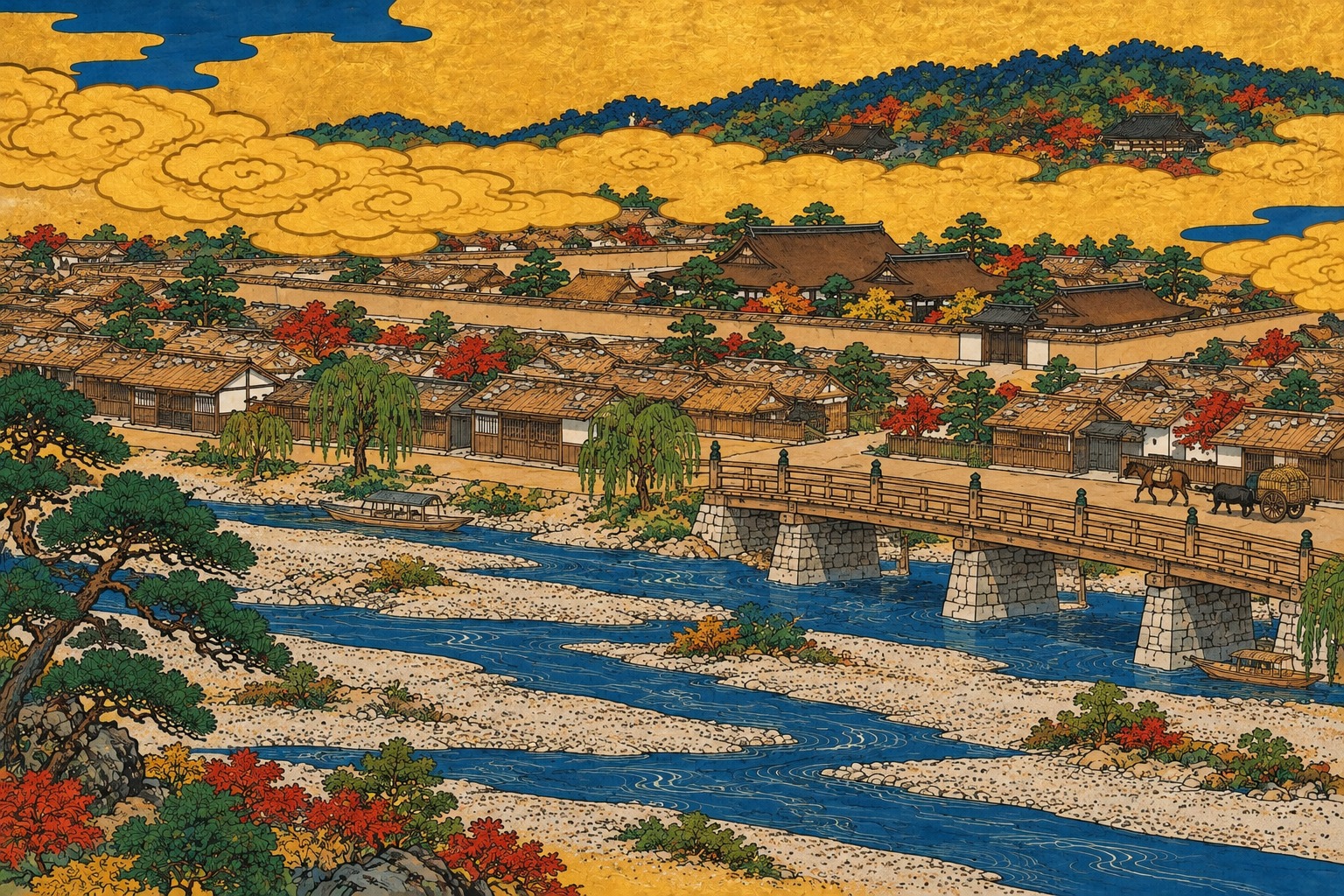
| Sanjo Bridge | The eastern end of the Tokaido, by most accounts rebuilt in 1590 with stone piers, a wooden deck and rail, and bronze finials on the posts | Porters, pack horses, travelers from Otsu, watchmen | Arrivals, ambushes, a display of heads |
| The Kamo riverbed | A wide gravel bed with shallow braided channels; Sanjo and Rokujo are the execution grounds | Guards, kawata, gravel diggers, the curious | Trials ended, heads shown, a body found |
| The Palace quarter | The Imperial Palace and the nobles' houses round it | Court nobles, their stewards, messengers, poets | A letter delivered, a title sought |
| Hoko-ji and the eastern hills | The hall of the broken Great Buddha, with founders at work on a bronze one from 1599; Higashiyama's wooded ridge with temple roofs; the shrine to Hideyoshi as a god, built in 1599 | Monks, pilgrims, masons, metal founders | A pilgrimage, a meeting out of town |
| Yanagimachi | The licensed quarter, licensed in 1589 | Performers, house keepers, guests | Information, debt |
| Daitokuji | The Rinzai temple of the tea masters | Monks, tea men, retired lords | Tea as politics, a quiet bed |
| Daigo-ji | The mountain temple in the southeast, its tenth-century pagoda still standing; Hideyoshi held his last blossom viewing here in 1598 | Monks, carpenters | A rebuilding site, a refuge |
| The shops and craft streets | Sword polishers and appraisers, silk dealers, medicine sellers, printers | Artisans, apprentices | A blade appraised, a sale made |
| Fushimi | Hideyoshi's last castle, 8 km south (see below) | Warriors, hostages, boatmen | Letters, the river road to Osaka |
The Sanjo Bridge and the Riverbeds
Sanjo bridge carries Tokaido and Lake Biwa traffic into Kyoto, with packhorses waiting at its foot. The shallow Kamo branches across gravel below. Upstream and downstream dry beds serve as execution grounds: about 39 of Hidetsugu's household died at Sanjo on Bunroku 4, 8th month, 2nd day [AD 5 September 1595]. After Sekigahara the three Western commanders die at Rokujo, their heads displayed at the bridge (The Realm in 1600, Mitsunari, Konishi and Ankokuji Ekei).
Riverbed, Rokujo and Fukakusa kawata communities work leather, bury the dead and execute prisoners for lords. Hinin watch and clean streets. These assigned duties precede the fully developed legal hierarchy of later years (Era Rules, Law and Justice).
At the Table: The Bridge
Who. Porters, packhorse drivers, two watchmen, errand-running samurai, a woman carrying a bundle, riverside kawata. Danger. A wrong name or hostile lord's colors attract attention; after November 1600, strangers face extra scrutiny. Use. Meet contacts or evade pursuit amid the bridge's traffic, using the gravel bed for cover and witnesses.
The Palace Quarter
Low palace halls behind an earth wall offer no fortress. Nearby noble houses compensate for thin purses with rank, employing stewards, poets, calligraphers and messengers. An introduction outweighs a sword here. Shrine priests throughout the country obtain licenses through Kyoto's Yoshida house.
At the Table: The Palace
Who. Nobles, stewards, poets, shrine priests clearing papers and lords' gift-bearing agents. Danger. Rank determines reception; an unpatronized ronin is an outsider. Use. Obtain titles, introductions and authority to legitimize a lord's claim.
Hoko-ji, the Hills and the Temples
East of the river stands Hoko-ji, the temple Hideyoshi built for his Great Buddha. The nails and clamps of its hall were the stated reason for the sword hunt of 1588 (Era Rules, Law and Justice). The wooden figure broke in the earthquake of 1596. From 1599 metal founders work inside the hall on a bronze figure for Hideyori, with furnaces, charcoal and copper under a wooden roof. Hideyoshi has been honored as the god Toyokuni Daimyojin since 1599, when the court granted the title; his shrine stands on Amidagamine, the hill behind Hoko-ji, with his grave on its summit, and in 1600 it is the grandest new building in the city. Ieyasu's government suppresses it in 1615, later than the play range. Higashiyama is a low wooded ridge with temple roofs along it. For the great temples, their lands and the faith, see The Realm in 1600.
Tea masters gather at Daitokuji. The plain style's founder Sen no Rikyu died by order on Tensho 19, 2nd month, 28th day [AD 21 April 1591], for debated reasons. Lords number among his pupils; 1600's leading master, Furuta Oribe, is an Eastern lord. Hideyoshi made tea political: its gatherings permit unrecorded meetings.
At the Table: The Eastern Temples
Who. Monks, tea men, pilgrims, masons, metal founders and plainly dressed retired lords. Danger. A sectarian quarrel, old grudge or mistaken guest can make a gathering a trap. Use. Find lodging, a go-between or news of Fushimi's visitors.
Yanagimachi, the Licensed Quarter
Hideyoshi licensed the brothels at Nijo-Yanagi-no-baba, Yanagimachi, in AD 1589; accounts disagree on the license holders' names. Houses' men guard the walled block's single gate. Keepers own buildings and shares in the license, clothe and feed the women, and sell their company and bodies. These women are yujo, before the terms oiran or geisha exist. Skilled dancers, musicians, poets and conversationalists at the top of the trade attract lords' agents for an evening's company as well as the ensuing night.
Contracts are recorded in 1600, but their terms are not. The details that follow derive from later quarter records.
- The contract. A woman enters by sale or by pledge. Her family, a broker or a creditor signs her over to a house for a term of years against a sum paid to them, or against a debt they cannot pay (Era Rules, Money and Stakes, Debt). Many are bound as girls and serve as attendants until they are old enough to work. The scaled price of a contract is 1 to 10 ryo (Gear and Prices, Services and the Sick Room).
- The ledger. To the original sum, a house adds clothing, bedding, medicine and missed days of work. Debts commonly accumulate faster than earnings repay them, extending a nominal ten-year term.
- The work and the income. A guest pays the house, not the woman. A night with a woman of lower rank costs 20 to 100 Exodus and a night with one of top rank 200 to 600 (Gear and Prices). The night is food, drink, music, talk and sex. The fee is the house's. What a guest gives her with his own hand is hers, and gifts are how a ledger is paid down.
- Leaving. There are three ways out. The term ends with the ledger clear. A patron pays the ledger and takes her as a wife or a concubine, or sets her free. Or she runs. The block and the magistrate treat a runaway as the house's property: the gate men search, the family that signed answers for the sum (Era Rules, Law and Justice, Collective liability), and she is brought back with the cost of the search added to her ledger.
- The risks. Pregnancy, pox (present since 1512), violent guests and fire behind a single gate threaten the women. A house may sell a contract to a worse house or port town without the woman's consent.
A player character of the quarter uses the Entertainer and Courtesan Role (Character Creation and Roles). She holds Stipend, the house's purse that dresses and keeps her, and owes the house 2 Duties. The house calls a Duty as a night worked, a guest received or a performance outside the gate. Gifts she is given are added to her Stake, and each sum equal to her Stake that she pays the house clears 1 Duty (Money and Stakes, Debt). She leaves the quarter only with the house's leave, which is a Request (Name and Allegiance), or when the house sends her out to perform. A character who is a guest pays the prices above, and a character who wants to take a woman out pays her ledger, which the house sets.
Information trades alongside entertainment. Merchants, lords' agents and visiting samurai speak freely, giving Streetwise or Charm access to their talk (Era Rules, Covert Work, Gathering Information). Play here as performer, contracted woman, house keeper or guest.
Waka, Entertainer of Yanagimachi (fictional, cast)
About 26, slender, with long hair worn loose or tied at the nape; a white kosode printed in gold leaf and a vermilion sash worn at the front.
Under the working name Waka, she dances, plays biwa and hand drum, and performs beyond the quarter. Her contract binds her to the house described above; leaving requires its permission. She tracks visitors, payments, conversations and favors owed. She can supply information, arrange contacts, patronize a performer or embody an unsettled debt.
At the Table: The Quarter
Who. House keepers, performers high and low, guests, hired musicians and a lord's plainly dressed agent. Danger. Guests must settle bills; knowing too much may get a performer's contract sold. Use. Hear what Kyoto's guests reveal.
Fushimi
On the Uji, 8 km south of Kyoto, Fushimi was Hideyoshi's last home and the site of his death in September 1598. After the 1596 earthquake, its castle was rebuilt on Kohata hill. Accounts describe five stories, gilding, white plaster against black timber, stone foundations and turrets. Ranked warrior residences surround it; boats descend the Yodo to Osaka in roughly half a day. Ieyasu resides here as an Elder after Hideyoshi's death, with daimyo families held here and at Osaka as pledges.
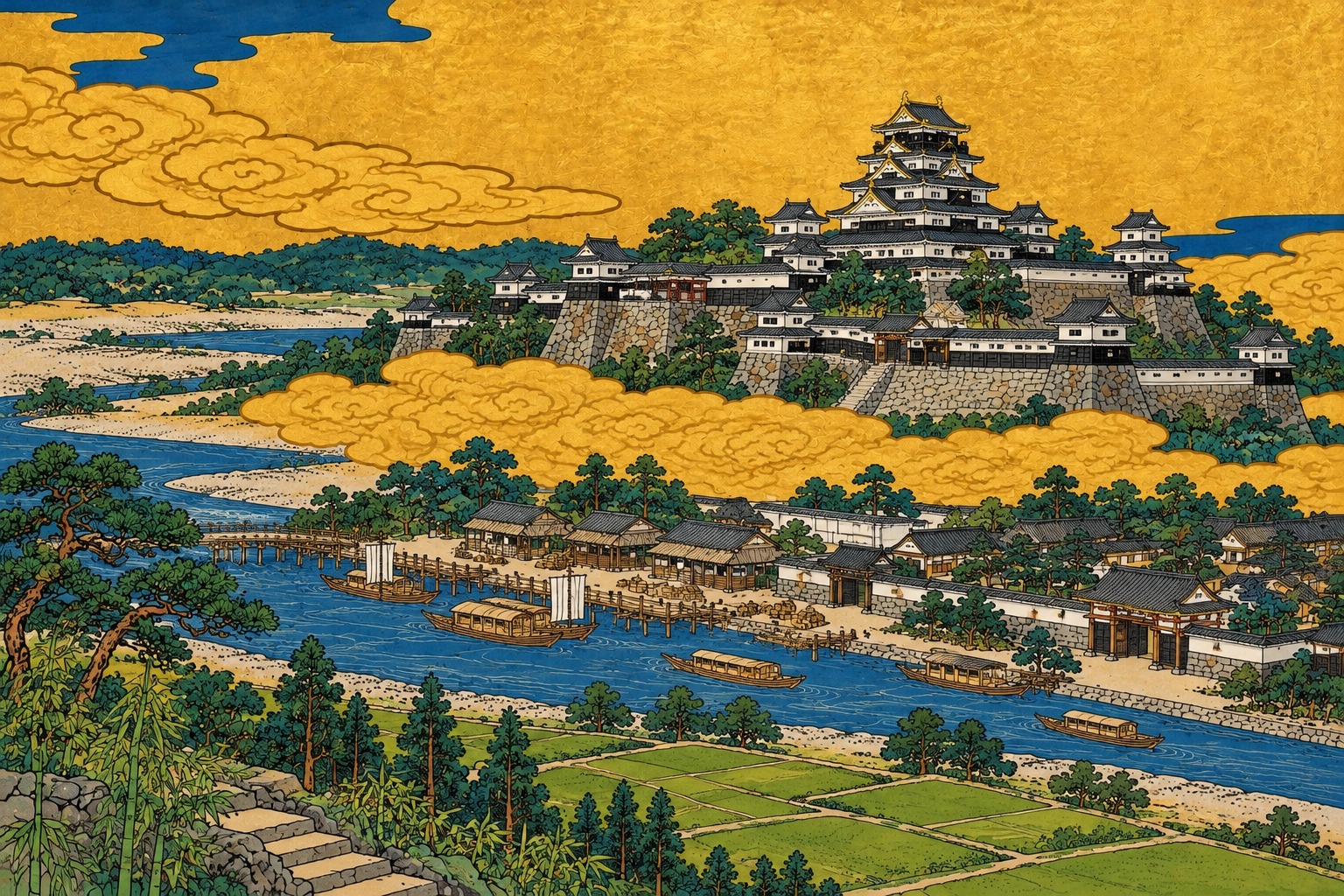
Clock step 3 brings the Western siege, ending on the 1st day of the 8th month [AD 8 September 1600] with the deaths of Torii Mototada and his garrison and the castle's burning. The Realm in 1600, The Summer of Choosing, recounts it. Until Ieyasu rebuilds, a ruined hill overlooks the still-working port.
What the Stories Say
Kyoto temples display supposed Fushimi floorboards as "blood ceilings", stained by the dying garrison. Evidence does not establish their origin; the claim belongs to later pious tradition. A GM can introduce it as unproven temple rumor.
Later: Fushimi after 1600
Ieyasu rebuilds Fushimi in 1601 and 1602 and receives the patent of shogun there on Keicho 8, 2nd month, 12th day [AD 24 March 1603]. The castle is dismantled within two decades. The first gold and silver coins of the new coinage are begun at Fushimi and Sakai in 1601.
At the Table: Fushimi
Who. Guards, hostages' servants, boatmen, messengers, samurai who hold lodgings by rank; after the fire, salvage gangs, kawata and levied farmers clearing the hill. Danger. Before the siege it is a place where a wrong word costs a head; in August 1600 it is under siege; afterward the ruin is searched by both sides. Use. Messages, the Yodo boat, and an audience with a lord who cannot be seen at Osaka.
The Craft Streets
Between palace and river, sword polishers, appraisers, silk dealers, medicine sellers and printers trade. Hon'ami appraisers and craftsmen supply papers that greatly increase a blade's price (Gear and Prices). Silk arrives from China via Nagasaki; at Fushimi Ieyasu has used wooden type for books since 1599.
At the Table: The Craft Streets
Who. Polishers, appraisers, apprentices, dealers and blade-selling customers. Danger. Forged signatures, stolen blades or an agent posing as a buyer. Use. Value or trace a sword, establish a trade contact or identify an owner.
Order and the Watch in Kyoto
Retainers and townsmen keep Kyoto's watches without a police force. Blocks are responsible for their gates and fires and shut the gates at night. Hideyoshi's 1597 orders group five households under shared liability for crime and visitors; nationwide Edo arrangements come later (Era Rules, Law and Justice). Quarreling parties both face punishment, regardless of who began it.
Drawing a blade brings the block, household group and governor against a character. Unsponsored strangers are a collective liability, so headmen and inn keepers ask names before offering beds. Ankokuji Ekei's capture here after Sekigahara makes the cost of sheltering fugitives familiar.
The Capital Through the Year
Kyoto's townsmen revived Gion Matsuri in 1500 after the Onin War. Its decorated yamahoko floats pass through streets in the 6th month (July). Dry autumn weather lowers the Kamo, while summer rain and typhoons swell it and close roads.
The court keeps its own calendar of rites and ranks, and the city lives by markets and festivals as much as by orders. Hideyoshi's last great party was the blossom viewing at Daigo-ji on Keicho 3, 3rd month, 15th day [AD 20 April 1598], for which about 700 cherry trees are reported to have been moved. He performed Noh himself, and the Komparu and Kanze troupes enjoyed his patronage. Warriors learn the chant and the dance, and Noh costumes pass as gifts between lords. Poetry follows its own masters: renga, linked verse, under Satomura Joha, and court poetry. Haiku is far in the future.
Rumor outruns armies. In October 1600 townspeople watch Otsu's siege from Mount Hiei's slopes (Places and Campaign Tools, Otsu). Inns supply characters with news of lords' movements.
Christians and Friars in Kyoto
The Jesuits maintain a Kyoto house. Pedro Bautista's few Franciscans arrived from Manila as "ambassadors" in 1593, preaching openly and drawing Jesuit blame for provoking Hideyoshi. The 26 victims of 1597 were marched from Kyoto to Nagasaki (see Nagasaki). Spanish friars remain in Kyoto and Kyushu in 1600, rivals to the Jesuits. Local Christians are mainly merchants and craftsmen, their faith tolerated in practice and numbers debated.
Kyoto for Each Standing
- Samurai. Court rank and lord's colors open doors. A samurai without a lord's letter is questioned at every gate.
- Ronin. Kyoto is full of work for a blade that can be paid and forgotten, and of lords' agents who want one. A ronin has no block to vouch for him.
- Foot Soldier. Every lord with a mansion at Fushimi keeps a guard company there. A foot soldier off duty in the city is his captain's problem.
- Townsman. The block is a protector and a trap: it vouches for you, and it answers for you. For an entertainer, Yanagimachi and the tea houses are the center of the trade; performers go where the guests are and hear what the guests say.
- Villager. Farmers of the home provinces bring vegetables, charcoal and firewood to the city gates each morning and are levied for its building works.
- Priest. A temple lodges a monk, and the great sects have land and law of their own. A priest is rarely stopped at a gate.
- Outcast. The kawata at the riverbeds are the city's necessary hands. They are not asked their opinion, and they see who comes and goes at night.
People of Kyoto (fictional)
| Name | Who | What they want | Use at the table |
|---|---|---|---|
| Ogawa Heiroku, about 55 | Headman of a town block near Sanjo | A quiet block and no trouble at his gate | He can open the night gate, vouch for a lodger or name the man who hired the spy next door |
| Abe Ume, about 38 | Keeper of an inn near the bridge | Guests who pay, news she can sell | She knows every traveler from the road; she sells word to the watch or to the guest's enemy |
| Genyo, a monk of a sub-temple of Daitokuji, about 47 | A tea master with a modest hall | A pupil with a name | He hosts gatherings where lords meet in plain dress, and he keeps a lord's confidence |
| Yamada Riku, about 30 | A physician's assistant who carried the medicine chest at Fushimi in 1598 | To be forgotten by everyone who was in that sickroom | She knows who came to the Taiko's bedside and what was said there |
Hooks in Kyoto
| Hook | Who | The offer | Opposition | Complication | Clock step or rule | Fits |
|---|---|---|---|---|---|---|
| The Sickroom at Fushimi (September AD 1598 to early 1599) | Yamada Riku, at Fushimi and then in hiding in Kyoto | Hideyoshi is dead and the Commissioners are keeping it quiet until the armies are home from Korea. Two lords' agents will pay to know whether he lives and what he ordered at the end. Riku wants to be taken out of the city before either finds her | The Commissioners' men, who want silence (Magistrate's Officer); a lord's agent who wants her alive (Shinobi Agent) | Her master, the physician, has already sold one account of the sickroom, and it was false | Before step 0. Covert Work: Cover, Gates; Travel: The Stage | Physician, Shinobi, Entertainer, Merchant |
| The Night Gate | Ogawa Heiroku, a block near Sanjo | A traveler has died inside the locked block. Ogawa wants the dead man's name and his lord found before the watch asks | The governor's watch (Town Watchman, Magistrate's Officer); the neighbors, who want the body carried out and nothing said | The dead man carried a sealed letter, and the block answers for whatever he was (Law and Justice, Collective liability) | Any step. Law and Justice: The Lord's Justice; Covert Work: Gathering Information (Guarded) | Merchant, Craftsman, Ronin, Physician (reads the body), Outcast (carries it) |
| A Blade Without Papers | A craftsman who works for an appraiser, in the craft streets | A sword left to be polished carries a signature that cannot be real and an owner's name that can. He wants to know whose it is before he returns it | The man who left it, a retainer selling his dead lord's sword (Foot Retainer); the appraiser's house, which wants no scandal | After November 1600 the blade is a fugitive's, and holding it is harboring (Clock step 9) | Any step; worse from step 9. Gear and Prices; Law and Justice: The Lord's Justice | Samurai, Ronin, Craftsman, Merchant |
| A Debt of the Quarter | A woman of a house at Yanagimachi | Her contract has been sold without her knowledge. She wants the buyer found and the price learned before she is moved | The house keeper, who took the money; the buyer's agent | The buyer is a broker for a port town, and the sale is lawful. The only ways to stop it are to pay the ledger or to shame the house | Any step. Money and Stakes: Debt, Haggling; Name and Allegiance: The Request | Entertainer, Merchant, Priest, Physician (admitted to the houses) |
| The Gathering (summer AD 1600) | Genyo, at a Daitokuji sub-temple | A lord's guest will come in plain dress. Genyo needs the party to watch the road and the neighboring rooms for one evening | The other side's watcher (Shinobi Agent); a temple servant who has been paid | The guest is from the other side, and the two men are setting a price for standing still on the day of battle | Steps 1 to 6. Covert Work: Gathering Information (Sealed), Informants and Messages | Any; Sohei and Priest pass as temple men, Entertainer as hired music |
| The Envoy to Tanabe (October AD 1600) | A steward of a court noble, in the Palace quarter | The court is sending an order to end the siege of Tanabe, whose lord holds a poetic tradition the court will not see lost. The steward wants an escort through the Western siege lines and back | The besiegers' pickets (Ashigaru Spearman, Ashigaru Captain); officers who do not want the siege lifted before the battle | The besieging lords are in no hurry to take the castle, and the envoy's party is asked by both camps to carry something else | Step 6. Covert Work: Gates; Travel: The Stage; Name and Allegiance: Attitude | Samurai, Ashigaru, Priest, Entertainer (a poet) |
| The Heads at Sanjo (from AD November 1600) | A priest or a family, at the bridge | Three commanders' heads are on show. A family wants prayers said and a name kept alive | The watch at the bridge, which notes who stops (Town Watchman); an informer among the crowd | Konishi's kin are Christians and want a rite the watch will not allow; Ankokuji's temple wants his remains | Step 9. Law and Justice; Covert Work: Cover; Name and Allegiance: After the Clock | Priest, Sohei, Christian, Outcast (the kawata handle the heads) |
| What Burned at Fushimi (AD 1601) | The widow of a Torii retainer, at the burned castle | Ieyasu's builders are clearing the hill. She wants her husband's remains and his helmet found before the ground is leveled | The overseers of the works; salvage men who sell relics of the garrison | Levied farmers and kawata do the clearing and have found more than bones: a chest of the garrison's letters | Step 10. Covert Work: Gathering Information; Law and Justice: The Lord's Justice | Farmer, Outcast, Ashigaru, Priest, Sohei |
| Ground for a Castle (AD 1601 to 1602) | Ogawa Heiroku, or a headman like him | His block stands on the site of Nijo castle and is ordered cleared. He wants time, a new site and a price, and someone to carry the block's petition to the deputy | The deputy's surveyors (Magistrate's Officer); a timber merchant who is buying the cleared lots cheaply | The petition names an officer who took a gift. Presented, it wins the block an enemy; withheld, the block gets nothing | Step 10. Name and Allegiance: The Request; Money and Stakes: Bribes | Merchant, Craftsman, Farmer (carters), Ashigaru (guards on the works) |
| The Casting (AD January 1603) | A master founder, at Hoko-ji | The hall has burned in the casting, and he is to be blamed. He wants his furnace men's account heard and the man who ordered the last pour named | Hideyori's commissioner for the work; temple guards who lost their hall (Temple Guard, Warrior Monk) | Burned men need care, and the commissioner wants them out of the city before they talk | After the Clock. Battle, Fire and Fear: Fire; Medicine and Illness: Care; Law and Justice | Craftsman, Physician, Sohei, Farmer (charcoal carriers) |
Osaka
Hideyoshi began Japan's greatest fortress at Osaka in Tensho 11 [AD 1583], on Ishiyama Hongan-ji's former site (The Realm in 1600, Temples). Its keep dates to about 1585; expansion continued until 1598. Merchants relocated from Sakai and elsewhere populate the surrounding town, 40 to 45 km downstream from Kyoto on the Yodo.
Accounts describe a five-story keep of black-lacquered boards and gilded roof tiles, raised on stone inside concentric moats and bridges. Screens of the 1615 fighting show enlargements completed by 1614. Today's massive stone-walled castle is Tokugawa construction, begun in 1620 after the Toyotomi fortress's destruction in 1615.
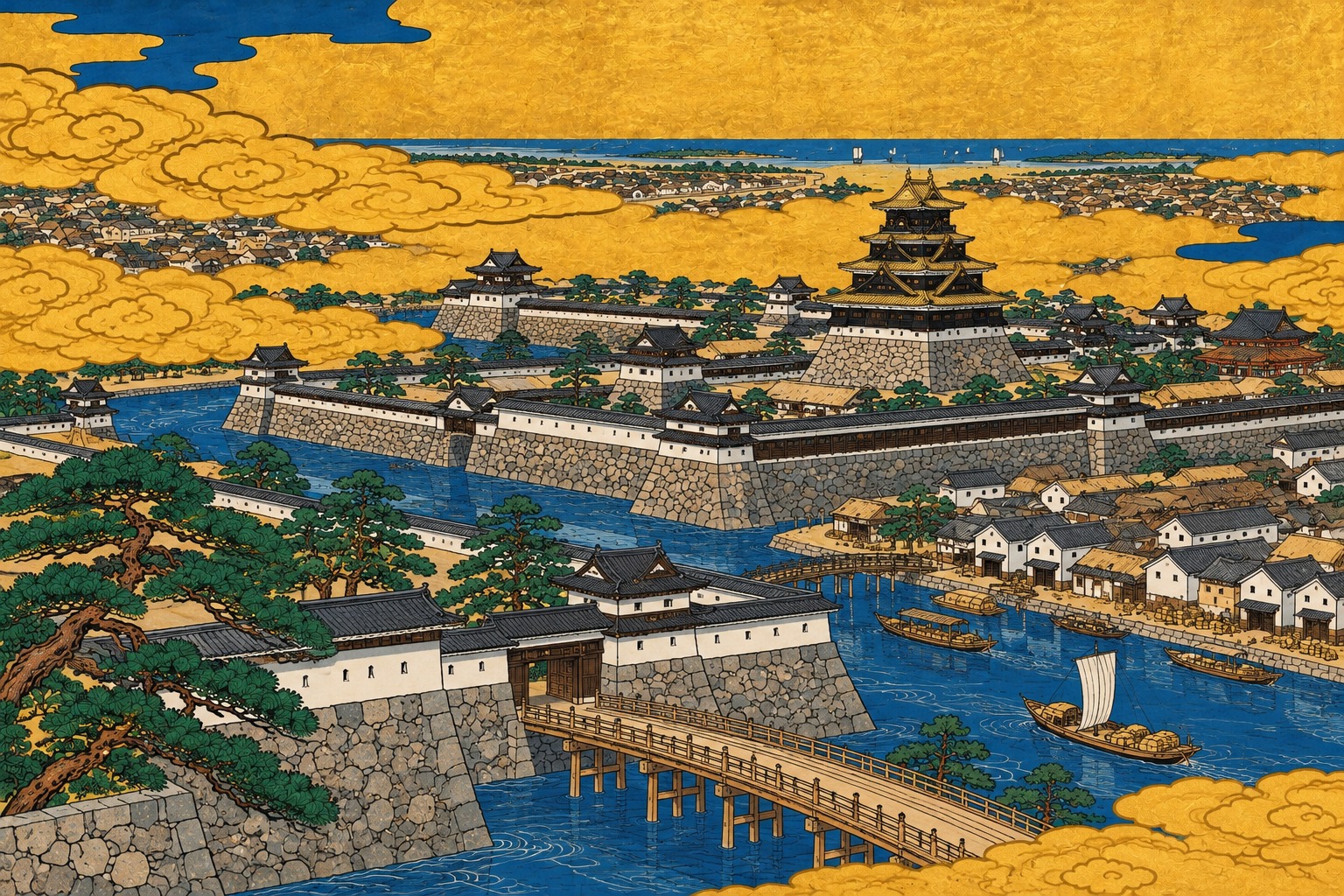
Canals connect sea and river traffic to white-plastered kura storehouses, while Yodo boats serve Fushimi and the sea. Osaka, like the west generally, uses silver; the east favors gold (Gear and Prices).
Who Holds Osaka
| Who | What they hold in AD 1600 | What they want | At the table |
|---|---|---|---|
| Toyotomi Hideyori, seven (eight by the Japanese count) | The castle, as Hideyoshi's heir; the nominal lord of both armies | Nothing; he is a child | His name stands on every order |
| Yodo-dono (Chacha), his mother | Hideyoshi's concubine and Oichi's daughter; she lives in the castle with her son | Her son's place | Letters go to her, and her word closes some doors |
| Ieyasu | The western citadel (nishinomaru) from Keicho 4, 9th month, 28th day [AD 15 November 1599] until he leaves for Aizu on Keicho 5, 6th month, 16th day [AD 26 July 1600]; and again from Keicho 5, 9th month, 27th day [AD 2 November 1600] until the spring of 1601 | The realm | A ruler whose guests come from every lord |
| Mori Terumoto | Enters the western citadel on Keicho 5, 7th month, 19th day [AD 27 August 1600] as the Western lords' nominal head, and gives it up days after the battle | To keep his eight provinces | He never takes the field; after Sekigahara he loses most of his lands |
| The Five Commissioners | Ishida Mitsunari, Masuda Nagamori and Natsuka Masaie lead the Western side; Maeda Gen'i sits on the council but informs Ieyasu; Asano Nagamasa is confined in 1599 | Their own place | From August to October 1600 they hold Osaka |
| The city office | Toyotomi magistrates (bugyo) run the town, its courts and its revenue under the Commissioners; the record this book draws on does not name the men of 1600 | Order and the revenue | An official who must sign |
| Katagiri Katsumoto | One of Hideyoshi's old captains. From 1601 he is the elder of Hideyori's house, by Ieyasu's appointment | To keep the Toyotomi house alive between its own pride and Ieyasu | After the battle every request to the castle goes through him |
Later: Osaka after 1600
From November 1600 to spring 1601, Ieyasu issues the settlement from the western citadel before moving to Fushimi. Hideyori retains Osaka castle and reduced Settsu, Kawachi and Izumi lands; Katagiri Katsumoto administers his house from 1601. In 1603 Hideyori marries Hidetada's daughter Senhime. The castle's fall on 3 June 1615 (Keicho 20) ends the Toyotomi house.
What the Stories Say
Hideyoshi's portable golden tea room is recorded at the palace in 1586 and Hizen Nagoya in 1592. Its repeated dimensions and furnishing details come from later accounts. Gold fittings in the castle itself are attested.
Osaka by the Clock
Four transfers of castle control occur during play. Find dates and events in The Era, The Choosing of Sides, 1599 to 1603; use this table for conditions the party encounters.
| When | Who holds the castle | What the party meets |
|---|---|---|
| Early 1599 to November 1599 | Hideyori, moved here from Fushimi in the 1st month of Keicho 4, under Maeda Toshiie until Toshiie dies in the spring | Lords' men arming in the mansions; the Commissioners and the generals at each other's gates (The Realm in 1600, The Quarrel of 1599) |
| November 1599 to July 1600 (to Clock step 1) | Ieyasu, in the western citadel | Every lord's agent waiting on him. He comes in the 9th month of Keicho 4 [AD October 1599] for the chrysanthemum festival; a plot to kill him is reported on his arrival and blamed on Maeda Toshinaga, Asano Nagamasa, Ono Harunaga and Hijikata Katsuhisa. Whether it existed is doubted |
| August to October 1600 (steps 2 to 8) | The Western Commissioners, with Mori Terumoto in the western citadel | Gates that close on an order; mansions watched; levies and powder moving east; passes read at every ring |
| November 1600 to spring 1601 (steps 9 and 10) | Ieyasu again | Petitioners from every house that lost or won; lists of the attainted; ronin at the inns |
| 1601 to 1603 | Hideyori's household under Katagiri Katsumoto | A rich, quiet, watched castle with Hideyoshi's gold in its storehouses and fewer men at its gates |
Before Sekigahara, letters and hostages drive Osaka scenes. Each house keeps men outside and women inside the gates while its autumn allegiance remains uncertain. The Era, Names and Address, explains approaches to the castle's occupants.
Places in Osaka
| Place | What it is in AD 1600 | Who is there | Scenes |
|---|---|---|---|
| The castle | Keep, baileys, moats and gate bridges | Guards, officials, retainers on watch | Audience, hostages, a pass |
| The western citadel | Where Ieyasu lives, then Mori Terumoto, then Ieyasu again | Lords' guards, messengers | A summons, a conference |
| The daimyo mansions | Compounds around the castle where lords' families live as pledges | Wives, children, retainers | An escape, a letter, a servant who sells word |
| The merchant town | Canals, storehouses, dealers, inns | Rice dealers, boatmen, porters | Cargo, loans, a bargain |
| The Yodo wharves | Boats to Fushimi and the sea; barges loaded with rice | Boatmen, toll collectors, dealers | A passage, an escort |
| The road to Sakai | 12 km south past the Sumiyoshi shrine (see Sakai) | Carriers, pilgrims, merchants' clerks | A message, a delivery, a tail |
The Castle
Visitors cross stone-lined moats on gate bridges, then pass officers at successive rings. Turrets and plaster walls follow the stone bases below the keep. Hideyori's household lives within; regents rule in his name. Western banners and competing orders in summer 1600 make it a divided seat of authority. Ieyasu questions Liefde pilot William Adams here that spring (The Realm in 1600, Europeans).
At the Table: The Castle
Who. Gate captains, clerks, retainers of every lord on duty, the child's attendants, Yodo-dono's women. Danger. A pass is checked at every ring; a name that is wrong is noticed in the next. Use. Audiences, hostages, orders sealed in Hideyori's name.
The Mansions and the Pledges
In 1600, daimyo wives and heirs secure loyalty as pledges at Osaka and Fushimi. Edo's alternate-attendance system dates only to 1635. At Clock step 2 the West attempts to seize Eastern lords' wives, but Hosokawa Gracia's death ends the attempt (The Realm in 1600, The Summer of Choosing). Surveillance replaces seizure.
At the Table: The Mansions
Who. Retainers of every house, wives and their attendants, children's tutors, guards, servants who carry letters. Danger. A servant who talks, a guard who has orders, a mansion that is watched from outside. Use. The place for a secret, a rescue, an escort or a theft of a letter.
The Merchant Town and the Yodo
Hideyoshi's relocated merchants occupy canal-side houses and storehouses. Rice traders, boat owners and money-changers depend on lordly stipends. The Yodo carries rice, timber and passengers between the sea, Fushimi and Kyoto, with few barriers or tolls after Hideyoshi's removals. Downstream travel from Fushimi takes about half a day.
At the Table: The Wharves
Who. Boat owners, porters, dealers, toll collectors, women who run inns near the quay. Danger. A cargo that is not what the dealer says; a boat whose master is paid by someone else. Use. Passage, escort, smuggling and gossip.
Osaka for Each Standing
-
Samurai. Every house keeps retainers in Osaka. In August 1600 a samurai's lord decides whether he is a guest or a suspect.
-
Ronin. The Western side raises troops, and a masterless man who is willing finds an employer by the second inn.
-
Foot Soldier. Gate duty, mansion guard and the levy's camps outside the town. From step 3 companies leave for the siege lines.
-
Townsman. Dealers, boatmen and shop keepers live by the lords' stipends. They care who wins only after they know who pays. The Kinai has Christian households, and a Portuguese-speaking interpreter is worth a lord's attention.
-
Villager. The villages of Settsu and Kawachi send rice, porters and pack horses on the castle's order.
-
Priest. Temples of the Hongan-ji sect stood here before the castle. A priest's cloth is a pass, and also a way to be asked questions.
-
Outcast. Porters, riverbed workers and street cleaners go unremarked in a city crowded with lords' men.
People of Osaka (fictional)
| Name | Who | What they want | Use at the table |
|---|---|---|---|
| Harada Hachiemon, about 44 | A gate captain at the second ring of the castle | To keep his post whoever wins | He sees every pass and every face, and can be bought or turned |
| Iwasaki Sobei, about 52 | A rice dealer with clients in several houses | A steady margin and no side | He knows every lord's stipend and who is short of rice |
| Fujita Kichi, about 36 | Keeper of an inn at the Yodo wharves | Guests who pay and tell her nothing | She hears boatmen talk and can place a traveler on a boat |
Hooks in Osaka
| Hook | Who | The offer | Opposition | Complication | Clock step or rule | Fits |
|---|---|---|---|---|---|---|
| Barges to Fushimi (best in AD 1599) | Iwasaki Sobei, at the Yodo wharves | He ships rice for three houses that are arming against each other and wants an escort paid by none of them | River toll men; the retainers of whichever house thinks its rice is feeding a rival (Foot Retainer) | One barge carries powder under the rice, and Iwasaki does not know which | Before step 0. Covert Work: Gates; Money and Stakes: Bribes | Ronin, Merchant, Ashigaru, Farmer (the boat crews are villagers) |
| The Tale-Bearer (October to November AD 1599) | A steward of one of the accused houses, in the mansions | A plot against Ieyasu has been reported and his lord is named in it. He wants to know who carried the tale and what proof was shown | Ieyasu's officers in the western citadel; the informer's own men (Shinobi Agent) | By the usual account the report came from inside the Commissioners. Naming the man sets the steward's house against the regime it serves | Before step 0. Covert Work: Gathering Information (Sealed); Name and Allegiance: Attitude | Shinobi, Entertainer, Samurai, Merchant |
| The Foreign Pilot (spring AD 1600) | A gate captain, at the castle | An English pilot is in custody, and Ieyasu wants a second interpreter who does not answer to the Jesuits | The Jesuit interpreter and the Portuguese, who have told Ieyasu the ship is a pirate | The party's translation is weighed against a father's. A wrong word hangs the crew or makes the mission an enemy | Step 0. Name and Allegiance: The Request, Attitude; Law and Justice: The Lord's Justice | Interpreter, Christian, Merchant, Physician (the crew is sick) |
| The Wives' Road (August AD 1600) | A servant of an Eastern lord's household, at a mansion near the castle | The lord has marched with Ieyasu. His wife and child must be out of the city before the Commissioners' men post guards on the mansion | The Commissioners' gate officers and Kondo Gengoro Kagetoshi (Adversaries) | A party sworn to a Western house is being asked to break its own lord's order: helping is a Duty refused, and being seen is a side changed. Its lord may instead order it to stop the flight, and then the servant is the quarry | Step 2. Covert Work: Gates, Disguise; Name and Allegiance: Calling In | Any; Physician, Priest and Merchant pass the gates most easily |
| Fever in the Mansions (September AD 1600) | A Western officer of the mansion guard | Sickness has broken out among the families held as pledges, and a dead hostage is worth nothing. He wants a physician brought in | Kondo Gengoro Kagetoshi, who searches whoever goes in and out | A wife inside wants a letter carried out in the medicine chest, and offers more than the officer pays | Steps 5 and 6. Medicine and Illness: The Illness Clock, Care; Covert Work: Informants and Messages | Physician, Priest, Entertainer, Shinobi (as the physician's servant) |
| Men of the Levy (September AD 1600) | A village headman of Kawachi, at a camp outside the town | He brought forty porters on the castle's order, and they are to be marched to Mino. He wants them home for the harvest, or at least counted and paid | The levy's captain (Ashigaru Captain) | The headman's tally and the captain's differ by six men, and the captain has sold their rations | Steps 5 and 6. Law and Justice: Collective liability; Money and Stakes: Bribes, Stipends | Farmer, Ashigaru, Outcast, Merchant |
| The Petitioners' Gate (November AD 1600 to spring 1601) | A captain of an attainted house, at the western citadel | His lord is dead and his company is unpaid. He wants a petition put into the hands of one of Ieyasu's officers before the lists are closed | Rival petitioners; Harada Hachiemon, who decides who waits and who goes in | The petition asks for the company to be taken on whole. The officer will take the men and not the captain | Steps 9 and 10. Name and Allegiance: The Request, After the Clock; Money and Stakes: Bribes | Ashigaru, Ronin, Samurai, Merchant |
| The Taiko's Gold (AD 1602) | A clerk of Katagiri Katsumoto | Bars of Hideyoshi's gold are leaving a castle storehouse, and the count is short. He wants the buyer found before Ieyasu's officers hear the house cannot keep its own treasure | A storehouse keeper and his buyer, a Sakai money-changer | The gold is paying ronin whom someone in the castle is quietly keeping. The clerk's master does not want that found either | After the Clock. Covert Work: Gathering Information (Close); Money and Stakes: Bribes | Merchant, Shinobi, Craftsman, Samurai |
Sakai
Sakai, named for the Settsu-Izumi boundary, lies 12 km south of Osaka. A century as Japan's richest, self-governing town has ended in lost autonomy. In AD 1600 it remains a center for gunmaking and silver loans, and a place for lords' agents to buy foreign cargo without visiting Kyushu.
Licensed trade with Ming China and Ryukyu enriched Sakai's merchants. Their egoshu council, usually counted as 36, governed behind landward moats, with the sea westward and hired troops for defense. In 1561 Jesuit Gaspar Vilela compared its consuls to Venice. Nobunaga demanded 20,000 kan for war in 1568; after discussing resistance, the council paid. His governor Matsui Yukan arrived in 1570. Hideyoshi later filled the moat, usually dated 1586, transferred merchants to Osaka and installed his magistrates.
Who Holds Sakai
| Who | What they hold in AD 1600 | What they want | At the table |
|---|---|---|---|
| The magistrate's office | The town's courts, harbor dues and the control of its guns, for the Toyotomi. Ishida Mitsunari held the post in 1586 with the merchant Konishi Ryusa. Mitsunari's elder brother Ishida Masazumi held it from about 1593; the common account ends his term in 1599, and the record does not clearly name the man of 1600 | The guns and the revenue for whoever holds Osaka | In August 1600 the office serves the Western side. Masazumi dies at Sawayama after the battle |
| The merchant houses | The wards, the storehouses, the credit and the old council's habit of deciding things among themselves. The Imai house is headed by Imai Sokun, son of the tea master and arms dealer Imai Sokyu, who died in 1593; the Tsuda house of the Tennojiya by Tsuda Sobon | Trade with both sides and a town that is not burned | Sokun is close to Ieyasu and arranged a Tokugawa marriage in 1599; other houses supply the West |
| The gunsmiths | Workshops in the north of the town, working to orders from lords and through the merchant houses. The houses of Enamiya and Shibatsuji are on record in the next decade | Iron, charcoal and orders that are paid | Whoever holds the magistracy has first call on the barrels |
| The temples | Nanshuji, the Zen temple of the tea men; Myokokuji, of the Nichiren sect; many smaller halls | Patrons | Lodging and a quiet room |
| The Christians | A mission house and a congregation among the merchants since the 1560s, when the merchant Hibiya Ryokei [Diogo] gave the fathers a room | To be left alone | The Konishi, Sakai druggists turned lords, are the town's best-known Christian house |
Later: Sakai after 1600
After Sekigahara Sakai becomes a Tokugawa town. Ieyasu's officers Naruse Masanari, Hosoi Masanari and Yonekitsu Chikakatsu take the office in 1600. Silver for the new coinage is worked here from 1601. In 1604, later than the play range, Sakai's merchants share the Nagasaki silk with Kyoto's and Nagasaki's under a fixed allotment. The town burns in the fighting of 1615.
Places in Sakai
| Place | What it is in AD 1600 | Who is there | Scenes |
|---|---|---|---|
| The moat and its bridges | A ditch about 10 m wide on three sides, silted and partly filled, crossed by plank bridges | Carriers, watchmen, children fishing | An arrival noted, a body in the reeds |
| The cross street | The wide street that divides the north wards, in Settsu, from the south wards, in Izumi | Clerks, porters, money-changers | A meeting in plain sight |
| The gunsmiths' streets | Forges and boring sheds in the north wards | Smiths, apprentices, iron and charcoal dealers, a lord's inspector | An order, a proof firing, a theft |
| The merchant houses | White-plastered storehouses with tile roofs, counting rooms and tea rooms behind plain fronts | House heads, clerks, brokers | Credit, a price, a letter of introduction |
| The wharf | A wooden wharf with seagoing coasters (sengokubune) for the Inland Sea run | Ship masters, sailors, harbor clerks | Passage to Kyushu, a cargo, a stranger landed |
| Nanshuji | The Rinzai temple where Sakai's tea men studied Zen | Monks, tea men | A gathering, a refuge |
| Myokokuji | A Nichiren temple known for its great cycad; Ieyasu was a guest in Sakai when Nobunaga was killed in 1582 | Monks, merchants of the sect | Lodging for a lord's agent |
| The magistrate's office | Where suits are heard and gun orders are registered | Clerks, guards, petitioners | A permit, a hearing, a seizure |
The Council and the Magistrate
House heads preserve council habits in private tea-room meetings, agreeing what to offer a magistrate before he asks. Public compliance can conceal a sudden iron shortage. The office hears town disputes (Era Rules, Law and Justice) and registers every lord's gun orders. At Clock steps 2 and 10 that register is Sakai's most valuable book.
At the Table: The Office and the Houses
Who. The magistrate's clerks and guards, heads of houses, their senior clerks, a lord's buyer with a letter. Danger. Every large purchase is recorded. A buyer for one side is known to the other side's friends within the day. Use. A permit, a hearing, a look at the register, an introduction that only a house head can give.
Guns and Iron
Japanese records date Tanegashima's first matchlocks to 1543; Portuguese accounts give 1542. Sakai merchant Tachibanaya Matasaburo learned their manufacture there and brought it home. Half a century later Sakai rivals Omi's Kunitomo as a production center, supplying finer guns. Smiths forge barrels around iron rods, ream them, fit breech screws and proof-fire them; separate workshops supply stocks, and locks are brass. A master and six men use bar iron, abundant charcoal and skilled labor to finish a few monthly. These guns serve as lordly gifts and merchant capital (The Black Powder Armory; Gear and Prices). Buyers source their own powder, with overseas saltpeter supplied by the same trading houses.
Morita Zenbei, Gunsmith of Sakai (fictional, cast)
About 46, short, thick in the forearm, burn marks on his arms, the crown shaved with a small topknot under a white headcloth; a short hemp-tan kosode tucked up into the sash, sleeves tied back.
Morita forges and reams matchlock barrels for merchant and lordly clients. Good iron, charcoal and payment on delivery concern him most. Use him to supply guns (The Black Powder Armory), identify buyers or face forced service. One lord's commission can make him another's enemy.
At the Table: The Gunsmiths
Who. Masters, journeymen, apprentices at the bellows, iron dealers, charcoal carriers from the hills, a lord's inspector counting barrels. Danger. A proof firing that bursts; an order taken from the wrong side; an agent buying up the iron so that a rival's order fails. Use. Guns, repairs, a count of who has ordered how many, a craftsman to hire or to carry off.
Tea and the Great Houses
Sakai gave warrior tea its masters. Merchant-born Sen no Rikyu, Imai Sokyu and Tsuda Sogyu served the great lords; the latter two sold powder and weapons while teaching Nobunaga and Hideyoshi tea. All three are dead by 1600, but their houses retain utensils, rooms and customs. In a tea room, lord, merchant and priest meet almost as equals without a written record. Provenanced bowls and caddies can command a fief's revenue as gifts, bribes or loan security.
Izumiya Tomi, Merchant and Broker of Sakai (fictional, cast)
About 41, medium height, composed, a mole by the mouth, gray at the temples; a dark plum silk kosode with a small pattern and a gold-brown sash worn at the front.
Tomi's small merchant house takes its shop name from Izumi province. She trades in goods, credit and information for lords and merchants on both sides. She can patronize the party, arrange business, quote prices or buy goods it cannot sell openly.
At the Table: The Tea Room
Who. A house head as host, a lord's agent, a tea man, a monk of Nanshuji, a clerk waiting outside with the ledger. Danger. A transaction that is overheard; a guest who is a spy; a utensil that is not what its box says. Use. An introduction, a loan, a meeting between two sides that never happened.
The Wharf and the Overseas Trade
Inland Sea shipping links Sakai to Shimonoseki, Hakata and Nagasaki (Places and Campaign Tools, The Western Roads and the Inland Sea). Houses bring Nagasaki's Chinese silk, saltpeter, lead and medicines into the Kinai; a few sail to Luzon and beyond themselves. Imports and foreigners are nanban, southern barbarian. Ieyasu brings the Dutch Liefde, carrying guns, powder and shot, to Sakai in spring 1600 before sending her to the Kanto.
At the Table: The Wharf
Who. Ship masters, sailors, harbor clerks, porters, a Kyushu merchant's factor, Christians back from Nagasaki. Danger. A cargo listed as one thing and loaded as another; a passenger the office wants; weather that holds a ship for a week. Use. Passage west, news from Kyushu a week ahead of the road, foreign goods without the journey.
Sakai in the War and After
Trade serves both sides before Clock step 2. Western control of Osaka and Sakai's magistracy then directs sales to the West until battle, with Ieyasu-friendly houses watched and some members confined. Afterwards, three Western commanders are paraded through Sakai, including local druggist's son Konishi Yukinaga. New Tokugawa officers examine the gun register and question houses about their customers.
Sakai for Each Standing
- Samurai. A lord's buyer is received with tea and written into the register. A samurai with no errand is assumed to be watching someone.
- Ronin. The houses hire guards for storehouses and cargoes, and ask no questions they do not need answered.
- Foot Soldier. A gunner sent to collect and prove his company's barrels is a welcome guest in the smiths' streets.
- Townsman. This is a town run by townsmen. A merchant or craftsman with an introduction is among his own; without one he is a competitor.
- Villager. Charcoal burners and carriers from the Izumi and Kawachi hills feed the forges, and their headmen deal with the iron merchants.
- Priest. The Zen temples are part of the tea world, and the Nichiren halls belong to the merchants who built them. A monk is a guest or a go-between.
- Outcast. Porters and harbor hands. The condemned are walked through these streets, and the men who lead them are kawata.
People of Sakai (fictional)
| Name | Who | What they want | Use at the table |
|---|---|---|---|
| Kimura Yozaemon, about 58 | Head of an old council house in the south wards | The town left standing whoever wins | He can call the house heads together, and he knows what each sold to whom |
| Hara Sakubei, about 35 | Master of a coaster on the Inland Sea run | A full hold and no inspection | He lands people and goods at Hakata or Nagasaki and brings back what he is asked not to list |
| Nui [Marta], about 30 | Widow of a druggist, a Christian, who deals in medicines and saltpeter | To keep the shop and her late husband's Nagasaki partners | She supplies physicians and gunners alike and hears from Nagasaki before the office does |
| Enkai, about 50 | A former gun monk of Negoro, burned out in 1585, now a proof-master for the smiths | His old brothers found and fed | He can judge any gun and gunner, and knows where the Negoro men went |
Hooks in Sakai
| Hook | Who | The offer | Opposition | Complication | Clock step or rule | Fits |
|---|---|---|---|---|---|---|
| The Captives' Boat (winter AD 1598 to 1599) | Hara Sakubei, at the wharf | He has carried Korean captives up from Kyushu for a dealer. One is a potter two lords' agents want, and Sakubei wants the sale settled without a fight on his deck | The two agents (Foot Retainer); the dealer, who owns the papers | The potter speaks for the others: he will work for whoever buys his family with him. A Christian house offers to ransom all of them and cannot pay until spring | Before step 0. Money and Stakes: Haggling, Debt; Law and Justice: The Lord's Justice | Merchant, Interpreter, Christian, Physician, Craftsman |
| The Second Host | Izumiya Tomi, at a tea house | A gathering has two hosts who do not know each other. She wants the party to see that neither guest leaves with the other's letter | Each guest's own man outside (Shinobi Agent, Ronin Swordsman) | Tomi has taken a fee from both hosts, and one of them learns it during the evening | Any step. Covert Work: Informants and Messages; Name and Allegiance: Attitude | Any; Entertainer, Priest and Merchant are inside the room |
| The Negoro Men (AD 1599 to summer 1600) | Enkai, in the smiths' streets | A lord's recruiter is hiring former gun monks into a matchlock company. Enkai wants his old brothers found before they sign, and warned what the last such company was paid | The recruiter and his captain (Ashigaru Captain, Ashigaru Gunner) | Half of them want to sign. The other half have an offer from the other side | Steps 0 to 2. Name and Allegiance: The Request; Money and Stakes: Stipends | Sohei, Ashigaru, Ronin, Shinobi |
| The Ship at the Wharf (May to July AD 1600) | A harbor clerk | The Dutch ship lies here under Ieyasu's guard with cannon, 500 matchlocks and powder aboard. The clerk is asked by three parties what has been taken off her, and wants someone else to find out | Ieyasu's guard on the wharf (Foot Retainer); a Jesuit's agent who wants her charts; a Western lord's buyer | Her sick crewmen are lodged in the town and need a physician. Whoever treats them hears what the cargo was | Steps 0 and 1. Covert Work: Gathering Information (Guarded), Gates; Medicine and Illness: Care | Physician, Interpreter, Shinobi, Merchant, Christian |
| A Gun Order (July to September AD 1600) | Morita Zenbei | A lord's agent has ordered fifty matchlocks by autumn. Another buyer has bought up the bar iron and the charcoal, and Morita has no powder to prove the barrels he has finished. He wants iron and charcoal found and a gunner to prove the guns | The rival buyer; the magistrate's inspector, who counts every barrel for the Western side from step 2 (Magistrate's Officer) | If the order is for an Eastern lord, it must leave a Western-held town. If Morita fails, the advance he took is a debt | Steps 1 to 5. Money and Stakes: Haggling, Debt; Covert Work: Gates; Gear and Prices, military goods | Craftsman, Merchant, Ashigaru (to prove the guns), Farmer (the charcoal villages), Ronin |
| The Druggist's Son (early November AD 1600) | Nui [Marta], on the cross street | Konishi is to be walked through the town in a cart. His kin and the congregation want a rosary put into his hands and their storehouse emptied before it is seized | The escort (Foot Retainer); the new Tokugawa officers; neighbors eager to show which side they were on | The kawata who lead the cart can pass the rosary, for a price and a favor owed | Step 9. Covert Work: Disguise, Informants and Messages; Money and Stakes: Bribes | Christian, Outcast, Priest, Merchant |
| The Register (winter AD 1600 to 1601) | Kimura Yozaemon | The Tokugawa officers have the register of gun orders and are asking questions. He wants one page read before they reach it, and the house on it warned | The new officers and their clerks (Magistrate's Officer, Town Watchman) | The page shows a house that armed both sides. It is Kimura's own | Step 10. Covert Work: Cover, Gathering Information (Close); Name and Allegiance: After the Clock | Merchant, Shinobi, Craftsman, Samurai |
Edo
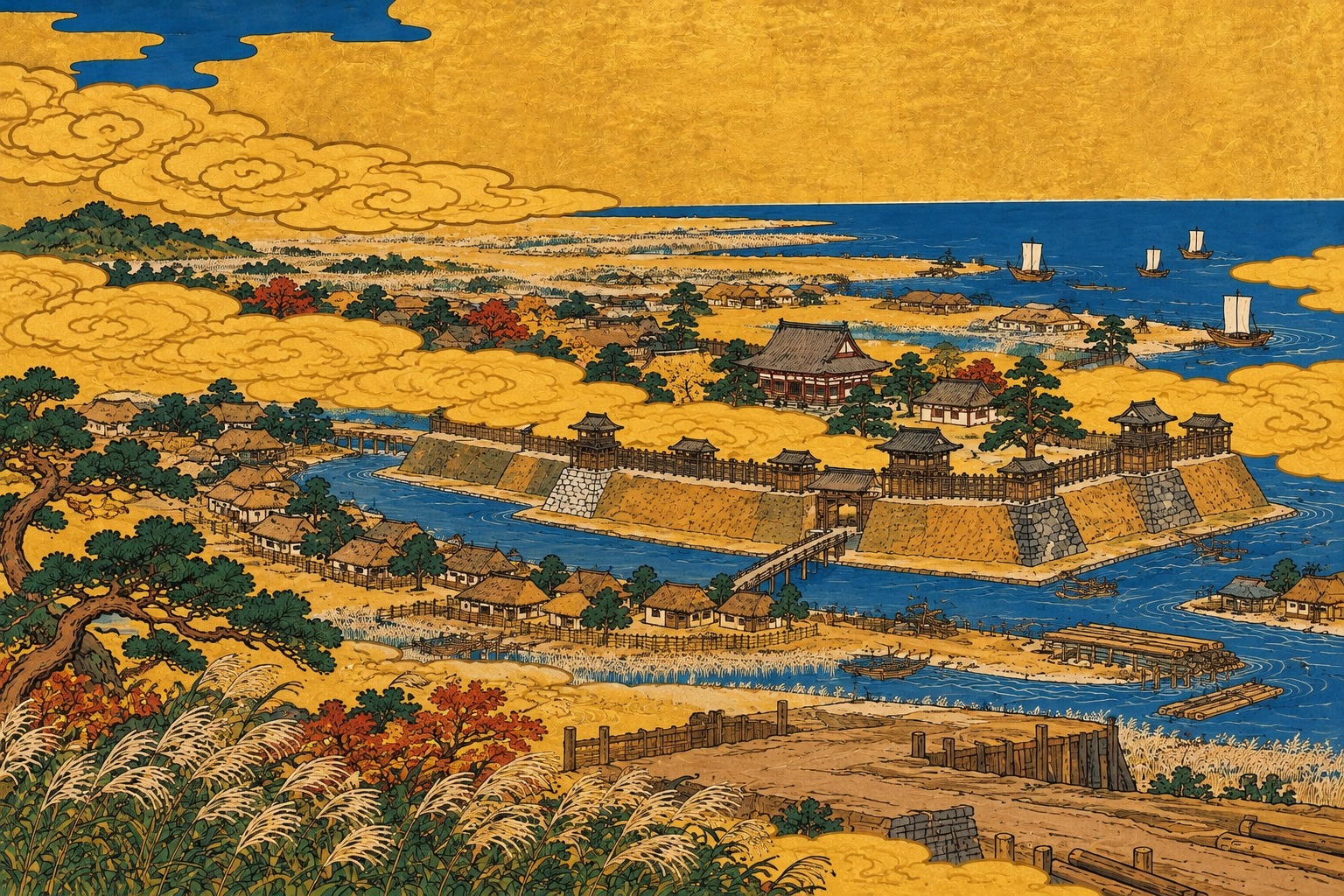
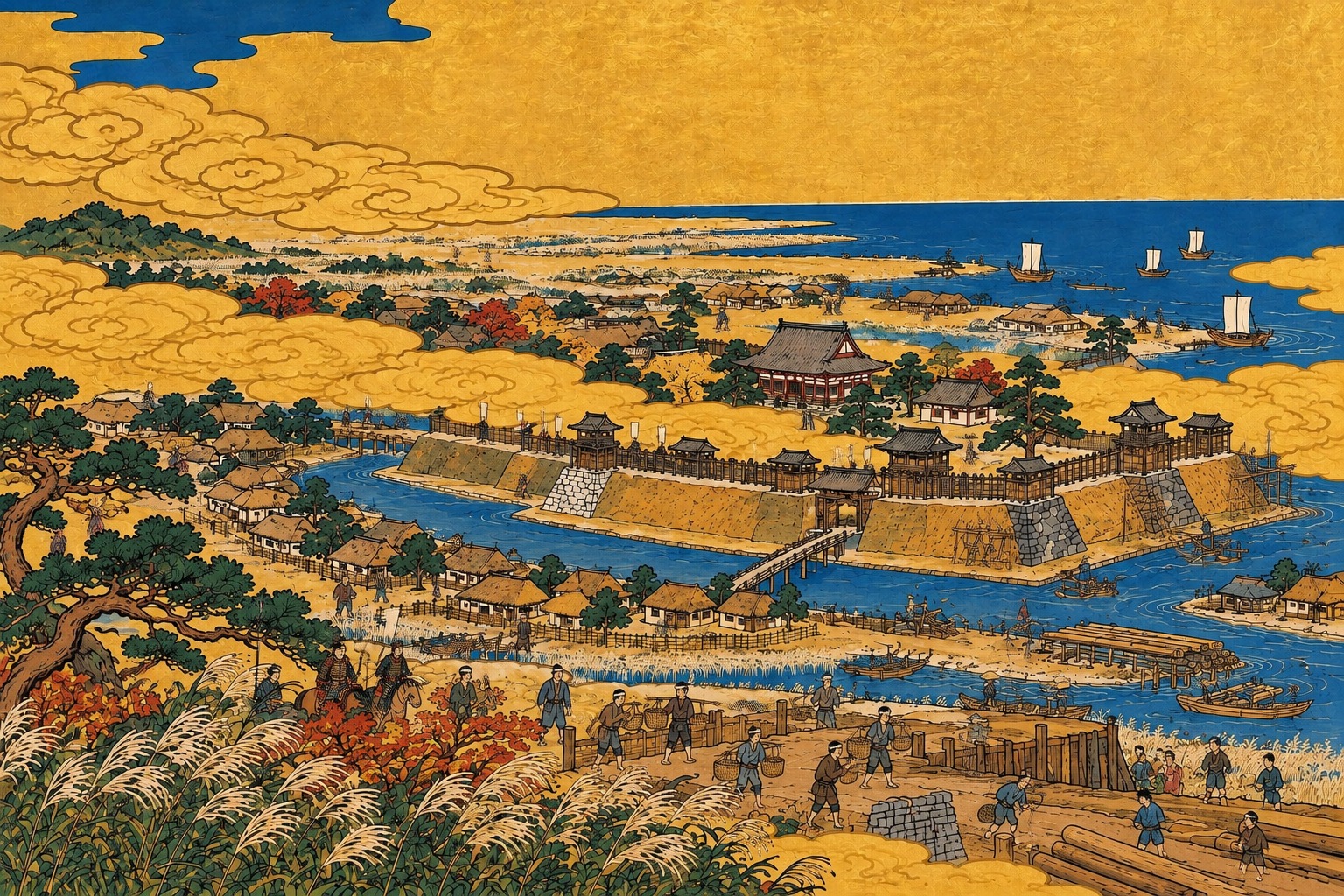
Perhaps a few tens of thousands live in Musashi's ten-year-old castle town of Edo in AD 1600; no firm count survives. Ieyasu entered on Tensho 18, 8th month, 1st day [AD 30 August 1590], transferred by Hideyoshi from five home provinces to eight in the Kanto. Ota Dokan's decaying 1457 castle then overlooked merchant lanes, fishing hamlets and reed marsh. The Kanto domain, Japan's largest, yields about 2.5 million koku.
Ieyasu's additions include raw-earth ramparts and a moat, with few stone walls and no keep before the great stone works and 1607 tower. Workers fill Hibiya inlet's edges east of the castle for warrior plots, cutting canals and building in timber. Kyoto remains the capital; Edo becomes the shogunate's seat only after 1603.
Who Holds Edo
| Who | What they hold in AD 1600 | What they want | At the table |
|---|---|---|---|
| Tokugawa Ieyasu | The Kanto and the castle; lord of the east | The realm | In Edo from Keicho 5, 7th month, 2nd day [AD 10 August 1600]; he goes north against Aizu, turns back at Oyama, and leaves for the west on Keicho 5, 9th month, 1st day [AD 7 October 1600] with about 30,000 of his own men |
| Tokugawa Hidetada | Ieyasu's heir; he leaves Edo in the 7th month for the Aizu campaign and later brings the main army down the Nakasendo | To join his father | He is held up at Ueda and arrives after the battle |
| Tokugawa administrators | Ieyasu's officials who run the town, the building and the roads: Itakura Katsushige and Hikosaka Motomasa have been the town's magistrates (machi-bugyo) since 1590, and Hikosaka is also one of the Kanto intendants with Ina Tadatsugu and Okubo Nagayasu | The works finished | Itakura leaves for Kyoto in 1601; Hikosaka is dismissed in 1606, later than the play range |
| Matsu (Hoshun'in) | The widow of Maeda Toshiie; sent to Edo as a hostage in June 1600 | The safety of her house | A guest in a lord's house who cannot leave |
| Warrior houses | Plots in the town laid out by rank | A house and a place | Retainers who now live in a town they do not know |
| The temples | Zojoji moved into the area in 1598; Sensoji stands to the north as an older temple | Alms and land | Lodging, burials, a record of who came |
The Hojo Left Behind
The Kanto belonged to the Hojo until Odawara's surrender on Tensho 18, 7th month, 5th day [AD 4 August 1590], after roughly 100 days. Ujimasa was ordered to die; Ujinao was exiled. Four weeks later Ieyasu entered Edo. His vassal Okubo Tadachika now holds Odawara at Hakone's approach. Former Hojo retainers chose new service, farming or wandering. Ten years later an Edo labor gang may include a former Odawara company commander, unquestioned.
Ieyasu's Edo
Hideyoshi's death calls Ieyasu from his Kanto seat to the Elders' duties at Fushimi and Osaka. Officers govern Edo during most of 1598 to 1600. He visits twice in summer 1600, around the Aizu march (dates above; The Realm in 1600, The Summer of Choosing). Porters, horses and supplies are levied from town and countryside; soldiers arrive and depart. Suppliers prosper, while merchants unable to supply the army face demands for loans.
The coastal Tokaido, inland Nakasendo and northern Aizu road approach Edo. For western passes, river crossings and ferry, see Places and Campaign Tools, The Tokaido. Hakone lacks a checkpoint in AD 1600.
Retainers patrol Edo; headmen and neighbor groups maintain rural order without professional police (Era Rules, Law and Justice). Eastern trade uses gold. A westerner's bar silver must be weighed and exchanged at a money-changer's margin (Era Rules, Money and Stakes).
Places in Edo
| Place | What it is in AD 1600 | Who is there | Scenes |
|---|---|---|---|
| The castle works | Raw ramparts, a new moat, timber turrets and plank gates | Carpenters, masons, laborers, overseers | A theft, an accident, an inspection |
| The reclamation | The edges of the Hibiya inlet and the shore being filled for plots | Work parties, boatmen, earth carriers | A body found, a quarrel over pay |
| The warrior plots | Compounds with plank fences, laid out by rank | Retainers, servants | New men, rival houses, a duel |
| The merchant lanes | A few streets of shops and craftsmen | Carpenters' suppliers, rice and charcoal sellers | News, a loan, a meal |
| The fishing hamlets | Huts on the shore, nets, boats | Fishers, net bosses | Passage, smuggling, a hiding place |
| Zojoji and Sensoji | The temples | Monks, pilgrims | Lodging, a burial |
The Castle Works
Earth baskets, timber and piled stone crowd the castle works. Labor gangs excavate and carry under tally-keeping overseers; wages follow those tallies (Gear and Prices gives a carpenter's day wage). Unnamed, unsponsored strangers are stopped.
At the Table: The Works
Who. Laborers in work parties, carpenters, masons, overseers, warriors on guard, the lord's officials. Danger. An accident with a hoist or a bank that slides; a quarrel over a tally; a stranger arrested as a spy. Use. A job for hire, a hiding place among strangers, a record of who dug what.
The Reclamation and the Shore
Boats follow Hibiya inlet between castle and bay-side spit almost to the eastern gate. Filling its banks creates plots. Fishing boats, timber rafts and packhorses work the shallow shore, with fishing hamlets between warrior plots. Tradition dates Edo's first public bath to 1591 at one Eiraku mon, but the account is debated. Temples and inns offer steam baths.
At the Table: The Shore
Who. Fishers, net bosses, boatmen, earth carriers, a warrior overseeing a work party. Danger. Mud and tide, a boat whose master wants no passengers, laborers who have not been paid. Use. A quiet landing, a messenger boat, a body that need not be found.
The Warrior Plots
The retainers who followed Ieyasu east in 1590 and arrived later receive ranked plots behind plain plank fences. Many are newcomers both to Edo and their employing house. A neighboring retainer may once have served the Hojo.
At the Table: The Plots
Who. Retainers, servants, messengers, ronin who come looking for work. Danger. A dispute between houses over a boundary; a ronin who was once a Hojo man and hates the new lord. Use. Employment, a feud, and a chance to learn how a lord's household works.
Zojoji, Sensoji and the Merchant Lanes
Zojoji moved within the town around 1598. Northward stands the older temple of Sensoji. Closely packed thatched merchant shops line the intervening lanes.
At the Table: The Lanes
Who. Monks, pilgrims, shop keepers, carpenters' suppliers, charcoal and rice sellers. Danger. Fire; a shopkeeper who sells word. Use. A meal, a letter, a bed for a night.
Later: Edo after 1600
At the end of Keicho 6 [AD 1601], fire spreads from merchant lanes across Edo overnight. Subsequent orders replace thatch with board roofs. After Ieyasu's 1603 shogunal appointment, daimyo levies rebuild the city from 1603 to 1605: Kanda hill's earth fills Hibiya inlet, and Nihonbashi opens in 1603. The keep follows in 1607. Hidetada becomes shogun on 2 June 1605; Ieyasu settles at Sunpu in 1607.
Edo for Each Standing
- Samurai. Ieyasu's retainers are new here, and so is everything. A samurai finds a plot to hold and a house to join.
- Ronin. The new town has work for any man who can carry earth, guard a gate or handle a spear.
- Foot Soldier. The companies muster here in the summer of 1600 and march twice. Between campaigns they guard the works.
- Townsman. A carpenter, a boatman or a shop keeper can start in a month and be in debt in two.
- Villager. A farmer's son who walks in from the country can join a work party and earn a wage. His village is levied for porters and horses whether he goes or not.
- Priest. Zojoji is new in the town and Sensoji is old on the shore. Both take alms.
- Outcast. Laborers on the works include people no one asks about. A party of them can pass for any other.
People of Edo (fictional)
| Name | Who | What they want | Use at the table |
|---|---|---|---|
| Takahashi Kyuzo, about 50 | Master carpenter for the castle works | Timber on time and pay he can trust | He hires carpenters, knows the plans and is a good witness to a theft |
| Tsukuda Natsu, about 45 | Net boss in a fishing hamlet on the shore | Her people's fishing grounds and no tax collector | She can land a boat unseen and knows the tide |
| Suzuki Denzo, about 43 | A laborer boss and a former retainer of the old Hojo | Work for his men and a lord who treats them fairly | He hates the Tokugawa and cannot say so; he can recruit forty men |
Hooks in Edo
| Hook | Who | The offer | Opposition | Complication | Clock step or rule | Fits |
|---|---|---|---|---|---|---|
| The Moved Graves (AD 1598 to 1599) | A monk of Zojoji | The temple has been moved to new ground, and a village's graves and fields lie under it. He wants the village settled and its dead moved with the rites before the surveyors return | The intendant's surveyors (Magistrate's Officer); the village's young men, who mean to pull up the stakes (Village Militia) | Kawata must move the dead and will not be paid by the temple. One grave is a Hojo captain's, and his old men come to see it moved | Before step 0. Law and Justice: Collective liability; Name and Allegiance: The Request | Sohei, Priest, Farmer, Outcast |
| The Tally Sticks | Takahashi Kyuzo, at the castle works | The tally sticks for a month's timber are missing, and pay depends on them. He wants them found before the overseer asks | The overseer's clerk, who sold the timber twice; a rival master carpenter | The sticks were taken by Takahashi's own apprentice to cover a debt | Any step. Covert Work: Gathering Information (Guarded); Money and Stakes: Debt | Craftsman, Merchant, Farmer (the carters), Outcast |
| The Ronin Boss | Suzuki Denzo, at a work camp on the shore | His men have been called out for work they were not hired for. He wants a witness of standing for his side of the quarrel | The overseer and his guard (Foot Retainer, Ashigaru Spearman) | The work is a powder store, and the overseer cannot say so. Denzo's past makes any refusal look like a rising | Any step; sharper at steps 1 to 6. Law and Justice: The Lord's Justice; Name and Allegiance: Attitude | Ronin, Samurai, Ashigaru, Priest |
| A Landing at Night | Tsukuda Natsu, on the shore | A boat wants to land a passenger without notice. She wants someone to look at the passenger first | The shore patrol (Town Watchman); whoever is following the boat | At steps 2 to 6 the passenger is a messenger from the west with letters for a lord who has not yet declared | Any step. Covert Work: Gates, Informants and Messages | Shinobi, Merchant, Farmer, Ronin |
| A Letter for the Hostage (from June AD 1600) | A servant of the Maeda household, at a warrior plot | The Maeda widow is held as a guest in Edo and wants a letter carried to her son in Kaga, and an answer brought back | Her hosts' guards (Foot Retainer); a Tokugawa officer who reads what leaves the house | The letter tells her son to stand with Ieyasu whatever is done to her. Her hosts would be glad to see it go, and the servant does not know that | Steps 0 to 4. Covert Work: Informants and Messages; Travel: The Long Ride | Priest, Physician, Entertainer, Merchant |
| The Kanto Levy (July to August AD 1600) | A village headman, in the town | His village owes twelve porters and four horses for the march on Aizu, in the weeks before harvest. He wants the count reduced or substitutes hired | The levy officer (Ashigaru Captain); a neighbor village that will be charged the difference | The substitutes on offer are Suzuki Denzo's men, and a village that sends Hojo ronin in its name answers for them | Steps 1 to 4. Law and Justice: Collective liability; Money and Stakes: Bribes, Haggling | Farmer, Ashigaru, Merchant, Ronin |
| The Autumn March (October AD 1600) | A supply merchant, in the lanes | Ieyasu's army has taken every porter. He needs men to carry rice and match cord to the army on the Tokaido, and the army pays nothing until the campaign ends | Bandits on the road behind the army (Bandit); a quartermaster who pays in promises | If the battle is lost the notes are worthless. The merchant has borrowed against them already | Step 6. Travel: The Stage; Money and Stakes: Debt | Merchant, Ashigaru, Farmer, Outcast, Ronin |
| The Gate at Fushimi (AD 1601) | The son of a Koka man who died at Fushimi | Ieyasu is rewarding the families of the Koka men of the garrison. A rival claimant says this man's father opened the gate to the enemy. He wants the tale traced to its teller | The rival claimant and his kin (Shinobi Agent); a clerk who must strike one name from the list | No one who was inside lived. The proof either way is in Kyoto, among what was dug out of the ruin | Step 10. Law and Justice: The Lord's Justice; Covert Work: Gathering Information (Close) | Shinobi, Ashigaru, Samurai, Priest |
| Boards for Thatch (winter AD 1601 to 1602) | Takahashi Kyuzo | The town has burned, and every roof is to be boarded. He wants timber rafts brought down the river past buyers who are seizing them, and a fair price held | Timber merchants who have cornered the boards; officers requisitioning for the warrior plots (Foot Retainer) | A rumor blames the fire on Hojo ronin, and Suzuki Denzo's camp is where the watch looks first | After the Clock. Battle, Fire and Fear: Fire; Medicine and Illness: Care; Money and Stakes: Haggling | Craftsman, Merchant, Physician, Ronin, Farmer |
| The Boundary Stake (AD 1602 to 1603) | A retainer new to Edo, at the warrior plots | His neighbor has moved the stake between their plots. He will not go to the magistrate, because both parties to a quarrel are punished. He wants it settled quietly | The neighbor's household (Foot Retainer, Ronin Swordsman) | The neighbor is a former Western man taken on after the settlement and is waiting for an excuse | After the Clock. Law and Justice: Both parties punished; Era Rules, Schools and Popularity (a bout) | Samurai, Ashigaru, Ronin, Priest (as go-between) |
Nagasaki
Portuguese trade and Christianity define Nagasaki. Omura Sumitada arranged its harbor with the Jesuits in 1570; the first Portuguese vessel arrived in 1571, and he granted it to the mission in 1580. The expulsion edict of Tensho 15, 6th month, 19th day [AD 24 July 1587] failed to end missionary work. Hideyoshi assumed direct control on Tensho 16, 4th month, 2nd day [AD 27 April 1588], though older summaries give 1587. First deputy Nabeshima Naoshige preceded Toyotomi magistrate (bugyo) Terazawa Hirotaka, appointed in 1592 (1593 in some accounts). Also lord of Karatsu, Terazawa serves Ieyasu in the campaign.
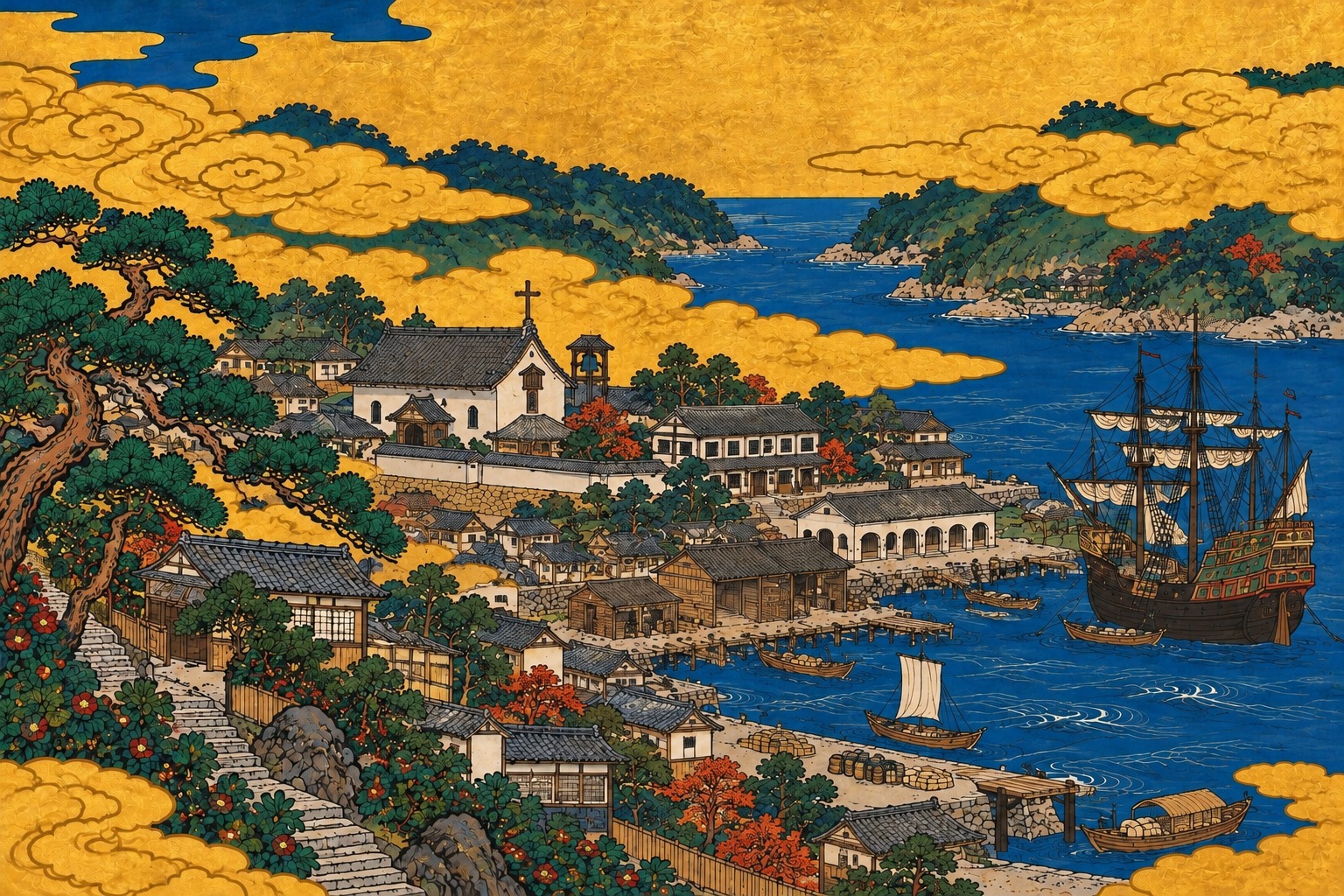
Steep wooded hills enclose Nagasaki's long harbor, with board- and thatch-roofed timber houses climbing them. House, church and Jesuit college occupy the waterside cape above the quay. The church is enlarged as the Assumption in 1601; usual accounts bring college and press from Amakusa in 1597 and 1598. Hillside All Saints, built in 1569 with a Japanese roof and cross, lies outside town. Exact building locations are unrecorded. Perhaps 15,000 people live here, overwhelmingly Christian.
Who Holds Nagasaki
| Who | What they hold in AD 1600 | What they want | At the table |
|---|---|---|---|
| Terazawa Hirotaka | The magistracy: courts, harbor, customs. He is often away at Karatsu or with the army, and a deputy sits for him. The Jesuits' letters say he was baptized in the 1590s and turned against the mission after 1597 | To keep the post under Ieyasu | He impounds cargo and sends reports to Osaka, and after the battle to Ieyasu |
| The town elders | The inner town, the old wards by the cape, which pay no land tax. Four elder houses (otona) run it: by the usual list the Takagi, Takashima, Goto and Machida, all Christians | The trade, the faith and the town's privileges | Nothing is landed, lodged or hired in the inner town without one of them knowing |
| Murayama Toan [Antonio] | The outer town, the newer wards, as the regime's deputy (daikan) since 1592, when he won the post from Hideyoshi in person in return for a fixed yearly payment in silver | Wealth, and the ear of whoever rules | A self-made man the elder houses dislike; he deals with the friars as well as the Jesuits |
| The Jesuits | The church, the college, the press and a share in the silk; Bishop Luis de Cerqueira lives here from 1598 | To keep the mission alive | Alessandro Valignano, the Visitor, is in Japan from 1598 to 1603. Joao Rodrigues, called Tcuzu, is the interpreter |
| The captain-major | The Portuguese authority for the ship's voyage | A good sale and a safe return | There is no Portuguese fort or settlement |
| Christian townsmen | The town's boats, houses and brotherhoods | To keep the faith and the trade | Most of the town |
| Spanish friars | A few Franciscans, at odds with the Jesuits | To preach | Their order lost six friars at Nishizaka in 1597 |
| The Omura and Arima lords | The surrounding lands; Omura Yoshiaki [Sancho] and Arima Harunobu [Protasio] are Christians | Their domains | Neighbors who matter to the town's safety |
Christians in Nagasaki, as of AD 1600
For national Christian numbers, law and mission, see The Realm in 1600, Christians. Nagasaki's ordinary life includes baptism, street feast days, confraternities and the rejection of suicide.
Following the San Felipe incident, Hideyoshi ordered 26 Christians crucified at Nishizaka above Nagasaki on Keicho 1, 12th month, 19th day [AD 5 February 1597]. Marched from Kyoto, they included six Franciscans, three Jesuits (among them Paul Miki) and 17 Japanese laymen. Guards prevented relic-taking crowds; local Christians now visit the hill as pilgrims.
Nagasaki Christians founded the Portuguese-pattern Misericordia lay brotherhood in 1583. Town tradition places its house, almshouse, leper hospital and orphanage in Moto-Hakata-machi; it survived until 1620. Christians use Japanese names ordinarily, with bracketed baptismal names, such as Ota Sosuke [Simao].
Places in Nagasaki
| Place | What it is in AD 1600 | Who is there | Scenes |
|---|---|---|---|
| The harbor and the quay | The long narrow harbor; wooden quays and warehouse sheds | Boatmen, porters, Portuguese in ruffs, Jesuits in black, the enslaved Africans and Asians of the Portuguese households | The ship, a cargo, a passenger |
| The cape | The Jesuit house, church, college and printing press with movable type | Jesuits, brothers, students, printers | Books, letters, schooling |
| The inner and outer town | The old wards of the elders and the newer wards under Murayama Toan | Elders, ward heads, lodging-house keepers | A lodging, a permit, a rivalry |
| The magistrate's office | Where the bugyo or his deputy sits | Clerks, guards, petitioners | A permit, an impounded cargo |
| The hillside lanes | Steep terraced lanes with stone steps | Townsmen, women, children | A chase, a hiding place |
| The Misericordia | The brotherhood's house, almshouse and hospital | Brothers and sisters of the confraternity, the sick, orphans | Care, a ransom raised, a person hidden |
| Nishizaka | The hill of the 1597 crucifixions | Pilgrims, guards | A pilgrimage, a relic |
| The Macau ship | The great carrack at anchor, from summer until she sails on the winter wind | Sailors, factors, the captain-major | A sale, a cargo, a quarrel |
The Quay and the Ship
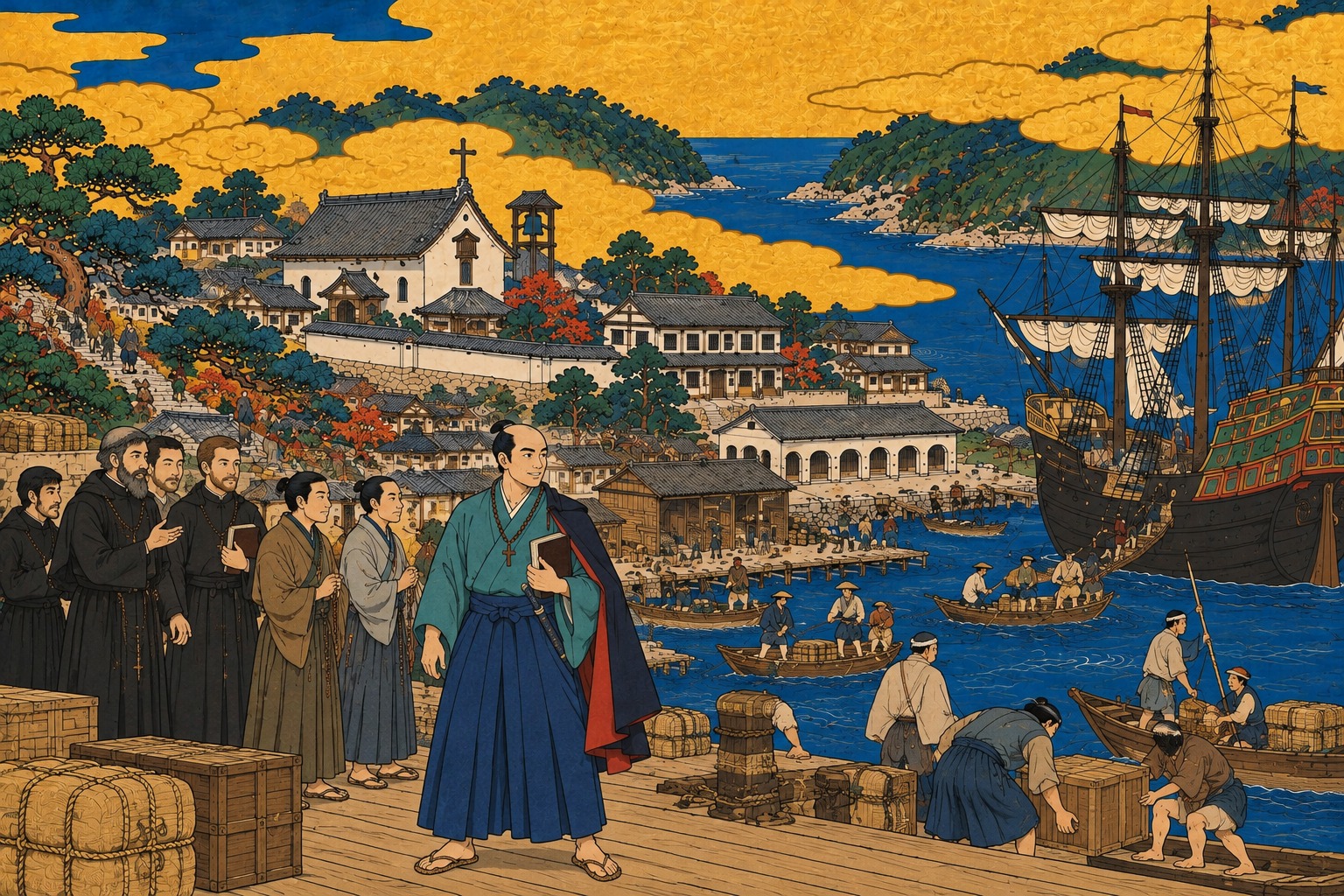
The summer Macau ship exchanges Chinese silk, barred from direct sale to Japan, for Japanese silver. Jesuit participation funds the mission. Lighters surround a black carrack with tiered stern and dense rigging. Dutch war, slow markets or shipwreck sometimes cancel a year's arrival; lists disagree about missed play-range years.
Bales and barrels crowd the quay alongside ruffed, baggy-trousered Portuguese, black-clad Jesuits and Africans, Indians and Malays, many of them enslaved. Japanese terms call these visitors nanbanjin, southern barbarians; priests are bateren, from padre, and brothers iruman.
At the Table: The Quay
Who. Portuguese factors, sailors, Jesuits, enslaved men of the ship's officers, Japanese boatmen and porters, the magistrate's clerks. Danger. A quarrel between a sailor and a boatman can become a matter for the magistrate; an interpreter's mistake is paid for in silver. Use. Silk, silver, passage to Macau, introductions, and a place to learn who is buying.
The Trade in People
Nagasaki ships people out of Japan. Since the 1550s Portuguese buyers have acquired Kyushu war captives, adults and children, from lords, soldiers, army-following hitokai dealers, kidnappers and desperate parents or creditors. Purchases may be outright or for terms the buyer can ignore overseas. Destinations include Macau, Manila, Malacca and Goa, occasionally Portugal and Mexico. Portugal's King Sebastian banned Japanese purchases around 1570 to 1571, unenforced in Asia.
During his 1587 Kyushu campaign, Hideyoshi challenged Jesuit superior Gaspar Coelho over Portuguese purchases of Japanese captives. He demanded returns and banned overseas sales that summer. Trade continued. Jesuits neither operated nor stopped it: until the 1590s, Nagasaki fathers certified lawful purchase and terms, while mission houses employed bound servants.
Korean campaigns of 1592 to 1598 supplied tens of thousands of captives (The Realm in 1600, Korea). Dealers moved them from Kyushu ports to Nagasaki and Hirado, collapsing prices. Florentine merchant Francesco Carletti, present from June 1597 to March 1598, bought five Koreans for just over twelve scudi, had them baptized, freed all five at Goa; one, Antonio, went with him to Italy. Bishop Pedro Martins threatened buyers with excommunication in 1596. At Nagasaki in 1598, Bishop Luis de Cerqueira and the Jesuits declared purchases of Japanese and Koreans unlawful, renewed that penalty and ended their certification of sales.
Bishop, Taiko and Portuguese king condemn or forbid the trade, yet in AD 1600 people still sail out at night, from nearby coves or on false servant papers. Many Korean residents receive baptism, and confraternities ransom some.
The ship also imports enslaved people. Portuguese traders and officers bring owned servants and hired men from Mozambique, East Africa, India, Malacca and Java: guards, halberdiers, sailors, parasol carriers and musicians. Screens depict these dark-skinned men; Japanese call Africans kurobo. Some are owned and some wage-paid. The bishop complained in 1598 that some bought Japanese and Korean women themselves. A lord can take a man into service, as Nobunaga did the African retainer Yasuke in 1581 and 1582.
| What is sold | Price | Evidence |
|---|---|---|
| A Korean captive at Nagasaki, 1597 to 1599 | 80 to 100 Exodus, under half a ryo: less than a plain sword | RECONSTRUCTED from Carletti's five for twelve scudi |
| A Japanese sold for a term of years | 200 to 2,000 Exodus (1 to 10 ryo) | RECONSTRUCTED from the quarter's contract (Gear and Prices, Services and the Sick Room) |
| A captive with a craft: a potter, a physician, a scribe | What two lords' agents will bid | Set by the GM |
At the Table: The Trade in People
Who. A dealer with a string of captives from a Kyushu port; a Portuguese factor buying for Macau; a ship's officer with his household slaves; a brother of the Misericordia with a purse; a magistrate's clerk who is paid not to count. Danger. A traveler with no sponsor can be sold: a debt, a kidnapping on the road or a false paper is enough, and once he is carried overseas, recovering him is far harder. Whoever stops a sale takes a dealer's income and a factor's cargo. Use. A ransom to raise; a named person to find before the ship sails; a paper to prove false before the magistrate (Era Rules, Law and Justice); a runaway to hide.
The Cape: College, Press and Church
On the cape, the Jesuit compound includes the principal church, mission house and college for brothers and Japanese catechists. A small bell stands by the church. Printing, begun in Kyushu in 1590, supplies religious works and Japanese and Portuguese books; a Japanese-Portuguese dictionary follows in 1603. Older All Saints outside town offers retreat. Jesuits teach, interpret, trade and minister.
At the Table: The College
Who. Jesuits, Japanese brothers, students, printers, women of the confraternity. Danger. A page with the wrong word is a danger to its owner; a visitor who is a spy of the magistrate. Use. Letters, interpreters, books and a safe night.
The Magistrate's Day
Reporting to Osaka, the bugyo or his deputy hears claims, collects customs and controls the harbor. The office remains nominally Toyotomi under an Ieyasu-serving magistrate. Petitioners wait with gifts and letter-bearing clerks; captains register before unloading. The 1588 edict prohibits piracy (The Era, The Sea).
Spring 1600's Liefde wreck at distant Bungo prompts action from Nagasaki (The Realm in 1600, Europeans). Magistrate's men seize her cargo. Jesuits and Portuguese denounce her as a pirate ship and urge crucifixion of the crew. Only Adams's 1611 letters record what was said.
At the Table: The Magistrate
Who. Clerks, guards, petitioners, Portuguese and Japanese factors, an interpreter. Danger. A cargo can be held for months. A petitioner without a patron waits at the gate. Use. A permit, a seizure to contest, and a chance to see how the Toyotomi's rule works at its edge.
Ota Sosuke [Simao], Interpreter of Nagasaki (fictional, cast)
About 33, medium height, light and quick, a narrow clean-shaven face with an easy half-smile and the crown shaved with a topknot; a teal kosode, a deep blue hakama, a short Portuguese-style cape over one shoulder and a wooden rosary with a red-brown cord at his neck.
Ota interprets Portuguese and Japanese for traders, Jesuits and officials. Taking no political side earns their trust. As a Christian in 1600 he practices a tolerated but insecure faith. Use him to interpret, befriend the party or conceal useful knowledge.
Friars, Fathers and Interpreters
Spanish Franciscans rival the Jesuits. Spain has held Manila since 1571; the crowns united with Portugal in 1580 but kept trade separate. Manila's Franciscans ignored the 1585 papal reservation of Japan to Jesuits. The Spanish San Felipe wrecked at Urado, Tosa, on Bunroku 5, 8th month, 28th day [AD 19 October 1596]. Hideyoshi heard that her pilot claimed Spain sent friars ahead of conquest, though both attribution and words are disputed. The execution of 26 Christians followed.
Interpreters sustain the mission. Joao Rodrigues, known as Tcuzu ("the interpreter"), serves Hideyoshi and then Ieyasu; Japanese brothers and catechists handle many crucial exchanges. Skilled interpreters earn broker-like pay. Ieyasu tolerates missions for trade and seeks Spanish Mexico's Pacific route, opening Manila talks in 1601.
Nagasaki in the War
Letters and ships bring war to a Nagasaki that musters no army. Its magistrate serves East; nearby Konishi Yukinaga of Uto, a Christian protector of the mission, commands West with Jesuit friendship. His neighbor and enemy Kato Kiyomasa, a devout Nichiren Buddhist, besieges Uto during his absence at Sekigahara. Nagasaki waits for news by ship and rider, days late, of patron or magistrate's victory (Era Rules, Travel). Konishi's death hands his lands to Kato and displaces Christian retainers and families (The Realm in 1600, Christians, offers a hook).
Later: Nagasaki after 1600
Ieyasu replaces Terazawa with Ogasawara Ichian as magistrate in 1603. Beyond play in 1604, he confirms Murayama Toan's outer-town authority and fixes ship-silk prices through allotment. Dutch and English Hirado posts follow in 1609 and 1613. Christianity is banned between 1612 and 1614, before Dejima or a Chinese quarter.
Nagasaki for Each Standing
- Samurai. An outsider's rank counts for little in a port where the magistrate and the Portuguese each have their own business.
- Ronin. The quay hires guards for cargo and escorts for letters.
- Foot Soldier. The magistrate keeps a small guard. A soldier home from Korea may have come back with captives to sell.
- Townsman. Most of the town is Christian. A newcomer is asked which church, and the answer matters. The faith is permitted in practice and the 1587 edict is still law, and Christians live with both facts.
- Villager. The farmers and fishers of the Omura and Arima lands around the harbor are Christians too, and bring the town its food.
- Priest. A Buddhist priest is a stranger here. A Christian brother is at home, and is watched.
- Outcast. Porters, boatmen and the poor of the lanes carry every load that matters, and no one counts them.
People of Nagasaki (fictional)
| Name | Who | What they want | Use at the table |
|---|---|---|---|
| Yohei [Luis], about 40 | A lighterman who unloads the ship | A full lighter and a safe quay | He knows every cargo that comes and goes, and which of the Portuguese pays in silver |
| Hana [Maria], about 48 | A midwife and a member of the confraternity | Her people's safety | She is in every Christian house and hears the news before the priests do |
| Gaspar Teixeira, about 36 | A Portuguese factor of the ship | A sale and a quiet quay | He pays well for a guide, an interpreter or a go-between and talks little of what he carries |
| Yun [Madalena], about 19 | A Korean captive, taken in 1597 and sold twice, now a servant in a Portuguese factor's lodging | Her younger brother, sold to another buyer at Hirado | She speaks Korean, Japanese and some Portuguese, and hears what the factors say at table |
| Bento, about 30 | A man from Mozambique, enslaved to the captain-major's household as a halberdier and bodyguard | His freedom, by purchase or by a lord's service | He goes everywhere his master goes, and is looked at by everyone and listened to by no one |
Hooks in Nagasaki
| Hook | Who | The offer | Opposition | Complication | Clock step or rule | Fits |
|---|---|---|---|---|---|---|
| The Relic (AD 1598 to 1599) | Hana [Maria], at Nishizaka | A family of the town holds a relic taken from the crosses of 1597. A Spanish friar offers silver for it, the Jesuits want it handed to the bishop, and the magistrate has forbidden such things to be kept. She wants it moved to a safe house before any of the three comes for it | The magistrate's guards on the hill (Town Watchman, Magistrate's Officer); the friar's buyer; a Jesuit brother | The family is divided. One son has already promised it to the friar and taken his money | Before step 0. Covert Work: Cover, Gates; Law and Justice: The Lord's Justice | Christian, Priest, Merchant, Outcast |
| The Captives' Lot (winter AD 1598 to 1599) | Yun [Madalena], or a brother of the Misericordia | A dealer has landed forty Koreans from the last ships home, and a factor will load them before the carrack sails. The brotherhood has silver for ten. Yun wants one boy found among them | The dealer and his guards (Bandit, Ronin Swordsman); Gaspar Teixeira, who has a paper for each | The bishop's ban is two months old. Proving the papers false before the magistrate stops the loading, and the magistrate's clerk has been paid | Before step 0. Money and Stakes: Haggling, Bribes; Law and Justice: The Lord's Justice | Merchant, Interpreter, Christian, Physician, Priest |
| The Impounded Cargo | A Portuguese or Japanese merchant, at the magistrate's office | The magistrate has held a cargo for a month. The merchant wants it released and does not care how | The magistrate's deputy and his clerks (Magistrate's Officer) | The cargo is lead and saltpeter. From step 2 both sides want it, and the deputy is waiting to see who wins | Any step; steps 2 to 9 for the war. Name and Allegiance: The Request; Money and Stakes: Bribes | Samurai, Merchant, Interpreter, Shinobi |
| Silk Without a Seal | Yohei [Luis], on the quay | A bale was landed with no mark. He knows who it belongs to and wishes he did not | An elder house's men; Murayama Toan's ward heads | The bale is the Jesuits' private share, landed outside the count. Whoever reports it chooses between the inner town and the outer | Any step. Covert Work: Gathering Information (Close); Name and Allegiance: Attitude | Merchant, Outcast, Christian, Shinobi |
| The Brother's Errand (August to October AD 1600) | A Jesuit brother, at the college | Letters and printed pages must reach the Kyoto house overland, through the pickets of both armies, with no mention of what they are | War pickets on the western roads (Ashigaru Spearman, Ashigaru Captain) | Among the pages is a letter from the Visitor to Konishi. Found by an Eastern picket, it proves the mission chose a side | Steps 2 to 6. Covert Work: Gates, Disguise; Travel: The Stage | Ronin, Priest, Christian, Shinobi, Merchant |
| The Magistrate Marches (September to October AD 1600) | An elder of the inner town | Terazawa is with Ieyasu's army and has taken his guard. Uto is under siege across the water, and the elders want the storehouses watched and a rumored landing looked into | Raiders in the confusion of the siege (Wako Raider, Sailor or Boatman); the deputy, who thinks the elders are arming | The boats that come are Konishi's wounded and their families, asking for the hospital | Steps 5 to 8. Battle, Fire and Fear: Nerve; Medicine and Illness: Care; Covert Work: Gates | Ashigaru, Ronin, Physician, Farmer (the harbor villages), Shinobi |
| A Letter in Two Tongues (November AD 1600) | Gaspar Teixeira, on the quay | The captain-major must send congratulations to the victor, and the first news does not say plainly who won. He wants two letters set down in Japanese, so that nothing can be taken two ways, and the right one delivered | The magistrate's deputy, who wants to read both; a rival interpreter | Whoever carries the letters holds proof that the Portuguese were ready to greet either side | Steps 8 and 9. Covert Work: Informants and Messages; Travel: The Long Ride | Interpreter, Priest, Merchant, Samurai |
| Bento's Price | Bento, on the quay | A Kyushu lord's officer has offered him a place as a guard. His master will not sell him. He wants to be off the ship's books before she sails | The captain-major's men (Sailor or Boatman); the magistrate, who has no rule for this and wants no quarrel with the ship | The lord's officer will not pay or fight for him. He will take him if he arrives | Any step, when the ship is in. Covert Work: Disguise; Name and Allegiance: The Request | Samurai, Ronin, Shinobi, Merchant |
| The Empty Quay (any summer the ship fails) | A Nagasaki merchant who lent silver on the voyage | The ship is not coming. He has borrowed from a Sakai house against her cargo and wants time, or a way to be gone before the creditor's clerk arrives | The creditor's agent; other investors who mean to seize first | Dutch raiders or a storm took the ship. A man in the town sold the sailing date, and the elders are looking for him | After the Clock. Money and Stakes: Debt; Covert Work: Gathering Information (Close) | Merchant, Interpreter, Shinobi, Farmer (silver carriers) |
| The New Magistrate (AD 1603) | A clerk of the old office | Ogasawara Ichian is on the road. The elders, Murayama Toan and the Jesuits each want to be the first to greet him, and the clerk wants Terazawa's private ledger out of the office before he arrives | The elder houses' men, Toan's men, and each other | The ledger shows who paid Terazawa to look away from the quay at night, and one of the names is the bishop's steward | After the Clock. Covert Work: Informants and Messages; Travel: The Stage; Money and Stakes: Bribes | Merchant, Interpreter, Shinobi, Samurai |
Five Cities, One Campaign
Link these dated hooks across the play range. Each row passes a person, paper or debt onward with the party, using the hooks' own dates.
| When | Clock step | City and hook | What carries the party on |
|---|---|---|---|
| Winter 1598 to 1599 | Before 0 | Nagasaki, The Captives' Lot | A Sakai ship master, Hara Sakubei, takes the ransomed north |
| 1599 | Before 0 | Sakai, The Captives' Boat; Osaka, Barges to Fushimi | Iwasaki's rice and Izumiya's credit put the party on the Yodo and in two houses' books |
| Spring 1600 | 0 | Osaka, The Foreign Pilot; Sakai, The Ship at the Wharf | The party has seen Ieyasu's officers at work and knows what the ship carried |
| July to September 1600 | 1 to 5 | Sakai, A Gun Order; Osaka, The Wives' Road | The order's buyer or the rescued wife names the side the party is now on |
| August to October 1600 | 2 to 6 | Nagasaki, The Brother's Errand, or Edo, The Autumn March | A road to the war from the west or the east, ending near the armies (Places and Campaign Tools, Ogaki, Gifu and Akasaka) |
| 21 October 1600 | 8 | The battle (Era Rules, Battle, Fire and Fear) | Where the party stood sets its Attitudes afterward |
| November 1600 | 9 | Sakai, The Druggist's Son; Kyoto, The Heads at Sanjo | The dead commanders' kin, and the watch's list of who stopped at the bridge |
| Winter 1600 to 1601 | 10 | Osaka, The Petitioners' Gate; Sakai, The Register | A place with the victors, or a name on the wrong page |
| 1601 to 1603 | After | Kyoto, What Burned at Fushimi; Edo, The Gate at Fushimi; Nagasaki, The New Magistrate | The chest from the ruin settles a claim in Edo; the new order reaches the last Toyotomi port |
Truth and Legend
Truth: AD 1600's Kyoto is a capital of plank-roofed, gated blocks without a castle. Osaka holds a child in Hideyoshi's black-and-gold fortress. Gunmaking Sakai has lost self-government; ten-year-old Edo lacks a keep. Christian Nagasaki awaits its summer ship. These are five real cities at the map's date.
Legend: Kyoto's alleged Fushimi blood ceilings, the Liefde's cannon at Sekigahara (absent from Japanese records) and details of Hideyoshi's golden tea room remain unproven stories. Let people tell them as such.