The Realm in 1600
Hideyoshi is dead, and two parties contest his legacy in autumn AD 1600. His regents promised to serve his son, a promise almost none intends to honor. Villages, temple estates and ports, as well as their warrior lords, watch the armies. This chapter identifies the regents and great houses, traces Sekigahara's sides and aftermath, and describes temples, outcast groups and neighbors beyond the warrior houses. For service to a lord, consult Era Rules, Name and Allegiance.
The Banners
- 五大老 Go-Tairo (goh-tie-ROH): the Five Regents, or Elders.
- 天下 tenka (ten-KAH): "all under heaven", the realm and the rule of it.
- 関ヶ原 Sekigahara (seh-kee-gah-HAH-rah): "barrier plain", the battlefield of AD 1600.
The Regents
Hideyoshi's Arrangement
Before his death, in Keicho 3's 7th and 8th months [AD August to September 1598], Hideyoshi arranged his son's regency. Five Elders, senior lords, would govern jointly above five administrator Commissioners. Disputes between them would go to three middle-ranking mediators (churo): Nakamura Kazuuji, Ikoma Chikamasa and Horio Yoshiharu. Ieyasu was assigned Fushimi; Maeda Toshiie, as Hideyori's guardian, Osaka. That summer the daimyo swore allegiance to the boy.
The 1598 documents call these bodies "the elders" (otona) and "the commissioners" (bugyo). Fixed titles go-tairo and go-bugyo belong to Edo usage.
The Five Elders
| Elder | Seat | Koku | In 1600 |
|---|---|---|---|
| Tokugawa Ieyasu | Edo and the eight provinces of the Kanto; lives at Fushimi, then Osaka | about 2.5 million (2,557,000 in the usual register) | East. The largest domain in Japan by far, and Naidaijin at court |
| Maeda Toshiie | Kaga | 835,000 (his son's, after him) | Dies at Osaka on Keicho 4, intercalary 3rd month, 3rd day [AD 27 April 1599]. His son Toshinaga succeeds to Kaga, Etchu and Noto with 835,000 koku and stands with the East; his mother is sent to Edo as a hostage in June 1600 |
| Mori Terumoto | Hiroshima; eight provinces | 1,205,000 | West, as nominal commander in chief. He stays in Osaka castle and never takes the field |
| Uesugi Kagekatsu | Aizu | 1,200,000 | The pretext for the whole campaign. He fights the Mogami and Date in the north and not at Sekigahara |
| Ukita Hideie | Okayama; Bizen, Mimasaka and part of Bitchu | 574,000 | West. Hideyoshi's adopted son, married to his adopted daughter, and the field commander with 17,000 men, the largest Western contingent |
A signatory to the 1595 regulations, Kobayakawa Takakage died in 1597, before the five of 1598 were appointed.
The Five Commissioners
| Commissioner | Seat | Koku | In 1600 |
|---|---|---|---|
| Ishida Mitsunari | Sawayama, in Omi | 194,000 | Retires in 1599 and organizes the Western side |
| Asano Nagamasa | Kofu, in Kai | 217,000 | Removed from office and confined to Musashi after the plot against Ieyasu in 1599. His son Yoshinaga fights with the East |
| Masuda Nagamori | Koriyama, in Yamato | 200,000 | West. Stays at Osaka |
| Natsuka Masaie | Minakuchi, in Omi | 50,000 (some say 120,000) | West. Holds a position on Mount Nangu and never fights |
| Maeda Gen'i | Kameyama, in Tanba | 50,000 | A priest-turned-administrator who signs the charges against Ieyasu, then keeps out and warns him |
Koku figures are reported assessments drawn from the Keicho 3 survey registers and later copies. Dates, the lands included and surviving accounts differ, so treat each figure as approximate.

The Quarrel of 1599
Within five months of Hideyoshi's death, council unity fails. In Keicho 4's 1st month [AD January to February 1599], the Elders and Commissioners charge Ieyasu with unauthorized marriages linking his house to the Date, Fukushima and Hachisuka, contrary to Hideyoshi's rule. Fushimi fills with armed men. Maeda Toshiie heads the accusers until the three mediators secure an exchange of oaths.
On Keicho 4, intercalary 3rd month, 3rd day [AD 27 April 1599], Toshiie dies. That night seven Korea veterans, Kato Kiyomasa, Fukushima Masanori, Kuroda Nagamasa, Hosokawa Tadaoki, Asano Yoshinaga, Ikeda Terumasa and Kato Yoshiaki, seek to kill Ishida Mitsunari at Osaka over the Commissioners' audits of their conduct. Mitsunari escapes to Fushimi. Edo sources place him in Ieyasu's mansion, a famous but now doubted story; better evidence puts him in his own residence while Ieyasu mediates. Resigning office, he withdraws to Sawayama under escort by Ieyasu's son Yuki Hideyasu.
Ieyasu visits Osaka for the Chrysanthemum festival in Keicho 4's 9th month [AD October 1599]. Before he enters the western citadel, a reported assassination plot on the road supplies grounds to remove Asano Nagamasa from the council, exile others and compel the Maeda to send Toshiie's widow to Edo as a hostage in June 1600. The plot's reality is doubted. Ieyasu occupies the western citadel and governs from Toshiie's former seat.
| Hook | Who | The offer | Opposition | Complication | Clock step or rule | Fits |
|---|---|---|---|---|---|---|
| The Marriage Contracts (January to February AD 1599) | A steward of the Hachisuka or the Fukushima | The contract with Ieyasu's house is the charge against the lord. The steward wants the papers and the go-between's letters taken out of Osaka before the Commissioners' men search the mansion | The Commissioners' inspectors, who want the papers as proof | The go-between is one of the mediators. Handing him the papers is safe, and he will remember who did | Before Step 0. Covert Work: Informants and Messages; Law and Justice | Samurai, Ronin, Merchant, Shinobi |
| The Night of the Seven Generals (27 April AD 1599) | A clerk of one of the Commissioners | The generals' men are on their way to Mitsunari's mansion in Osaka. The clerk wants a warning carried across the city before they arrive, then wants the party to see that his master's household gets out | The seven generals' retainers, who hold the streets by dark | Mitsunari flees to Fushimi, and the generals know it. The party in the streets has no pass for either side | Before Step 0. Covert Work: Gates; Travel: The Long Ride | Any; Ashigaru, Shinobi and Physician (a doctor is let through) |
Hatred born in Korea binds the Eastern core more strongly than devotion to Ieyasu: field commanders despise the Commissioners who investigated them.
The Household at Osaka
Osaka castle houses seven-year-old Hideyori and his mother Yodo, also called Chacha, daughter of Nobunaga's sister Oichi. She bore him in Bunroku 2 [AD 29 August 1593], after Hideyoshi turned fifty. Hideyoshi's wife Nene, Kita-no-Mandokoro, has moved from the western citadel to Kyoto by 1600. Hideyori exercises no power, though all authority claims his name. His sworn guardians and leading vassals keep wives and heirs near his castle as hostages.
Who Holds the Shogunate
The shogunate has had no governing holder since 1573 and no holder at all from 1588 to 1603. Hideyoshi chose court regency instead: he held kampaku from 1585 until transferring it to his nephew Hidetsugu at the turn of AD 1591 to 1592. Hidetsugu held it until 1595; in 1600 it is vacant, intended for Hideyori at adulthood. Toyotomi authority rests on court offices, regent and chancellor, rather than the warrior office.
Hideyoshi's choice remains debated. The usual Edo account reserves the shogunate for Minamoto descendants and says the exiled Yoshiaki refused to adopt him. Late sources underpin the adoption story, and a legal ancestry requirement is doubted. "Only a Minamoto could be shogun" describes a believed custom, without a written law.
The court accepts Ieyasu's claimed Minamoto ancestry through the Nitta, permitting his appointment in 1603.
The Great Houses
Castle, lord, vassals and supporting villages make a great house, ranked by koku. The table identifies those most useful in play, with seats, assessed yields and 1600 allegiances. After the Battle records their fates.
The Realm by Region
| Region | Who holds it in 1600 |
|---|---|
| The Kanto | Tokugawa Ieyasu at Edo, with eight provinces. Around him, Gamo Hideyuki at Utsunomiya, Satake Yoshinobu at Mito, Yuki Hideyasu at Yuki |
| The far north | Uesugi Kagekatsu at Aizu, Date Masamune in Mutsu, Mogami Yoshiaki in Dewa, Hori Hideharu in Echigo |
| The Tokaido and the middle provinces | Nakamura Kazuuji (Suruga), Yamauchi Kazutoyo (Kakegawa), Horio Yoshiharu (Hamamatsu), Tanaka Yoshimasa (Okazaki), Ikeda Terumasa (Yoshida), Fukushima Masanori (Kiyosu), Oda Hidenobu (Gifu), Asano Nagamasa (Kofu), Sanada Masayuki (Ueda) |
| Hokuriku | Maeda Toshinaga (Kaga, Etchu, Noto), Otani Yoshitsugu (Tsuruga) |
| The home provinces and Omi | The Toyotomi at Osaka. Ishida Mitsunari at Sawayama, Natsuka Masaie at Minakuchi, Kyogoku Takatsugu at Otsu, Masuda Nagamori at Koriyama, Tsutsui Sadatsugu at Iga Ueno, Maeda Gen'i at Kameyama |
| The Chugoku and the Japan Sea coast | Mori Terumoto (eight provinces), Ukita Hideie (Bizen), Kikkawa Hiroie (Izumo), Hosokawa Tadaoki (Tango) |
| Shikoku | Chosokabe Morichika (Tosa), Hachisuka Iemasa (Awa), Ikoma Chikamasa (Sanuki), Todo Takatora (Itajima in Iyo), Kato Yoshiaki (Masaki in Iyo) |
| Kyushu | Shimazu in Satsuma, Konishi and Kato Kiyomasa in Higo, Kuroda Nagamasa (Buzen), Nabeshima (Saga), Tachibana Muneshige (Yanagawa), the Christian lords of Arima and Omura, So Yoshitoshi on Tsushima, and Terazawa Hirotaka at Nagasaki |
| House and lord | Seat and lands | Koku | Side and role in 1600 |
|---|---|---|---|
| Toyotomi Hideyori | Osaka castle; a direct domain scattered through the home provinces, with mines and cities | The Toyotomi treasury lands, second only to Ieyasu's before the war; the surveys differ and no figure is printed here. Reduced after 1601 | Nominal lord of both sides. Both armies claim to act for him |
| Shimazu Yoshihiro (for his brother Yoshihisa, head of the house) | Kagoshima; Satsuma, Osumi, part of Hyuga | 605,000 (some say 559,000) | West. Brings about 1,500 men and no more. The house never commits |
| Date Masamune | Iwadeyama; part of Mutsu | 580,000 | East. Holds the north against the Uesugi. Holds a written promise of a million koku |
| Satake Yoshinobu | Mito; Hitachi | 545,700 | Neutral, suspected of Western sympathy as a friend of Mitsunari |
| Kobayakawa Hideaki | Najima; Chikuzen and part of Chikugo | about 590,000 by the usual reckoning (figures vary) | West, then East. Nene's nephew, once Hideyoshi's adopted son. Turns on the field |
| Mogami Yoshiaki | Yamagata; part of Dewa | 240,000 | East. Holds Hasedo against the Uesugi |
| Chosokabe Morichika | Urado; Tosa | 222,000 | West. Has 6,600 men on Mount Nangu and never fights |
| Nabeshima Naoshige and his son Katsushige | Saga; part of Hizen | 357,000 | Katsushige is with the West near Ogaki and withdraws before the battle. Naoshige then attacks the Western Tachibana for Ieyasu. A house that played both ends |
| Fukushima Masanori | Kiyosu; Owari | 200,000 | East. First to declare at Oyama and leads the first assault. Korea veteran, hates Mitsunari |
| Konishi Yukinaga | Uto; south Higo | 200,000 (some say 240,000) | West, in the center. A Christian and a Sakai merchant's son, commander of the first division in Korea |
| Kato Kiyomasa | Kumamoto; north Higo | 195,000 | East. In Kyushu during the battle, where he takes Konishi's lands. A Nichiren Buddhist |
| Kuroda Nagamasa | Nakatsu; part of Buzen | 180,000 | East. Negotiates the Kobayakawa and Kikkawa defections. His father Kuroda Josui (Yoshitaka, baptized Simeon) raises a private army in Kyushu |
| Hosokawa Tadaoki | Miyazu; Tango | 180,000 | East. Fights at Sekigahara. His father Yusai holds Tanabe, and his wife Gracia dies at Osaka |
| Ikeda Terumasa | Yoshida; Mikawa | 152,000 | East. Ieyasu's son-in-law, who takes Gifu |
| Sanada Masayuki | Ueda; part of Shinano | 38,000 | West, with his younger son Sanada Nobushige [Yukimura]. His elder son Nobuyuki serves the East. Holds Hidetada at Ueda |
| Kyogoku Takatsugu | Otsu; part of Omi | 60,000 | East. Holds Otsu castle with about 3,000 men |
| Otani Yoshitsugu | Tsuruga; part of Echizen | 50,000 | West, Mitsunari's friend. Reported to have leprosy and carried in a litter. Dies by his own hand on the field |
| Tachibana Muneshige | Yanagawa; part of Chikugo | 132,000 | West. Besieges Otsu and misses the battle. One of the best commanders in the Western camp |
| Kikkawa Hiroie | Izumo | 142,000 | West on the roll, secretly pledged to Ieyasu. His troops block the Mori on Mount Nangu |
| Tanaka Yoshimasa | Okazaki; Mikawa | 100,000 | East. His men capture Mitsunari |
| Terazawa Hirotaka | Karatsu; part of Hizen | 80,000 | East. Governs Nagasaki for the Toyotomi from 1592, and Ieyasu keeps him there |
| Oda Hidenobu | Gifu; part of Mino | 135,000 | West. Nobunaga's grandson, baptized in 1595. Loses Gifu in a day |
| Asano Nagamasa and his son Yoshinaga | Kofu; Kai | 217,000 | East. Nagamasa is a commissioner removed in 1599, and Yoshinaga fights at Gifu and Sekigahara |
| Gamo Hideyuki | Utsunomiya; Shimotsuke | 180,000 | East. Watches the Uesugi |
| Hori Hideharu | Kasugayama; Echigo | 300,000 (450,000 with branch houses) | East. Holds Echigo, the Uesugi's old province, against risings the Uesugi stir up |
| Yuki Hideyasu | Yuki; part of Shimosa | 101,000 | East. Ieyasu's second son, adopted by the Yuki. Left at Utsunomiya to watch the Uesugi |
| Hachisuka Iemasa | Tokushima; Awa | 177,000 | His marriage tie to Ieyasu is one of the charges of 1599. Iemasa retires to Mount Koya and his son Yoshishige fights with the East |
| Ikoma Chikamasa | Takamatsu; Sanuki | 150,000 (some say 171,000) | A mediator. Nominally West, in Osaka. His son Kazumasa serves the East |
| Nakamura Kazuuji | Sunpu; Suruga | 145,000 | A mediator, East. Dies on Keicho 5.7.17 [AD 25 August 1600] |
| Horio Yoshiharu | Hamamatsu; Totomi | 120,000 (his son Tadauji) | A mediator, East |
| Yamauchi Kazutoyo | Kakegawa; Totomi | 59,000 | East. Offers Ieyasu his castle at Oyama |
| Todo Takatora | Itajima; Iyo | 83,000 | East. A great castle-builder |
| Kato Yoshiaki | Masaki; part of Iyo | 100,000 | East. One of the seven generals of 1599. Furuta Shigekatsu, not Yoshiaki, holds Matsusaka in Ise for the East |
| Tsutsui Sadatsugu | Ueno; Iga | 95,000 | East. Western troops raid his castle in his absence |
| Wakisaka Yasuharu, Ogawa Suketada, Akaza Naoyasu and Kutsuki Mototsuna | Awaji, Imabari, Imajo in Echizen (Akaza) and the Kutsuki valley in Omi | 33,000; 70,000; 20,000; 10,000 | West, then East. They defect with Kobayakawa on the field |
| Mori Hidemoto | A Mori branch in Nagato | 200,000 within the Mori total | West. Commands the Mori contingent on Nangu and is blocked by Kikkawa |
| Ankokuji Ekei | Holds lands in Iyo as a diplomat-monk of the Mori | 60,000 | West. On Nangu. Executed with Mitsunari |
| Arima Harunobu, Omura Yoshiaki, Matsura Shigenobu and So Yoshitoshi | Arima, Omura, Hirado and Tsushima | 40,000; 27,000; 63,000; 10,000 (nominal) | Arima and Omura are Christian lords, and So Yoshitoshi is Konishi's son-in-law; Matsura of Hirado is a Buddhist and neither. All four come through the war with their fiefs by prompt submission. So Yoshitoshi divorces Konishi's daughter to keep Tsushima |
Many lesser houses are omitted. When choosing a provincial lord, weigh the side favored by his hostages and grudges.
Inside a House
These officers administer a great house.
- The karo (house elder) is the senior retainer.
- The jodai is the castle warden, who holds a castle for the lord.
- A kashira (captain) leads a company, and a kumigashira leads a company of ashigaru under him.
- A bugyo is a commissioner or magistrate for a task, such as the land survey, a city or a harbor.
- A metsuke is an inspector. The office is more developed under the Tokugawa than in 1600.
- The hatamoto are the lord's close vassals, the men who stand under his banner.
Retainers occupy assigned quarters in the castle town (jokamachi), while a lord's wife and heir may be hostages at Osaka or Edo. The lord maintains his tax roll, courts and house law (kaho). For restrictions on him, see The Era, Law and Order.
The Middle Houses
For a party's lord, a 30,000-to-100,000-koku house offers a useful scale: Sanada, Kyogoku, Otani, Wakisaka or Tanaka. It can hold a castle and road and dispatch retainers, yet one mistaken choice can destroy it. Service remains optional. Characters may serve a lord, temple or house, or play independent townspeople or free agents (Era Rules, Name and Allegiance).
Both armies claim Hideyori and count Toyotomi commissioners as leaders. Loyalty against rebellion does not explain the division; hostages and grievances shape each lord's choice.
Who Governs the Cities
Toyotomi city magistrates (bugyo) remain in office under Ieyasu. Kyoto's Maeda Gen'i, a former Tendai monk and one of the Five Commissioners, governs for Hideyoshi. Nagasaki's Terazawa Hirotaka, appointed in 1592, serves through 1603 before Ogasawara Ichian replaces him. Ieyasu's Kyoto deputy (shoshidai), Itakura Katsushige, serves from 1601 to 1620. Fushimi, Osaka and Sakai have their own officers. Kyoto, Osaka, Sakai, Edo, Nagasaki, under each city's Who Holds, identifies them and the limits of the evidence. A magistrate speaks for his appointing regime.
Land and People
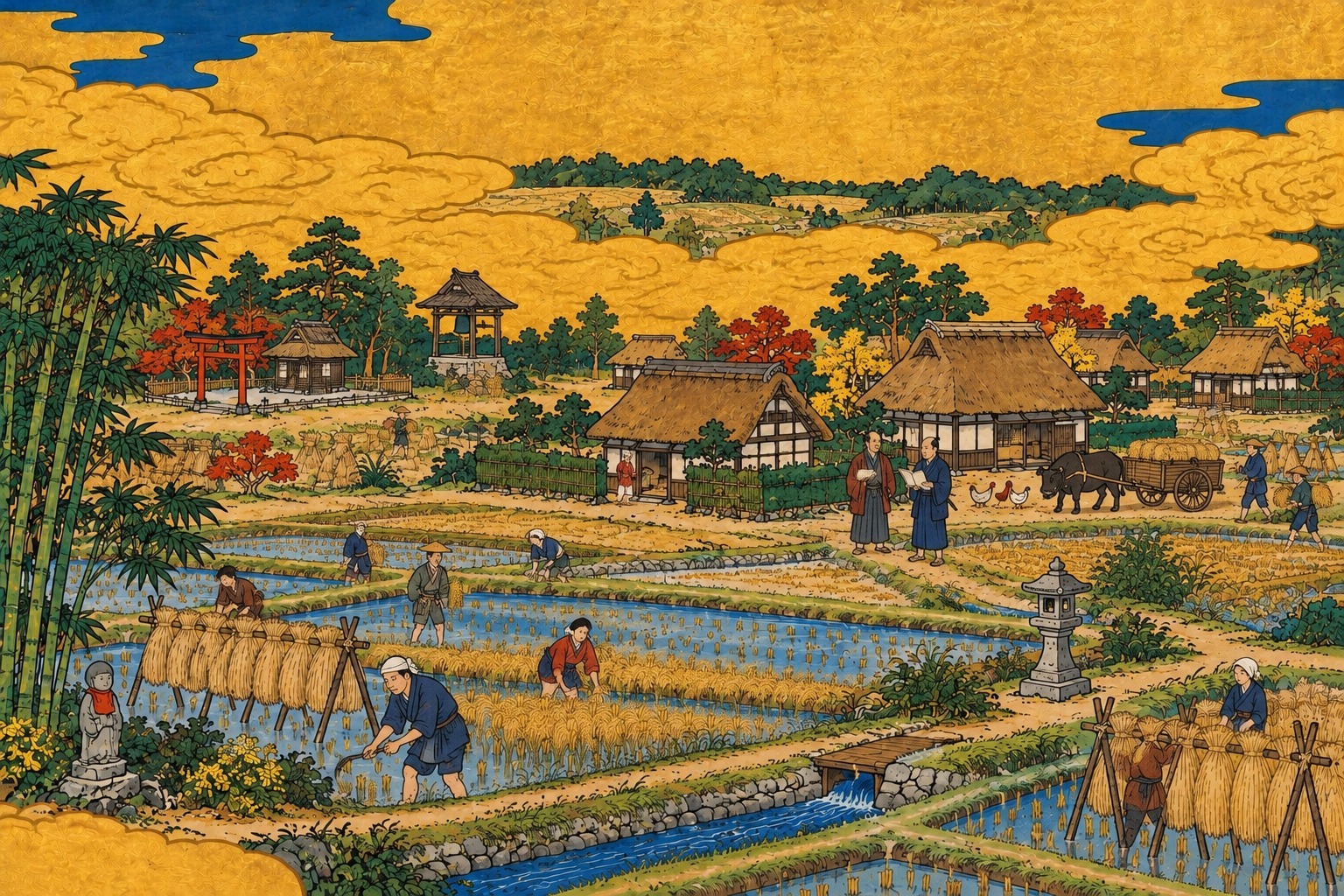
A castle and vassal band draw support from a domain's villages. Headmen answer to the lord for assessed koku, rice and men (The Era, Money and Rice).

Who Switched
Some lords changed sides, stood still or left the field. On the field: Kobayakawa Hideaki, Wakisaka Yasuharu, Ogawa Suketada, Akaza Naoyasu and Kutsuki Mototsuna all went from West to East. A secret agreement kept Kikkawa Hiroie, and with him Mori Hidemoto, standing still. Nabeshima Katsushige withdrew before the battle, and Chosokabe Morichika, Natsuka Masaie and Ankokuji Ekei left Nangu without fighting. Kyogoku Takatsugu changed before the battle and held Otsu for the East. Maeda Gen'i and the Ikoma, Nakamura and Horio houses sat on the Toyotomi council and served Ieyasu. Kuroda Josui, Kato Kiyomasa, Fukushima Masanori, Hosokawa Tadaoki and most of the Korea-war field commanders had pledged themselves to Ieyasu in writing before the battle.
| Hook | Who | The offer | Opposition | Complication | Clock step or rule | Fits |
|---|---|---|---|---|---|---|
| The Hostage's Letter (August AD 1600) | A steward in a middling house | The lord's wife is at Osaka, and he wants a letter carried out past the pickets and a reply carried back, without anyone learning which side the house leans to | The Western pickets on the Osaka roads and an officer of the Mori with a list of names | The letter says in plain words where the house stands. Whoever opens it marks the house for the side that reads it | Step 2. Covert Work: Gates, Informants and Messages | Any; Merchant, Physician and Shinobi pass a gate most easily |
| The Promised Koku (from AD November 1600) | A retainer of the Date | The written promise of a million koku sits in a chest at Iwadeyama. Ieyasu's men will come to take it back, and the man who knows where it is wants it moved before they do | An inspector sent from Edo; a Date elder who wants the paper burned | The paper is the house's only proof of what it was promised, and proof that the house bargained with Ieyasu while it was fighting for him | Step 10. Covert Work: Gathering Information; Travel: The Long Ride | Samurai, Ronin, Merchant, Shinobi |
| Two Hundred Spears (September AD 1600) | A Sanada officer | The house wants two hundred spear heads and shafts bought, loaded and carried to Ueda before a Tokugawa army comes down the Nakasendo. The officer says nothing of what they are for | Tokugawa pickets on the Nakasendo and a neighboring lord's patrols | The smiths want silver, and the house pays in promises. The elder son serves the East, so the officer cannot say why the order is urgent | Steps 5 and 6. Money and Stakes: Haggling and Stipends; Travel | Merchant, Craftsman, Ashigaru, Farmer (carters) |
Sekigahara
Two Sides, One Name
Eastern army and Western army are later writers' terms. Contemporary combatants mention "the battle at Yamanaka" or Ieyasu's and Mitsunari's sides. East and West serve here as convenient shorthand matching the maps.
Two parties contest power within one regime, each invoking Hideyori.
Korea exhausted the Western houses of Kyushu, Chugoku and Shikoku, Shimazu, Kobayakawa, Konishi, Tachibana, Nabeshima, Mori and Chosokabe, through seven years' losses of men and silver. The Commissioners' enemies at the Eastern core fought there too. Tokugawa troops, absent from Korea, avoided its losses.
The Summer of Choosing
Uesugi refuses. From Aizu, granted at 1,200,000 koku in 1598, Uesugi Kagekatsu recruits retainers and builds castles and roads. In spring 1600 he rejects Ieyasu's summons to explain himself in Kyoto. A reply was sent, but the defiant letter attributed to chief retainer Naoe Kanetsugu survives only in later copies, leaving authorship disputed. Claiming Hideyori's authority, Ieyasu declares an Aizu punitive campaign and leaves Osaka on 26 July. After a Fushimi farewell council with Torii Mototada, left with about 1,800 men to defend it, he reaches Edo on 10 August.
The Western combination. In mid-August Ishida Mitsunari, Otani Yoshitsugu, Masuda Nagamori, Natsuka Masaie, Maeda Gen'i and Mori monk Ankokuji Ekei recruit Mori Terumoto as nominal leader. Three commissioners circulate thirteen charges against Ieyasu to the daimyo on 25 August. Two days later Terumoto enters Osaka castle. Attempts to seize Eastern lords' wives end after Hosokawa Gracia dies resisting capture. Thereafter the wives are watched rather than taken.
Fushimi. The war opens at Ieyasu's residence as Elder. Torii Mototada, 61 (62 in Japanese reckoning), defends it with about 1,800 men against roughly 40,000 Westerners led by Ukita Hideie, Kobayakawa Hideaki, Shimazu Yoshihiro, Mori Hidemoto and others. Beginning on 27 August, the siege lasts thirteen days until the castle falls and Mototada dies fighting on 8 September (Kyoto, Osaka, Sakai, Edo, Nagasaki, Fushimi).
Tanabe. In Tango, Hosokawa Tadaoki's father Yusai defends Tanabe with about 500 against about 15,000 led by Onogi Shigekatsu and others, for roughly 50 days. He alone preserves the secret transmission of the Kokinshu poetry commentary. Emperor Go-Yozei sends envoys to save him; imperial orders open the castle three days before Sekigahara. Its besiegers arrive too late for battle.
The turn at Oyama. At Oyama in Shimotsuke on 2 September, Ieyasu asks his accompanying lords to choose. Fukushima Masanori declares for him first, followed by the rest. Leaving Yuki Hideyasu to watch Uesugi, Ieyasu turns west. Some Japanese historians dispute a single staged council, but not the army's reversal.
Gifu. On 30 September, Fukushima Masanori and Ikeda Terumasa capture Gifu in a day, unusually fast thanks to superior numbers and incomplete defenses. Nobunaga's grandson Oda Hidenobu surrenders and goes to Mount Koya. Western forward troops retreat to Ogaki, while the Eastern vanguard awaits Ieyasu at Akasaka.
Ueda. About 38,000 Tokugawa troops take the Nakasendo under Hidetada. At Shinano's Ueda, Sanada Masayuki and younger son Sanada Nobushige [Yukimura] delay them with 2,000 to 3,000. Elder son Nobuyuki, married to Honda Tadakatsu's daughter, serves Ieyasu. Hidetada abandons the siege, loses more time to Kiso rain and arrives at Otsu five days after battle.
Otsu. Kyogoku Takatsugu, brother-in-law to both Hideyori's mother and Hidetada's wife, joins the East. About 3,000 defend his Lake Biwa castle against roughly 15,000 under Mori Motoyasu and Tachibana Muneshige. Takatsugu surrenders under truce around the 13th or 14th of the 9th month and retires to Mount Koya. Motoyasu enters Otsu on Sekigahara's morning; the besiegers, including Tachibana, miss that battle.
At the Table: The Sieges
Who. Torii's Fushimi defenders, Tanabe and Otsu besiegers, Ueda's Sanada and Tanabe's imperial envoys. Danger. Fushimi's garrison loses the war's opening engagement; its besiegers win. Use. Tanabe demonstrates the court's power to lift a siege for poetry, though it cannot muster an army. Ueda lets a small house with a strong castle and clever lord alter a campaign, earning exile for it.
| Hook | Who | The offer | Opposition | Complication | Clock step or rule | Fits |
|---|---|---|---|---|---|---|
| The Last Letter from Fushimi (27 August to 8 September AD 1600) | A steward of Torii Mototada | The garrison cannot leave. He wants Torii's letters to his house and two wounded retainers carried out through the siege lines, and a physician to go in the other direction | The Western lines under Ukita and Kobayakawa; whoever inside is sending word out to the besiegers | The tale of the Koka gate says the besiegers hold a garrison man's family. The party cannot tell which man at the gate is the one in question | Step 3. Covert Work: Gates; Battle, Fire and Fear: Fire; Medicine and Illness: Care | Shinobi, Physician, Ashigaru, Samurai |
The march. On the 1st day of the 9th month, Ieyasu takes about 30,000 of his own troops from Edo down the Tokaido via Shimada, Okazaki and Kiyosu. He reaches Gifu on the 13th, then Akasaka, 4 kilometers from Ogaki, about noon on the 14th: roughly 400 kilometers in fourteen days with an army.
Dates for the summer are in The Era, The Timeline, AD 1467 to 1615.
Other Fronts
Other fronts keep houses far from Sekigahara. In the north, Uesugi Kagekatsu faces Mogami and Date at Hasedo from 21 October to early November; Hori Hideharu resists Uesugi-backed risings in Echigo. Hokuriku's Maeda Toshinaga fights Komatsu's Niwa Nagashige and Otani allies without reaching the main battle. In Kyushu, Kuroda Josui raises a private army while Kato Kiyomasa captures Konishi's Uto, then helps besiege Tachibana Muneshige at Yanagawa. Parties here are at war even without news from Sekigahara.
The Plain
At Mino's western edge, about 15 kilometers west of Ogaki, Sekigahara occupies a basin on the ancient Fuwa barrier site. The Nakasendo passes through into Omi, with branches south to Ise and north to Echizen.
Rain and darkness cover the Western army's departure from Ogaki on the night of the 14th to the 15th of the 9th month. It blocks the road from the basin's surrounding hills. Why it moves is debated: tradition credits rumors that Ieyasu would bypass Ogaki for Sawayama and Osaka; revisionists see an effort to save Otani Yoshitsugu at Yamanaka after Kobayakawa's known defection exposed him. The Eastern army follows overnight into morning fog.
| Position | Who holds it | What happens |
|---|---|---|
| Mount Nangu, southeast | Mori Hidemoto, Kikkawa Hiroie, Ankokuji Ekei, Natsuka Masaie, Chosokabe Morichika | Never moves. Kikkawa's pledge to Ieyasu keeps his vanguard between the Mori and the fight |
| Matsuo hill, southwest | Kobayakawa Hideaki | Turns on Otani at the opening of the fight |
| Sasao hill, northwest | Ishida Mitsunari with about 6,000 men | Falls back as the line collapses and flees toward Mount Ibuki |
| The center | Ukita, Konishi, Otani, Ishida, Shimazu | Holds the first assaults, then breaks |
| The Eastern line | Fukushima, Ii Naomasa, Kuroda, Hosokawa, Kato Yoshiaki, Tanaka Yoshimasa | Makes the first attacks and, when the line breaks, the pursuit |
The Day
Fog blankets the basin on Keicho 5, 9th month, 15th day [AD 21 October 1600]. Traditional accounts begin combat around 8 a.m.; the earliest letters put it near 10 a.m. Initial attacks by Fukushima, Ii Naomasa, Kuroda, Hosokawa, Kato Yoshiaki and Tanaka fail to break the Western center of Ukita, Konishi, Otani, Ishida and Shimazu.
Kobayakawa Hideaki turns on Otani at the opening of the fight. Ieyasu's letters of the 15th and 17th and a Kuroda Nagamasa letter place it early; later accounts choose noon. The Western leaders knew the plan and had positioned Otani to face Hideaki. Kobayakawa's 15,600 men (8,000 in some accounts) strike Otani's flank, followed by Wakisaka Yasuharu, Ogawa Suketada, Akaza Naoyasu and Kutsuki Mototsuna. Otani's army is destroyed. Described as a leper and carried in a litter, he orders his own killing.
The Western line collapses from the south. Konishi and Ukita flee. Mitsunari flees toward Mount Ibuki. Shimazu Yoshihiro cuts his way out to the southeast through the Eastern army, in a retreat the Satsuma remember as "the Shimazu retreat through the enemy" (Shimazu no nokiguchi). He reaches Satsuma by sea with about 80 of his 1,500 men, and his nephew Toyohisa is dead. The Mori group on Nangu never moves. Kikkawa Hiroie had promised Ieyasu neutrality in return for the Mori lands. That night Natsuka, Ankokuji and Chosokabe leave Nangu without fighting. In the traditional accounts the fighting ends about 2 p.m. On the reading from the earliest letters it is a short rout, over by about noon.
A Shimazu diary and retainer's memoir support a noon defection, keeping the timing in dispute. Its decisive effect is agreed.
What the Stories Say: The Noon Hesitation
In the familiar story, Kobayakawa Hideaki spends the morning on Matsuo hill despite promising to change sides. Around noon, an impatient Ieyasu orders warning matchlock shots at him. Startled, Hideaki finally charges Otani.
No early Edo work mentions the "probing shots" story; it first appears in a 1663 chronicle. Edo chronicles and the General Staff's 1893 reconstruction established the version inherited by Western books. Researchers working from contemporary letters regard it as a later story, and the matter remains disputed. This book follows the earliest letters.
What the Stories Say: Small Tales
- The empty lunchbox. Told of Mori Hidemoto on Nangu, who is said to have excused his inaction by saying his men were eating. It is Edo lore.
- The persimmon. Told of Ishida Mitsunari on his way to execution, who is said to have refused a persimmon as bad for his health. It is Edo lore.
- The blood ceilings. Floorboards at Kyoto temples (Yogen-in and others) are shown as the boards of Fushimi castle, stained by Torii Mototada's men. The tradition is a later pious one.
- The Inubushi parting. The Sanada family is said to have split into two sides by formal agreement at Inubushi. It is later Sanada tradition.
- The Liefde's cannon. A Spanish report says the guns of the Dutch ship were landed and fired at Sekigahara. No Japanese record of the battle mentions foreign cannon. Japanese scholars treat the claim as unproven.
Numbers
Neither army leaves a surviving muster roll. House levies and later chronicles underpin all reconstructions. Traditional totals give about 75,000 East and 80,000 West, besides Hidetada's absent 38,000, perhaps overstating each by a third. Reducing chronicle totals accordingly yields near 50,000 a side. The traditional Western 80,000 includes about 28,000 idle on Mount Nangu and Kobayakawa's 15,600 defectors.
| Contingent | Reported strength (traditional count) |
|---|---|
| Ieyasu's own troops | 30,000 |
| Ukita Hideie | 17,000 |
| Kobayakawa Hideaki | 15,600 (some say 8,000) |
| Mori Hidemoto | 15,000 |
| Ishida Mitsunari | 6,000 |
| Fukushima Masanori | 6,000 |
| Kuroda Nagamasa | 5,400 |
| Hosokawa Tadaoki | 5,000 |
| Konishi Yukinaga | 4,000 (some say 6,000) |
| Ii Naomasa | 3,600 |
| Kato Yoshiaki and Tanaka Yoshimasa | 3,000 each |
| Shimazu Yoshihiro | 1,500 |
| Otani Yoshitsugu | 600 to 1,500, plus allies |
The dead were not counted contemporaneously. Later figures range from about 8,000 to 32,600 Western deaths and 4,000 to 10,000 Eastern. Lords inflated their head-taking reports to secure rewards.
Who Was Not There
Hidetada arrives at Otsu five days late. Uesugi Kagekatsu remains north, Kato Kiyomasa in Kyushu. Tanabe and Otsu's besiegers are absent, including the able Western commander Tachibana Muneshige. Letters, pledges and bribes have already settled much of the result.
After the Battle
Mitsunari, Konishi and Ankokuji Ekei
Kobayakawa and Tanaka attack Sawayama on the 17th day of the 9th month [AD 23 October 1600], and it falls the next day. Mitsunari's father, brother and family die there. Villagers of northern Omi hide Mitsunari until Tanaka Yoshimasa's men find him on 27 October. He is shown at the gate of Ieyasu's lodging at Otsu. Konishi Yukinaga, captured on Mount Ibuki, and Ankokuji Ekei, captured in Kyoto, join him. On Keicho 5, 10th month, 1st day [AD 6 November 1600] the three are paraded through Osaka and Sakai and beheaded at Rokujogawara, the Kamo riverbed in Kyoto. Their heads are shown at Sanjo bridge. They are not allowed seppuku. Konishi, a Christian, refuses the Buddhist last rites.
The Settlement
Rewards and punishments occupy Ieyasu for two years. Tokugawa direct holdings grow to include mines of gold and silver and Kyoto, Sakai and Nagasaki. Depending on the count, roughly 88 attainted houses surrender six to eight million koku. Hideyori retains Osaka castle and a diminished direct domain in Settsu, Kawachi and Izumi. The table follows the leading houses.
| House | Before | After |
|---|---|---|
| Mori | 1,205,000 koku in eight provinces | Cut to Suo and Nagato at 298,000; the seat moves to Hagi in AD 1604, after play. Terumoto takes the tonsure. Kikkawa Hiroie, holder of the pledge, gets Iwakuni under the Mori. Ieyasu takes the Iwami silver mines. The Mori resentment of the Tokugawa lasts to 1868 |
| Uesugi | 1,200,000 at Aizu | 300,000 at Yonezawa, August 1601 |
| Satake | 545,700 at Mito | Moved to Kubota in Akita at 200,000, 1602 |
| Shimazu | about 600,000 | Confirmed in Satsuma, Osumi and Hyuga in April 1602 after two years of refusal and negotiation. The only Western great house to keep its whole domain |
| Ukita Hideie | 574,000 | Flees to Satsuma and surrenders in 1603. His exile to Hachijo island in 1606 is later than the play range |
| Chosokabe | 222,000 in Tosa | Loses Tosa, which goes to Yamauchi Kazutoyo at 202,000 |
| Sanada | 38,000 | Masayuki and Nobushige are exiled to Kudoyama, at the foot of Mount Koya. Nobuyuki gets Ueda at 95,000 |
| Ishida, Konishi | Executed; their lands go to others | |
| Natsuka | 50,000 | Natsuka Masaie loses Minakuchi and is reported to have taken his own life at Hino |
| Masuda | 200,000 | Attainted and exiled |
| Maeda Gen'i | 50,000 | Keeps his fief and dies in 1602 |
| Kobayakawa Hideaki | about 590,000 | Okayama, 510,000 to 550,000 by a different survey. Dies in 1602 without an heir, and the line ends |
| Fukushima | 200,000 | Hiroshima, 498,000 |
| Kato Kiyomasa | 195,000 | Most of Higo, about 520,000 (not Sagara's Kuma district; Amakusa passes to Terazawa in 1601) |
| Kuroda | 180,000 | Chikuzen, 523,000 |
| Hosokawa | 180,000 | Buzen (Kokura), 399,000 |
| Ikeda Terumasa | 152,000 | Himeji, 520,000 |
| Date | 580,000 | About 600,000 at Sendai. The written promise of a million koku is not honored |
| Maeda Toshinaga | 835,000 | Adds the rest of Kaga, to about 1.2 million, the largest fief after the Tokugawa |
| Mogami | 240,000 | 570,000 |
| Yuki Hideyasu | 101,000 | Echizen, 670,000 |
| Tanaka | 100,000 | Yanagawa, 325,000 |
| Kyogoku Takatsugu | 60,000 | Obama in Wakasa, 92,000 |
| Tachibana Muneshige | 132,000 | Attainted. Restored to Yanagawa in 1620, later than the play range |
Advance pledges distinguish the defectors' rewards. Wakisaka Yasuharu and Kutsuki Mototsuna retain their fiefs; Ogawa Suketada and Akaza Naoyasu, lacking such pledges, lose theirs.
Where the Defeated Go
Defeated lords often retire to Mount Koya: Oda Hidenobu after Gifu, Kyogoku Takatsugu after Otsu, Hachisuka Iemasa and the Sanada. Mori Terumoto takes the tonsure, while Ukita Hideie escapes to friendly Satsuma. Their men find new service, walk the roads as ronin or return to farming.
Two and a half years pass before Ieyasu becomes shogun, appointed at Fushimi on Keicho 8, 2nd month, 12th day [AD 24 March 1603]. Attainder leaves many Ukita, Chosokabe, Konishi and Ishida retainers masterless. These ronin crowd the roads late in play; many later join Osaka in 1614, beyond the play range.
| Hook | Who | The offer | Opposition | Complication | Clock step or rule | Fits |
|---|---|---|---|---|---|---|
| The Rokujo Riverbed (from AD 6 November 1600) | A clerk of the Kyoto magistrate | The condemned men's property is being sorted. A chest has gone missing that two lords' agents want to see, and the clerk wants it found before his office is asked | The two agents, and the watch of the Kyoto magistrate | The chest holds the names of lords who sent Mitsunari money. Those lords now pay for silence, and whoever finds it chooses between selling the list and burning it | Step 9. Law and Justice; Covert Work: Gathering Information; Money and Stakes: Bribes | Samurai, Ronin, Townsperson, Priest, Outcast |
| The Cut Domain (AD 1601) | A karo of the Mori | The house has been cut to two provinces and cannot feed its retainers. He wants someone to carry a plea to Edo, and someone else to carry a different message to Osaka | The Kikkawa, who hold Iwakuni under the Mori and gain by the cut; Tokugawa officers at Osaka | The two messages contradict each other. A courier who reads both knows the house is bargaining both ways | Step 10. Name and Allegiance: The Request; Travel: The Long Ride | Samurai, Ronin, Merchant, Priest |
| The Quiet Return (AD 1600 to April 1602) | A Shimazu captain | Men who came home with Yoshihiro by sea are not asked where they have been. He wants them hidden from the questions that are coming, and their wounds treated without a record | Tokugawa inquiry officers on the Kyushu roads; the Eastern lords of Kyushu, Kato Kiyomasa among them | The house is still negotiating, and any man found out is a hostage in the bargain. Some of the men carry a fever | Step 10. Medicine and Illness: Care; Covert Work: Disguise | Physician, Ashigaru, Shinobi, Samurai |
Temples
Disarmed great temples retain wealth despite Hideyoshi's survey taking much of their land. Estates, loans, sake, paper and pawnshops sustain them. They shelter refugees, though sanctuary's old protections are ending.
| Temple or sect | Seat | History | In 1600 |
|---|---|---|---|
| Hongan-ji (True Pure Land, Jodo Shinshu, also called Ikko) | Kyoto, at Rokujo Horikawa, on land Hideyoshi gave in 1591 | Its leagues of farmer-soldiers (Ikko-ikki) ruled Kaga for about 90 years (1488 to 1580) and held Nagashima until Nobunaga destroyed it in 1574. The Ishiyama Hongan-ji resisted Nobunaga from 1570 to 1580 and surrendered by imperial mediation. Hideyoshi built Osaka castle on the site in 1583 | Finished as a military force. In 1602, inside the play range, the sect splits into the Nishi (West) and Higashi (East) Hongan-ji under Ieyasu's sponsorship: two abbots, two temples |
| Tendai | Enryakuji on Mount Hiei, above Kyoto | Nobunaga burned it on 30 September 1571 and killed its monks | Rebuilt from 1584 under Hideyoshi's sponsorship |
| Shingon | Mount Koya (Koyasan), in Kii | A monastery-city with armed monks. Hideyoshi forced it to submit in 1585 through the monk Mokujiki Ogo. Hidetsugu died there in 1595. Negoro-ji, famous for its matchlock force, was burned in 1585 | Still keeps armed men. After Sekigahara, Sanada Masayuki is exiled to nearby Kudoyama at its foot |
| Nichiren | Kyoto | Strong among Kyoto townspeople. The Lotus leagues (Hokke-ikki) were destroyed in 1536. Its Fuju-fuse branch refuses gifts from non-believers and clashed with Hideyoshi | Active again in Kyoto. Kato Kiyomasa is a follower |
| Zen: Rinzai and Soto | Gozan temples of Kyoto, Daitokuji, Myoshinji, Eiheiji, Sojiji | The literate class: diplomats, scribes, tutors and advisers to warlords | Daitokuji is the center of the tea masters. Ankokuji Ekei, an adviser to the Mori, was a Zen monk and is executed in 1600 |
At the Table: Temples
Who. Monks, stewards, pawnbrokers, pilgrims and gate-side refugees. Use. Hide, arrange burial, commission a letter or borrow from a temple.
| Hook | Who | The offer | Opposition | Complication | Clock step or rule | Fits |
|---|---|---|---|---|---|---|
| The Divided Temple (AD 1602) | A steward of the Hongan-ji | Ieyasu will split the sect and give the East its own land. The steward wants the temple's ledgers, loans and deeds copied and the copies hidden before the split sorts them between two abbots | The officers carrying out Ieyasu's order; the party of the abbot who gains by the split | Debtors of the temple see the split as a chance to lose their notes. Half of the monks will follow the other abbot | After Step 10. Money and Stakes: Debt; Law and Justice | Priest, Sohei, Merchant, Townsperson |
Warrior Monks
Armed monks date to the eleventh century, but sohei is an Edo word. Contemporary terms include akuso ("evil monk"), shuto ("the crowd") and daishu ("the great assembly"). By 1600 Nobunaga and Hideyoshi have broken the great temple forces, though guards and individual fighting monks remain. Heian illustrations and Benkei legend supply the familiar white hood and naginata.
Mountain Ascetics
Yamabushi, "those who lie in the mountains", practice Shugendo's combination of esoteric Buddhism and mountain Shinto. Tendai's Honzan-ha, based at Kyoto's Shogoin, and Shingon's Tozan-ha, based at Daigoji, organize them. Pilgrimages to Omine, Kumano and Dewa Sanzan, horagai conch trumpets, exorcism, divination and healing distinguish them. They guide, carry messages and scout for lords. Formal Shugendo regulations arrive in 1613, after play.
Outcasts
Some groups live outside the orders of warrior, farmer, craftsman and merchant. The kawata (leather workers, also called kawaramono, "riverbed people", from where they live; also kiyome, "purifiers") work leather, serve as executioners and bury the dead. They live on the riverbanks because tanning needs the water, and the hides of fallen cattle and horses are theirs by custom. The hinin ("non-people") are the beggars, the sick, above all lepers, the orphaned and the ruined, with some performers among them. Lords assign their duties: leatherwork, executions, street cleaning. The sharper legal division into two tiers hardens in the seventeenth century, after the play range. In 1600 the groups exist, and the lines are not yet fixed.
| Kawata | Hinin | |
|---|---|---|
| Who | Leatherworkers, executioners, gravediggers | Beggars, the sick and lepers, orphans, the ruined |
| How one enters | By birth. Standing passes from parent to child, and the settlements are old | By sickness or ruin. A man or woman sometimes climbs out |
| Who heads them | Heads of their own in each province, who hold the leather trade as a monopoly in return for the lord's dues and services | The chori, heads of the communities (shuku) at temple gates and graveyards |
| What they do | Leather for armor lacing, saddles, scabbards and drums, in quantities the lords of the warring century demanded; a castle town's settlement is part of its lord's war economy | Beg, keep and clean temple precincts, bury the executed and the unclaimed, carry the sick and, under the city's officers, lay hands on criminals |
| In Kyoto | The Rokujo and Fukakusa quarters | Kiyomizu-saka; also at Nara |
Kinai hinin have strong temple links; neither group's head governs the other. Edo's Danzaemon authority over both belongs to the next century's Tokugawa order. Medieval eta later becomes a Tokugawa legal term, while 1600 uses kawata.
Kyoto executes on the dry Rokujo and Sanjo riverbeds, where prominent victims were beheaded in 1595 and 1600.
Itinerant blind lute and puppet reciters, sarugaku and dengaku troupes, jugglers, lord-hired wrestlers, wandering priestesses and mendicant monks occupy other positions. A lord, temple or simply the next audience may support them.
At the Table: The Settlements
Who. Porters, tanners, drum makers, gravediggers, beggars at a temple gate. Use. A settlement sells leather, sandals and drumskins to every house and is entered by no one of standing, which is why a kawata porter hears what a retainer does not say before his equals (Era Rules, Covert Work). The Outcast Origin and the Riverbed Trades Role are in Character Creation and Roles.
Christians
Who and Where
Between 200,000 and 300,000 Japanese are Christians in 1600; the estimates differ, and the Jesuits counted about 150,000 around 1580. Most are in Kyushu: in Nagasaki, which is almost wholly Christian, in Omura, Arima and Amakusa and in Bungo. The rest are in the Kinai, at Osaka, Sakai, Kyoto and Takatsuki, with scattered households elsewhere. They are the farmers and fishermen of the Christian lords' domains, baptized with their villages, townsmen of the ports, retainers who followed a lord into the faith, and a few lords. Converts gather in confraternities that feed the sick and bury the dead (Kyoto, Osaka, Sakai, Edo, Nagasaki, Christians in Nagasaki, as of AD 1600), Catholic teaching requires one wife and forbids taking one's own life, which is why Hosokawa Gracia died by a retainer's hand.
The Mission
| Body | Strength and place in 1600 |
|---|---|
| Jesuits | About 110 to 130 priests and brothers, more than half of them Portuguese, with Japanese brothers (iruman) and lay catechists (dojuku), who do most of the preaching in Japanese. The Visitor Alessandro Valignano is in the country from 1598 to 1603 on his third visit |
| Bishop | Luis de Cerqueira has lived at Nagasaki since 1598 |
| College, seminary, press | At Nagasaki. The mission press prints in Japanese and in Roman letters, and a Misericordia hospital serves the town |
| Franciscans | Spanish friars, whose brethren died at Nagasaki in 1597, are back in small numbers. By their own account Jeronimo de Jesus met Ieyasu in 1598 and had his leave in 1599 to build a church at Edo, because Ieyasu wants the Manila trade. The two orders dispute who may preach where |
The Law in 1600
The 1587 expulsion edict remains law without enforcement. Padres work openly in Kyushu, quietly in the Kinai; magistrates can identify Christians but generally choose not to (The Era, The Timeline, AD 1467 to 1615). The church-emptying bans come in 1612 to 1614, beyond play.
Faith does not unite the Christians politically. Konishi Yukinaga [Agostinho] leads Western troops with Jesuit sympathy. Kuroda Nagamasa, whose father Josui was baptized Simeon, fights East. Arima and Omura's Christian lords retain their lands through prompt submission (The Great Houses). Audiences count a Christian character's faith for or against him as a marker (Era Rules, Name and Allegiance, Attitude; Character Creation and Roles, Christian).
| Hook | Who | The offer | Opposition | Complication | Clock step or rule | Fits |
|---|---|---|---|---|---|---|
| The Households of Uto (November AD 1600 to 1601) | A Jesuit brother | Konishi's retainers and their families are in Uto under Kato Kiyomasa, who is a Nichiren Buddhist and has taken the castle. The brother wants families led out of the domain to Nagasaki or Omura | Kato's officers on the Higo roads and his inquiry into Konishi's household | The families are mixed with Buddhists who stay behind and name them. The brother will not say which lord will take the refugees | Step 10. Travel: The Stage; Name and Allegiance: Attitude (faith) | Christian, Physician, Farmer, Samurai, Ronin |
Beyond the Warrior Houses
Ezo and the Ainu
Ezo (Hokkaido) is Ainu country, and so are Sakhalin and the Kuril islands beyond it. Japan holds only the southern tip of the island, the Oshima peninsula, under the Kakizaki house, who took the name Matsumae in 1599 on submitting to Ieyasu and receive his black-seal letter in 1604, which makes them the one door for Japanese trade with the Ainu; that is later than the play range, and in 1600 the trade is still open. Ainu traders cross the strait to Tsugaru and the ports of northern Honshu in their own boats, and Japanese traders go north, under no monopoly. The Matsumae's rank is a trading house's, not a rice lord's: nothing grows in Ezo that the survey can count.
The Ainu live in small villages (kotan) of a few households each, by the rivers and the shore, under a headman who speaks for the village. They hunt deer and bear, take salmon in the autumn runs and sea mammals on the coast, and work iron they do not smelt. Their language is unrelated to Japanese and has no writing of its own. A Japanese who speaks it is a trader or a Matsumae man (Skills and Talents, Letters and Tongues). Smallpox carried north by the trade is the quiet killer of Ainu villages in this century and the next, and no count of the Ainu exists for 1600.
| Direction | Goods |
|---|---|
| What the Ainu bring south | Salmon, kelp, herring, furs, hunting hawks, and the eagle feathers that fletch a warrior's arrows |
| What they take north | Rice, sake, iron, swords, lacquerware and cloth |
An Ainu in Japan in 1600 is a trader at Tsugaru or Matsumae, a guide, or a man brought south in a Matsumae retainer's service; he is no lord's subject. A player character of the Ainu is made under Character Creation and Roles, Ainu, Ryukyuan and Korean Characters, and the GM sets Attitudes by Era Rules, Name and Allegiance, Attitude.
The Ryukyu Kingdom
Ryukyu is not Japan. It is an independent kingdom at Shuri on Okinawa under King Sho Nei, who reigns from 1589 to 1620, and a tributary of the Ming since 1372. It has its own court, its own language and a trade network linking China, Japan, Korea and Southeast Asia. It refused Hideyoshi's demand for troops for Korea and sent supplies instead under pressure from the Shimazu, who claim the rights of a patron over it. In 1600 Ryukyu treats the Toyotomi and the Tokugawa as foreign powers. Ieyasu demands a mission in 1602; the Satsuma invasion of 1609 is later than the play range.
Ryukyuan traders and sailors belong in Sakai or Satsuma in this period. Build one through Character Creation and Roles, Ainu, Ryukyuan and Korean Characters. The unarmed arts later called karate are not documented in Ryukyu in 1600 (Historical Reference, Truth and Legend, Warriors and Their Ways).
Korea
The war ended in December 1598 with no treaty, and there are no relations in 1600. Korean captives are still in Japan as laborers, potters and slaves, in numbers estimated from 50,000 to 100,000; some are sold to the Portuguese and carried out of Japan (see Nagasaki in Kyoto, Osaka, Sakai, Edo, Nagasaki). Korea and the Ming keep armies on the Korean coast. The So of Tsushima, whose living is Korean trade, begin sending envoys to Busan in 1599 to reopen it. To a Korean, a Japanese in 1600 is an enemy. A Korean player character is made under Character Creation and Roles, Ainu, Ryukyuan and Korean Characters.
China
Ming China prohibits Japanese trade, blaming earlier pirate raids and the war since 1592. Chinese goods nevertheless pass through Portuguese Macau, smugglers and private junks serving Hirado, Nagasaki, Satsuma and the Goto islands, and Ryukyu. At Nagasaki and Hirado, Chinese merchants live among townspeople without a separate quarter or legal standing. Ieyasu's post-Sekigahara efforts to restore formal Ming trade through Satsuma and Ryukyu fail.
Europeans
One Portuguese ship, the black ship (kurofune), comes in most years from Macau to Nagasaki with Chinese silk and leaves with Japanese silver. The captain-major of the voyage is the Portuguese authority in Japan. There is no fort and no settlement. The black ships carry captives and enslaved people out of Japan as well as silk in; the trade is described under Nagasaki in Kyoto, Osaka, Sakai, Edo, Nagasaki. Nagasaki is a Toyotomi town under the magistrate Terazawa Hirotaka, with a Jesuit college and churches, and its people are overwhelmingly Christian. The Jesuits favor the Western side by association with Konishi and fear Ieyasu. Spanish Franciscans are few and are at odds with the Jesuits. Spain holds Manila. From 1601 Ieyasu opens talks with the Spanish there for a trade route across the Pacific, which falls later than the map year and inside the play range.
The Dutch ship Liefde reaches Bungo on Keicho 5, 3rd month, 16th day [AD 29 April 1600], with about two dozen living men of some 110. The English pilot William Adams is aboard. Ieyasu questions him at Osaka castle in May. In 1600 he is a shipwrecked pilot. Ieyasu keeps him afterward as an adviser, and his fief and the name Miura Anjin come about 1604 to 1605. His letters do not mention the battle. There are no Dutch or English trading posts yet. The Dutch post at Hirado opens in 1609 and the English in 1613, both later than the play range. Nagasaki, the Jesuits and the Liefde's crew are in Kyoto, Osaka, Sakai, Edo, Nagasaki.