The Era
More than a century of civil war has yet to end in Japan in autumn AD 1600. Here are the institutions and habits that shape play: rank, law, money, travel from Kyoto to Edo, beliefs, food and dress, followed by a timeline from AD 1467 to AD 1615. Era Rules supplies the corresponding rolls, The Realm in 1600 identifies the lords, and the five cities have their own chapter.
The Banners
- 乱世 ransei (rahn-SAY): an age of turmoil, the way people later spoke of the century of war.
- 暮らし kurashi (koo-RAH-shee): daily life, the way people live from day to day.
- 法 ho (hoh): law.
The Year AD 1600
Keicho 5 began on 15 February 1600 and ends about 2 February 1601. Hideyoshi had governed first as regent, then retired regent, until his death at Fushimi on Keicho 3, 8th month, 18th day [AD 18 September 1598]. His son Toyotomi Hideyori, born on 29 August 1593, is seven. The council appointed to govern until the boy's majority has split by autumn 1600.
Every scene rests on four facts.
- No shogun governs. Government by a shogun ended in 1573; the office is vacant from 1588 to 1603. Ieyasu receives the title only on Keicho 8, 2nd month, 12th day [AD 24 March 1603].
- The emperor reigns and does not rule. From Kyoto, Go-Yozei's court grants ranks and names but commands no army.
- The lords answer to a boy. Each side claims to serve Hideyori and includes members of Hideyoshi's council.
- Rice is the measure of everything. Koku express a lord's rank, taxes and military obligations, and a retainer's value.
Choose among three phases of play, or carry a campaign through them all. 1598 to 1599 sees the regency break apart. In 1600, lords choose sides before Sekigahara settles the contest on Keicho 5, 9th month, 15th day [AD 21 October 1600]. 1601 to 1603 brings rewards for victors, scattered survivors of defeated houses and Ieyasu's appointment as shogun. Even characters without a lord travel roads under military watch.
Dates in This Book
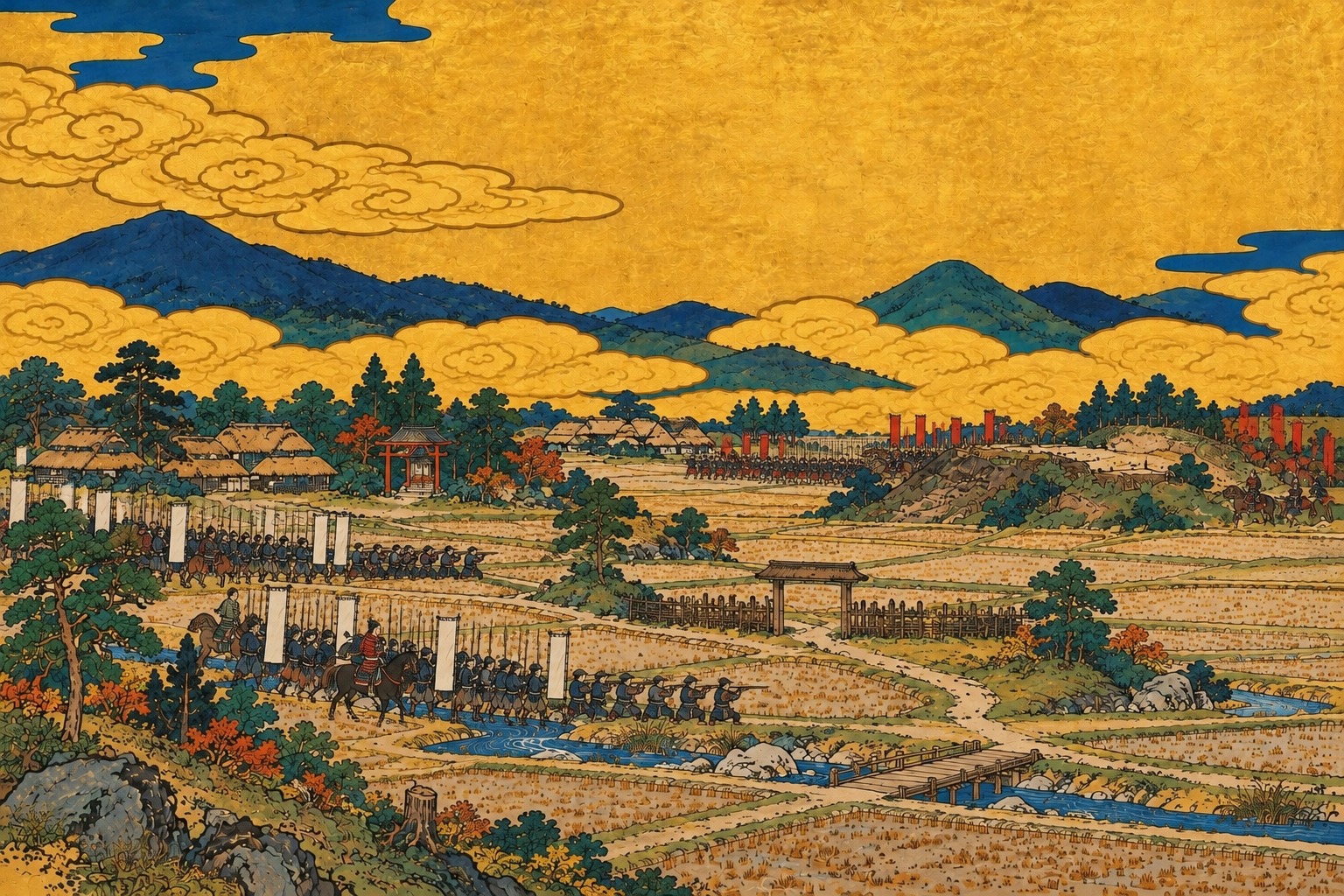
The lunisolar year contains twelve months of 29 or 30 days, sometimes an added thirteenth, with New Year between late January and late February. Japanese autumn months fall roughly five to six weeks after the Western month with the same number. Keicho 5, 9th month, 15th day is 21 October 1600, or 11 October in the Julian calendar used by English writers. A September date for Sekigahara in an English book mistakes the Japanese month number for a Western one.
Read dates Japanese first, Gregorian in brackets: Keicho 5, 9th month, 15th day [AD 21 October 1600], abbreviated in tables to Keicho 5.9.15. A source that supplies only a year receives no invented day. Portuguese, Spanish and Jesuit letters are Gregorian; English letters, including William Adams's, remain Julian, ten days behind. Before October 1582, dates follow Europe's then-current Julian calendar (Historical Reference, The Calendar).
Years are numbered within named eras: Tensho, 1573 to 1592; Bunroku, 1592 to 1596; and Keicho, from 16 December 1596 to 1615. Japanese age starts at one at birth and increases each New Year, putting a recorded age one or two years above a Western count.
Japan in AD 1600
Autumn AD 1600 fixes the map's date, covering Honshu from Edo to Kyushu in Sekigahara's year. Beyond its boundaries lie Ezo (Hokkaido) and the Ryukyu Kingdom, both described in The Realm in 1600.
What to find on it. Japan's sixty-six provinces (kuni) locate places, beneath an overlay of clan domains and the great lords' wartime allegiances. Follow the coastal Tokaido, mountain Nakasendo and western trade route through the Inland Sea. Kyoto, Osaka, Sakai, Edo and Nagasaki are marked alongside the 1600 campaign's castles and the Sekigahara basin.
What the map leaves out, because 1600 does not have it. Hakone's barrier and the Tokaido's fifty-three post stations belong to later years. Owari's seat is Kiyosu, before Nagoya has a castle. Edo has yet to become the shogun's capital.
At the table. Naming a province identifies the lord whose roads, tolls and men a party encounters. For journey distances and times, consult Places and Campaign Tools.
Who Holds Power
Use the table to identify a power, its leader and its holdings in 1600. For individual lords, houses and koku, see The Realm in 1600.
| Power | Who leads it in 1600 | What it holds |
|---|---|---|
| The court | Emperor Go-Yozei at Kyoto, reigned 1586 to 1611 | Ranks, offices, era names and clan names that every warlord wants. No army and little land: the court's estates come to about 10,000 koku in 1601 |
| The Toyotomi house | Toyotomi Hideyori, seven, at Osaka castle with his mother Yodo | The realm's legal claim, a scattered direct domain, the mines and the great cities. Both armies say they march for him |
| The council of Elders | Ieyasu and four others, with Mori Terumoto the nominal head of the west | The right to give orders in Hideyori's name. Divided by 1600 |
| The Commissioners | Ishida Mitsunari and four others | The day-to-day administration of the realm in Hideyori's name |
| Tokugawa Ieyasu | Naidaijin (Inner Minister), at Osaka and Fushimi in the spring, at Edo and on the march in the autumn | The eight provinces of the Kanto and Edo, about 2.5 million koku, the largest domain in Japan |
| The great houses | Mori, Uesugi, Maeda, Shimazu, Date and others | Provinces, castles, vassal bands and the levy of men |
| The temples | Hongan-ji, Mount Koya, Mount Hiei, the Zen monasteries of Kyoto | Estates, banking, learning and the right to bury the dead. Their armies have been broken |
| The towns | Sakai, Kyoto's block associations, Hakata | Money, guns and food. Sakai lost its self-rule to Nobunaga after his 1568 levy demand, with direct rule from 1570 and its moats to Hideyoshi in 1586 |
| The Europeans | The Jesuits and the captain-major of the annual Portuguese ship at Nagasaki | The silk trade, the mission, a college and a hospital |
How People Are Ordered
Warriors
Bushi means warrior generally. In 1600, samurai, from saburau (to serve), usually denotes a middle-ranking mounted retainer, though the 1591 edict below also applies it to low-ranking warrior servants. Beneath mounted samurai are foot samurai (kachi), paid ashigaru companies of spearmen, archers and matchlockmen, and attendant-porters (chugen and komono). Landholding rural warriors who farm are jizamurai. Masterless ronin predate 1600, but their numbers swell after Sekigahara dissolves defeated houses. Close vassals are hatamoto. A domain's great lord is a daimyo; the 10,000-koku threshold is a later Tokugawa definition.
Warrior and farmer remain overlapping categories in 1600 despite the edicts below. Ashigaru may count as either, according to their house; village headmen retain weapons, while the Shimazu and Sanada still recruit from the fields.
Japan's population is about 12 to 17 million. Retainers receive either village revenue through a fief (chigyo) or a rice stipend (kuramai) from their lord's granary. A rating of 100 koku assigns 100 koku of assessed yield, rather than delivering 100 koku to the samurai himself.
House law, family precepts (kakun) and a lord's favor govern a warrior's loyalty. No written bushido code exists in 1600 (Historical Reference, Truth and Legend), and many warriors at Sekigahara change allegiance.
Courtiers
Kyoto's kuge, descendants of the Heian aristocracy, comprise roughly 70 to 80 court-ranked houses. Their offices are titular, their incomes stipends from Hideyoshi and, after 1600, Ieyasu. They command less wealth than great daimyo but alone can confer the prestigious ranks and names warriors seek.
Court ranks descend from senior first to junior eighth, with upper and lower subdivisions from fourth rank downward. Titular offices mark warriors' rank in 1600: Chancellor (Daijo-daijin), Ministers of the Left and Right, Inner Minister (Naidaijin), great and middle counselors (Dainagon and Chunagon), the eight ministries and provincial governors. Ieyasu holds Naidaijin, the Elders counselors' offices, and Hideyori received Gon-chunagon (middle counselor) at five. A middling lord's title need not match his territory or work: Kuroda Nagamasa, "Kai-no-kami", never held Kai; Kato Kiyomasa, "Kazue-no-kami", does not run the accounts bureau his title names.
Farmers, Craftsmen and Merchants
A headman registers the hyakusho, or farmers, whose village collectively owes the lord its tax. Textbooks give the Taiko two parts in three, but actual rates vary locally. Craftsmen and merchants are free under castle-town or guild (za) protection. Nobunaga and Hideyoshi dismantled many guild monopolies in their domains and great lords absorbed the once self-governing merchant cities of Sakai and Hakata. In Kyoto, block associations close their gates each night.
The Edicts That Drew the Lines
Hideyoshi's edicts shape who may do what in 1600.
- The sword hunt (katanagari) of Tensho 16, 7th month, 8th day [AD 29 August 1588] ordered farmers to hand in swords, short swords, bows, spears and guns. The metal was to go into the great Buddha at Hoko-ji. The aim was to end peasant revolts and private feuds. Enforcement was patchy: it was hardest in provinces with a history of revolt and in newly surveyed land, and many villages kept weapons.
- The land survey (Taiko kenchi, 1582 to 1598) recorded every plot with its cultivator and its yield in koku, and tied the cultivator to the land. The national total is usually given as about 18.5 million koku.
- The status edict of Tensho 19, 8th month, 21st day [AD 8 October 1591] has three articles. Warrior servants may not become townsmen or farmers. Farmers may not leave their fields to trade or take wages. A man may not change masters without leave, and a runaway servant is returned.
- The peace edicts of 1585 and 1587 forbade private war between lords and sent their quarrels to Hideyoshi.
Later: The Four Classes
The rigid warrior-farmer-craftsman-merchant division often attributed to the 1591 edict belongs to seventeenth-century doctrine. Most modern historians instead see wartime labor control directed at mobile farmer-soldiers. In 1600, movement between categories continues under uneven enforcement.
Outcasts and Itinerants
Outside the orders, kawata leather workers bury the dead and carry out executions; their riverside homes give them the name kawaramono, riverbed people. Hinin include beggars, guards and some performers. Lords assign these duties, with sharper legal divisions developing after 1600. See The Realm in 1600 for the groups, and Character Creation and Roles for the Outcast Origin and Riverbed Trades Role. Traveling performers include sarugaku and dengaku troupes, blind Heike lute reciters (biwa-hoshi), puppet reciters, jugglers and lord-employed wrestlers, alongside wandering priestesses and mendicant monks.
Women
An absent samurai leaves his wife in charge of household and often estate: she manages property, accounts and records and represents family interests in marriage alliances. Political marriages move women between houses, as do hostage requirements. Hideyoshi and then Ieyasu demand lords' wives and children at Osaka or Fushimi. Widows often become nuns and maintain their houses' memorial rites.
Accounts of armed women concern holding a house or castle for an absent lord, defending a besieged castle or village, or legend. Three lives have firm historical foundations.
- Ii Naotora (died 1582) held the lordship of the Ii at Iinoya in Totomi from about 1565 and raised the boy who became Ii Naomasa. That she led troops herself is legend.
- Tachibana Ginchiyo (1569 to 1602) was named head of the Tachibana house by her father about 1575. Her husband Muneshige commands a Western force at Otsu in 1600.
- Hosokawa Gracia died at the Hosokawa mansion in Osaka on Keicho 5, 7th month, 17th day [AD 25 August 1600]. The Western side was trying to take the wives of eastern lords as hostages. She refused to go. As a Christian she would not take her own life, so her retainer Ogasawara Shosai killed her and the house was burned. The scheme to seize hostages stopped.
Foot soldiers, temple fighters and castle guards use naginata in 1600. Formal training for women develops later, though a woman might use one to defend her household. Tradition alone supplies two fighting stories: Kaihime, attested at Oshi castle in 1590 but unverified as a combatant, and Hachioji women said to have killed themselves above a waterfall that year.
Marriage does not change a woman's birth family name. Noblewomen are addressed by a husband's office or residence; the table gives Hideyoshi's wife and Hideyori's mother as examples.
By the usual account, Hideyoshi licensed Kyoto's Yanagimachi gathering of brothels in 1589. Sale or indenture brings women into this licensed quarter, where yujo trade amid information and debt. The celebrated ranks and the word geisha date to later centuries.
At the table. Standing and ties describe a woman's position. For playable choices, see Character Creation and Roles, Any Role, Any Origin, Within the Custom.
Names and Address
Write family names before given names, as in Tokugawa Ieyasu. Address a warrior by court title, common name (tsusho) or seat; his personal nanori is rarely spoken.
| Person | How people address or speak of him or her in 1600 |
|---|---|
| Tokugawa Ieyasu | Naifu (from Naidaijin, his office) or Edo-dono (from his seat) |
| Ishida Mitsunari | Jibu (from his post in the Ministry of Rites) |
| Toyotomi Hideyoshi | Taiko-sama |
| Toyotomi Hideyori | Hideyori-sama, or the young lord (waka-gimi) |
| Hideyoshi's wife Nene | Kita-no-Mandokoro |
| Hideyori's mother | Yodo-dono |
Warrior boys keep childhood names, often in -maru, until coming of age at twelve to sixteen. Retirement brings men lay-priest names in -sai, -an or -ken. Taking vows gives either sex a dharma name; death brings a posthumous name.
Address fellow warriors with -dono, and lords or superiors with -sama. The softened -san comes later than 1600. For reputation and standing, see Era Rules, Name and Allegiance.
At the table. Origin determines Standing (Character Creation and Roles; Era Rules, Name and Allegiance).
Law and Order
Castle towns rely on their lords' retainer patrols; countryside order rests with headmen and neighbors. A police force and the Edo-period system of magistrates and constables have yet to develop.
The five-man group and the village answer for one another. Under Hideyoshi's 1597 policing order, samurai are grouped in fives and servants in tens, each group sharing liability for offenses and movements; the familiar rural five-household system develops under the Tokugawa. Older collective responsibility (renza) also makes headmen and neighbors liable for a member's crime or tax arrears. Both parties to a quarrel are punished (kenka ryoseibai), regardless of who started it. Fighting on a road or in a village carries a price.
A lord has his own law. A daimyo rules his domain, holds his own courts and keeps his own house code. In 1600 he cannot make war on a neighbor, marry his children into another house without leave, deal directly with the court for titles, keep his wife and heir at home or refuse the levy of men. Building a castle or a road without leave counts as preparing for war, which is the charge against Uesugi in 1600.
Penalties are severe and public. Conviction can bring beheading, crucifixion, burning, exile, loss of fief or display of a severed head. A fallen lord's family may share his fate. Hidetsugu's wives, children and attendants, usually counted as 39, were executed at Kyoto's Sanjo on Bunroku 4, 8th month, 2nd day [AD 5 September 1595]. Execution grounds occupy the dry riverbeds at Rokujo and Sanjo.
Barriers are a local matter. After Nobunaga and Hideyoshi removed old toll barriers in their domains, no national system exists in 1600. Hakone has no checkpoint. Travelers instead encounter domain posts checking goods and runaway farmers, town gates closing at night, and both sides' road pickets in summer 1600. Hakone's Tokugawa barrier and travel-permit system begin in 1619.
At the table. Identify the authority stopping the party. Era Rules, Law and Justice covers arrest, trial, punishment, the unlicensed sword, death and seppuku.
| Hook | Who | The offer |
|---|---|---|
| The Hidden Spears | A village headman | His village hid weapons in the sword hunt of 1588, and a lord's clerk is counting again. He wants them moved before the count |
| Both Parties | A ferryman on the Tokaido | Two travelers fought on his boat and the magistrate will punish both. The man who began it has paid him to say otherwise |
| The Five-Man Group | A farmer | A neighbor in his group of five households has run, and the village answers for the debt unless the runaway is found |
Money and Rice
Rice supplies food and a measure of power. One koku, 180 liters or about 150 kilograms of brown (hulled) rice, feeds an adult for a year. Assessed koku yield (kokudaka) determines domain rank, taxation and military levies. Campaign rations are about 5 go daily per soldier, or about 1.8 koku annually.
Money circulates in three metals, with no fixed exchange rate in 1600.
- Gold circulates as large oval plates (oban), small ingots and gold dust, weighed. The standard coin of 1 ryo, the Keicho koban of 17.76 grams, is first struck in 1601, late in the play range.
- Silver is the money of the west, weighed in momme (about 3.75 grams) from bars. New refining at the Iwami mines makes Japan one of the world's leading silver exporters. Gold is the money of the east.
- Copper coin, called mon, is the money of the street. Most of it is Chinese, with the Ming Yongle coin among the commonest, and local lords control which coins they will take. A string of 1,000 mon is a kanmon. Japan does not mint its own copper until 1606.
Rates vary by region and week in 1600; the first official three-metal rate dates to 1609, beyond play. For consistent prices, Gear and Prices uses the conversion in Era Rules, Money and Stakes, The Broker's Table.
A koku of rice fetches about 10 to 20 momme of silver, or about 800 to 1,600 mon. The eighteenth-century equivalence of one koku to one ryo is inapplicable. Daily unskilled wages are about 10 mon in good coin or one to two sho of rice; a carpenter earns 100 to 110 mon in good coin. Gear and Prices explains the pricing method.
At the table. Koku measure domains, villages and stipends; coins measure towns, trade and a party's purse. Rice-paid characters need buyers before they can spend copper.
| Hook | Who | The offer |
|---|---|---|
| The Rice Draft | A retainer | His stipend is drawn from a granary in a province that may turn hostile. He needs it sold for silver before the season ends |
| Bad Coin | A Sakai moneychanger | A string of copper has more clipped and foreign cash than he can pass. Someone is feeding it into his shop, and he wants to know who |
Roads and Travel
The Roads
The Tokaido (the Eastern Sea Road) runs along the Pacific coast from Kyoto to Edo, about 492 kilometers. Its obstacles are the Suzuka pass into Omi, the ferry across Ise Bay from Miya to Kuwana, the unbridged Fuji, Abe, Oi and Tenryu rivers (waded with porters, and the Oi is the worst), and the Hakone pass at 846 meters. The Nakasendo (the Central Mountain Road, with its mountain stretch called the Kisoji) runs from Kyoto through Omi, Mino, the Kiso valley and Shinano to Kozuke and Musashi, about 534 kilometers. It is longer, higher and has fewer rivers, and it is the road Hidetada takes in 1600. The two roads meet at Kusatsu in Omi. Other roads carry the Aizu campaign (the Oshu road), the western armies (the San'yodo to Shimonoseki) and the traffic to Nagasaki.
A ri is about 3.9 kilometers, or 36 cho. Older provincial ri of about 650 meters survive, so check what a local distance actually measures.
Later: The Post Stations
Tokaido post-station edicts begin in Keicho 6.1 [AD February 1601]; all fifty-three are in place only in 1624. The Nakasendo follows from 1602. The earliest stations appear near the end of play, but before 1601 the road, older lodging towns and local relays exist without the organized system.
Time and Speed
Edo-period records give foot travel at 8 to 10 ri (31 to 40 kilometers) a day and Edo to Kyoto in 12 to 15 days. Armies usually move slower, occasionally faster; the timeline gives Ieyasu's 1600 march. Hideyoshi's roughly 200-kilometer week in 1582 astonished contemporaries. Foot and mounted messengers carry news: the Western rising reached Ieyasu at Oyama from Fushimi, about 145 ri (some 570 kilometers), in five to seven days. Summer rain and autumn typhoons close roads for days. In 1600 the Kiso rivers delay Hidetada.
The Sea
The Inland Sea is the highway of the west, from Osaka and Sakai to Shimonoseki and Kyushu, about 400 kilometers and three to seven days by sail, depending on the wind. Lake Biwa carries goods from Otsu to the north, and the Yodo river carries a boat from Fushimi to Osaka in about half a day. Japanese ships are single-masted and square-sailed and hug the coast. No Japanese ship can sail to Europe. The Shimazu escape from Sekigahara by sea from the Sakai area.
Pirates (kaizoku) have lost their independence. The Murakami of Noshima and Kurushima, Kuki of Shima and Matsura of Hirado command fleets as daimyo or their vassals, subject to the 1588 edict. Small raids and Sino-Japanese smuggling continue in the East China Sea. An Inland Sea "pirate" in 1600 is a sea lord answering to another lord.
Where You Sleep
Temples, roadside chaya tea houses and kichin-yado lodging houses shelter travelers. At the latter, guests supply food and pay for firewood. Meal-serving hatago inns and lords' official honjin lodgings belong to the Tokugawa age.
At the table. Use Era Rules, Travel for daily range and delay costs, Places and Campaign Tools for distances, and The Stable for horses and care.
| Hook | Who | The offer |
|---|---|---|
| The Late River | A porter at the Oi crossing | Rain has closed the ford and a messenger must cross tonight. The porters will carry him for more than the messenger's lord will pay |
| The Border Post | A guard at a domain's edge | He is checking for runaway farmers and will pass anyone who carries a letter from a lord, any lord |
| The Sea Lord's Fee | A shipmaster at Sakai | His cargo is bound for Shimonoseki, and he wants an escort past a sea lord who calls his tolls a courtesy |
Armies and Sieges
The Levy
A lord owes men in proportion to his koku. Hideyoshi's order for the Korean war of 1592 set the rate by distance from the front: 6 men per 100 koku in Kyushu and Shikoku, 5 in the Chugoku and Kii, 4 in the home provinces around Kyoto, and down to 2 in the far east. A 100,000 koku house in Kyushu owed 6,000 men for Korea, though the real turnout was about 80 percent. The numbers include porters and servants as well as fighters. Era Rules, Name and Allegiance gives the table rule for a lord's call on his retainers.
Who Fights
A daimyo's army is his vassal band (kashindan): mounted samurai (kiba-musha) with their own followers, foot samurai, and the ashigaru companies of matchlockmen (teppo-gumi), archers (yumi-gumi) and spearmen (yari-gumi). Laborers, grooms and porters (ninsoku) march in large numbers behind them. The great temple armies are gone as field forces: Hiei was burned in 1571, the Ishiyama Hongan-ji gave up in 1580, and Negoro was destroyed in 1585. Mount Koya and the Shinshu temples still keep armed men. Men of Iga and Koka serve as hired scouts and castle troops.
By 1600 the matchlock (teppo) is the main missile weapon, and the bow and the spear follow it. The sword is everyone's companion weapon. A typical levy of the 1590s had guns and spears in roughly equal numbers, bows in smaller number and mounted men at 5 to 10 percent. Ashigaru spears run 4.5 to 6.5 meters. Mounted samurai usually fight on foot. Cannon are few and small, and there is no field artillery of note at Sekigahara. The Black Powder Armory, The Ranged Armory, The Fantasy Armory and The Armourer own the stats (Adversaries, The Arms of 1600, and Era Rules, Battle, Fire and Fear, say how they are used). The armor of the age is the tosei gusoku, a modern armor of plates, with a cheap issue version for ashigaru that carries the lord's crest on the breastplate.
What Korea Taught
Korean service gave the western houses, Shimazu, Kobayakawa, Konishi, Tachibana, Nabeshima, Mori and Chosokabe, seven years' experience at heavy cost. Ming artillery and Korean warships exposed the limits of Japanese guns and spears. Coastal forts used new stone-wall techniques later seen in Japan's castles of 1600 to 1615, and matchlocks occupy a growing share of levies. Tokugawa troops avoided Korea's losses, though many of its veterans fought Nobunaga's wars.
Banners and Command
Signs distinguish armies wearing similar armor. Foot samurai and ashigaru carry back-flags (sashimono); units display tall nobori in their lord's color, and commanders stand beside great standards (uma-jirushi). House crests (mon) include Tokugawa hollyhock, the circled Shimazu cross and Sanada six coins. A messenger's cloth balloon (horo) identifies his role.
Standards and curtains mark a commander's headquarters (honjin), where bodyguards and messengers attend him and drums, conches and gongs signal orders. Mixed, self-contained units (sonae) number from a few hundred to a few thousand. A signal opens matchlock fire, followed by bows and advancing spear lines. Samurai submit heads for pay claims after battle; fleeing lords are hunted for theirs. Most battles last a few hours.
Sieges
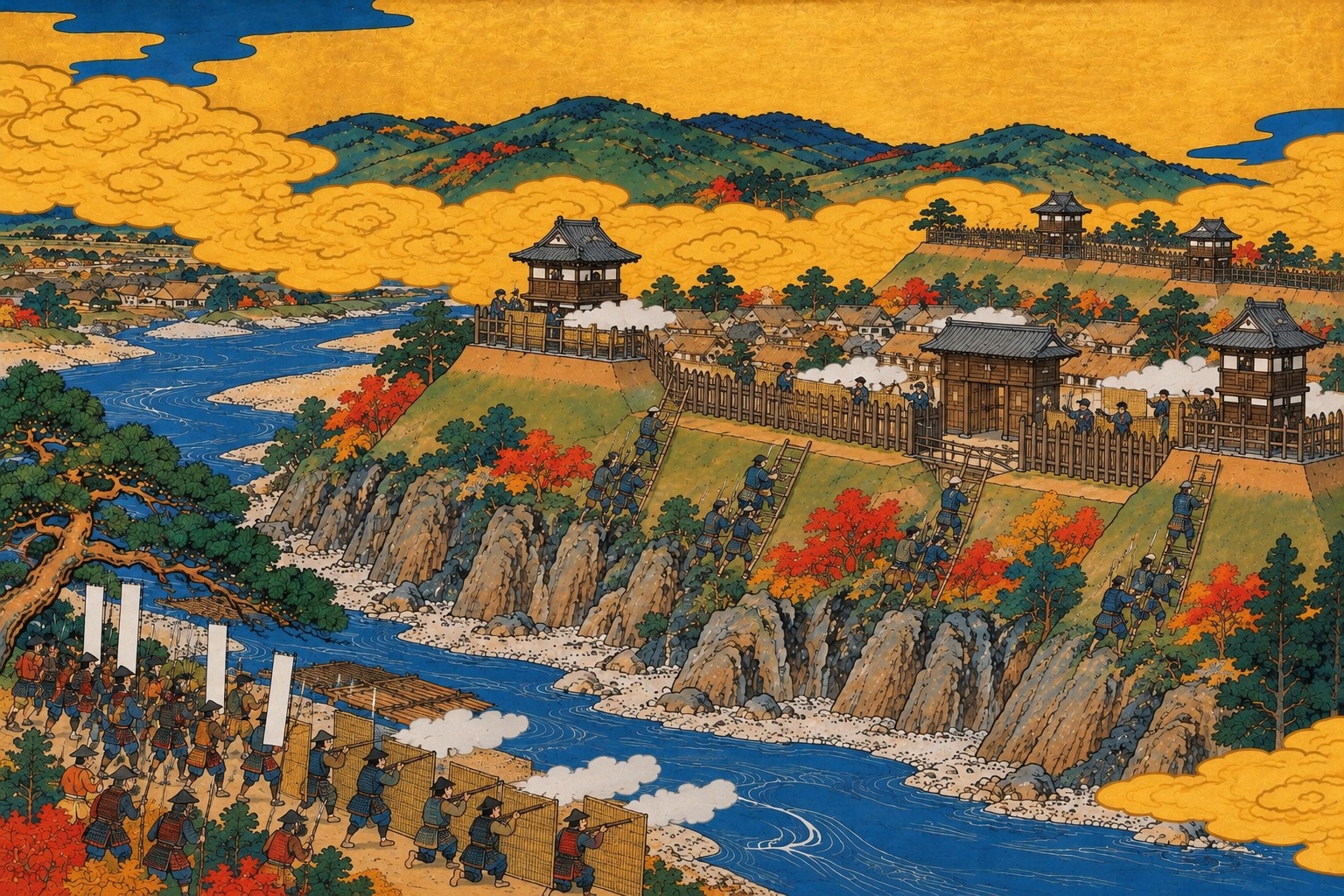
A hilltop or lowland castle in 1600 combines moats, stone-faced slopes, loophole-pierced plaster walls and gatehouses, with a tower keep for a final defense. Negotiation ends far more sieges than assault. Besiegers starve a garrison (Tottori, 1581), flood it (Takamatsu, 1582), mine or bombard it with small guns, or secure a gate through betrayal (Fushimi, 1600). Usually the commander surrenders and dies to spare his men.
What the Stories Say: Guns and Castles
The Nagashino story gives Nobunaga 3,000 gunners in 1575, firing in three rotating ranks to break the Takeda charge. The oldest Shinchoko-ki text instead records 1,000 guns without rotation. A 1611 chronicle and early-1900s General Staff history supply the three ranks, now doubted by modern historians.
Hideyoshi supposedly raised a hilltop castle overnight at Odawara in 1590 to frighten the Hojo. Construction actually took about 80 days; only the removal of screening trees coincided with its revelation.
Religion
Kami and Buddhas
Shinto, shrine worship of the kami (gods or spirits), is not a separate organized religion in 1600. It is closely joined to Buddhism. Most temples contain shrines and most shrines temples. Major sites include Ise, sacred to the sun goddess Amaterasu, Izumo, Kasuga in Nara, the Hachiman shrines and Kyoto's Kitano Tenmangu. Kyoto's Yoshida line licenses shrine priests. Miko, shrine maidens, serve fixed shrines or travel to divine, dance and sometimes entertain.
In Keicho 4 [AD 1599], the emperor deifies Hideyoshi as Toyokuni Daimyojin. His Kyoto shrine remains until Ieyasu closes it in 1615.
Temples and Priests
Temple businesses include estates, lending, sake brewing, papermaking and pawnshops, while sanctuary rights are fading. Zen monasteries educate the literate; their monks write for warlords, teach, serve as envoys and influence tea. Mori adviser Ankokuji Ekei is one such monk. True Pure Land, Nichiren and Shingon Buddhism serve townspeople, farmers and soldiers. For sects' histories and strength, see The Realm in 1600.
Funerals are priests' work, usually cremation for elites and townspeople and burial for others. The dead receive Buddhist posthumous names and rites on the forty-ninth day and anniversaries. Warriors, monks and poets often leave death poems (jisei).
Christians
Francis Xavier landed at Kagoshima on 15 August 1549. By 1600 there are about 200,000 to 300,000 Christians, 1 to 2 percent of the people, mostly in Kyushu (Nagasaki, Arima, Omura, Amakusa, Bungo) and in the Kinai (Osaka, Sakai, Kyoto). Perhaps 110 to 130 Jesuits work in Japan, many of them Japanese brothers. Several lords are baptized, among them Konishi Yukinaga, Arima Harunobu and Omura Yoshiaki, and the most famous convert is Hosokawa Gracia. Hideyoshi ordered the missionaries out on 24 July 1587, and the order is only partly enforced. On 5 February 1597 twenty-six Christians were crucified at Nishizaka in Nagasaki. In 1600 the mission lives under an edict that is not repealed and not enforced. Catholic teaching forbids suicide and requires one wife (a hard rule in a daimyo's house), and in Nagasaki they hold confraternities and a Jesuit college. Nagasaki and the Jesuits are in the cities chapter, and the Christian Origin is in Character Creation and Roles.
The Year in Festivals
New Year (Shogatsu) falls in the first month. Setsubun is the bean-throwing on the day before spring begins. Other fixed days are the Doll festival in the 3rd month, the boys' festival on 5.5, Tanabata on 7.7, the Obon days of the dead on 7.13 to 7.16 and the Chrysanthemum festival on 9.9. The Gion festival of Kyoto runs in the 6th month with its floats, revived by the townsmen after the Onin War. On Keicho 3, 3rd month, 15th day [AD 20 April 1598] Hideyoshi held his great blossom viewing at Daigo, with about 700 cherry trees planted for it.
Death and Seppuku
A warrior in 1600 may take his own life to avoid capture, to answer for a failure or to atone for a wrong, and a victor may order a defeated man to do it as a mark of favor in place of a public execution. Hideyoshi ordered it for Sen no Rikyu in 1591, for Hidetsugu in 1595 and, at Odawara in 1590, for Hojo Ujimasa. The cut is to the belly, with a second man sometimes finishing the work; the ritual form with white robes and a dagger on a tray is of the Edo age, and in the sixteenth century it was less formal. Era Rules, Law and Justice gives the rule. Torii Mototada died at the end of the siege of Fushimi on Keicho 5, 8th month, 1st day [AD 8 September 1600]; the accounts of his death differ. A few retainers follow their lord in death (junshi), and the practice is neither required nor forbidden.
Defeat does not guarantee seppuku. Ishida Mitsunari, Konishi Yukinaga and Ankokuji Ekei were paraded through Osaka and Sakai after Sekigahara, then beheaded at Kyoto's Rokujogawara on Keicho 5, 10th month, 1st day [AD 6 November 1600]. Christian Konishi refused Buddhist last rites.
Daily Life
Food
Samurai and prosperous townspeople eat rice; farmers stretch it with barley, millet, buckwheat and daikon. Common dishes include soy and miso soups, tofu, pickles, seaweed and fish, fresh near the sea or preserved inland. Morning and evening meals, the usual two each day, are served on individual lacquer trays with chopsticks. Guests wash hands and rinse mouths first. Buddhist norms deem meat polluting, but hill people eat boar, deer, hare and birds, and lords eat falconry game. Hosts pour sake; elites and temples drink tea. Portuguese or Spanish tobacco arrives around the century's turn. Imported sugar sweets, castella and konpeito, remain rare.
Sweet potatoes arrive after play; nigiri sushi, ramen and street-food tempura also belong to later years.
Dress
The small-sleeved kosode robe and narrow obi sash form basic dress. Men wear hakama trousers, with warriors adding a stiff kamishimo top for formality and a sleeveless jinbaori over armor. Hemp clothes farmers, silk the elite; cotton use is growing. Rank brings women layered robes and an outer uchikake, with long hair tied low. Married women and court ladies blacken teeth. Men's shaved foreheads lead to topknots. Feet wear straw waraji, zori, wooden geta clogs and split-toe tabi socks.
The samurai's usual long-and-short sword pair is customary in 1600. Only later does it become a legal class marker.
Houses and Castles
Timber-framed farmhouses have thatched roofs, earth floors and open hearths; better homes add raised wooden floors, the rich tatami. Warrior shoin residences feature study alcoves, staggered shelves and Kano-painted sliding doors. Nobunaga's Azuchi begins the spread of tower keeps (tenshu) in 1576, followed by Osaka, Fushimi and Matsumoto. Retainer, merchant and craftsman quarters grow around castles. Edo's modest castle has no great keep until 1607.
Tea, Noh and Poetry
The tea gathering (cha-no-yu) is a political event as well as an art. Sen no Rikyu shaped its plain, rustic style, and Hideyoshi used it to show favor and rank. Rikyu was ordered to die on Tensho 19, 2nd month, 28th day [AD 21 April 1591]; the reason is debated. Hideyoshi's patronage of Noh, and the warlords who learn its chant and dance, make it the theater of the powerful. Linked verse (renga) and court poetry (waka) are the verse of the age. Hosokawa Yusai holds the secret transmission of the Kokinshu commentary, which is why the emperor's envoys end the siege of Tanabe (The Timeline). Haiku as a form is later. Korean potters brought home from the war are founding kilns in Satsuma and Karatsu; Hagi's kilns follow in AD 1604.
Writing, Learning and Medicine
Household officers and register-keeping village headmen use written records and formal letters. Movable-type printing comes from the Jesuit mission press in Kyushu from 1590 and seized Korean type used for Keicho editions in Kyoto. Chinese-derived medicine supplies herbs, acupuncture and moxibustion; Jesuit hospitals offer Western surgery. Smallpox, dysentery and malaria are common, and famine and disease followed Korean service. Steam and hot baths are frequent at temples, inns and elite homes. For care and illness procedures, consult Era Rules, Medicine and Illness.
Time of Day
Twelve zodiac-named toki divide the day. Summer lengthens daylight periods, winter the night ones. Jesuits have brought a few mechanical clocks.
The Timeline, AD 1467 to 1615
Play spans AD 1598 to AD 1603. Earlier rows establish its history; later rows are marked as future events. Disagreements between sources are identified.
The Age of the Warring States, 1467 to 1582
| Date | Event |
|---|---|
| Onin 1 to Bunmei 9 [AD 1467 to 1477] | The Onin War. A succession quarrel in the Ashikaga shogunate and two great houses becomes an eleven-year war, fought mostly in Kyoto between the Hosokawa and Yamana camps. Kyoto burns. The shogunate keeps its title and loses its power, and by convention the Sengoku (warring states) period begins here |
| AD 1493 | The Meio coup: Hosokawa Masamoto deposes the shogun Ashikaga Yoshitane. Some Japanese historians date the Sengoku period from here |
| Tenbun 12 [AD 1543] | Portuguese traders reach Tanegashima and sell two matchlocks to the island's lord. Smiths copy them within a year. Portuguese records give 1542 |
| AD 15 August 1549 | Francis Xavier lands at Kagoshima |
| Eiroku 3.5.19 [AD 12 June 1560] | Okehazama. Oda Nobunaga kills Imagawa Yoshimoto in a surprise attack during a rainstorm. The old figures of 45,000 and 2,000 are doubted |
| AD 1562 | The Kiyosu alliance between Nobunaga and Matsudaira Motoyasu, who soon takes the name Tokugawa (1566). It holds until Nobunaga's death |
| Eiroku 11 [AD 1568] | Nobunaga enters Kyoto and installs Ashikaga Yoshiaki as shogun |
| Genki 2.9.12 [AD 30 September 1571] | Nobunaga burns Enryakuji on Mount Hiei and kills its monks |
| AD 1570 to 1580 | The Ishiyama Hongan-ji war. The True Pure Land fortress-temple at Osaka resists Nobunaga for ten years and gives up in 1580 |
| Genki 4.7.18 [AD 15 August 1573] | Nobunaga expels Yoshiaki from Kyoto. No shogun governs after this |
| Tensho 3.5.21 [AD 28 June 1575] | Nagashino. Nobunaga and Ieyasu break the Takeda from behind a palisade with massed matchlock fire. The oldest text gives 1,000 guns |
| AD 1576 to 1579 | Nobunaga builds Azuchi castle on Lake Biwa, the first great tower keep |
| Tensho 10.6.2 [AD 21 June 1582] | Honno-ji. Akechi Mitsuhide attacks Nobunaga at his lodging in Kyoto, and Nobunaga dies in the burning temple. His body is never identified. Mitsuhide's motive is unknown |
| Tensho 10.6.13 [AD 2 July 1582] | Yamazaki. Hideyoshi, hurrying back from the Mori front, destroys Mitsuhide |
Hideyoshi, 1583 to 1598
| Date | Event |
|---|---|
| Tensho 11.4.21 [AD 11 June 1583] | Shizugatake. Hideyoshi defeats Shibata Katsuie and begins Osaka castle on the Hongan-ji site |
| AD 1584 | The Komaki and Nagakute campaign. Ieyasu wins the field and makes his peace with Hideyoshi in 1586 |
| Tensho 13.7.11 [AD 6 August 1585] | Hideyoshi becomes kampaku, the first warrior to hold the regency. The first peace edict forbids private war |
| Tensho 15.5.8 [AD 13 June 1587] | The Shimazu submit, ending the Kyushu campaign |
| Tensho 15.6.19 [AD 24 July 1587] | Hideyoshi orders the missionaries out. Enforcement is partial |
| Tensho 16.1.13 [AD 9 February 1588] | Yoshiaki resigns the title of shogun and takes Buddhist vows. The office stands vacant |
| Tensho 16.7.8 [AD 29 August 1588] | The sword hunt and the anti-piracy edict |
| Tensho 18.7.5 [AD 4 August 1590] | Odawara surrenders after about 100 days. The Hojo fall: Ujimasa is ordered to die |
| Tensho 18.8.1 [AD 30 August 1590] | Ieyasu is moved to the eight Kanto provinces and enters Edo |
| Tensho 19.2.28 [AD 21 April 1591] | Sen no Rikyu is ordered to die |
| Tensho 19.8.21 [AD 8 October 1591] | The status edict |
| Tensho 19.12.28 [AD 11 February 1592] | Hideyoshi passes the regency to his nephew Hidetsugu and becomes the Taiko |
| Bunroku 1.4.12 to 13 [AD 23 to 24 May 1592] | The first landing at Busan begins the Korean war. Hideyoshi directs it from Nagoya in Hizen and never goes to Korea |
| Bunroku 2.8.3 [AD 29 August 1593] | Toyotomi Hideyori is born at Osaka |
| Bunroku 4.7.15 [AD 20 August 1595] | Hidetsugu is forced to commit seppuku on Mount Koya. His household is executed at Sanjo on 5 September |
| Bunroku 5 [AD 1596] | An earthquake wrecks Fushimi castle on Bunroku 5, intercalary 7th month, 13th day [AD 5 September]. Ming envoys invest Hideyoshi as King of Japan on 22 to 23 October, and he takes it as an insult. The Spanish ship San Felipe wrecks in Tosa |
| Keicho 1.12.19 [AD 5 February 1597] | Twenty-six Christians are crucified at Nagasaki |
| Keicho 2 [AD 1597] | The second invasion of Korea. The Mimizuka (Ear Mound), dedicated in Kyoto in the 9th month, covers the salted noses that were sent home as proof of kills |
| Keicho 3.3.15 [AD 20 April 1598] | Hideyoshi's blossom viewing at Daigo |
| Keicho 3.8.18 [AD 18 September 1598] | Hideyoshi dies at Fushimi. The council of Five Elders and Five Commissioners rules for Hideyori |
| Keicho 3.11.18 to 19 [AD 16 to 17 December 1598] | The last Japanese convoys fight their way out of Korea at Noryang. Captives are carried to Japan, in numbers estimated from 50,000 to 100,000 |
The Choosing of Sides, 1599 to 1603
| Date | Event |
|---|---|
| Keicho 4.1 [AD January to February 1599] | The Elders and Commissioners accuse Ieyasu of arranging marriages without leave. Maeda Toshiie leads the accusers, and the three mediators bring the two sides to exchange oaths |
| Keicho 4, intercalary 3.3 [AD 27 April 1599] | Maeda Toshiie dies at Osaka. That night seven generals who served in Korea go after Ishida Mitsunari. He retires to Sawayama |
| Keicho 4.9 [AD October to November 1599] | Ieyasu moves into the western citadel of Osaka castle. A reported plot to kill him on the road removes Asano Nagamasa from the council |
| Keicho 5.3.16 [AD 29 April 1600] | The Dutch ship Liefde, with William Adams aboard, reaches Bungo with about two dozen living men of some 110. Ieyasu questions Adams at Osaka castle in May (12 May in Adams's own Julian dating, 22 May Gregorian) |
| Keicho 5.4 [Spring AD 1600] | Uesugi Kagekatsu refuses Ieyasu's summons to Kyoto. Ieyasu announces a campaign against Aizu in Hideyori's name |
| Keicho 5.6.16 [AD 26 July 1600] | Ieyasu leaves Osaka for the Aizu campaign |
| Keicho 5.7.12 to 17 [AD August 1600] | The Western combination forms at Osaka, with Mori Terumoto as nominal head. Thirteen charges against Ieyasu are issued on 25 August |
| Keicho 5.7.17 [AD 25 August 1600] | Hosokawa Gracia dies when the Western side tries to take hostages |
| Keicho 5.7.19 to 8.1 [AD 27 August to 8 September 1600] | The siege of Fushimi. Torii Mototada and about 1,800 men hold the castle against about 40,000 until it falls and he dies |
| Keicho 5.7.21 to 9.12 [AD 29 August to 18 October 1600] | The siege of Tanabe. Hosokawa Yusai holds it with about 500 men against about 15,000 for about 50 days, until the emperor's envoys order the siege lifted. The castle is given up three days before Sekigahara |
| Keicho 5.7.25 [AD 2 September 1600] | The turning of Ieyasu's army at Oyama. The tale of a single staged council is doubted; the turn is certain |
| Keicho 5.8.23 [AD 30 September 1600] | Gifu castle falls in one day to Fukushima Masanori and Ikeda Terumasa |
| Keicho 5.8.24 to 9.11 [AD 1 to 17 October 1600] | Hidetada's march and the second siege of Ueda. Sanada Masayuki holds Tokugawa Hidetada, with about 38,000, long enough that Hidetada reaches Otsu on Keicho 5.9.20 [AD 26 October 1600], five days after the battle |
| Keicho 5.9.1 to 14 [AD 7 to 20 October 1600] | Ieyasu marches from Edo along the Tokaido to Akasaka, about 400 kilometers in fourteen days |

| Date | Event |
|---|---|
| Keicho 5.9.15 [AD 21 October 1600] | Sekigahara. The Western line collapses from the south after Kobayakawa Hideaki turns on Otani Yoshitsugu. The hour of that move is debated. The Realm in 1600 tells the day |
| Keicho 5.9.17 to 9.18 [AD 23 to 24 October 1600] | Sawayama, Mitsunari's seat, is attacked and falls the next day |
| Keicho 5.9.21 [AD 27 October 1600] | Mitsunari is captured by Tanaka Yoshimasa's men in northern Omi, where villagers had hidden him |
| Keicho 5.10.1 [AD 6 November 1600] | Mitsunari, Konishi Yukinaga and Ankokuji Ekei are beheaded at Rokujogawara |
| AD 1600 to 1602 | The settlement. About 88 houses are attainted and six to eight million koku change hands. Mori, Uesugi and Satake are cut; the Shimazu keep their land |
| Keicho 6 [AD 1601] | The Keicho gold and silver coinage begins. The post stations of the Tokaido are established. Ieyasu has Nijo castle in Kyoto built (to 1603). Uesugi Kagekatsu is moved to Yonezawa at 300,000 koku in August |
| Keicho 8.2.12 [AD 24 March 1603] | Ieyasu is appointed shogun. The Tokugawa shogunate dates from here |
After the Play Range, 1603 to 1615
| Date | Event |
|---|---|
| AD 1603 to 1605 | Edo is rebuilt as the shogunate's seat by levies on the lords. Hideyori marries Hidetada's daughter Senhime in 1603 |
| Keicho 10.4.16 [AD 2 June 1605] | Ieyasu resigns the shogunate to Hidetada and keeps power as retired shogun (ogosho) |
| AD 1609 | Satsuma invades the Ryukyu Kingdom. The Dutch open a trading post at Hirado |
| AD 1611 | Emperor Go-Yozei abdicates |
| AD 1614 to 1615 | The Osaka campaigns. Ieyasu besieges Hideyori the castle falls on 3 June 1615, and Hideyori dies the next day. The Toyotomi house ends |
| AD 1615 | The Laws for Warrior Houses (buke shohatto) follow, with the order of one castle to a province |