Places and Campaign Tools
Plan journeys, road scenes and campaigns across AD 1598 to 1603 here. Kyoto, Osaka, Sakai, Edo, Nagasaki covers the five cities and Fushimi; this chapter supplies the connecting roads and places. For travel rates and checks at fords, passes and gates, see Era Rules, Travel and Covert Work. The Campaign Tools below build stories around the Sekigahara Clock in Era Rules, Name and Allegiance.
The Banners
- 街道 kaido (KYE-doh): the great roads that link the provinces.
- 旅 tabi (TAH-bee): a journey.
- 宿 shuku (SHOO-koo): a lodging place, an inn or a post town.
Roads and Distances
Distances use modern road measures rounded to the nearest kilometer or five, plus ri (about 3.93 km; Era Rules, Travel). The tilde (~) marks rounding for play. Calculate days with the stage rates in Era Rules, Travel, The Stage.
TERMS: COUNTING THE DAYS
I Round up. Divide the leg's ri by the traveler's stage and count any part of a stage as a whole stage: 24 ri at 8 to 10 ri a day is 3 days, not 2. The party arrives during the last day counted.
II A pass costs a stage. Add one stage for each pass or climb named in the Pass column (Era Rules, Travel, Obstacles). The tables below have already added it.
III Several legs. To count a journey of several legs, add the ri first and round once, then add the passes. Adding the days of each leg counts every fraction twice.
IV A messenger. A lord's messenger who changes horses carries a letter from Kyoto to Edo in 5 to 7 days (Era Rules, Travel, The Stage). For a shorter leg, give him twice a rider's stage in a day.
V A deadline. Count the top of the range when the party must be sure of a date, and the bottom when it has fair weather, no load and a road it knows.
Travel Days by Land
| Leg | km | ri | Pass | On foot or with a pack horse | An army | A rider on one horse |
|---|---|---|---|---|---|---|
| The home provinces | ||||||
| Kyoto to Fushimi | 8 | ~2 | 1 | 1 | 1 | |
| Fushimi to Osaka | ~40 | ~10 | 1 to 2 | 2 | 1 | |
| Kyoto to Osaka | 45 | ~11 | 2 | 2 | 1 | |
| Osaka to Sakai | 12 | ~3 | 1 | 1 | 1 | |
| Kyoto to Otsu | ~13 | ~3 | 1 | 1 | 1 | |
| Kyoto to Kusatsu, where the roads part | ~26 | ~6.5 | 1 | 1 | 1 | |
| Kyoto to Minakuchi, in Koka | ~50 | ~13 | 2 | 2 | 1 to 2 | |
| Kyoto to Iga Ueno | ~75 | ~19 | 2 to 3 | 3 | 2 | |
| Kyoto to Tanabe, in Tango | ~95 | ~24 | 3 | 3 to 4 | 2 | |
| Osaka to Koyasan | ~80 | ~20 | The climb | 3 to 4 | 4 | 3 |
| Omi and Mino | ||||||
| Kyoto to Sekigahara | 95 | ~24 | 3 | 3 to 4 | 2 | |
| Otsu to Sekigahara | ~82 | ~21 | 3 | 3 | 2 | |
| Osaka to Sekigahara | ~135 | ~34 | 4 to 5 | 5 | 3 | |
| Sekigahara to Sawayama | ~22 | ~5.5 | 1 | 1 | 1 | |
| Sekigahara to Ogaki | 15 | ~4 | 1 | 1 | 1 | |
| Ogaki to Gifu | ~18 | ~5 | 1 | 1 | 1 | |
| Gifu to Akasaka | ~20 | ~5 | 1 | 1 | 1 | |
| Miya to Gifu, by Kiyosu and the Mino road | ~40 | ~10 | 1 to 2 | 2 | 1 | |
| Sekigahara to Kuwana, by the Ise road | ~40 | ~10 | 1 to 2 | 2 | 1 | |
| Kuwana to the Ise shrines, by Matsusaka | ~85 | ~22 | 3 | 3 to 4 | 2 | |
| The Tokaido in its parts | ||||||
| Kusatsu to Kuwana | ~86 | ~22 | Suzuka | 4 | 4 to 5 | 3 |
| Miya to Okazaki | ~32 | ~8 | 1 | 1 to 2 | 1 | |
| Okazaki to Hamamatsu | ~63 | ~16 | 2 | 2 to 3 | 2 | |
| Hamamatsu to Sunpu | ~80 | ~20 | 2 to 3 | 3 | 2 | |
| Sunpu to Mishima | ~63 | ~16 | 2 | 2 to 3 | 2 | |
| Mishima to Odawara | ~31 | ~8 | Hakone | 2 | 2 to 3 | 2 |
| Odawara to Edo | 83 | ~21 | 3 | 3 | 2 | |
| The east | ||||||
| Edo to Oyama, in Shimotsuke | ~78 | ~20 | 2 to 3 | 3 | 2 | |
| Edo to Ueda, by the Nakasendo and the Hokkoku road | ~190 | ~48 | Usui | 6 to 7 | 7 to 8 | 5 |
| Edo to Akasaka, by the Tokaido and the Mino road | ~400 | ~102 | Hakone | 12 to 14 | 14 to 16 | 8 to 10 |
| The west | ||||||
| Osaka to Himeji | ~85 | ~22 | 3 | 3 to 4 | 2 | |
| Himeji to Okayama | ~85 | ~22 | 3 | 3 to 4 | 2 | |
| Okayama to Hiroshima | ~165 | ~42 | 5 to 6 | 6 | 3 to 4 | |
| Hiroshima to Shimonoseki | ~195 | ~50 | 5 to 7 | 7 to 8 | 4 to 5 | |
| Shimonoseki to Hakata, with the ferry over the strait | ~75 | ~19 | 2 to 3 | 3 | 2 | |
| Hakata to Nagasaki | ~160 | ~41 | 5 to 6 | 6 | 3 to 4 | |
| The whole roads | ||||||
| Kyoto to Edo, by the Tokaido | 492 | ~125 | Suzuka, Hakone | 12 to 15 | 16 to 18 | 9 to 11 |
| Kyoto to Edo, by the Nakasendo | 534 | ~136 | Usui, Wada, Torii | 14 to 17 | 17 to 20 | 10 to 12 |
| Osaka to Shimonoseki, by the San'yodo | ~530 | ~135 | 14 to 17 | 17 to 20 | 9 to 12 | |
| Shimonoseki to Nagasaki | ~235 | ~60 | 6 to 8 | 8 to 9 | 4 to 5 |
The whole roads. The two Kyoto to Edo rows are the pace of a traveler who walks the road end to end in fair weather, with the passes, the Miya ferry and the fords inside the figure: 12 to 15 days by the Tokaido is the record of the later road (Era Rules, Travel, The Roads), and the other cells of the two rows are counted the same way, with no separate day for a pass. A party that carries a load, stops in a town or must be sure of a date counts the legs instead (Counting the Days III), and the Tokaido then comes to 15 to 18 days on foot.
Travel Days by Water
A coastal ship covers 15 to 35 ri daily in a fair wind, none in a foul one (Era Rules, Travel, The Stage). Times labeled this book's estimate lack recorded figures. Fares cover one traveler.
| Passage | Distance | Time | Fare in Exodus |
|---|---|---|---|
| The Yodo, Fushimi down to Osaka | ~10 ri | Half a day with the current | About 3 RECONSTRUCTED |
| The Yodo, Osaka up to Fushimi | ~10 ri | 1 to 2 days, poled and towed (this book's estimate) | About 6 RECONSTRUCTED |
| Lake Biwa, Otsu to the north shore | ~15 ri | A day under sail in fair weather (this book's estimate) | About 3 RECONSTRUCTED |
| Lake Biwa, Yabase to Sakamoto | ~3 ri | Half a day in fair weather; no crossing in a rising wind (this book's estimate) | About 2 RECONSTRUCTED |
| Ise Bay, Miya to Kuwana | 7 ri | Half a day; no crossing in a rising wind | About 2 RECONSTRUCTED |
| A river ferry or the Shimonoseki strait | under 1 ri | An hour, or a wait for the water to fall | 1 or less (Gear and Prices, Keep, Lodging and Travel) |
| Osaka or Sakai to Shimonoseki, by the Inland Sea | ~100 ri | 3 to 7 days | 200 to 600 for a seagoing passage of any length (Gear and Prices, Keep, Lodging and Travel) |
| Shimonoseki to Hakata | ~19 ri | 1 day | As above |
| Hakata to Nagasaki, round Hirado | ~50 ri | 2 to 4 days | As above |
| Osaka to Nagasaki, the whole passage | ~170 ri | 6 to 12 days | 200 to 600 |
The Tokaido
About 492 km is the later reference distance from Kyoto's Sanjo bridge to Edo's Nihonbashi (built in 1603) along the Eastern Sea Road. Its towns stand in AD 1600, before the Tokugawa network of fifty-three post stations is organized (The Era, Roads and Travel, The Post Stations).

Divide the road into four parts and a ferry crossing. Travel Days by Land gives each part's duration.
- Kyoto to Kusatsu, about 6.5 ri. Over the Higashiyama hills to Otsu on Lake Biwa, then along the lake's south shore. At Kusatsu the Nakasendo leaves for Mino. The Tokaido turns south-east.
- Kusatsu to Miya, about 22 ri by land and 7 by water. Through the hills of southern Omi and over the Suzuka pass into Ise, then along the coast to Kuwana. At Kuwana the road meets Ise Bay, and travelers take the ferry across to Miya (Travel Days by Water).
- Miya to Mishima, about 60 ri. Owari and Mikawa, the Tokugawa home country, then Totomi and Suruga and the four unbridged rivers, in the order a traveler going east meets them: the Tenryu, the Oi, the Abe and the Fuji. Porters carry travelers across them. The Oi is the worst.
- Mishima to Edo, about 29 ri. The climb to the Hakone pass at 846 m, down to Odawara and across the Sagami plain to Edo.
In AD 1600 Ieyasu's army follows the Tokaido through Shimada, Okazaki and Kiyosu. At Miya it leaves the route for the Mino road, heading north-west about 15 ri to Gifu and Akasaka (The Realm in 1600, The Summer of Choosing).
What the party meets. Hakone has no national barrier. Domain border posts and closed night gates obstruct travel; from Clock step 2, war pickets cover every road (Era Rules, Covert Work, Gates). Stay at a temple for an offering, a tea house, or a lodging house charging for firewood while guests supply food (Gear and Prices, Keep, Lodging and Travel).
Later: The Road After 1601
Stations begin keeping horses and porters for officials in Keicho 6 [AD 1601]. Pine avenues follow in 1604 and the Hakone barrier in 1619. Through AD 1603, show the early stations and new posts checking travelers' seals. See Historical Reference, The Anchors, for dates.
At the Table: The Tokaido
Who. Pilgrims bound for Ise, peddlers, a lord's baggage train, porters who carry travelers at the rivers, ferrymen at Miya and Kuwana, masterless men in twos and threes. Costs. A ferry over a river is 5 to 20 mon; a night in a lodging house about 10 to 12 mon, at a tea house or temple less (Gear and Prices). Danger. A flood that closes a ford; a Western picket after Clock step 2; a horse lamed on the Suzuka pass. Use. A journey of twelve to fifteen days with a different ledger on each leg: friendly lords near Edo, mediators in Totomi and Mikawa, Western pickets in Omi.
The Nakasendo
The Central Mountain Road links Kusatsu, Omi, Mino, Sekigahara, the Kiso valley and Shinano with Edo, about 534 km from Kyoto. Compared with the Tokaido, it is longer and higher but crosses fewer rivers. Tokugawa Hidetada brings about 38,000 men along it in AD 1600; the Western army blocks it at Sekigahara. Organized stations begin in 1602, after the map year.
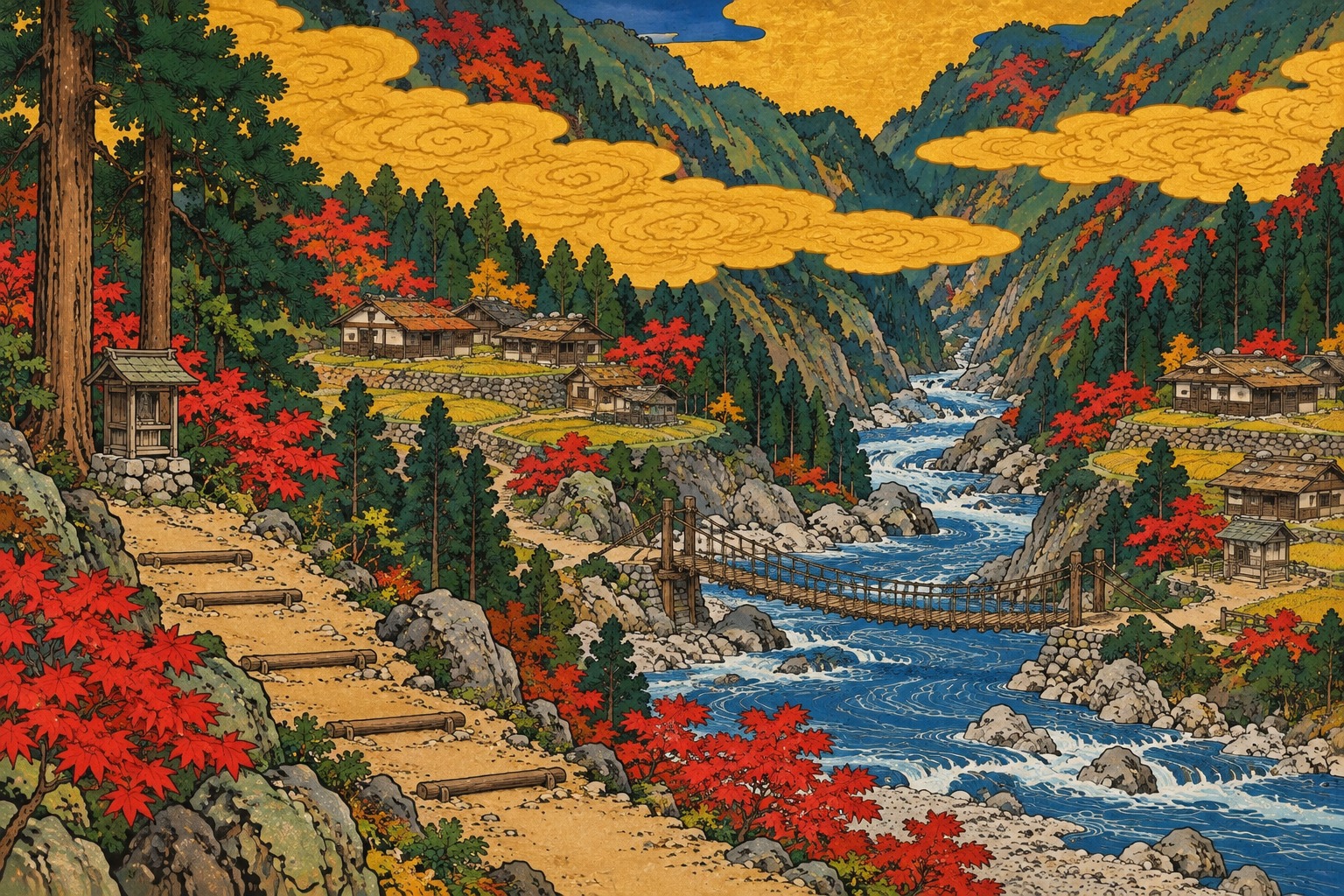
In the central Kiso valley, the track climbs log steps past terraced villages. Rafts carry cypress downstream for castles and temples. Rain closes the track more often than rivers do; shorten the stage and use Era Rules, Travel, Obstacles.
At the Table: The Nakasendo
Who. Timber cutters, raftsmen, charcoal burners, pack-horse drivers carrying salt up from the coast, mountain ascetics, the rear of a column. Danger. Rain on the pass; a mountain band that tolls the path; a bridge of rope or logs that has gone. Use. The slow road for a party that wants to avoid the Tokaido's pickets, at the cost of days. A mixed party can split here: those on foot go by the Kiso, a messenger on a good horse by the lowland.
The Western Roads and the Inland Sea
Take the San'yodo, or Saigoku road, west from Osaka along the Inland Sea's north shore: Himeji, Ukita-held Okayama, Mori-held Hiroshima, Shimonoseki and Kyushu. The sea route saves time. Osaka or Sakai to Shimonoseki covers about 400 km in three to seven days under sail, wind permitting, versus 14 to 17 days walking (Travel Days by Water; Travel Days by Land).

Single-masted coasters with square sails move between ports; Japanese ships do not sail to Europe. Sea lords, including the Murakami of Noshima and Kurushima, are daimyo or their vassals, subject to the anti-piracy edict of 1588. The AD 1600 "pirate" commands a fleet and answers to a lord (The Era, Roads and Travel). Tomo and Onomichi are old landings along the route, available under those names.
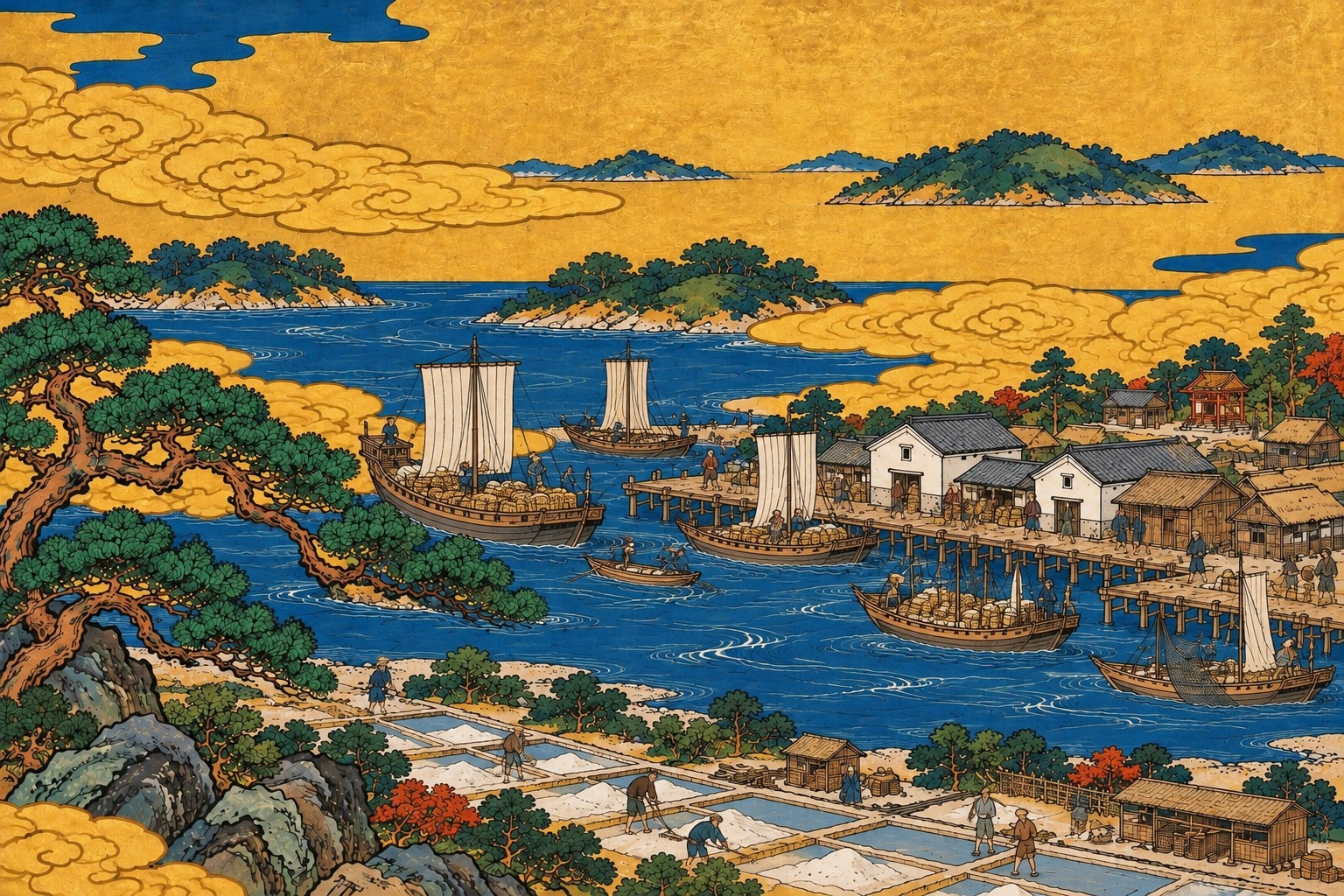
A seagoing passage costs 200 to 600 Exodus (Gear and Prices, Keep, Lodging and Travel). Short passages are in Travel Days by Water.
At the Table: The Inland Sea
Who. A shipmaster and his mate, porters on the quay, a toll-keeper for the sea lord, salt merchants, fishing families. Danger. A foul wind that costs days; a war boat that stops the ship to see papers (Covert Work, Gates); a cargo that is not what the broker said. Use. The fast road from Osaka to the west. A party with papers for one side finds the Western ports shut after Clock step 2.
Water Roads Near the Cities
Three short water routes matter to a campaign.
- The Yodo, Fushimi to Osaka. Rice, timber and passengers go down it by boat, and tolls are thin. The boat back is poled and towed against the current.
- Lake Biwa. Boats carry goods from Otsu to the north shore. The lake is the way round a picket on the Nakasendo for a party with a boat and a bribe (Era Rules, Money and Stakes, Bribes).
- Ise Bay. The ferry from Miya to Kuwana is part of the Tokaido. In a rising wind the ferrymen will not go (Era Rules, Travel, Obstacles).
Times and fares for all three are in Travel Days by Water.
Places Between the Cities
Use these AD 1600 places and settlement types for road scenes. For Fushimi and Sakai, see Kyoto, Osaka, Sakai, Edo, Nagasaki. Place Fushimi on the Yodo 8 km south of Kyoto, and Sakai 12 km south of Osaka.
A Town on the Road
A stage ends at a town whose services depend on its lord (The Era, Roads and Travel, The Post Stations). Among a few hundred houses, travelers find a temple, tea house, lodging house and stable for hiring or changing horses. At a river there is a ferry or ford. Border posts check goods and fleeing farmers at the domain's edge.

At the Table: A Town on the Road
Who. The headman, the stable keeper, the lodging-house keeper and his family, porters, a priest who takes pilgrims, a lord's border-post guards. Costs. Lodging and a bath at the low end of Gear and Prices; a fresh Riding Horse about 300 Exodus at a castle town (Gear and Prices, Horses and Pack Animals). Danger. A party without papers at a border post; a brawl where both sides are punished (Era Rules, Law and Justice). Use. A night to learn the rumors of the road, to buy a horse, to find a guide, or to be found.
A Castle Town
Around a lord's keep stand vassals' quarters, a merchant and craft street, outlying temples and gates closed at night. His officers judge the townspeople and ask openly armed strangers whom they serve (Era Rules, Law and Justice, Who Bears Arms). War fills the town with levies, grain and hostages.
At the Table: A Castle Town
Who. The lord's steward, the gate keeper, market brokers, guilds of craftsmen, a physician, wives and children held for their lords. Danger. A night gate, an officer who wants to know your lord, a muster that sweeps up idle men. Use. A lord's audience, a market for guns and horses, a school's practice hall, a loan against a Name.
Otsu
On Lake Biwa's south shore, Otsu is Kyoto's first eastern town, serving both great roads and lake traffic. Kyogoku Takatsugu holds its castle for the East with about 3,000 men in AD 1600. About 15,000 Western troops, led by Mori Motoyasu and Tachibana Muneshige, begin the siege around Keicho 5, 9th month, 3rd day [AD 9 October 1600]. Around the 13th to 14th [19 to 20 October], Kyogoku accepts a truce and retires to Mount Koya. The attackers enter on the 15th [21 October], missing Sekigahara that morning. Kyoto spectators reportedly watched from Mount Hiei.
At the Table: Otsu
Who. Boatmen, rice and timber dealers, a lord's besieged garrison in the 9th month, Western officers in the siege lines, townspeople on the hills with food and wine to sell. Danger. A siege camp where every stranger is a spy. Use. The place where the two roads meet the lake: a scene for a messenger, a smuggler or a party sent to carry out a garrison's family before the truce.
Ogaki, Gifu and Akasaka
The autumn war's Mino front runs through these three places.
- Gifu is Oda Hidenobu's castle, held for the West. It falls in a day to Fukushima Masanori and Ikeda Terumasa on the 23rd day of the 8th month [AD 30 September 1600], and Hidenobu goes to Mount Koya.
- Ogaki is the Western base. The Western army leaves it in rain on the night of the 14th to the 15th of the 9th month.
- Akasaka, 4 km from Ogaki, is where the Eastern vanguard waits for Ieyasu. He arrives on the evening of the 14th.
From Clock step 5 to step 7 the two camps look at each other across 4 km of fields and buy information (Era Rules, Name and Allegiance, The Sekigahara Clock). A party that carries letters, scouts roads or watches pickets works here.
At the Table: The Forward Line
Who. Pickets of both sides, scouts, farmers who have lost their harvest to foragers, merchants selling rice to both camps, a hundred small lords' men. Danger. A picket that searches everything (Covert Work, The Search). Use. The best week of the campaign for informants and bribes. Every stranger has a price on one side or the other.
Sekigahara and Its Basin
Sekigahara is a post village in a basin about 15 km west of Ogaki, at the western edge of Mino. The basin is small and ringed with low hills. Mount Nangu, about 420 m, rises on the south-east, Matsuo hill on the south-west and Sasao hill on the north-west. Mount Ibuki stands beyond, in the far north-west. The Nakasendo enters from the east and passes on into Omi, and roads branch to Ise in the south and to Echizen in the north. The ancient Fuwa barrier, now a few ruined earthworks, stands here. The fields are in stubble in October, and the night's rain turns the paths to mud. The morning fog is a traditional detail from a late text; the earliest accounts do not insist on it. The course of the battle and the positions of the armies are in The Realm in 1600, The Plain and The Day. Your place in the line is in Era Rules, Battle, Fire and Fear.
Reaching the basin. The Western army marches the 15 km from Ogaki in a night of rain, about 4 ri. The Eastern army follows from Akasaka. A party that wants to be in the basin before the armies must be there by the 14th [20 October] (Roads and Distances).
After the battle. The beaten Western side scatters. Sawayama, Mitsunari's castle, is stormed on Keicho 5, 9th month, 17th day [AD 23 October 1600] and falls within a day. Konishi Yukinaga is taken on Mount Ibuki on the 19th [AD 25 October]. Ishida Mitsunari is hidden by the villagers of Furuhashi in northern Omi and is taken on the 21st [AD 27 October]. The roads out are Ibuki and the Echizen road to the north, the Ise road to the coast and the sea at Sakai, and the long road to Mount Koya (The Realm in 1600, Where the Defeated Go).
At the Table: The Basin
Who. Villagers whose rice is under the armies' feet, camp followers, peddlers, a lord's messenger, wounded men, the heads of the dead in the lord's tally. Danger. A field of fighting men who do not know whose man you are. Use. A battlefield scene, a flight, a pursuit through hill country, a search for a body or a name.
Mount Koya
Founded in AD 816, Kii's Mount Koya (Koyasan) is the Shingon center, its temples and graves set among old cedars. Temples own land, receive pilgrims and maintain armed men despite their submission to Hideyoshi in 1585. Defeated and retiring lords lay down arms here. Hidetsugu died on Koya in AD 1595; Oda Hidenobu, Kyogoku Takatsugu and Hachisuka Iemasa come in 1600, while the Sanada withdraw to Kudoyama on its lands. A stone-lined path passes the great lords' monuments.

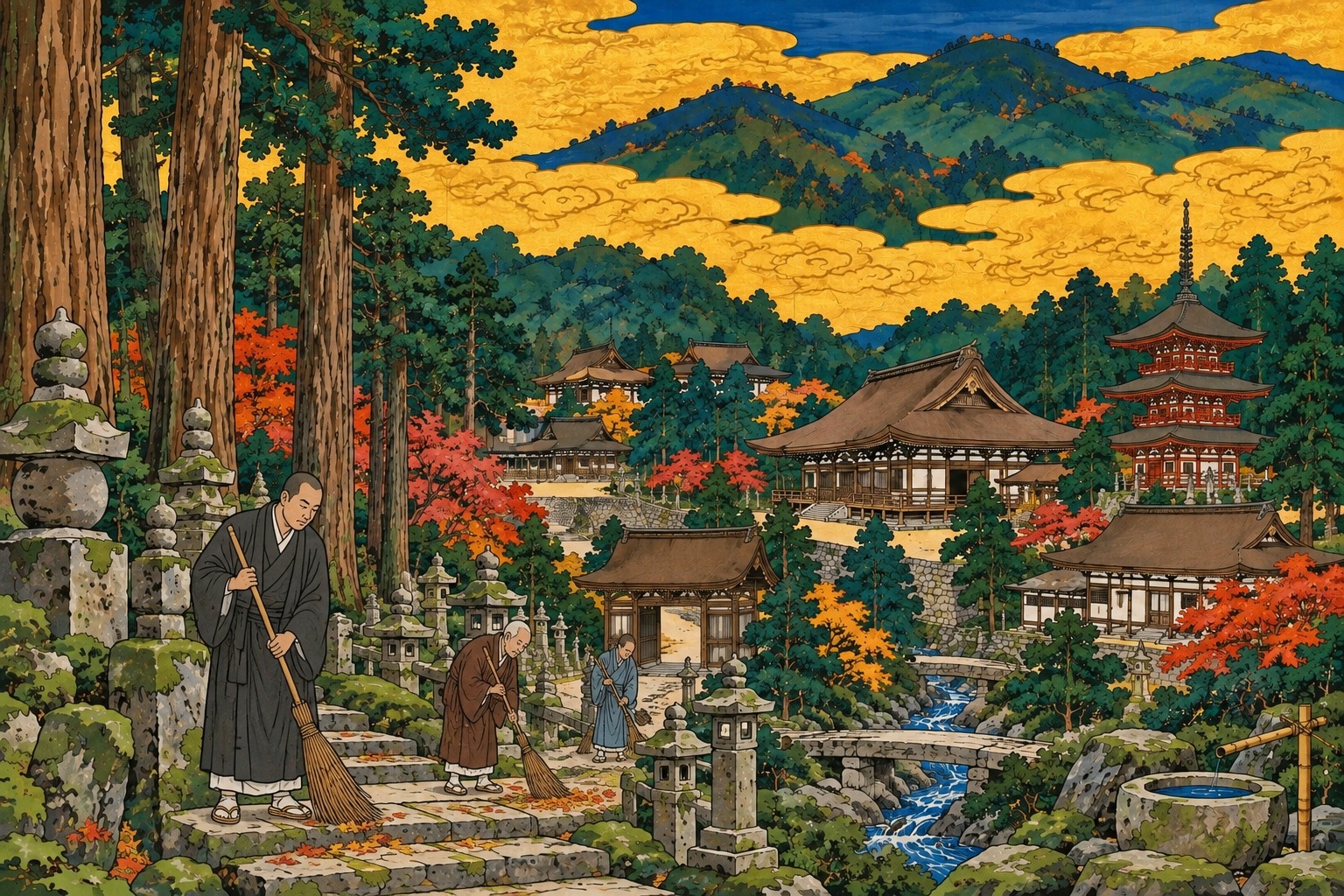
The usual account bars women from the inner precincts, lodging them at the mountain's edge. A temple night costs a reconstructed offering of about 15 to 30 mon (Gear and Prices). Taking the tonsure on Koya changes a man's Standing to Priest (Era Rules, Name and Allegiance, Standing).
At the Table: Mount Koya
Who. The guest-master of a lodge, the retainers of a lord in retirement, monks who drilled with the naginata, pilgrims, lords' messengers. Danger. A retainer of a ruined house who comes to avenge him, a pilgrim who is a spy. Use. A place where a party can wait out the war, a place to find a lord's last orders, a place where a retired lord's retainer can be asked what his master will not write down.
Iga and Koka
Within two days of Kyoto, Iga and Koka's hill country lacked daimyo rule. Until the 1580s, leagues of small warrior-farmer landholders governed from fortified farms, hiring out scouts and soldiers. Iga repelled Oda Nobukatsu in 1579 but fell to Nobunaga in 1581, scattering its families. Hideyoshi removed many Koka families' samurai status in 1585. In AD 1600, Eastern-aligned Tsutsui Sadatsugu holds Iga from Ueno at 95,000 koku; Western raiders attack during his absence. Koka men serve various lords. Nearby Hino and Hachiman's Omi merchants already maintain a road-trading network.
Iga and Koka have headmen, fields and debts, rather than the hidden villages of later tales. A Shinobi (Village League) Origin character (Character Creation and Roles) belongs to one of these communities, with a home village, go-between and reputation for hire.
The Iga and Koka Companies
After guiding Ieyasu home through Iga in 1582, Iga men enter Tokugawa service. By AD 1600, the Hattori command about 200 as Edo castle foot guards, using the usual figure. About 100 Koka men form a company after Fushimi falls in 1600, where their fellows served and died. Both companies guard gates and carry muskets; neither runs an intelligence bureau.
At the Table: Iga and Koka
Who. A headman who keeps the village register, a go-between who knows who hires, farmers who keep a spear and a matchlock, a Tokugawa or Tsutsui recruiter. Danger. A village that answers for what a guest does (Law and Justice, Collective liability). Use. A way to find a Shinobi Agent or an informant, a place to hide, a family at home with debts to pay.
Hakone and Odawara
The former Hojo seat at Odawara lies 83 km from Edo. It surrendered after about 100 siege days on Tensho 18, 7th month, 5th day [AD 4 August 1590]. Okubo Tadachika has held this Tokugawa castle town since 1594. In AD 1600 it is the last major town before Hakone's 846 m pass. The climb consumes a stage, bad weather a day; no barrier stands there.
At the Table: The Pass
Who. Porters, carriers of lords' baggage, pilgrims, a lodging-house keeper who knows the weather, a road band that tolls travelers. Danger. Rain, fog on the pass, a band in the trees. Use. The way into the Kanto from the west, where a party meets Ieyasu's officers, and the first place the road narrows enough to stop a messenger.
Himeji
About 85 km west of Osaka along the San'yodo, Himeji in AD 1600 retains Hideyoshi's smaller castle of 1581 and its three-story keep. Kinoshita Iesada, brother of Hideyoshi's widow, holds it. After Sekigahara, Ikeda Terumasa receives Himeji at 520,000 koku, building the familiar white keep in 1601 to 1609. Leave that later structure out of scenes in the map year.
At the Table: Himeji
Who. Kinoshita's garrison, merchants from Osaka, travelers on the western road. Use. The gate to the western domains; after AD 1601, the place a new lord makes grand.
Ise
Between Ise Bay and the sea stands Amaterasu's Grand Shrine, the foremost shrine of the kami (The Era, Religion). Pilgrims arrive from every province; its priests maintain their own estates and accounts. The road south from Sekigahara leads into Ise, where Furuta Shigekatsu holds Matsusaka for the East in AD 1600. Defeated Western men use it to seek the coast.
At the Table: The Road to Ise
Who. Pilgrims on foot, shrine priests, peddlers selling charms and paper, a lord's messenger in plain dress. Danger. A party in pilgrim dress that cannot say the right prayers; a Western picket looking for fugitives. Use. Pilgrim dress is a disguise that opens roads (Era Rules, Covert Work, Disguise); a pilgrim who keeps the part is seldom stopped.
The Road to Nagasaki
A party that sails from Osaka to Shimonoseki, or walks the San'yodo to it, takes the ferry over the strait, meets the Kyushu road and goes on to Hakata, one of the merchant cities of the west, and from Hakata to Nagasaki. The whole way from Shimonoseki is about 235 km, 6 to 8 days on foot (Roads and Distances). In the autumn of AD 1600 Kyushu has its own war. Kato Kiyomasa, for the Eastern side, takes Konishi Yukinaga's castle at Uto and then joins the siege of Tachibana Muneshige's Yanagawa, and Kuroda Josui (Yoshitaka) raises a private army in the north of the island. A party that goes to Nagasaki in the autumn finds the roads full of messengers and levy men, and a port town that wants to know what the news from the east will mean for the silk trade (Kyoto, Osaka, Sakai, Edo, Nagasaki, Nagasaki).
At the Table: The Road to Nagasaki
Who. Interpreters, Portuguese traders' servants, Christian converts on pilgrimage, silver and silk brokers, soldiers of Kato and Kuroda. Danger. A border post of a lord who has not chosen. Use. A long road for a party that starts in Osaka and ends in Ota Sosuke's home port.
Ueda and the Sanada
Sanada Masayuki built Ueda in 1583 on a terrace above Shinano's Chikuma river. It stands on the Hokkoku road about 9 ri from Oiwake on the Nakasendo; a tenshu in AD 1600 remains unestablished. That autumn, Masayuki and his younger son Sanada Nobushige [Yukimura] defend it with 2,000 to 3,000 men against Hidetada's 38,000, diverted from the Nakasendo. See The Realm in 1600, The Summer of Choosing.

At the Table: Ueda
Who. Sanada retainers, villagers who supplied and then fed an army, Tokugawa scouts, merchants of the Chikuma valley. Danger. A siege where the besiegers are on a road that leads home. Use. A siege-watch session or a messenger run to the castle between Keicho 5, 8.24 and 9.11 [AD 1 to 17 October 1600].
Campaign Tools
Seasons of Play
Play spans Hideyoshi's death in AD 1598 through Ieyasu's appointment as shogun in 1603. Surround the AD 1600 Sekigahara Clock (Era Rules, Name and Allegiance) with an earlier and a later season to cover the five years.
| Season | When | What the Clock does | What a session is about |
|---|---|---|---|
| The Taiko's House | Keicho 3, 8th month [AD September 1598] to the spring of 1600 | Not yet running. Hideyoshi dies on the 18th day of the 8th month [AD 18 September 1598]; the armies come home from Korea by the end of the year; in Keicho 4, 1st and 2nd months, the elders and commissioners accuse Ieyasu and settle it with oaths; Maeda Toshiie dies on Keicho 4, intercalary 3.3 [AD 27 April 1599] and the seven generals move on Mitsunari that night; on the 28th day of the 9th month [AD 15 November 1599] Ieyasu moves into the western citadel of Osaka | Choosing a lord, a school or a town; building Name and a ledger; first errands for a house |
| The Clock | Keicho 5, 4th month to 10th month [AD spring to November 1600] | Steps 0 to 9 | The war: letters, pickets, musters, a siege, the field, the flight |
| The Settlement | Keicho 5, 10th month [AD November 1600] to Keicho 8, 2nd month [AD March 1603] | Step 10, with Attitudes reset | Ronin and fugitives, new lords, the first post stations (1601), new coin struck at Fushimi and Sakai (1601), Nijo castle (1601 to 1603), Ieyasu named shogun at Fushimi on Keicho 8, 2nd month, 12th day [AD 24 March 1603] |
How long. For a short campaign, spend 8 to 13 sessions moving from Clock step 0 or 1 to the settlement at step 10 (Running the Era, Pacing a Sekigahara Campaign). A full campaign takes 30 to 40 sessions across the three seasons, allowing Name and ledgers to develop before war.
The road sets the calendar. Use the travel table to decide when a character can arrive, and work back from the date. To stand at Sekigahara on the 15th of the 9th month, a party in Osaka leaves by the 9th on foot (4 to 5 days, with a margin of one). A party in Edo needs 12 to 14 days on foot to reach Akasaka, so it must leave on the 1st, as Ieyasu does, and lose no day on the road; a rider needs 8 to 10 days and can leave as late as the 4th. A day lost on the road moves the party one stage behind (Tracks and Clocks, Tracks IV).
Three Campaign Shapes
Choose one of these three shapes for a mixed party at the first session; allow it to change.
Under a Lord
As a house's retainers, the party records its lord's calls on a ledger (Era Rules, Name and Allegiance). The lord may be a real daimyo or his retainer, speaking offstage through a steward. The Realm in 1600 establishes his side. Running the Era, Your Lord's War, gives each Clock step's calls, the house's battle position and its aftermath.
- Taiko's House. Errands, audience, a school's bout for the lord's honor, hostages to keep safe at Osaka or Fushimi.
- The Clock. At the step where the house declares, the party is called to march, hold, carry or stay. A character who refuses pays 1 Name (Calling In II), and a character who leaves with his lord's enemies pays 2 Name and is in the field against him (Leaving III).
- The Settlement. If the house is on the winning side, the lord is rewarded and the party is sent to hold a new land. If it is on the losing side, the party are ronin by step 10 (Era Rules, Name and Allegiance, The Sekigahara Clock).
Example. Hirano Heita Masatsugu serves an Eastern house. Nomura Shino, a Western retainer's daughter, is in the party as a guest and a friend. At step 2 their lords are on opposite sides; the party must decide what each owes the other.
Free Agents
Townspeople, priests, ronin, physicians, interpreters and merchants sell their skills, keeping no ledger or at most one. Name and coin bring employment; employers bring the war to them. For pay and contractual obligations, see Gear and Prices, Hirelings and Pay.
- Taiko's House. Work for brokers and houses: a debt collected, a cargo escorted, a letter carried, a teacher found.
- The Clock. Every lord and merchant house wants information. The party can sell to both sides or to one; a side that learns of the other sale is Hostile 2 (Era Rules, Name and Allegiance, Attitude).
- The Settlement. The new regime hires interpreters, bankers and builders. The party chooses between profit and loyalty.
Example. Izumiya Tomi, a merchant, Ota Sosuke [Simao], an interpreter, and Sugiyama Jinbei Tomotaka, a ronin, work for a Sakai broker. When Western pickets close the Tokaido, the broker needs a letter in the east.
A Ronin or Shinobi Band
Ronin, Shinobi Agents, sohei and matchlock hunters can form a hired band without a lord. A go-between finds contracts; an employing lord owes only the agreed pay. Gear and Prices, Hirelings and Pay, sets pay, contract terms and penalties for breach.
- Taiko's House. Small jobs on the road: guard a train, watch a gate, find a runaway.
- The Clock. The war is a market. Each step brings an offer from each side; the band is asked to carry letters, scout pickets, hold a bridge or burn a store. A hire is not an Allegiance: a band that takes the other side's coin breaks its hire contract and pays what that rule sets (Gear and Prices, Hirelings and Pay).
- The Settlement. The defeated seek hiding places; the victors hunt the beaten and need hands that know the country.
Example. Ono Kane, an Iga shinobi, Shinkei, a warrior monk, and a ronin take a contract from a Koka go-between. They scout the Mino roads for the side that hired them and are offered more by the other. After Sekigahara, a village that sheltered them answers for it.
Mixed Parties
Retainers, ronin, monks and townspeople commonly travel together (Running the Era, Mixed Standings), sharing stages before reporting to different houses in town. Unite them for the next three sessions through a destination, enemy, debt or lord. The reason need not bind the whole campaign.
Session Shapes
Choose a shape with a beginning, middle and end when planning a session. Combine no more than two.
| Shape | It opens with | The middle | It ends with | Rules |
|---|---|---|---|---|
| The Road | A letter to deliver or a place to reach by a date | Stages, a ford, a pass, a night at a town, a picket | Arrival, or a letter that arrives late | Travel; Covert Work, Gates |
| The Watch | A man or a gate to watch | Informants, disguises, a Cover at risk, a search | A name learned or a Cover blown | Covert Work |
| The Audience | A summons to a lord, an abbot or a house head | Request, Name, Attitude, a rival in the room, a duty called | A Duty owed, or a door closed | Name and Allegiance |
| The Muster | A call to march, hold or carry | Orders, the column, a siege line or a field, nerve | A place held, lost or left | Battle, Fire and Fear |
| The Bout | A challenge by a school or a master | A public contest before a lord or a crowd; the lesson of a loss | Name gained or lost | Schools and Popularity; Schools of the Sword and Fist |
| The Town Day | A market, a festival or a brawl | A purchase, a rumor, a hearing before a magistrate | Fined, jailed, paid or taken on | Law and Justice; Money and Stakes |
A Night at the Inn
Most nights at a stage's end pass quietly. Choose a result or roll a d6 at the frequency set by How Often to Roll (Rumors, Hooks and Encounters). See Gear and Prices, Keep, Lodging and Travel, for costs.
| d6 | The night at a temple, a tea house or a lodging house |
|---|---|
| 1 to 2 | A quiet night: nothing happens |
| 3 | A guest on the next mat talks in his sleep, and he is carrying a lord's letter |
| 4 | The keeper asks for names and tells the headman; the headman's people are Wary 1 to the party in the morning (Era Rules, Name and Allegiance, Attitude) |
| 5 | A priest, a physician or a traveling entertainer is in the house: a wound treated for a fee or a favor, or the talk of the road for the price of a cup |
| 6 | A lord's retainers fill the house; the party sleeps in the stable or moves on |
Tracks and Clocks
TERMS: TRACKS
I A faction track. Give each of the five factions below a track of six boxes. Mark a box only when the party does one of the things in the row's Fills a box column, at most one box a session on each track. Time alone never fills a box. Erase one box from a track when a season (three months) passes with no new mark on it.
II What a track does. It never moves a date and never changes the field at Sekigahara. At three boxes the faction knows the party by name or reputation; at six it acts on what it knows. Each time, the faction's people become an audience with one marker, the party's own name, at the Attitude the row gives (Era Rules, Name and Allegiance, Attitude). Record each track by name on the GM's sheet.
III East against West. The Eastern and Western tracks cannot both stand above three. Once either holds three boxes, each new box marked on it erases one from the other. A party that works for both sides can be known to both and is relied on by neither.
IV A journey clock. For a deadline, count the stages to the place (Travel Days by Land, the top of the range) and the stages to the date. Each day lost to rain, a flood, a lame horse or a picket moves the party one stage behind. When the stages to the date are fewer than the stages to the place, the party arrives late and the letter, the guest or the hostage is too late.
V A watch clock. For a Cover, use Suspicion (Era Rules, Covert Work, Cover). For a hunt, give the hunters a track of six boxes; mark a box each time the party is seen, is searched, or leaves a trace. At six the hunters are at the door.
| Faction | Fills a box | At three | At six |
|---|---|---|---|
| The Eastern combination (Ieyasu's officers and lords) | The party carries an Eastern letter; passes a picket by Eastern papers; does a task for an Eastern lord | Eastern officers: Welcome 1 | Eastern officers: Welcome 2, and they rely on the party for a task. Western officers: Hostile 2 |
| The Western combination (Mitsunari's, Otani's and the Mori's men) | The same on the Western side | Western officers: Welcome 1 | Western officers: Welcome 2, and they rely on the party for a task. Eastern officers: Hostile 2 |
| The temples and the court | A pilgrim is helped; a rite is kept; a temple's letter is carried | Temples and court nobles: Welcome 1; an abbot or a noble will act as sponsor (Attitude IV) | Temples and court nobles: Welcome 2. A temple shelters the party, or the court sends an envoy on its behalf (the model is the imperial order that ends the siege of Tanabe on the 12th of the 9th month) |
| The merchant towns | A debt is paid; a cargo guarded; a broker is used | The merchant houses of Sakai, Osaka and Kyoto: Welcome 1; a house will lend (Era Rules, Money and Stakes, Debt) | The merchant houses: Welcome 2. One house treats the party as its own and calls on it at the worst time; that house's competitor is Hostile 2 |
| The hill leagues and villages | A village is fed or paid; a guide is hired; a runaway is hidden | Villagers of that district: Welcome 1; a headman gives bed, rice and silence | Villagers of that district: Welcome 2. A village that shelters the party answers for it (Law and Justice, Collective liability) |
Rumors, Hooks and Encounters
Choose from a table or roll a d6. Follow any rule cited for a check. Each entry offers an actionable true or false report from AD 1600; none includes monsters.
TERMS: HOW OFTEN TO ROLL
I A journey played day by day. On a journey of four stages or fewer where each day is a scene, roll once a stage on A Night at the Inn and once a stage on What the Road Does. The Starter Adventure's road is run this way.
II A long road. On a longer journey roll once every third stage on each of those two tables and let the other days pass as the travel table counts them. A Tokaido walk of 12 to 15 days is four or five rolls on each.
III Encounters. Roll for an encounter once for each leg of the travel table that runs through country that is not the party's own, and not more than once every third stage. Roll a d6 first: on 1 to 3 the road carries its ordinary traffic and nothing happens; on 4 to 6 roll on Encounters on the Road or choose.
IV Half stages. Two half stages lost are a day lost; a half stage gained cancels a half stage lost. Over a long road the gains and losses of What the Road Does come to less than a day, so the travel table stands.
Rumors
| d6 | The Taiko's House (AD 1598 to the spring of 1600): it is said that... | ...and the truth is |
|---|---|---|
| 1 | The Taiko is dead and the armies in Korea have not been told | true: the death is kept from them, and the elders order the withdrawal |
| 2 | The Elders have broken the Taiko's rule on marriages | true: Ieyasu's ties with the Date, Fukushima and Hachisuka are the charge; oaths settle it |
| 3 | Seven generals mean to kill Ishida Mitsunari | true: on the night of Toshiie's death they move, and Mitsunari escapes to Fushimi |
| 4 | A plot to kill Ieyasu was found on the road to Osaka | reported; it was used to remove men from power; whether it existed is debated |
| 5 | A foreign ship lies in a Kyushu bay and her crew are neither Portuguese nor Spanish | true: the Dutch ship Liefde reaches Bungo in April 1600 |
| 6 | The lord of Aizu builds castles and roads and recruits men | true: Uesugi Kagekatsu is summoned to Kyoto and refuses |
| d6 | The Clock, steps 1 to 8 (summer and autumn of AD 1600): it is said that... | ...and the truth is |
|---|---|---|
| 1 | Ieyasu has marched east and left Fushimi to old Torii | true: with about 1,800 men |
| 2 | The Western side will take the daimyo wives as hostages | true at Osaka; it ends when Hosokawa Gracia dies rather than be taken |
| 3 | The Mori lord leads the Western army | true in name; he stays in Osaka castle and never takes the field |
| 4 | Kobayakawa will change sides | true; the Western side half suspects it |
| 5 | Gifu will hold all winter | false: it falls in a day |
| 6 | Hidetada will reach his father in time | false: Sanada Masayuki holds him at Ueda, and he arrives five days after the battle |
| d6 | After the field, steps 9 and 10 (AD late October 1600 to 1603): it is said that... | ...and the truth is |
|---|---|---|
| 1 | Ieyasu will spare the Western commanders | false: Mitsunari, Konishi and Ankokuji are beheaded at Rokujo on the 1st of the 10th month [AD 6 November 1600] |
| 2 | The Mori will keep their lands | false: they are cut from eight provinces to two |
| 3 | Every Western retainer will be hunted | half true: the houses are attainted, and a village that shelters a fugitive answers for it |
| 4 | Mitsunari hides in the mountains | true until the 21st of the 9th month [AD 27 October], when he is found at Furuhashi |
| 5 | New gold and silver coin is coming | true in 1601, struck at Fushimi and Sakai |
| 6 | Ieyasu will be shogun | true on the 12th day of the 2nd month, Keicho 8 [AD 24 March 1603] |
Hooks
Choose or roll a d6 for each column, then combine the three results. Apply the rules cited in Session Shapes.
| d6 | Who asks | What they want | What goes wrong |
|---|---|---|---|
| 1 | A lord's steward | A letter carried across a picket to a house on the other side | The road is closed by a flood or a picket |
| 2 | An abbot's guest-master | A man or a woman escorted to a castle, a temple or a port | The letter or seal is a forgery |
| 3 | A broker of Sakai or Osaka | A man found who left no name | Someone else carries the same errand for the other side |
| 4 | A village headman | A debt collected or a hostage's keep paid | The client lies about whom he serves |
| 5 | A magistrate's clerk | A teacher found, or a bout answered for a school | A Duty on one of the party comes due that week |
| 6 | A retainer's wife | Prayers said and a dead man's name kept | The reward is rice or land, not coin |
Encounters on the Road
Choose an encounter or roll at the frequency in How Often to Roll III. Establish whom the party meets, their demands and what they offer. Use Adversaries for stat blocks and Covert Work's Gates check at posts or pickets.
| d6 | On a lowland road | On a mountain road | At sea or on a river | In a town |
|---|---|---|---|---|
| 1 | A lord's baggage train with bearers and a few riders; they want the road clear and ask whose man each traveler is | Charcoal burners and timber cutters with logs for the river | A coaster's master short of hands, hiring deckhands for the leg | A gate shut at night; the keeper wants papers, or a Gates check that 2 Exodus will help (Era Rules, Money and Stakes, Bribes) |
| 2 | Peddlers and pilgrims bound for Ise or a temple | A pack-horse train of salt or rice stopped at a washed-out bridge | A sea lord's war boat stops the ship to see its papers | A market day with a wrestling match and a purse on it |
| 3 | A border post checks goods and runaways | Mountain ascetics on the path; they want alms and give news | A rising wind: the ferryman will not cross and the coasters stay in port for a day, or two in a storm | The watch carries off two brawlers; both will be punished |
| 4 | Masterless men camp at a shrine, six or so; they want food, work or a message sent | A band tolls the path for cloth or coin | A fishing village headman who wants a stranger's name before he gives water | A fire in a street of thatch; the watch needs every hand |
| 5 | Farmers wait at a ford for the water to fall; porters offer to carry for a price | A column of troops marches down the path; its officer asks questions | A rice barge on the Yodo with a lord's tribute, a clerk and guards | A recruiting officer for a lord's company, offering rations |
| 6 | A Jesuit father with an interpreter and two servants, bound for Kyoto | A hunter with a matchlock who knows the passes and wants work as a guide | In a Kyushu bay, a Chinese trading junk sheltering from weather, its master trading quietly; elsewhere, a salt barge with room for passengers | A physician who treats for a fee and talks too much |
What the Road Does
In addition to encounters, choose or roll a d6 at the frequency in How Often to Roll. Apply Era Rules, Travel, Obstacles. Treat a result requiring an absent pass, ford or horse as result 1 to 3.
| d6 | What the road does |
|---|---|
| 1 to 3 | The road is as expected: nothing happens |
| 4 | Rain. On a mountain road or a pass: a Hard Savvy + Survival check or the stage is lost. At a ford: the river is in flood; cross on a Hard check with a Crisis Die, or wait 1 to 3 days for the water to fall. On an open lowland road: mud, and half a stage lost |
| 5 | A horse goes lame, or a lord's procession takes the road: half a stage lost |
| 6 | A fair day and a firm road: the party gains half a stage |