
The Black Powder Armory · Chapter 2
Reading an Entry
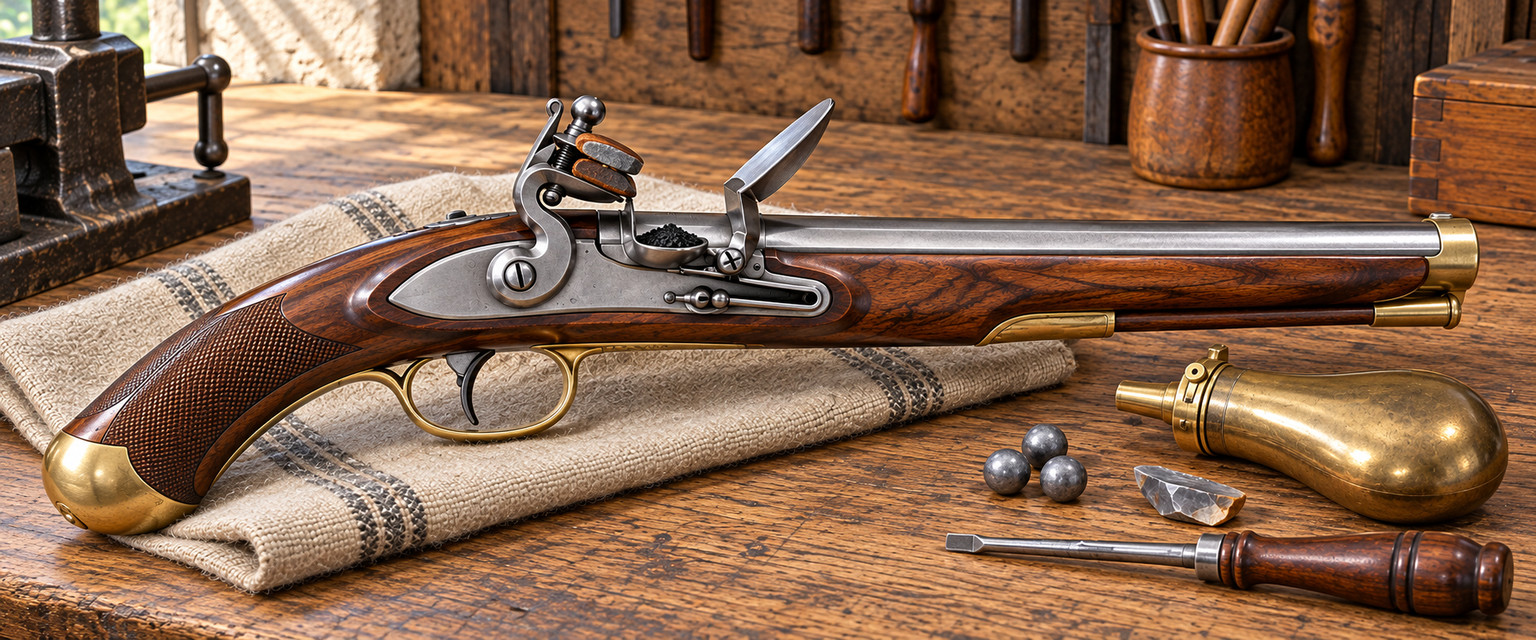
Belt Pistol
Holster pistol, officer's pistol, trade pistol
6 4 Short 1
Light Ranged 200 Common Ballistic Prepare 2, Unreliable, Concealable 1
The Fields
Damage is a flat number for anything fired or thrown. Add 1 for each uncancelled Success, then subtract the target's Resistance. Hand weapons print a bonus (+2) added to the wielder's Might.
Crit is the number of net Boons spent to inflict a Critical Injury. A dash means the weapon cannot inflict one.
Range is the farthest band at which the weapon attacks. Placed means it is set in position and fired later.
Enc is Encumbrance. A dash means the weapon is mounted and is not carried.
Skill is Light Ranged, Heavy Ranged, Gunnery, or Melee. At a table using the core rules' single Ranged skill, use Ranged for the first three.
Type is the damage type. Every firearm is Ballistic. Chapter 11 says what armour does about it.
Qualities are defined in Chapter 3.
One Shot, Then Reload
A muzzle-loading firearm holds one charge. It is carried loaded. After it fires, it is empty until it is reloaded.
Prepare X is the reload: the wielder spends X maneuvers, and the gun is loaded again. The maneuvers need not be in one turn. A character has one free maneuver a turn and may take a second for 2 Strain.
| Lock | In use | Reload | Weakness |
|---|---|---|---|
| Hand-held match | 1400 on | Prepare 4 | Slow Match, Unreliable, Inaccurate |
| Matchlock | 1400 to 1700 | Prepare 3 | Slow Match, Unreliable |
| Wheellock | 1500 to 1650 | Prepare 3 | Price |
| Flintlock | 1650 to 1840 | Prepare 2 | Unreliable |
| Flintlock rifle | 1700 to 1840 | Prepare 3 | Unreliable |
| Percussion cap | 1820 to 1870 | Prepare 2 | None |
| Breechloader | 1850 to 1890 | Prepare 1 | None |
| Revolver, repeater | 1836 on | Fires six, or runs dry | See its entry |
A flintlock musketeer who spends both maneuvers reloading, at a cost of 2 Strain, fires every turn. A matchlock musketeer fires every second turn at best. That difference won battles.
Loading Aids
| Item | Effect | Price |
|---|---|---|
| Bandolier of charges | Twelve wooden flasks, each one measured charge. A matchlock or wheellock's Prepare is 1 lower. Twelve reloads | 20 |
| Paper cartridges | Powder and ball in a paper tube, twenty to a box. A smoothbore flintlock, a percussion muzzle-loader, or a Rifle-Musket has Prepare 1 lower, to a minimum of 1. No effect on the Long Rifle | 15 |
| Spare cylinder | A loaded cylinder for a Cap-and-Ball or Dragoon Revolver. Swapping it takes two maneuvers | 60 |
| Powder horn and shot bag | What everyone else uses. Thirty reloads | 10 |
A Brace of Pistols
Drawing a loaded pistol is a maneuver. From a sash, a baldric, or a ribbon round the neck, the first draw each turn is free.
Dropping a fired pistol is free. A pistol on a ribbon or lanyard is not lost.
Loaded pistols count their full Encumbrance. Six of them is a real weight.
Misfires, Rain, and Damp
Unreliable. If an attack with an Unreliable weapon generates 2 or more Bane or a Calamity, it misfires: the priming flashes, or the match has gone out. The weapon is still loaded. It cannot be fired until an action is spent clearing and re-priming it.
Slow Match. The weapon fires only while its match is burning. Lighting a match is a maneuver with a flame to hand, and an action with flint and steel. A lit match is visible at night out to Long range and adds 2 Bane Dice to its carrier's Stealth checks.
| Conditions | Matchlock | Flintlock, wheellock | Percussion, cartridge |
|---|---|---|---|
| Wind or spray | Add 1 Bane Die | Add 1 Bane Die | No effect |
| Rain | Cannot fire | Add 2 Bane Dice | No effect |
| Soaked or submerged | Charge ruined; reload | Charge ruined; reload | Cap-and-ball: charge ruined. Cartridges: no effect |
Bane Dice from weather count toward a misfire like any others.
Smoke and Noise
Every shot gives away the shooter. Black powder makes a white cloud and a flat boom. No check is needed to know where a shot came from, by day or night.
Smoke builds. In still air, below decks, or in a room, after three or more black powder shots in the same place in one round, add 1 Bane Die to ranged attacks into, out of, or through it until the end of the next round. A swivel gun or a grenado counts as three shots.
The smokeless weapons of Chapter 12 make no cloud.
Price, Money, and Availability
Price is in the same units as the other armories. It is not a price in period money. As a rough guide:
| Setting | Divide prices by | To get |
|---|---|---|
| 1650 to 1800, the Atlantic world | 50 | Spanish dollars (pieces of eight) |
| 1650 to 1800, Britain | 200 | Pounds sterling |
| 1850 to 1900, the United States | 20 | US dollars |
A Universe with its own coinage picks one divisor and applies it to the whole book.
| Tag | Meaning |
|---|---|
| Common | Sold to anyone with the money, in any port or market town |
| Restricted | A gentleman's or an officer's weapon; a commoner carrying one is asked questions |
| Military | Made for a crown, a company, or a navy. Bought from a quartermaster, a prize court, or a thief |
| Rare | Made by a few craftsmen, or newly invented |
Period
Every entry is marked with the first period in which it is found: 1400 (1400 to 1650), 1650 (1650 to 1840), or 1840 (1840 to 1938). Old weapons stay in use. A matchlock is still a militia gun in 1700, and a flintlock is still a trade gun in 1870, at half the listed price.