Crown Meridian Ship Catalog · Chapter 3
The Crown Look
A Crown ship looks as though it expects to be inspected. Spacers read the maker from the silhouette before the transponder resolves.
Materials and Marks
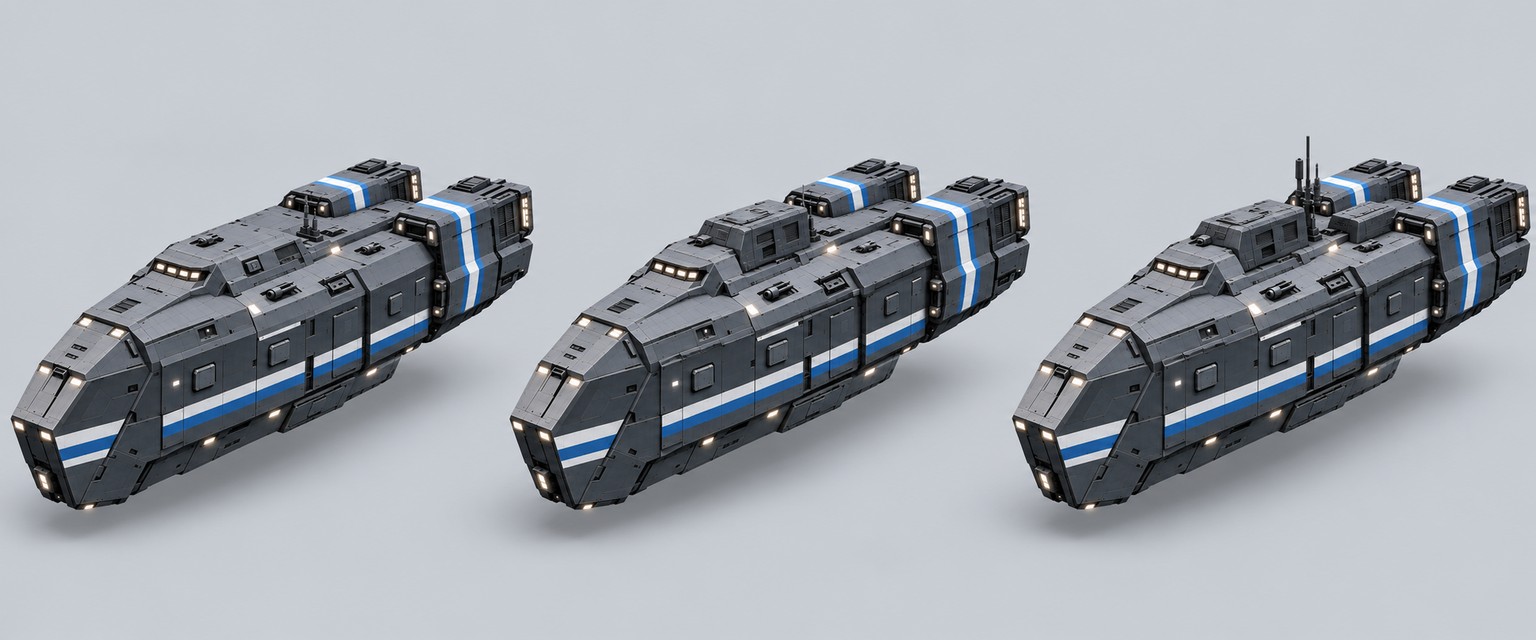
Plating. Graphite-gray and dark gunmetal, in large slab panels with clean, even seams.
Registry bands. Muted blue-white bands cross the hull at set intervals. They are plain colored bands. A Crown yard marks a ship's registry on a plate, not in the paint.
Inspection blocks. Rectangular panels at regular intervals let an inspector open a compartment without cutting the hull. Every Crown ship has them.
Hatches and panels. Access hatches are labeled in the maker's own marking system and sit where the manual says they do. Service panels are blocky and easy to reach.
Bridges and sensors. Bridges are recessed behind small windows. Sensors and weapons sit behind protective covers instead of hanging off the hull.
Lights. Plain white work lights, evenly spaced. Crown does not decorate.
Interiors. Corridors are straight and labeled. Emergency markings are obvious. Crew quarters are not luxurious, but the lights work, the air recyclers are easy to reach and the maintenance manuals are accurate.
The Three Hull Styles
Armored Brick-Keel. A compact deep keel under a wedge-shaped armored prow, slab-sided sealed compartments, a broad squared forward armor block and short squared engine housings. Used for Crown's small hulls: the boarding craft, armored shuttle and armored cutter.
Hammerhead Bulkframe. A long narrow bulkframe with a broad armored block across the bow. Weapon housings are protected, and the engines sit in a squared block at the stern. Used for the escort corvette and the industrial vessel.
Vaultship Geometry. Sealed vault-like bays, clear rectangular compartment segmentation, a stepped superstructure and a reinforced command tower. Used for the vault courier, institutional frigate and convoy carrier.
Telling a Generation by Sight
A generation changes the numbers, and the hull shows it. A spacer who knows the line can read a ship's letter from a distance.
| Line | Generation | What shows |
|---|---|---|
| CM-120 | A | A small sensor-and-equipment housing on top behind the docking collar; thicker nose armor |
| CM-260 | A | A second equipment housing on each flank below the cabin windows |
| CM-440 | A | A squared module housing on top behind the bridge; a thicker chine along each flank |
| CM-440 | B | A second mount cover on the top line; a taller sensor mast |
| CM-380 | A | A pair of flat radiator fins folded along the spine |
| CM-540 | A | A shield-emitter dome in the prow; one more module hatch |
| CM-540 | B | A ring emitter at the stern; two flat radiator panels on top |
| CM-590 | A | An extra clamp-and-gantry module on the spine; a squared housing by the engines |
| CM-640 | A | A longer hangar with a second pair of doors; a shallower keel under it |
| CM-720 | A | Another module block on the top deck; thicker radiator fins; a deeper hull |