Use the Exodus NDS Core Rules and cited sourcebooks unless an Era Rule states otherwise. Entries that change existing rules are labelled Modifies or Replaces, with the owning book and heading. In Black Flag, an Era Rule overrides the Core Rules and sourcebooks it names. Sail Combat is covered separately.
| Rule | Kind | Type |
|---|---|---|
| Crew and Articles | Signature subsystem | Adds |
| The Prize and Fence Loop | Signature subsystem | Adds |
| Infamy and Pardons | Part of the Loop | Adds |
| Scurvy and Fever | Short rule | Adds; Replaces Fortitude for illness |
| Law at Sea and Ashore | Short rule | Adds |
| Prejudice | Short rule | Adds |
| Marooning | Short rule | Adds |
| Careening and Repair | Short rule | Adds |
| Money and Credit | Short rule | Adds |
Find period prices in Gear and Prices. The Quartermaster's Ledger below converts pieces of eight to sterling.
Crew and Articles
Adds. Procedures for a pirate Company to write articles, vote, divide shares and remove its captain.
TERMS: THE COMPANY
I Each crew forms a Company. Its Size counts hands; it also has Quality and a Morale rating from 0 to 6. Player characters belong to the crew alongside NPC hands. Use the highest Infamy held by its Captain or officers for the Company (Infamy).
II Quality sets the pool the whole Company rolls when it acts as one, in a Boarding (Sail Combat) or in any check of the Company's as a body that the GM calls (a muster, a stand against a rush): Green 2 Mastery Dice ; Seasoned 3 Mastery Dice; Veteran 3 Mastery Dice and 1 Boon Die .
III Morale begins at 3. Increase it by 1 after taking a prize without loss, paying full shares, winning against the odds or keeping a costly article. Each prize or fight can change Morale by at most 1 in either direction; capture and share payment count as one event. Reduce it by 1 after a hard loss, withheld share, broken article, unvoted punishment or three-week dry cruise. At 0 the Company breaks: it mutinies or removes its captain at sea, or deserts in port.
TERMS: THE ARTICLES
I Write the Company's articles when a voyage begins or a new captain takes command. Choose from the table below. Each choice binds the Company until changed by its vote.
| Article | The choices |
|---|---|
| The Vote | Every hand has a vote in matters of moment, or only the officers and the ship's mess do |
| The Shares | The standard table (below), or a flatter one the Company votes |
| Injury pay | The standard scale (below), or the Company's own |
| Quarter | Quarter is given when called for, or it is given at the Company's choice, or never |
| Discipline | The Quartermaster's court judges and punishes; or the Company judges every serious charge |
| Drink and lights | Lights out at eight and drinking on deck, or no rule at all |
| Women and boys aboard | Not allowed, or allowed by the Company's vote |
II An article breach costs 1 Morale, or 2 if committed openly or against an article protecting hands from officers, such as shares, injury pay or quarter.
TERMS: CAPTAIN AND QUARTERMASTER
I In chase and battle, the Captain has absolute command; otherwise command depends on the Company's majority. The Quartermaster controls shares, discipline and the first boarding of prizes, reserving needed goods, settling minor quarrels and punishing minor offenses.
II Resolve disagreement between Captain and Quartermaster by each officer making a Leadership check (an Authority check). The Company obeys whoever rolls more net Successes. Ties favour the Captain during chase or battle, the Quartermaster otherwise.
III Refusing to board a prize, or issuing an order the Company considers cowardly, calls the Captain to account (No Confidence).
TERMS: THE VOTE
I Call a Vote for decisions affecting the Company: cruising grounds, attacks, pardons or prisoners' fates.
II The proposer rolls Leadership or Charm. Set Average for profit at ordinary trade risk, Hard for high risk or little gain, and Severe for breaking an article. Add 1 Boon Die at Morale 4 or 5, 2 at Morale 6, or a Bane Die at Morale 1. A Company at Morale 0 has broken and cannot Vote.
III Success carries the Vote. Failure defeats it; the proposer cannot submit it again until circumstances change. Two Boons gain 1 Morale through persuasive reasoning; Two Banes lose 1.
TERMS: NO CONFIDENCE
I Open No Confidence after the same officer loses two consecutive Votes, an article is broken, or an officer refuses to fight. The Company decides whether the officer retains the position.
II The officer makes a Leadership check against a difficulty set by Morale: Easy at 6; Average at 4 or 5; Hard at 2 or 3; Severe at 1. At Morale 0 the Company has already broken and no vote is taken. On a success the officer keeps the place and the Company gains 1 Morale. On a failure the officer is deposed and the Company elects a successor (the next Vote); a deposed Captain keeps a hand's share and any share that the articles give for service done.
III Deposed player characters remain members unless the Company votes to leave the officer ashore or marooned (Marooning).
TERMS: SHARES AND INJURY PAY
The standard share table. Before dividing a prize, the Quartermaster reserves the Company's requirements, including stores, powder and the surgeon's chest. Count one share per hand, then add the table's extras.
| Hand | Shares |
|---|---|
| Captain, Quartermaster | 2 |
| Master, Boatswain, Gunner | 1.5 |
| Surgeon, Carpenter, Mate, other officers | 1.25 |
| Every other hand | 1 |
| A boy | 0.5 |
The standard injury scale (Phillips's articles, 1723). Pay injuries sustained in Company service from public stock before dividing shares: a limb 800 pieces of eight; a joint 400, with lesser injuries paid proportionately. If funds are insufficient, the Company owes the balance and may vote the injured hand a share until payment clears it.
EXAMPLE: THE VOTE ON THE MARIGOLD
Kinsella commands seventy Seasoned hands at Morale 4. Before departing Nassau she proposes attacking the Marigold, a merchant brigantine sighted off Eleuthera. Rumour places a naval sixth rate to the north. Her Quartermaster, formerly a merchant mate, favours waiting a week. Kinsella herself follows the Quartermaster's trade but was elected captain.
The attack offers profit at the trade's ordinary risk, so the GM sets an Average Vote. With Charisma 3 and Leadership 2, Kinsella rolls 2 Mastery Dice and 1 Ability Die , adding 1 Boon Die for Morale 4. She obtains 2 net Successes. The Vote passes; the Quartermaster accepts the decision.
Three days afterwards the crew captures Marigold without deaths and receives full shares. The GM increases Morale to 5.
The Prize and Fence Loop
Adds. Seven recurring steps structure a pirate's year. Each uses the Core Rules and procedures elsewhere in this chapter.
TERMS: THE SEVEN STEPS
I Intelligence. Word of a ship comes from prisoners, ports and friends. A Streetwise or Negotiation check in a port, or a Charm or Intimidation check on a prisoner, is Average. On a success the GM names a ship and its Prize class in general terms; Two Boons give the cargo.
II Chase. Sail Combat, Sighting and Chase.
III Boarding and Quarter. Sail Combat, Boarding and Quarter. The Quartermaster goes aboard first and sets aside the goods the Company wants.
IV Appraisal. Determine cargo value with an Average Craft (appraising) or Negotiation check. Failure leaves the class unidentified. Two Banes reveal spoilage, water damage or counterfeit goods, lowering the class one step.
V Fence. Sell goods with Streetwise or Negotiation: Average in pirate ports, Hard elsewhere. The fence rate begins at 25 in 100 of cargo value. Add 10 in 100 per net Success, to a maximum of 60. Divide coin and plate at face value without fencing. Court-condemned goods (Law at Sea and Ashore) sell without a check at 50 in 100; court fees leave 45 in 100 net.
VI Spending. Pay shares in pieces of eight. A hand ashore spends 1 piece daily for lodging and drink, or 3 daily in total during a Spree. Tavern keepers extend credit to share-holders up to one share's value. Creditors may call debts; Jamaica permits selling a man for debt.
VII The Base and the Navy. A port that takes the Company's goods, gives it water and asks nothing is a Base. A Base is also a risk, for the navy follows Infamy.
TERMS: PRIZE CLASSES

Classify prizes as Poor, Fair, Rich or Great. The class measures ship and cargo value before fencing.
| Class | Value, pieces of eight (sterling) | Example |
|---|---|---|
| Poor | 1,000 (£225) | A coasting sloop of salt, tobacco or hides |
| Fair | 4,000 (£900) | A merchant brigantine of sugar, rum or wine |
| Rich | 12,000 (£2,700) | A merchantman with trade goods, or a plate-fleet straggler |
| Great | 40,000 (£9,000) | A ship carrying silver or indigo |
Divide a Fair prize across 70 shares at a fence rate of 40 in 100 to pay 23 pieces per share, about four months' naval able-seaman wages. Under the same terms, Rich pays 69 per share and Great about 229.
TERMS: PEOPLE HELD ABOARD
I Captured vessels may carry enslaved men, women and children for sale. Captives have no stat, prize class or price; a Stake cannot buy them. Before sorting goods, the Quartermaster reports their presence and the Company votes (The Vote).
II The Company's choices, each a scene:
- Set them ashore at the next landing, with water and food. The Company loses their share of the cargo's value.
- Offer them a place as hands. Each person chooses. A hand who joins takes a share after a month, by a Vote.
- Return the ship to its master with the people aboard.
- Sell them. The Company's articles decide whether this is allowed; a Company whose articles forbid it breaks an article (Era Rules, The Articles).
III Treat those held aboard as people rather than cargo. Voice at least one with a name, tongue, skill and aim, and let the table hear that person before the Vote.
TERMS: INFAMY
I Infamy, rated 0 to 5, measures recognition of a character's deeds. For a Company, use the highest rating among its Captain and officers.
| Infamy | Reach | Who knows the Name |
|---|---|---|
| 0 | None | Nobody |
| 1 | A port | One harbour town and its ships |
| 2 | A colony | A colony's governor, its courts and merchants |
| 3 | A sea | The Caribbean or the Guinea coast, the navy's station ships and the colonial press |
| 4 | The Atlantic | Every port with a newspaper, and the Admiralty |
| 5 | The Empire | London, the Crown and the whole Navy |
II Earning Infamy. The GM adds 1 Infamy (at most once a session, unless a player spends a Fortune Point or the GM a Peril Point for a second) when the Company takes a prize with a flag or a name, sinks or burns a ship, escapes from the gallows, wins a famous fight, or is named in a proclamation or the press.
III Within its Reach, an audience that knows the Name treats it as a marker (Prejudice). At Infamy 1 or 2 the Attitude is Welcome 1 or Wary 1; at Infamy 3 or more it is Welcome 2 or Hostile 2. The audience decides which: a pirate port is Welcome, a governor Hostile.
IV Losing Infamy. Reduce Infamy by 1 after a season (three months) without news of the character. Leaving its Reach, changing ship and name, or using Lie Low shortens that interval.
V The Navy. At Infamy 3 or more, whether personal or the Company's highest rating, the GM may spend a Peril Point to start a warship in pursuit. Whitcombe's sixth rate, another station ship or a guardacosta can follow, using that Infamy as its warrant.
TERMS: REWARDS AND THE PARDON
I Rewards. The proclamation of 5 September 1717 set a Crown reward for pirates taken on or after 6 September 1718, when the pardon window closed. The reward is by rank: a commander of a ship 100 pounds (about 444 pieces); a lieutenant, master, boatswain, carpenter or gunner 40 (178); an inferior officer 30 (133); a private man 20 (89); a hand who delivers up his own commander 200 (889).
II The King's Pardon. From 5 September 1717 until 5 September 1718 a pirate who surrendered to a governor or a Secretary of State was pardoned for piracies committed before 5 January 1718. A governor may offer a local pardon at any other date, as a bargain.
III Taking the pardon. First the Company votes (Crew and Articles). Negotiate with the governor using a Negotiation check, Average within the pardon window and Hard outside. Success reduces the character's Infamy to 0 for acts preceding the pardon.
IV A turned pardon. Taking a prize, killing for plunder or sailing with a Company that does either turns a pardoned character. Restore the former Infamy and add 1, to a maximum of 5. No further pardon is available.
EXAMPLE: THE PROVIDENCE'S CARGO
Salazar captures the Providence, a Bristol merchant brigantine carrying rum, linen and sugar. On Nassau's beach Cuffee appraises the goods with an Average Craft (appraising) check. His 1 net Success identifies Fair cargo worth 4,000 pieces of eight.
Calloway arranges the sale. Salazar rolls Negotiation at Average, the pirate-port difficulty. His 2 net Successes set the fence rate at 25 + 20 = 45 in 100, and Calloway pays 1,800 pieces. Sixty hands account for 64 shares after officers' extras. The Quartermaster reserves 120 pieces for stores and powder, leaving 1,680: 26 pieces and a quarter per share. Cuffee's 1.25 shares pay 33; Salazar's 2 pay 53, both rounded up.
At 3 pieces daily, Cuffee's player spends his share on an eleven-day Spree.
Scurvy and Fever

Adds. The Core Rules have no disease rule, and The Apothecary leaves disease to the book that needs it. Replaces the Fortitude skill (Core Rules, Skills and Talents, Fortitude) for resisting illness: the check below is a Willpower characteristic check.
TERMS: THE ILLNESS CLOCK
I Scurvy begins when a Company has been a month without fresh food (fruit, greens, fresh meat). For each further week the GM may start it on a hand at Mild, and on a hand who is already ill at Serious. Fever (the yellow fever of the ports, called the bleeding fever in these years, with ague and the flux) begins in a swamp port or a hot season: a Calamity on any check, or the GM's word that a night ashore at a low port in summer is an exposure.
II Each illness has a Severity, which sets the difficulty of the daily Willpower check, the Strain of a failure, the most Bane Dice it can pile on, and its Course.
| Severity | Willpower check | Strain on a failure | Bane Dice, at most | Course |
|---|---|---|---|---|
| Mild | Easy | 2 | 1 | 4 checks |
| Serious | Average | 4 | 2 | 7 checks |
| Grave | Hard | 6 | 3 | 10 checks |
III Once a day, at the start of the day, the ill character makes a Willpower check against the Severity, with Willpower alone and no skill. On a success mark one success; at two successes the illness ends. On a failure the character suffers the Strain and gains 1 Bane Die on all checks until the illness ends, up to the limit. A Breakthrough marks both successes. A Calamity also costs Strain equal to half the Strain the character has left. When the Course runs out the illness ends. Strain from the illness does not recover while the illness lasts, by rest, by Catch Breath or at the end of an encounter; it recovers as normal once the illness ends. Conditioned and Hardened (poison/disease) apply to this check as they would to a Fortitude check.
IV Only a Grave illness can kill. It reaches its crisis when the character is incapacitated by Strain: the first failed check after that inflicts a Critical Injury in place of Strain. A Grave illness inflicts one Critical Injury at most.
V Care. Once a day a caregiver makes a Medicine check: Average with clean water, rest and basic supplies, Hard without. Each net Success adds 1 Boon Die to the patient's next check, at most 3 from Care and Jesuit's bark together. For scurvy fresh fruit or greens added to the diet end it in three days regardless of the dice. Jesuit's bark adds 2 Boon Dice against ague (counted in that 3).
Law at Sea and Ashore

Adds. Authority and trial procedure. Port chapters describe local practice.
TERMS: AUTHORITY
| Who | Acts where | May do |
|---|---|---|
| A governor | His colony and its waters | Issue a commission, offer a local pardon, hold a court, call out the militia |
| A Vice-Admiralty court | A colony or a station | Condemn a prize |
| A court of Admiralty by commission | Where the commission names (at least seven commissioners; Piracy Act of 1698) | Try pirates |
| A naval captain | The sea and any port | Stop, search and take a vessel; hold prisoners until a court sits |
| A privateer (with a commission) | At sea against the named enemy | Take prizes, which a court must condemn |
| A pirate (without one) | Nowhere; the Company's articles are its law | Takes what the Company can hold |
Commission and prize. A letter of marque names an enemy of the Crown. The holder posts a bond with the court against misuse. The bond is this book's rule: 1,000 pieces of eight (£225), the value of a Poor prize, forfeit if a prize is taken from a friendly flag and returned when the commission lapses. A prize taken under it is lawful only when a Vice-Admiralty court condemns it, after which it is sold and divided; the court's agent takes a fee of 5 in 100 of the prize's value, a tenth of the sale, so the Company nets 45 in 100. The Cruisers and Convoys Act of 1708 gave the whole of a prize to its captors and set the prize agent's fee at 5 in 100 abroad; it lapsed in 1714 and later Acts repeated its terms. The table uses the 5 in 100 fee for every condemnation in the play range. A prize taken without a commission, or from a friendly power, is piracy.
TERMS: THE TRIAL
I Piracy is tried overseas by a court of Admiralty sitting by commission, of at least seven commissioners (merchants, factors, planters, naval officers). The court has a Disposition: Friendly (a governor who profits from the pirates), Fair or Hostile (a navy court after a fresh raid).
II Roll Lore (Law) or Charm for the defendant: Average before a Friendly court, Hard before Fair, Severe before Hostile. Start the sentence at hanged. Each net Success advances one step towards acquittal on hanged in chains; hanged; seven years' servitude; acquitted. Failure or a Calamity sets it to hanged in chains. Courts reject claims of coercion from defendants who signed articles and shared plunder.
III A hanged pirate hangs within the flood marks and is then taken down and hung in chains on a gibbet at the harbour mouth. A woman who proves she is with child is remanded for a jury of matrons.
Prejudice

Adds. Apply Prejudice to social situations, audiences and institutions equally across groups. It is never a character-sheet penalty; Origin and Role impose none.
TERMS: ATTITUDE
I An audience decides a social scene's outcome. It may be a clerk, captain, tavern crowd, governor, court or Company voting.
II Markers. The GM names up to three markers the audience reacts to: a nation, a faith, a language, a sex, a trade (pirate, navy, privateer, merchant), a legal status (free, indentured, held in bondage, Maroon) or a deed (a name in a proclamation). Any group in this book can be a marker, including every group a player character belongs to.
III Attitude. The GM sets an Attitude for each marker.
| Attitude | Effect on social checks with that audience |
|---|---|
| Welcome 2 | Add 2 Boon Dice |
| Welcome 1 | Add 1 Boon Die |
| Neutral | None |
| Wary 1 | Add 1 Bane Die |
| Hostile 2 | Add 2 Bane Dice, and no credit or favour without a Sponsor |
| Closed 3 | The door is shut. Use it only for an institution the record shows excluded that group |
IV What it touches. Charm, Negotiation, Leadership, Deception and Intimidation checks with that audience, and any check to be served, hired, paid, heard or let through, to at most 3 Bane Dice in all. It never touches attacks, damage, Wounds, characteristics or skills.
V Cover and Sponsor. A respected identity, such as a commission, Company's letter or church, or a respected person vouching for the character moves one marker's Attitude one step towards Neutral. Welcome Attitudes remain unchanged.
VI Reading the Room. Learn one audience's Attitudes with an Average Savvy and Perception check.
SAMPLE AUDIENCES
| Audience | Attitude |
|---|---|
| A Nassau tavern, 1716 | Pirates Welcome 1; navy officers Hostile 2; a man known as an informer Hostile 2 |
| A Port Royal court sitting by commission | Pirates Hostile 2; a captain with a commission Welcome 1; a woman Wary 1 |
| A Spanish port in a year of war | English ships Hostile 2; a Catholic Welcome 1; a Dutch trader Neutral |
| A colonial court hearing a charge against a white defendant | Testimony by an enslaved person Closed 3 (the slave codes) |
| A pirate Company in vote | A man with a record of cowardice Wary 1; a surgeon Welcome 1; a woman aboard under the articles, per the articles |
Marooning

Adds. A punishment named in the articles.
TERMS: MAROONING
I The Company marooned puts the offender ashore with a kit: a bottle of water, a bottle of powder, a few shot and one small arm. The place is a small island with no known water or a bare cay.
II Each week the marooned character makes a Survival check: Average if the island has fresh water, Severe if it does not. A failure costs 4 Strain, and Strain lost to hunger and thirst does not recover while the character is marooned. At incapacity the character makes a Hard Fortitude check each day; a failure inflicts a Critical Injury. A character who finds fresh water or shellfish adds 1 Boon Die to the next check.
III The GM may spend a Peril Point or a Calamity in any week to bring a sail. A sail may be a friend, a trader or a navy cruiser.
Careening and Repair
Adds. Rules for hull fouling and careening. Apply Core Rules, Vehicles, Repairing Vehicle Damage without alteration.
TERMS: THE FOULING
I A ship's bottom fouls with weed and shell, and the Caribbean shipworm eats the planking. Each three months at sea the GM adds 1 Foul to the ship, to a maximum of 2. At Foul 1 the ship's Speed is 1 lower; at Foul 2, 2 lower, to a minimum of 1.
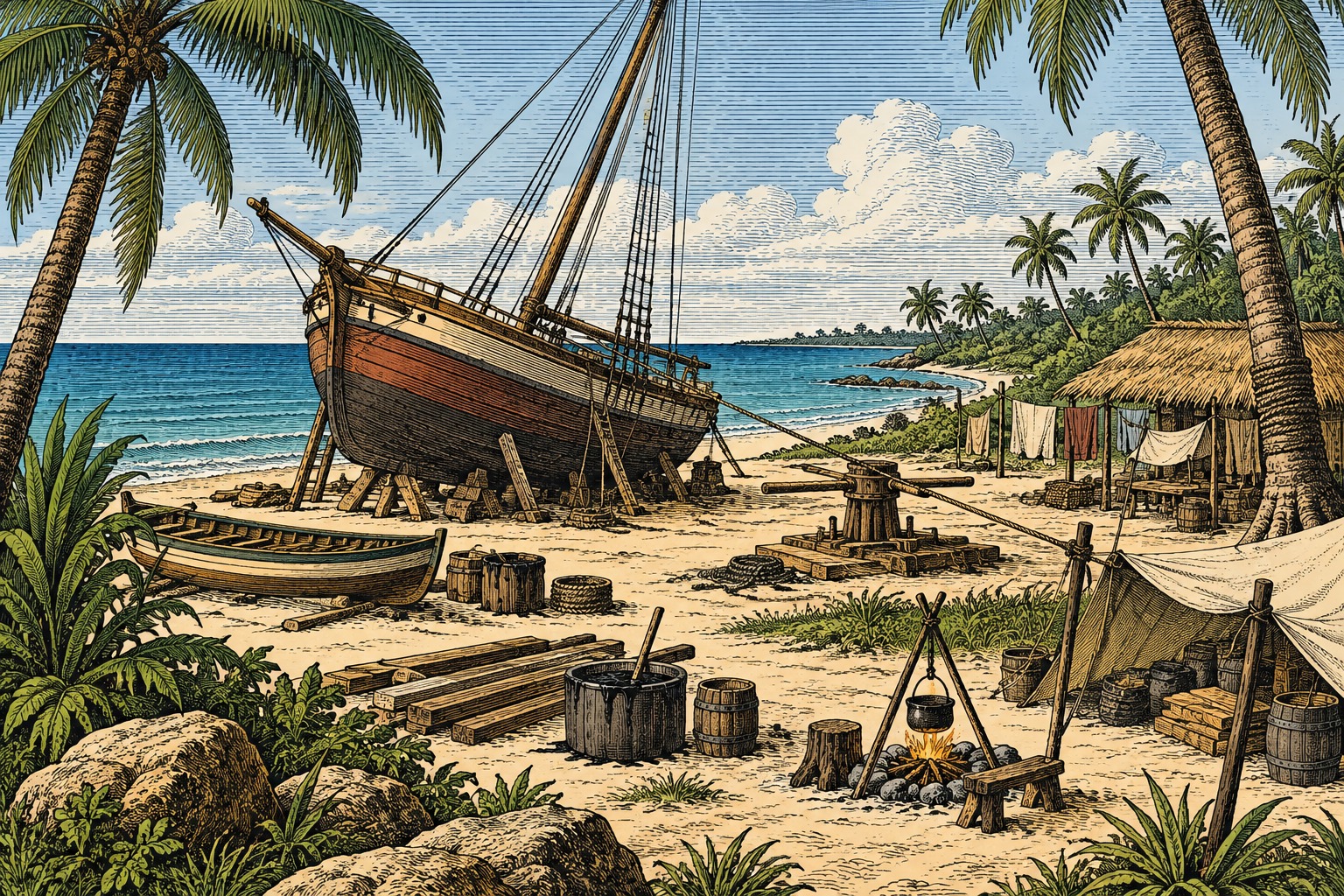
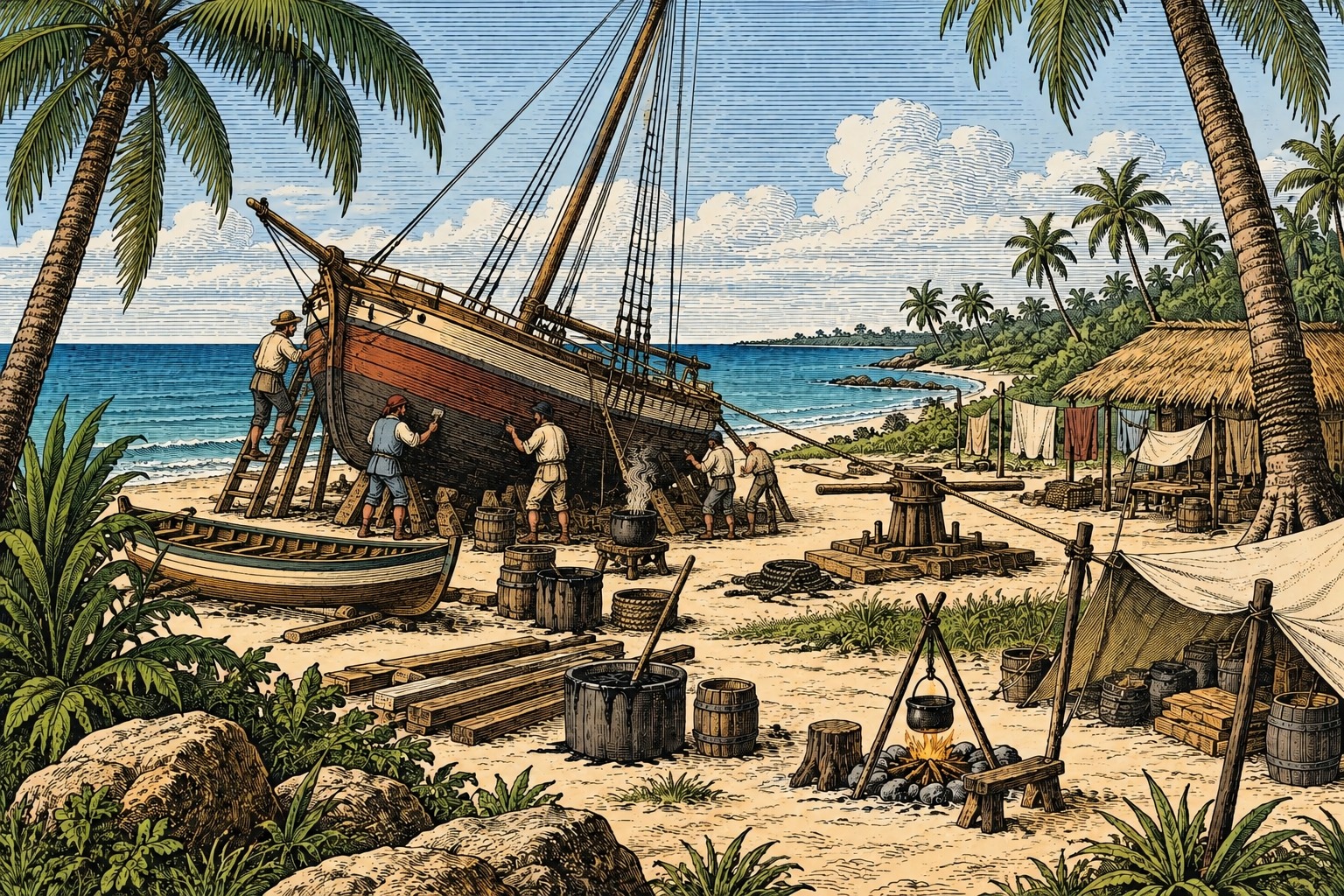
II Careening. A ship may be hove down on a beach or at a careening wharf. The Company takes out the guns and stores, heaves the ship on its side, scrapes and tars one side, then the other. It takes about a week with a full Company and a carpenter: five days if the Carpenter succeeds at an Average Craft check. Careening clears all Foul and removes 1 Hull Damage; a ship hove down cannot sail or fight, and an attacker that finds it adds 2 Boon Dice to its attacks.
Money and Credit
Adds. Use the piece of eight, Spain's silver dollar, for prize values and shares. Its 4s 6d sterling rating follows the Lords of Trade in Queen Anne's reign; colonial laws assign higher values. English wages appear in pounds, shillings and pence, with pieces of eight in brackets.
THE QUARTERMASTER'S LEDGER
| Sum | In pieces of eight |
|---|---|
| 1 shilling | about two ninths of a piece |
| 4s 6d | 1 piece |
| £1 (20s) | 4 and four ninths |
| £10, a privateer sailor's lot in 1708 | 44 |
| An able seaman's month in the Navy, £1 4s | 5 and a third |
| A commander's reward, £100 | 444 |
| The injury pay for a limb, £180 | 800 |
TERMS: STAKES
Standing determines a new character's Stake, as specified by the Role.
| Standing | Stake | Roles |
|---|---|---|
| Hand | 6 pieces | Able Seaman, Marine or Soldier, Boucanier or Logwood Cutter |
| Officer | 12 pieces | Gunner, Boatswain, Carpenter, Sailing Master, Surgeon, Quartermaster, Privateer Officer |
| Master | 45 pieces | Merchant Captain or Supercargo, Fence and Factor, Tavern Keeper and Broker |
| Clerk | 24 pieces | Colonial Clerk or Advocate, Chaplain, Priest or Pastor, Minister |
Starting with a Master Stake incurs Debt of 45 pieces to a named backer: merchant house, relative or Company stock. Payment falls due after the first voyage. Until an unpaid Debt is settled, its creditor remains an antagonist.