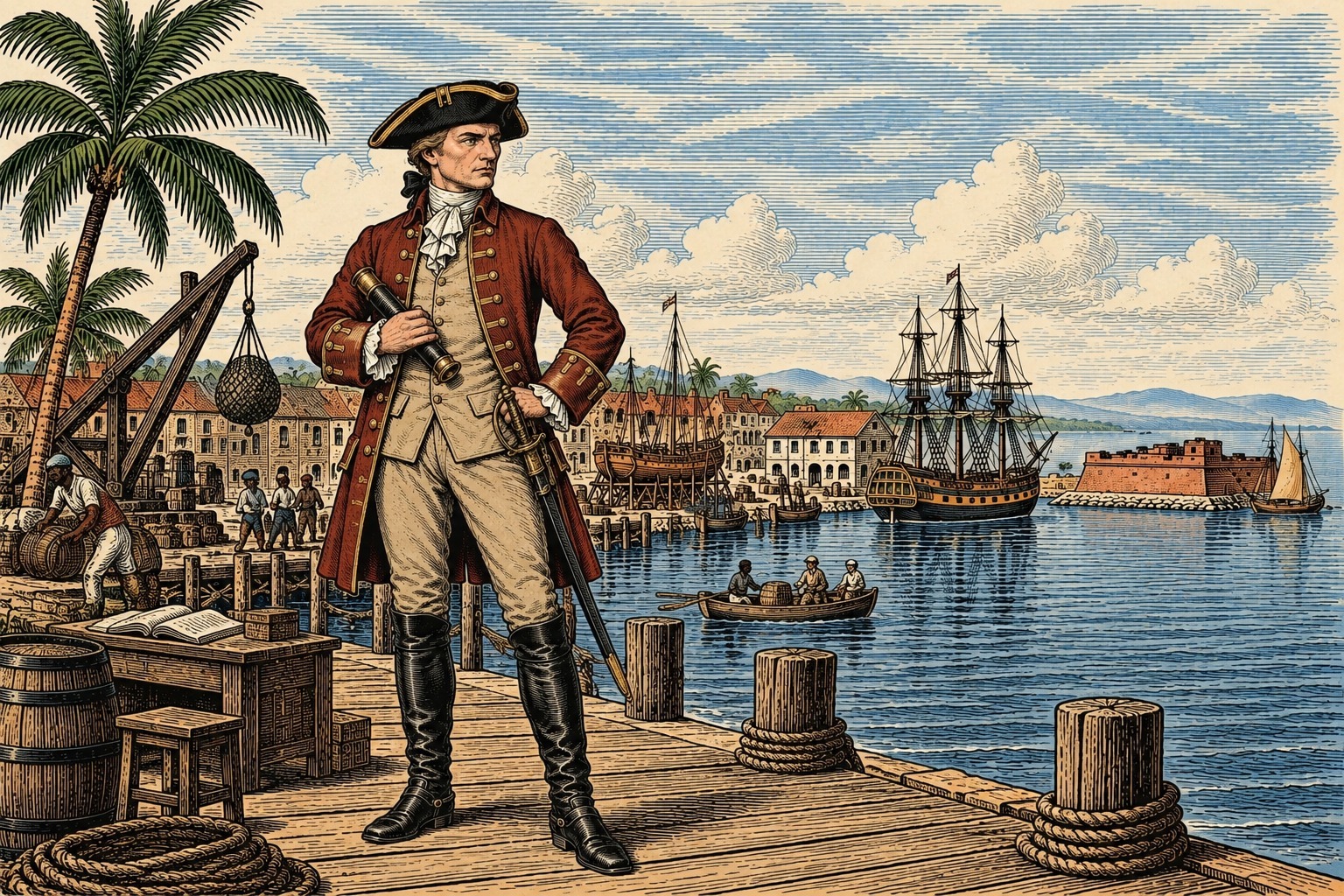
Port Royal occupies the tip of the sand spit sheltering Jamaica's Kingston Harbour. Before 1692 it ranked among English America's richest and largest towns, a base for buccaneers. By October 1716 earthquake and fire have reduced it to a naval and Admiralty town on a third to a half of its former ground. Jamaica has endured the hurricane of 1712; another storm lies ahead. Companies come for commissions, lawful prize sales, debts and hangings. The buccaneer port belongs to its history; this chapter describes the town of 1716.
A Town Between Two Disasters
England captured Jamaica in 1655. Port Royal became the Jamaica Station's naval base and the buccaneers' departure point. Morgan sailed against Panama in 1670; his men sacked and burned the city in 1671. For this chapter's town of 1716, those expeditions are history.
Earthquake and wave struck on 7 June 1692, killing about 2,000 immediately and another 3,000 through injury and disease in the following weeks. Port Royal had held roughly 6,500 people in 2,000 buildings, many brick-built and several storeys high. Half to two thirds of the town went into the sea, leaving about 18 to 25 of its fifty-odd acres. Fort Charles remained standing. The parish church collapsed, Forts James and Carlisle sank, and water covered Fort Rupert. Bermudian wreckers soon plundered the submerged town.
Officials planned Kingston across the harbour as a replacement. Disease killed thousands there, driving survivors back to rebuild Port Royal on its remaining third to half of the old ground. Fire destroyed that rebuilding in January 1703. Authorities prohibited resettlement and directed merchants to Kingston, but the Queen overturned the ban in 1704. Port Royal rose again. No population or house count survives for 1716; figures from 1692 describe the lost town.
The storm of 28 August 1712 destroys houses and plantations across Jamaica. On 28 August 1722 another hurricane crosses Port Royal itself and sinks harbour shipping, ending its commercial importance (Historical Reference, The Port Royal hurricane). By the mid-1720s only the naval station remains.
The Waterfront

Brick and timber merchant houses rise several storeys above waterfront warehouses, interrupted by earthquake and fire rubble. Roofs are plain shingle or tile. Sloops and merchantmen berth at the wharves; a sixth rate rides at naval moorings. Lighters bring barrels beneath cranes and hoists, and a pillory stands near the market. A few palms and sea grape grow on the narrow strip of packed sand. Low red-brick walls and gun embrasures mark Fort Charles at the harbour mouth; it has no tall tower.
Dockhands, bewigged merchants in long coats, soldiers and sailors crowd a handful of watched streets. Trade is busier than Nassau's, and authority far more visible.

The Navy at Port Royal
The Royal Navy anchors and careens at Port Royal. A naval officer has served here since at least 1675; Queen Anne's reign added a careening hulk. Wharves and storehouses follow from 1735. In 1716 this is an anchorage with a hulk rather than a dockyard.
Few warships are available, and repairs lag. Captain Soanes receives orders to take HMS Seahorse home in April 1716, her hull "badly worm-eaten". HMS Adventure delivers a commission at Jamaica on 25 July 1716. Independent Company soldiers occupy the fort, owed pay; the Assembly allows each man 5 shillings weekly for quarters (Sums on Record). Whitcombe's sixth rate represents the station's difficulties: short of men and Admiralty permission to careen, she spends most of the year in harbour. Whatever ships are present watch Companies with Infamy 3 or more (Era Rules, Infamy).
LEGEND
Accounts differ over continuous naval occupation versus re-establishment in 1735. Here, the careening hulk represents the earlier station; 1735 marks dockyard construction.
LEGEND
Popular accounts claim a tavern for every ten residents at the buccaneer town's height, with 40 licences issued in July 1661. Another cites a 1680 census listing a brothel with 21 white and two Black women. These claims rest on popular sources.
Who Governs Jamaica

Lord Archibald Hamilton has governed since 1711, but is recalled in 1716. In March he dismisses Chief Justice Peter Heywood for refusing the King's habeas corpus writ during the recent Assembly session, replaces him with Mr. Bernard and suspends him from the Council. By summer Heywood heads the government; by September he signs as Commander in Chief of Jamaica. Thomas Pitt receives the governorship in 1716 but resigns without travelling. Sir Nicholas Lawes's commission is approved on 25 July 1717; he takes office in 1718.
October's acting ruler is therefore the man Hamilton dismissed. Heywood seeks compensation from Havana and Santiago de Cuba for vessels condemned as prizes. Council and elected Assembly meet inland at Spanish Town. For a Company, these disputes matter because whoever currently holds the commission exercises the island's authority, and that holder can change.
Commissions. Hamilton issues privateering and anti-pirate commissions during 1715 and 1716. One, dated 21 November 1715, authorises Captain John Wills's Eagle to hunt pirates. Edward James and Jennings equip two sloops that November. Balchen of HMS Diamond reports on 13 May 1716 that they returned from the Florida wrecks with considerable money, attracting twenty more. France and Spain protest. Writing from Léogâne on 18 July 1716, Saint-Domingue's governor Blénac demands redress for Jamaica-based raiders. Spanish guardacostas seize Jamaicans fishing among the wrecks. Wartime commissions license attacks on enemy vessels; peacetime commissions can cloak raids on Spain in official paper. Their protection lasts only while authorities honour them. Governors can revoke them.
LEGEND
Weak accounts claim Hamilton barred commissioned ships from the wrecks in April 1716, making Jennings a pirate thereafter. Another attributes payment for the commission to the acting governor. Neither account is secure.
Accounts of the Florida salvage-camp raids in the winter of 1715 to 1716 put the plunder at 120,000 or 350,000 pieces of eight. The totals remain disputed.
Law: Prizes, Courts and the Gallows
A commissioned capture becomes lawful after an Admiralty court condemns it; sale and division follow. Port Royal provides that route. In December 1716 Heywood reports condemnation of the sloop Mary, distinct from other vessels of that name. Condemned goods sell without a check at the fixed rate, less court fees (Era Rules, Law at Sea and Ashore). The Company receives 45 in 100, comparable to a skilled fence's payment, through a lawful sale that avoids the gallows.
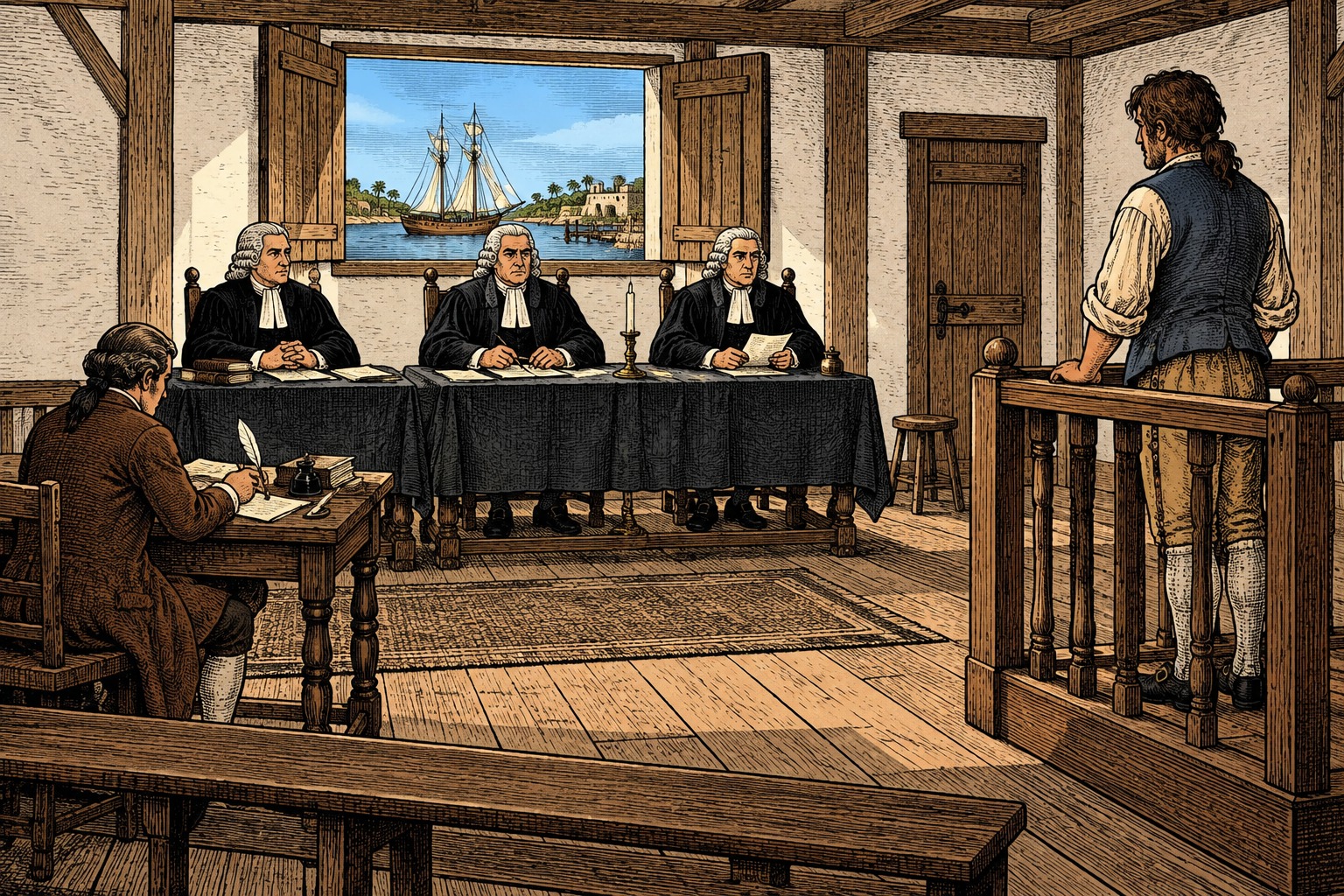
Piracy trials belong to a separate Court of Admiralty commissioned under the Piracy Act of 1698. Overseas proceedings require at least seven commissioners, drawn from merchants, factors, planters and naval officers. Era Rules, Law at Sea and Ashore gives trial procedure; this chapter describes the court's place in the town.
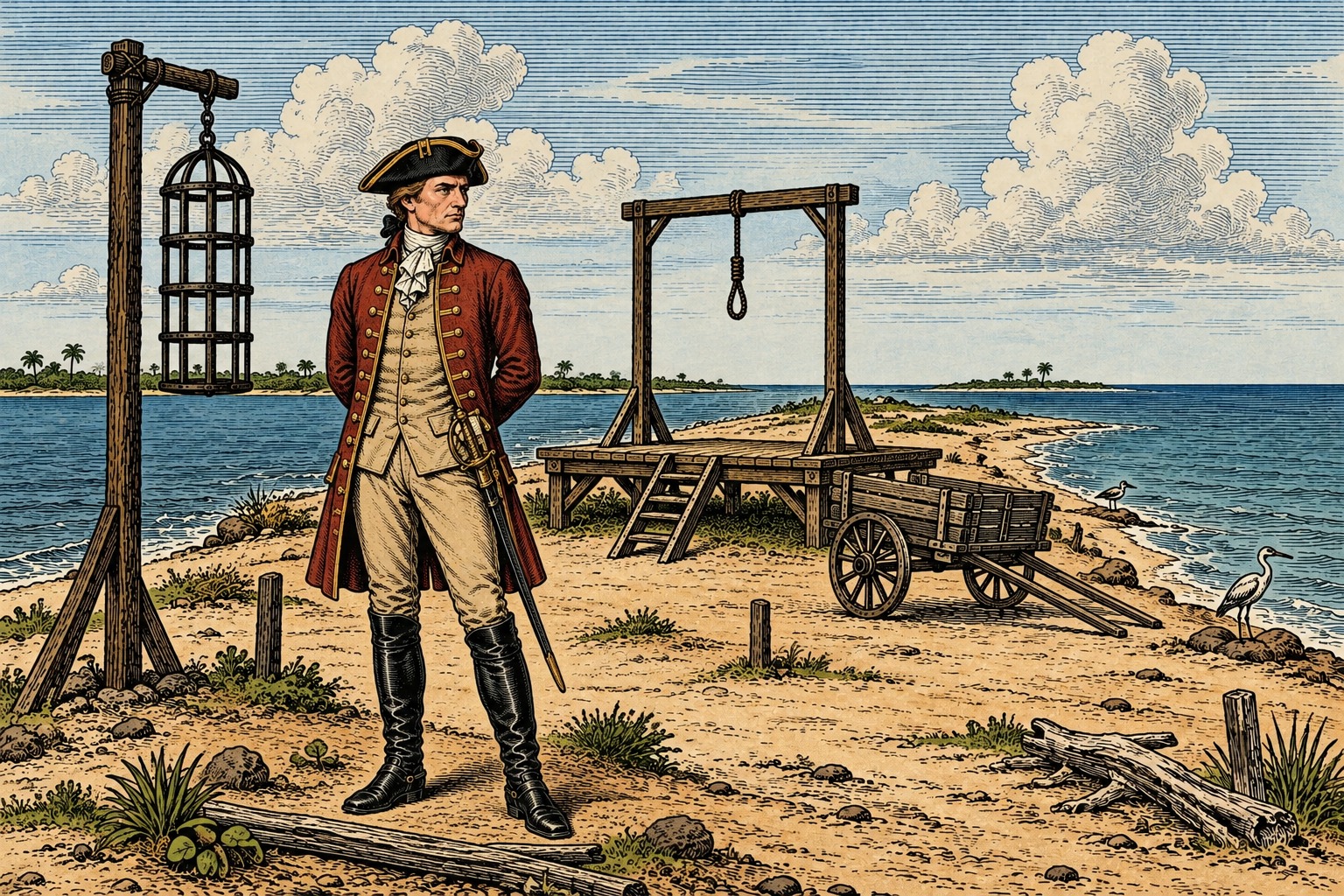
Executions are public. Rackham's crew is sentenced on 16 November 1720. Rackham and four companions hang at Port Royal's Gallows Point on 18 November; the rest follow at Kingston the next day. Rackham, sailing master Fetherston and quartermaster Corner are then displayed in chains at Plumb Point, Bush Key and Gun Cay. In January 1721 nine men are condemned for boarding Rackham's sloop at Negril Point despite committing no piracy. Six hang: three at Gallows Point on 17 February and three at Kingston the following day. Bonny and Read plead pregnancy after sentence and are remanded; Bonny is not executed. Companies visiting in 1716 see the same gallows these trials will use.
LEGEND
Johnson places the first five executions the day after sentencing. The trial record dates them to 18 November.
The Economy

Enslaved labour sustains Jamaica's sugar exports. The African Company and private merchants auction and contract the kidnapped Africans bought in their hundreds of thousands by sugar colonies. Jamaica also supplies Spanish buyers under the asiento (Trade and Shipping, Jamaica and the Spanish Ports; Powers of the Caribbean, The African Company and the South Sea Company). Its Assembly imposes a 20-shilling export duty per person in 1715, alongside a 10 per cent import duty, to retain "the better negroes" and depress purchase prices. The Crown disallows the export duty in 1718. Capturing a slaver places people under the Company's control (Era Rules, People Held Aboard); selling them joins the trade supporting Port Royal's merchants. Historical sale prices are in Trade and Shipping, The Landing and the Price.
Older trades employ sloops gathering Campeche logwood, Cayman turtle and Florida wreckage, or smuggling to the Spanish Main. Sloane saw roughly forty of Port Royal's 180 sloops engaged in turtle fishing in the late 1680s. Scarce coin leaves sugar circulating as payment.
SUMS ON RECORD AT JAMAICA
| Sum | What and when |
|---|---|
| 5s a week | A soldier's quarters, allowed by the Assembly, 1714 |
| 20s a week | An officer's quarters, 1714 |
| 20s a head | The Assembly's duty on enslaved people re-exported, 1715, disallowed in 1718 |
The Maroons. Free Black communities control the inland hills. Descendants of people escaping Spanish owners formed the earliest towns; fugitives from English plantations joined later. They resisted English authority through the later seventeenth century. In the 1720s and 1730s Cudjoe leads the Leeward Maroons, while Quao and Nanny lead the Windward. Accompong names a town. Treat these communities as independent powers: peaceful visitors can trade, and a Company seeking passage through the hills must negotiate and pay.
The People
Naval officers and soldiers. Captains answer to London and dispute men and stores with the governor. Independent Company soldiers await unpaid wages. Bribes or desertion offer alternatives to waiting.
Merchants and chandlers. Kingston has drawn merchants off the point, but their agents retain waterfront premises. Chandlers sell canvas, cordage, powder and shot; agents buy court-approved prizes.
Planters and their agents. Wealthy planters control the Assembly. They visit the point to ship sugar, consult factors and serve on juries.
Free people of African descent. Black and mixed-ancestry residents work as craftsmen, traders and tavern keepers, and own property. Elizabeth Keyhorne's 1713 will appears in a study of 741 Jamaican women's wills, identified as that of a widow of mixed ancestry. Calloway's mother came from Jamaica's free quarter. A free woman meeting the Company may own her house and possess rights denied to a bondsman.
Enslaved people. Enslaved workers load lighters, row boats, cook, clean and carry goods. Courts reject their testimony against white defendants (Era Rules, Prejudice). Owners hire them out as workers, guides or pilots, keeping the money themselves.
Women. Tavern and lodging-house keepers work alongside laundresses, seamstresses, food sellers and prostitutes in tavern back rooms. Era Rules assigns Wary 1 to a woman before commissioners. A plea of pregnancy goes before a jury of matrons.
Finding Needs
| Need | Where | Notes |
|---|---|---|
| Water | Wells on the point, and casks brought by boat | Fresh water is carried; a Company that lies at anchor sends boats |
| Careening and repair | The Navy's careening hulk, by leave, or a beach | Era Rules, Careening and Repair; the Navy's leave is the price of the hulk |
| Stores | The chandlers on the wharves | Canvas, cordage, powder and shot are on sale within the bands (Gear and Prices) |
| A fence | The wharves | Hard here (Era Rules, The Prize and Fence Loop); the court is the safe, poor road |
| A surgeon | A surgeon's shop in the port (Gear and Prices) | Ask at the waterfront (Hard to find); no named surgeon is on record |
| News | The wharf and the station ships | Rumours 3 and 11 are told on the wharf (Places and Campaign Tools, How News Travels) |
What a Company Does Here
Port Royal offers legal recognition unavailable at Nassau. Use Era Rules, The Prize and Fence Loop, with the following differences.
- Commission. A governor issues a letter of marque against a named enemy. With no war on, it is a bargain, struck with the acting governor or his secretary.
- Condemnation. A prize is brought to the court, condemned and sold. This is the safe, poor road. A fence here is Hard, and Average only in a pirate port.
- Debt and credit. A creditor's tally follows a Company from port to port. Era Rules, The Prize and Fence Loop, covers what a debt costs.
- The court. A Company that is tried makes the Lore (Law) or Charm check; the court's Disposition is Hostile after a fresh raid (Era Rules, Law at Sea and Ashore).
- The hanging. A Company that comes to watch sees the sentence done and learns what the Name costs. A Company with a Name is seen watching.
Places in Port Royal
Fort Charles
Low red-brick walls and gun embrasures at the harbour mouth. It began as Fort Cromwell and was renamed after the Restoration. It survived the quake. At the table: The soldiers' barracks and the harbour's guns; a Company with Infamy 3 or more passes under them.
The Wharves
Warehouses, cranes and lighters on the harbour side. Casks, hoists, a counting-house with ledgers, a pillory by the market. At the table: Where cargo is landed, appraised and watched; a fence here is Hard.
The Naval Anchorage
Moorings, a hulk and a sixth rate. Ships careen here and the Navy keeps its officer. At the table: Whitcombe's sixth rate lies here; the navy's gossip is for sale, and so are its stores.
The Court
A long table under a plain window, with a dock. Commissioners sit, a clerk reads, an agent takes a fee. At the table: The Vice-Admiralty court condemns prizes here, and the commissioners who try pirates sit at the same table (Where the Court Sits).
Gallows Point
A low spit on the harbour side of the Palisadoes, a short way east of the town, with a platform, two uprights and a crossbeam, and an empty iron cage on a post. Pirates are hanged here, and the gibbet shows what comes after. At the table: The cost of the Name made visible; Whitcombe comes to look at it.
The Drowned Town
The part of the old town that now lies under the harbour. Streets, cellars and brick walls under a few fathoms of water. At the table: A salvage hook; the wreckers got there first, and what is left is deep and dangerous.
Fictional People of Port Royal
Josiah Marsh, Chandler and Money-Lender (fictional)
Marsh is stout, with a wharf shop selling canvas and cordage. He lends to anyone owning a ship, keeps each Company's tally and knows which debtors have fallen behind. Calloway owes him 45 pieces of eight, now due. Hook: A favour at Nassau can clear the Company's debt.
Samuel Tolley, Clerk of the Court (fictional)
Thin and meticulous, Tolley maintains court papers, fees and dockets. He knows when commissioners next sit, who will serve and whose fees are paid. Hook: He sells places on the next docket, or missing papers.
Hannah Dacre, Tavern Keeper (fictional)
Dacre's house near the wharves draws sailors, clerks and soldiers. The widow hears their talk while cooking, brewing and letting rooms, keeping her prices in her head. Hook: A seaman left a bundle and never returned.
Hooks
| Hook | Who | The offer |
|---|---|---|
| The Commission | The acting governor's secretary | A commission against a named enemy, for a price and a share of the prize |
| The Debt | Josiah Marsh | Calloway's 45 pieces of eight is due; he will send a man to Nassau |
| The Docket | Samuel Tolley | A man the Company knows is to be tried at the next sitting, and a word could shift the commissioners |
| The Hulk | A naval lieutenant | The Navy's careening hulk has been stripped of a cannon and he needs it found before an inspection |
| The Drowned Street | A wrecker | A cellar in the drowned town holds a chest; he wants a boat, a diver and a partner |
| The Pass | Cuffee | A Maroon town will sell a pass through the hills to a Company that brings a healer (Places and Campaign Tools, Hooks Keyed to the Cast and the Powers) |
Use rumours 3 and 11 from Places and Campaign Tools on the wharf. Roll d10 on Complications in Port for trouble as the Company lands; a 5 puts the press gang on the waterfront.
TRUTH AND LEGEND
Truth: the quake of 7 June 1692 and the fire of January 1703 happened as set out above; Fort Charles survived and the parish church fell; Hamilton's commissions and the Balchen letter are in the record; Jamaican trials in the 1720s were held and men were hanged at Gallows Point.
Legend: the buccaneer town is remembered as the wickedest city on earth, with a tavern for every ten residents, and the quake as God's judgement on it. The first rests on popular counts, and the second is a sermon, not a record.