
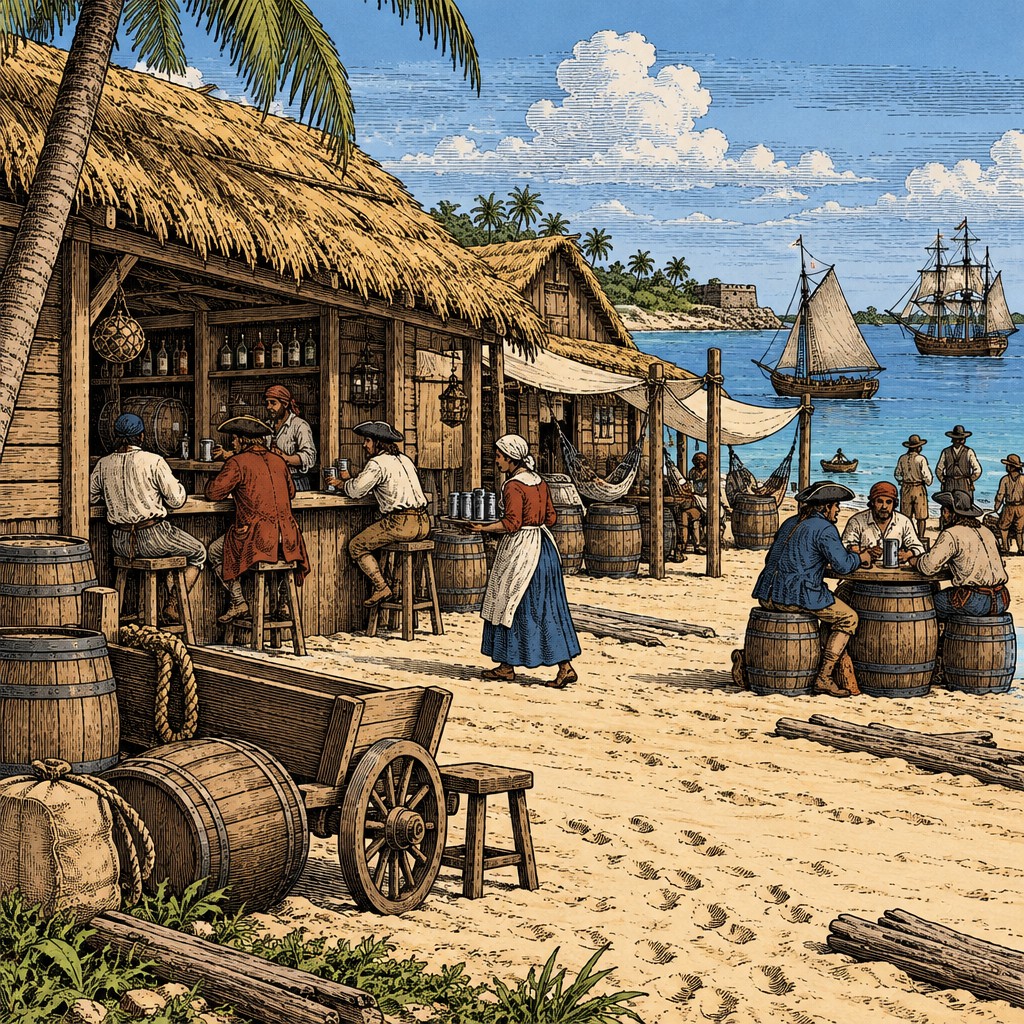
On New Providence in the Bahamas, Nassau serves as home port for the Beach at Nassau campaign frame (Places and Campaign Tools). Companies sell prizes, careen, drink and gather news here. The town described below is Nassau in October 1716: palmetto huts beside a ruined fort and the islands' best deep-water anchorage. The walled stone town familiar from film and television has no place on this beach.
The Harbour and the Bar
Deep water stretches between New Providence and low, green Hog Island. The English Pilot of 1716 records four fathoms (24 feet) or more inside, enough anchorage for hundreds of vessels. Entry from the west requires care. An eight-foot sand bar extends from Hog Island's West Point; beyond its end, a channel about two cables (1,200 feet) wide leads inward. The Pilot gives about 18 feet at low water off the fort. A later, undated manuscript draught gives 14 feet at the entrance, so channel depths remain approximate. The eastern approach is shallow. Fourth rates and larger ships cannot enter; sixth rates, sloops and brigantines can, with a pilot who knows the bar.
Nassau offers refuge from large hulls. A knowledgeable pilot can take the Company inside while a fourth rate waits offshore. A naval sixth rate attempting entry without a pilot risks grounding (Places and Campaign Tools, Ocracoke and Bath, the bar rule). Inside, sloops and brigantines crowd the anchorage alongside prizes. Boats line the sand; hulls lie on their sides ashore for cleaning.

The Beach Settlement
Single-room huts follow the beach, their split-log and wattle walls plastered with limestone clay beneath palmetto roofs. None has a chimney. Overgrown paths connect them; there is no street grid or pier. Substantial roads come with Rogers. Residents cook outdoors and sling hammocks between posts. Casks and bales sit above the tide, with drying sails spread over the sand.
No reliable headcount survives for 1716. Before the raids of 1703 and 1706, Nassau held about 250 white men, women and children, and roughly as many of African and mixed ancestry. Oldmixon's 1708 account calls the latter "Black, mulatto and mustee". The French and Spanish attacks left few houses standing; a captain visiting in 1707 counted three outside town.
Reports for 1707 to 1715 put some 600 people across Eleuthera, Harbour Island and New Providence, half of them free men. New Providence alone is variously credited with about thirty families or twenty men in those years. Pirates, wreckers and logwood cutters add a shifting population afloat. Estimates for 1717 and 1718 range from five hundred to a thousand pirates throughout the islands. Use that range for a busy season.
Without rivers or springs, islanders collect fresh water from shaded ponds and rock reservoirs. Empty casks send an arriving Company inland for supplies (Places and Campaign Tools, Stores and Water). Local farms grow corn, peas, pumpkins and yams alongside livestock and fruit trees.
Fort Nassau
Fort Nassau guards the harbour from the settlement's western end, with huts stretching east. Governor Nicholas Trott began it in the 1690s, completing it in 1697; the Charles Town judge of that name was his cousin. Raids in 1703 and 1706 left a repairable ruin. Pirates remount its guns in 1716. Rather than remain under their authority, senior official Thomas Walker, Judge of the Admiralty, moves his family to Abaco in July and complains from South Carolina in August. Earth, timber and old masonry form low, broken walls around a few guns on plain carriages. Nobody guards the gate. The battery can deter small vessels, but cannot withstand a large attacker.

LEGEND
One unsourced encyclopaedia entry describes a four-pointed stone star, damaged by Spain in 1700 and demolished late in the nineteenth century. The star and stone construction remain unverified. Raiders' removal of 22 guns in 1703 is documented.
Who Rules
No effective government operates here. The Lords Proprietors retain the charter but have neglected the islands for years. Edward Birch, in 1704, is the last proprietary governor on the standard list. Letters of 1701 to 1714 describe rule by "the strongest man carrys the day". On 10 March 1716 the King in Council approves Roger Mostyn as Governor of the Bahama Islands, yet no record shows him sailing and no commission reaches Nassau. The proprietors surrender government to the Crown in 1717; Rogers receives his commission on 6 January 1718.
Companies exercise the power government has abandoned. John Vickers's 1716 deposition quotes Hornigold claiming protection over all pirates, and names him, Jennings and others plundering Providence's sloops and residents. Walker reports pirates rearming the fort. Captains tell visitors they will leave English ships alone unless attacked. That assurance lasts only as long as its speakers choose to honour it.
Each Company enforces its articles through its vote and Quartermaster (Era Rules, Crew and Articles). Captains negotiate disputes between crews; heavier guns on the beach can settle what talk cannot. Use the sample audiences in Era Rules, Prejudice: a Nassau tavern in 1716 is Welcome 1 to pirates, Hostile 2 to naval officers and Hostile 2 to known informers.
Law and Order
Without courts, jailers or constables, Nassau leaves offences to the injured party, the offender's Company or negotiations between captains. Three cases recur.
-
Theft from a Company is the Quartermaster's matter and follows the Company's articles: marooning, a fine, a flogging, or the Vote (Era Rules, Marooning).
-
A fight on the beach is settled by the bystanders. A tavern brawl draws in the whole tavern, and a Port Tough is easy to hire (Adversaries).
-
A debt is settled by a tavern keeper's tally and by memory. Credit is good, but a debt can be called, and a man in arrears may be sold for it in Jamaica (Era Rules, The Prize and Fence Loop).
Naval officers and governors' agents risk violence ashore. Nassau offers no trial: hostile residents deal with strangers privately. A Company that keeps quiet receives only whatever protection the captains choose to extend.
The Economy and the Fence Trade
Prize cargoes support Nassau. Crews sell plunder, restock food, arms and ammunition, and clean their hulls. Rum is the cheapest drink. Without shops, buyers choose among goods landed from prizes or held by tavern keepers. Almost anything captured can be sold, with no guarantee of supply (Gear and Prices, Availability by Place). Residents supplement this trade with corn, peas, pumpkins, yams, fruit and salvage from wrecks.
A fence buys captured cargo at a discount, using coin or credit, then arranges resale. The Fence check in a pirate port is Average (Era Rules, The Prize and Fence Loop). The Company receives its earnings; the buyer assumes the risk. Calloway performs much the same service, holding stock, finding buyers with money and charging for introductions.
No customs collector, harbour master or anchorage fee delays a sale. A Company can land cargo at dawn and leave on the afternoon tide. Lacoste at Charles Town is the principal rum buyer, exchanging wine and brandy for rum barred from the French market (Other Ports, Charles Town; Pregenerated Characters).
The People
Pirates. Ships' crews dominate the port: discharged privateers and sailors from the peace of 1713, alongside naval and merchant deserters. An undated record gives Hornigold's sloop Mary 140 men, six guns and eight patteraroes; she may be the Boston depositions' Mary Anne (Historical Reference). An August 1716 report describes a sloop of his captured and destroyed under Carolina commissions (Other Ports, Charles Town). Crews elect and remove captains, whose authority rests on votes and successful prizes.
Residents. Long-established families farm, fish and sell at prices the Companies dictate. Some marry into pirate crews; others leave for Harbour Island or Eleuthera.
Merchants and traders. Bermuda, Jamaica and northern-colony sloops buy captured goods. Open dealing may attract later naval scrutiny; quiet transactions bring immediate profit.
Black and mixed-ancestry residents. Before 1703, Black and mixed-ancestry inhabitants roughly equalled the white population. Some were free, others enslaved; no breakdown survives for 1716. Enslaved residents work for local households. Free men and women fish, trade and keep house. Black sailors serve in pirate Companies with shares and votes, as Cuffee does under Salazar. Captured prizes also carry enslaved men and women whose fate goes before the Company's vote (Era Rules, People Held Aboard). No uniform Nassau practice is recorded; the table decides.
Women. Women earn money through prostitution, laundry, sewing, cooking and small trade. Some pirates have wives ashore. Circumstances vary: some women can leave freely, while others owe tavern keepers debts beyond their means.
Wreckers and cutters. Salvors and logwood cutters sail between Nassau, the Florida shore, Campeche and Honduras, bringing reports of wrecks (Places and Campaign Tools).
The Tavern Trade
Taverns sell drink, prostitution and credit alongside food and information. Calloway's is the best known. Above its plank counter and long room of benches and cask-ends, she lets rooms to women working for her and captains willing to talk. Customers buy rum, hot meals and news.
A tavern keeper rents rooms to prostitutes, takes part of their earnings and records the debt. Sailors spend prize shares quickly. Era Rules prices a Spree; tavern credit can extend to the value of one share for a man entitled to one. Debts give Calloway leverage over most Companies in town.
Dinah Calloway, Tavern Keeper, Sex Worker and Broker (fictional)
Of mixed ancestry: an English ship's carpenter for a father, an African woman of Jamaica's free quarter for a mother. About 36.
Calloway arrived from Port Royal in 1714 with a purse, a hut and a talent for accounts. She runs the tavern, works its rooms and tracks visiting Companies, flour shortages and expected shipping. She sells rumours to those who ask and warnings to those who pay. Pirate customers support her business, while her reports supply Sir Edmund Haldane's dispatches. She serves several interests without committing to one. Her Port Royal creditor, Josiah Marsh, is owed 45 pieces of eight (Port Royal). See Pregenerated Characters for her sheet.
Use her as fence, broker, source for Complications in Port, or Sponsor for a Company that deals fairly with her (Era Rules, Prejudice). Cross her and credit disappears; useful information goes to someone else.
What a Company Does Here
Nassau provides the final stages of the Prize and Fence Loop in Era Rules.
- Appraisal and Fence (steps IV and V). The Quartermaster lands the goods on the beach, a Craft (appraising) or Negotiation check names the class of the prize, and a Streetwise or Negotiation check sets the fence rate. At Nassau both are Average.
- Spending (step VI). Shares are paid and spent: lodging, drink, a Spree, credit at Calloway's. The credit is a debt (Era Rules, The Prize and Fence Loop).
- The Base and the Navy (step VII). Nassau is a Base: it takes the Company's goods, gives it water and asks nothing. The risk is that the navy follows Infamy to it.
- Between sailings. Careen, repair, ship new hands by the Vote, and listen. The tavern keeper has news (Complications in Port), and a rumour worth a cask of rum is for sale.
Finding Needs
| Need | Where | Notes |
|---|---|---|
| Water | The ponds and rock reservoirs inland | No rivers or springs; carry casks; a dry season thins the supply |
| Careening and repair | The harbour shore, or a quiet beach on the island | Era Rules, Careening and Repair; a Carpenter's Skill shortens it |
| Stores | Prizes and Calloway's stock | Provisions are bought, not requisitioned; powder and shot go to the highest bidder |
| A fence | The beach and Calloway's table | Average at Nassau; the rate is in Era Rules |
| A surgeon | The Company's own | The record names no physician at Nassau; a Company brings a surgeon, or a woman who knows bark and roots |
| News | Calloway, then the next sloop | A story reaches Nassau at the pace of the next ship (Places and Campaign Tools, How News Travels) |
Places in Nassau
The Harbour
A deep channel between New Providence and Hog Island. Four fathoms or more, room for hundreds of vessels, a channel about 1,200 feet wide past the bar at the western entrance. At the table: A safe anchorage for sloops and brigantines; a trap for a deep-draught ship on the bar.
The Beach
The sale ground, in front of the huts. Prizes are landed here, cargo is counted above the tide line, casks are stacked and a fence's men wait with a barrow. At the table: Where the Prize and Fence Loop happens; a quarrel here draws a crowd.
Fort Nassau
A ruined work at the west end of the settlement. A few guns, a gate no one minds, and gaps in the wall. At the table: A place to bargain from or to hold against a small attacker; no safe harbour from a warship.
Calloway's Tavern
A plank counter, benches and a stair, on the beach. Shutters open to the sea, a tally board chalked with names, a corner table for the captains. At the table: The town's information market and the starter adventure's setting.
The Careening Shore
A steep sandy stretch on the harbour shore, or a quiet beach on the island, where hulls are laid over. Water on the doorstep, a lookout needed on the high ground, tar pots and fires. At the table: A Company here is helpless for days (Era Rules, Careening and Repair).
The Ponds
Shaded pools and rock reservoirs inland. The only fresh water on the island. At the table: The first want of any Company; a Survival check, Average, finds it (Places and Campaign Tools, Stores and Water), and whoever holds it sets the price.
Harbour Island, a Day Away

Sir Edmund Haldane, the fictional Governor of Harbour Island, holds a title absent from the historical record. His small settlement lies off Eleuthera, 60 miles and a day's sail from Nassau (Places and Campaign Tools). He demands pirate suppression in letters to London while buying their flour. Companies approach him for pilots, local pardons or discreet contact with a Crown officer; his correspondence can also make him an enemy (Adversaries). In Nassau his name carries influence, but he never appears in person.
Hooks
| Hook | Who | The offer |
|---|---|---|
| The Short Water | A Company short of casks | The ponds are held by a man who wants a share of the next prize for his water |
| The Informer | Calloway | Someone in Nassau sells the Company's names to a Crown officer; she says who, for a price |
| The Good Cargo | A Bermuda trader | A sloop in the harbour will take a cargo no questions asked, at a poor price, if the Company is gone by dawn |
| The Rented Room | A woman of the house | She wants a debt bought out and will pay in what she hears upstairs |
| The Fort's Guns | A captain | The guns pirates mounted in Fort Nassau are for sale, with their powder, to a Company that can carry them |
Use Places and Campaign Tools for tavern news. Calloway sells rumours 1, 2, 4 and 8 from its Rumours table. Roll d10 on Complications in Port for the beach's latest news when a Company lands.
After 1716
Nassau's pirate port ends gradually. The proprietors relinquish government in 1717. The King's proclamation of 5 September offers pardon; Captain Vincent Pearse brings it aboard HMS Phoenix in 1718. Rogers arrives that July and lands on the 27th, received by about 300 armed men. A court tries ten on 9 December 1718; eight hang on the 12th (Historical Reference). A Spanish expedition withdraws in February 1720. Use these events as campaign clocks beyond 1716. They underpin the Closing Net frame (Places and Campaign Tools, The Campaign Frame).
TRUTH AND LEGEND
Truth: the town was huts and a ruined fort; no court or governing body sat; the harbour was deep; a deposition of 1716 quotes Hornigold on protecting all pirates; Rogers landed on 27 July 1718.
Legend: Nassau is often called a "Republic of Pirates" with a council, a code and an elected governor. The record shows no assembly, only captains and the strong. Vickers also reports that a pirate, Thomas Barrow, boasted he would make Providence a "second Madagascar", and the boast is only a boast. In Johnson's 1724 history Hornigold puts Edward Teach in a prize sloop; the story rests on Johnson alone. The figure of a thousand is Bennett's, from 1717 (Historical Reference); the "mere hundred inhabitants" has no source, and this book does not print it.
