
“We surrender! Men, lay down your arms! We want no bloodshed!”
Captain Proctor's voice carried across the deck of the Providence, louder than it needed to be. His men obeyed at once. Muskets clattered against the planks. A cutlass struck the deck and skidded toward the rail.
The sailors raised their hands.
Some stared at us. Others kept their eyes fixed on the boards beneath their feet. One young fellow was trembling so badly his raised hands shook. Nobody spoke. Nobody moved except to shift their weight from one foot to the other, as though standing still might somehow make things worse.
Overhead, a gull wheeled past the mast, screeching its displeasure at the commotion.
It had taken us the better part of the morning to catch the Providence. She'd had the wind in her favor and a current that seemed determined to carry her away from us. Her captain had used both well enough. But we were faster, and there was only so much ocean between a ship and the men determined to take her.
When we finally closed the distance, Cuffee ran up the black flag.
That had settled the matter.
The grappling hooks came next, then the boarding. By the time my boots struck her deck, Proctor's men had thrown down their arms.
And here we were.
“That is civil of you, Captain Proctor,” I said, looking over his frightened crew. “Makes things easier for everyone.”
“I ask only for mercy, Captain. For my men and our passengers. Take the cargo, take whatever you wish. Only leave us alive.”
“Well, there's no profit in killing men who aren't fighting back,” I said. “So long as nobody does anything foolish, we'll take what we came for and be on our way.”
I looked down the line of sailors.
“Understand?”
A few nodded. Most remained still.
“Good.”
The door to the passenger cabins opened.
A woman stepped onto the deck, dressed in a fine gown entirely unsuited to the circumstances. The fabric was expensive, her hair carefully arranged, and she carried herself with the stiff dignity of someone accustomed to giving orders and having them obeyed.
There was something concealed in her right hand, tucked close against the folds of her skirt.
A pistol, perhaps. Or a knife.
I watched her carefully.
“Rebecca!” Proctor exclaimed. “I told you to remain in your cabin!”
“What, and deny us the pleasure of her company?” Cuffee called.
He was perched atop a cargo crate, grinning. The scar along his cheek pulled one corner of his mouth higher than the other, giving him the look of a man perpetually amused by something unpleasant.
Rebecca looked him over with undisguised contempt.
“I am a lady, sir, and I will not be addressed in such a manner by your kind.”
She lifted her chin, pressing her lips tightly together. Her arms drew closer to her body.
“Rebecca, please,” Proctor said. There was something close to panic in his voice now. “Go back to your cabin.”
He pointed toward the open door.
“Hold there a moment, lady.”
Cuffee hopped down from the crate.
His grin had faded.
He moved closer, studying her face.
“I know you.”
Rebecca stiffened.
“I assure you, I have no acquaintance with—”
“I've seen you before.”
“You are mistaken. I do not associate with your—”
“Kind,” Cuffee finished. “Aye, you've said that already.”
He tilted his head.
For a moment he stood perfectly still. Then something changed in his face. His eyes widened, and the crooked corner of his mouth twitched.
“Oh, I remember you now.”
He reached for the bottom of his shirt and pulled it over his head.
His back was a ruin.
Long, pale ridges crossed from shoulder to hip, some thick as a man's finger, others thin and crooked. The skin between them was puckered and twisted. There were places where the lash had plainly cut so deep that the flesh had never properly healed.
Even among pirates, where scars were common enough, it was a terrible sight.
Cuffee turned his back toward the woman.
“Remember this?”
Rebecca looked at the scars. Her expression scarcely changed.
“You had me whipped,” Cuffee said. His voice was low now. “Thirty lashes. For stealing medicine.”
He took another step toward her.
“A man was dying of fever. I took a little medicine from your stores. Wouldn't have cost you more than a few shillings.”
He turned to face her.
“You had me tied to a post and whipped for it. Then you had the medicine thrown into the sea.”
For a moment, Rebecca said nothing.
Then she gave a small, dismissive breath.
“You were a thief. You received the punishment you deserved.”
Proctor closed his eyes.
“And as an escaped slave,” she continued, “you should consider yourself fortunate that I have not the means to return you to your rightful owner. The governor's pardons do not extend to stolen property. Whatever crimes you have committed since escaping will only add to your punishment when you are caught.”
The deck fell silent.
Cuffee stared at her.
His scarred lip twitched again.
“Do you have the faintest notion where you are, woman?”
“I know precisely where I am.”
“No. I don't believe you do.”
He gestured toward me.
“That's Captain Salazar. Wanted from London to the farthest British colonies. And these men here? Every last one of them would hang if the King's men caught us.”
Cuffee stepped closer.
“There's no magistrate aboard. No constable. No plantation overseer to call when someone displeases you.”
He smiled again, though there was no humor in it.
“Just us.”
“Rebecca,” Proctor said quietly, “for God's sake, be silent.”
I studied the woman.
“Rebecca, my dear, you don't strike me as nobility. A merchant's wife, perhaps? Where's your husband?”
Her eyes moved from Cuffee to me.
“My husband is dead. I own the sugar plantation myself, along with everything it produces. This is my cargo, aboard a vessel I chartered and paid for.”
She straightened.
“I have money, Captain. Considerable money. I can arrange a ransom for my release. You would be wise to consider it.”
I glanced toward Cuffee.
His shirt lay forgotten at his feet.
He was still staring at her.
“I'm afraid,” I said, “you've misunderstood your situation.”
“I have the means to pay you handsomely.”
“Oh, we're past that now, lady,” Cuffee said.
Rebecca looked toward me.
“Captain, surely you can see reason. I am worth far more to you alive and unharmed.”
“Aye,” I said. “That you are.”
For the first time since she'd stepped onto the deck, she seemed relieved.
I turned toward Cuffee.
“She's yours. Your share of the prize.”
He looked at me, then back at her.
“Mind you,” I continued, “a ransom's worth less if the goods are damaged. Don't expect me to make up the difference.”
Cuffee smiled.
Rebecca's relief vanished.
“Captain Proctor,” she whispered.
The merchant captain stared at the deck.
Nobody moved to help her.
The Pitch
Black Flag follows a Company through the Caribbean and Atlantic between 1660 and 1730, aboard a pirate sloop, a privateer's brigantine or a navy sixth rate. Its characters work at sea and ashore: sailors and officers, surgeons and tavern keepers, clerks and fences. Written articles govern their shares, and a vote decides where they cruise. Capture brings them before a court. Wind, fever, scurvy and shoals threaten a voyage before a gun is fired. Ashore, the law belongs to whoever commands the fort, the beach or the gallows. Taking a prize brings another problem: turning plunder into money before the crew spends its share.
The geography, powers and historical officials follow the record and its dates. The Era Cast, Haldane's governorship, other fictional characters, hooks and starter adventure supply people and situations for play. History stands until the Company's actions at the table change it.
Tone and Touchstones
A working sailor's outlook shapes the game: practical, unsentimental, alive to danger and ready with a joke. Weather, routine and accounts occupy much of a voyage; the choices a crew makes give those daily demands their drama.
- Black Sails, first season, for Nassau: its money, its politics and its moral weight.
- Master and Commander (Patrick O'Brian) for what a voyage is: ship detail, weather and routine.
- Treasure Island (Robert Louis Stevenson) for adventure and a crew you cannot quite trust.
- The Republic of Pirates (Colin Woodard) as the standard account of the Nassau years.
Dates and Region
| Item | Statement |
|---|---|
| Region | The Caribbean and the Bahamas; Florida and the Gulf; the North American seaboard from Virginia and the Carolinas to New England; the West African coast; and the Atlantic lanes between them. |
| Play range | 1660 to 1730. Set a session in any year of it. |
| Map year | 1716. The maps are drawn as the region stood in that year, and the starter adventure is set in it. |
| Earlier and later | Events before 1660 or after 1730 explain how the region got where it is. When one appears, it carries its date. |
Play spans four phases: the buccaneer years to 1697, the privateers' war of 1702 to 1713, Nassau's pirate years, and the suppression following Rogers. The last two receive the most attention. The Era explains each phase; the Historical Reference supplies dates and events.
What This Book Is Not
- Not an atlas. The maps show the region as it stood in 1716. Ports get entries; coasts get a paragraph.
- Not a history lecture. The Historical Reference holds the dates and the people so the other chapters need not. The book teaches what a table uses.
- Not a supernatural game. There are no curses, ghost ships or sea monsters. Period beliefs appear as beliefs.
- Not a navy wargame. Sail Combat plays one ship against another, with the crew and the captain's choices at the centre.
- Not the films. Walking the plank and parrots are not in the record of these years; buried treasure has one documented case, the cache William Kidd left with the Gardiner family on Gardiners Island in 1699, which the governor of New York recovered, and pirates spent rather than buried. What the Stories Get Wrong, in Running the Era, lists them and says what the record has instead. A table that wants the cliché may play it.
What a Table Needs
Use the Exodus NDS Core Rules for dice, character creation, skills, talents, combat and vehicles. Black Flag adds Origins, Roles, talents, period prices and three signature subsystems, found in Era Rules and Sail Combat. Equipment statistics come unchanged from the sourcebooks listed below. Gear and Prices provides only the brief selection needed to equip a character.
| Sourcebook | Supplies |
|---|---|
| The Black Powder Armory | Pistols, long arms, swivel guns, boarding gear, grenados and powder |
| The Heavy Armory | Great guns, batteries and broadsides, ramming, fire, and the hull rows for a sloop, galleon and sixth rate |
| The Fantasy Armory | Edged weapons: the cutlass, the dirk, the boarding axe |
| The Apothecary | Poisons, drugs and antidotes |
| The Armourer | The padded jack and the leather jerkin; there is no plate armour at sea |
| The Ranged Armory and The Stable | Bows for Indigenous characters, and mounts for a ride between ports |
An exception to a Core or sourcebook rule is labelled Modifies or Replaces and identifies the affected heading. In every other case, use the Core Rules and sourcebooks as written.
Where to Start

| If you are | Read first | Then |
|---|---|---|
| A player | Pregenerated Characters, or Character Creation and Roles to build your own | Crew and Articles, Prejudice and Money and Credit in Era Rules |
| The GM | Running the Era | The Era, Trade and Shipping, Places and Campaign Tools, the Starter Adventure, then Sail Combat |
| In a hurry | The Starter Adventure and the Quick Reference | Everything else when it arises |
Consult Powers of the Caribbean, Trade and Shipping, Nassau, Port Royal and Other Ports as the Company reaches them. Use the Historical Reference to check dates.
The Company
One Company unites the player characters: a ship's crew governed by shared articles and a vote, with Size, Quality and Morale. It provides a home and a livelihood, along with obligations that can become the party's biggest trouble (Era Rules, Crew and Articles).
Truth and Legend
Historical material appears as Truth or Legend. Truth is supported by the sources and presented as ordinary history. Legend covers disputed claims, unverified accounts and traditions useful in play; each appears in a box headed Legend. The GM can draw on these for colour, rumours or deliberate lies without presenting them as established history.
LEGEND
This is a Legend box. It identifies an unsettled claim: a widely repeated number, an embroidered account or a tradition the sources cannot confirm. If play requires a definite figure, the box specifies the number to use at the table.
Respect at the Table
Black Flag is written for adults. Slavery, flogging, execution and prostitution are part of the era's maritime economy and appear plainly in its history. Peoples have their own names, communities, ambitions and political power. Clothing and equipment belong to the period. The same Prejudice rule applies to every character (Era Rules, Prejudice).
Origins describes dress by climate and community (Character Creation and Roles).
The Era Cast
The same seven fictional men and women appear throughout the illustrations and chapters. Five have playable profiles in Pregenerated Characters; two have opposing stat blocks in Adversaries. Each belongs to 1716, with a personal history and motives the GM can bring into play.
Honora "Nora" Kinsella
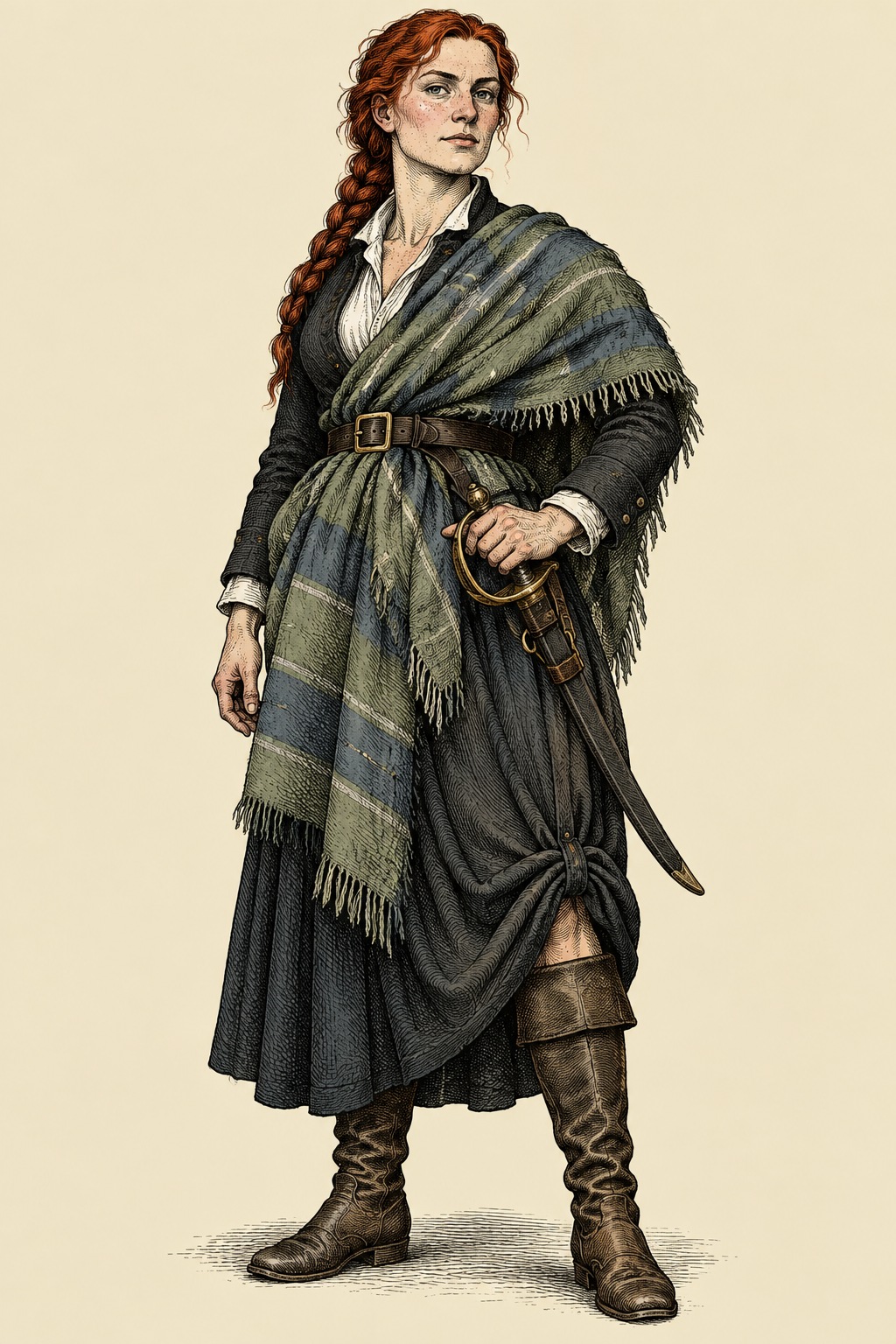
Irish pirate captain, about 34
Kinsella is from Wexford, the widow of a Highland officer killed at Preston in the Rising of 1715. Transported across the Atlantic under indentures sold by the Crown, she bought her freedom in Carolina. A sloop's crew elected her master in her second year. She now commands a brigantine with about seventy hands, wearing her husband's clan plaid belted across her shoulders. Votes and successful cruises keep her in command. Kinsella is fictional; the period record supplies no woman commanding a pirate vessel.
Rodrigo Salazar

Spanish pirate captain, about 44
Salazar served in Havana's Spanish coast guard until peace ended his pay. In the winter of 1715 to 1716, English sloops plundered the wreck camps under his protection. Armed with a letter of reprisal that no court would recognise, he began cruising on his own account with a sloop and a captured brigantine. London calls him a pirate and Madrid calls him a deserter; his loyalty rests with his crew. The opening story is told in his voice.
Sir Edmund Haldane

Governor of Harbour Island, about 53
A cousin at the Board of Trade helped Haldane purchase his knighthood and patent. His posting is a small settlement off Eleuthera, one day's sail from Nassau: thirty or so families, rusted battery guns and no instructions. He governs Harbour Island, not the Bahamas, and serves as no one's deputy. Dispatches to London demand the pirates' suppression; his flour comes from trading with them. He can serve as patron, customer or enemy.
Captain Josiah Whitcombe, Royal Navy
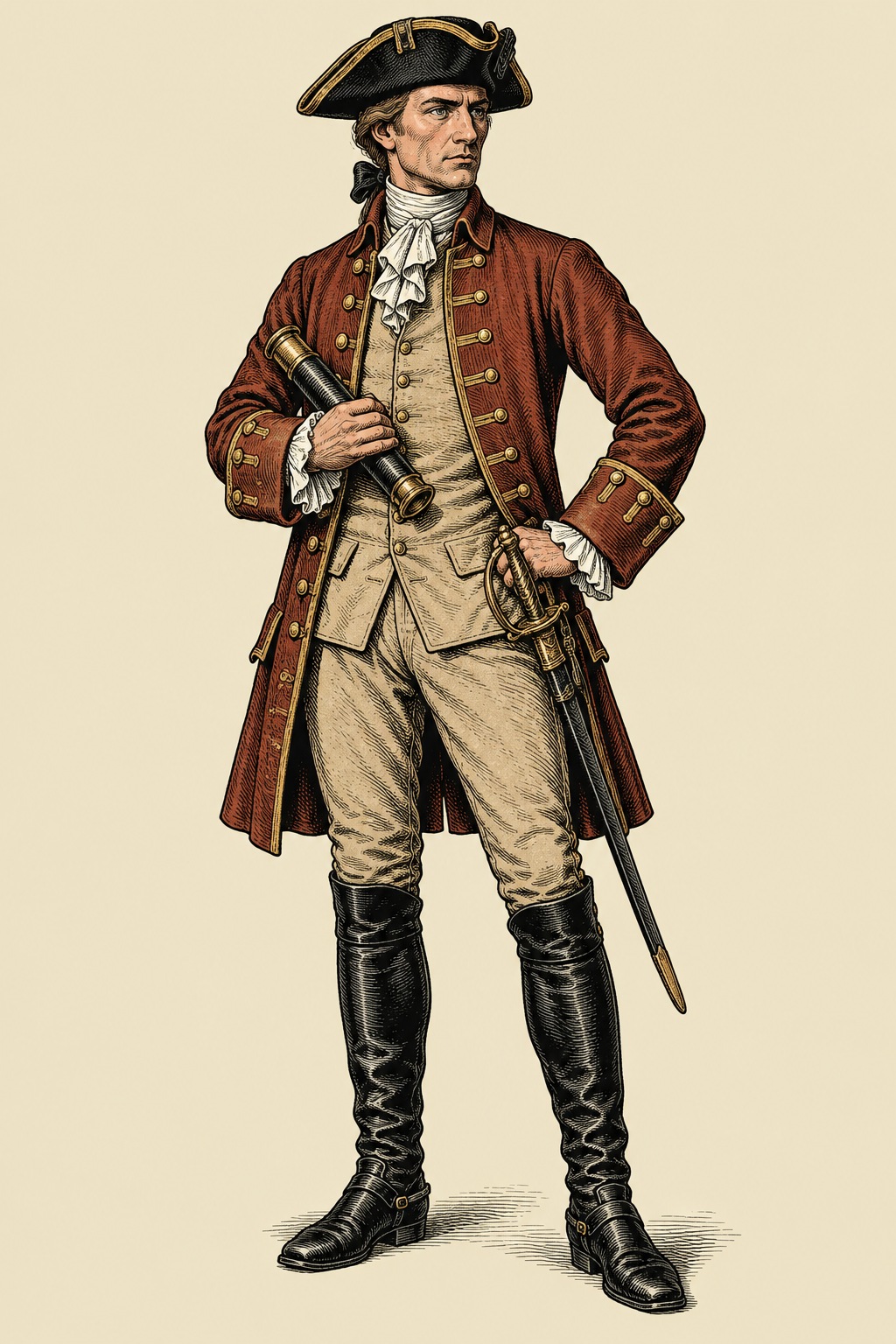
Captain of a sixth rate, about 39
An action against a sloop off Martinique earned Whitcombe his post-captaincy. His sixth rate now lies in harbour much of the year, short of hands and awaiting permission to careen. He carries a sealed order and a list of pirates he intends to send to the gallows. Formal, cold and honest, he refuses bribes. With no regulation naval uniform in 1716, he dresses in a gentleman's coat suited to his command.
Dinah Calloway

Tavern keeper and broker, Nassau, about 36
Calloway's father was an English ship's carpenter; her mother, an African woman from Jamaica's free quarter. She arrived in Nassau in 1714 with a purse, a hut and a talent for keeping track of debts. At her beach tavern she works the rooms herself and lets them to the women she employs and to indiscreet captains. She knows which crews have arrived, who needs flour and what shipping is expected. Pirate custom supports her business; her information supplies Haldane's dispatches.
Madeleine Lacoste
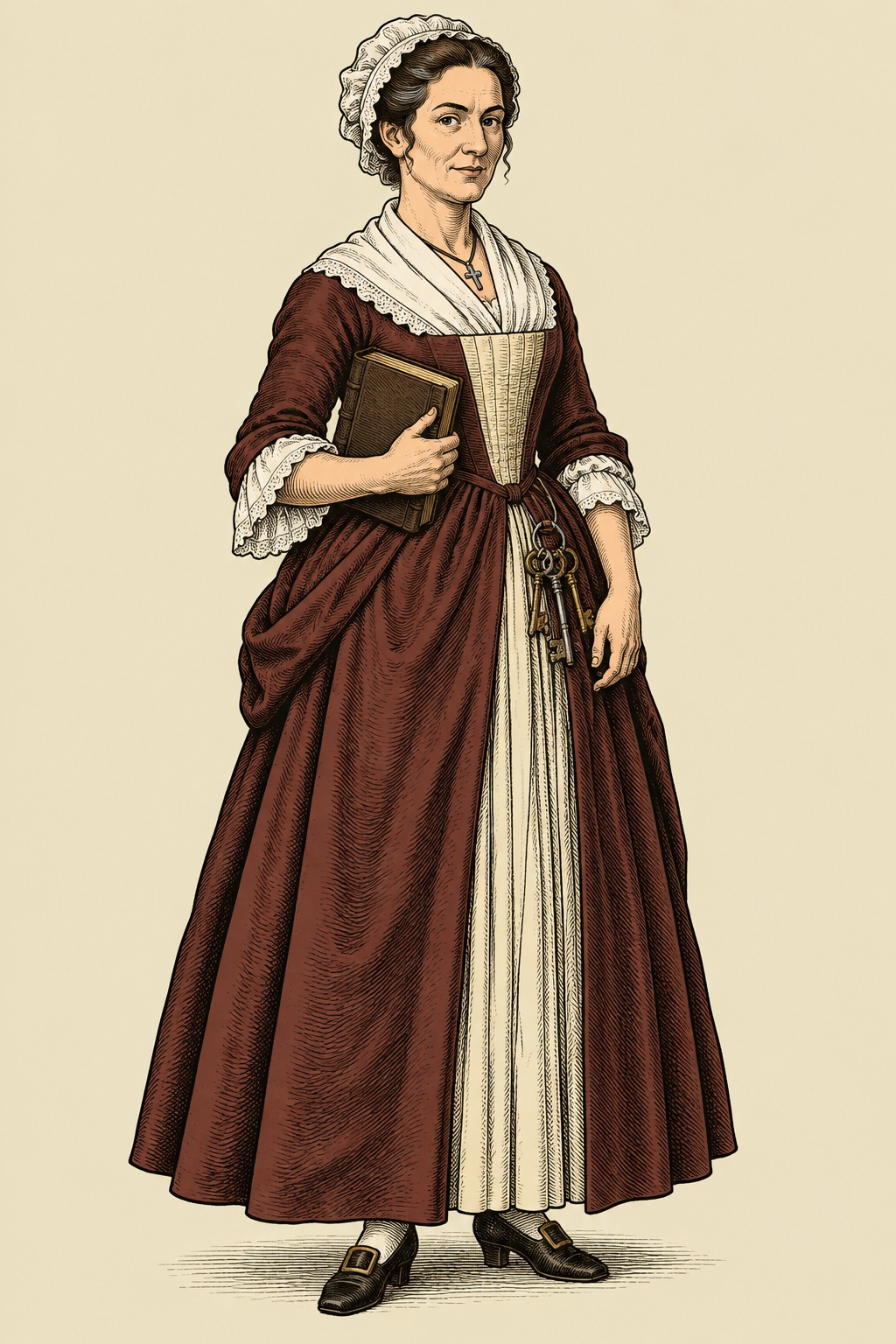
Bordeaux wine and brandy merchant, about 44
Lacoste manages the Bordeaux trading house still bearing her late husband's name. France's royal declaration of 1713 barred French rum to protect brandy (Trade and Shipping, The French and Spanish Frames). She sends wine and brandy to the islands and purchases superior English-island rum for markets closed to the French product. Her trade is in barrels: she neither owns enslaved people nor buys them. Both Lacoste and her firm are fictional.
Cuffee

Ship's surgeon and healer, about 30
Born on the Gold Coast and taken to Jamaica as a boy, Cuffee was forced to work in a plantation sick house. Older women taught him which barks could reduce fever. At twenty-eight he stole medicine for a dying man; his punishment was thirty lashes, and the medicine went overboard. He escaped and joined a crew that voted him a share. He has remained free ever since. Now Salazar's surgeon, he holds both a share of the takings and a vote in the Company.