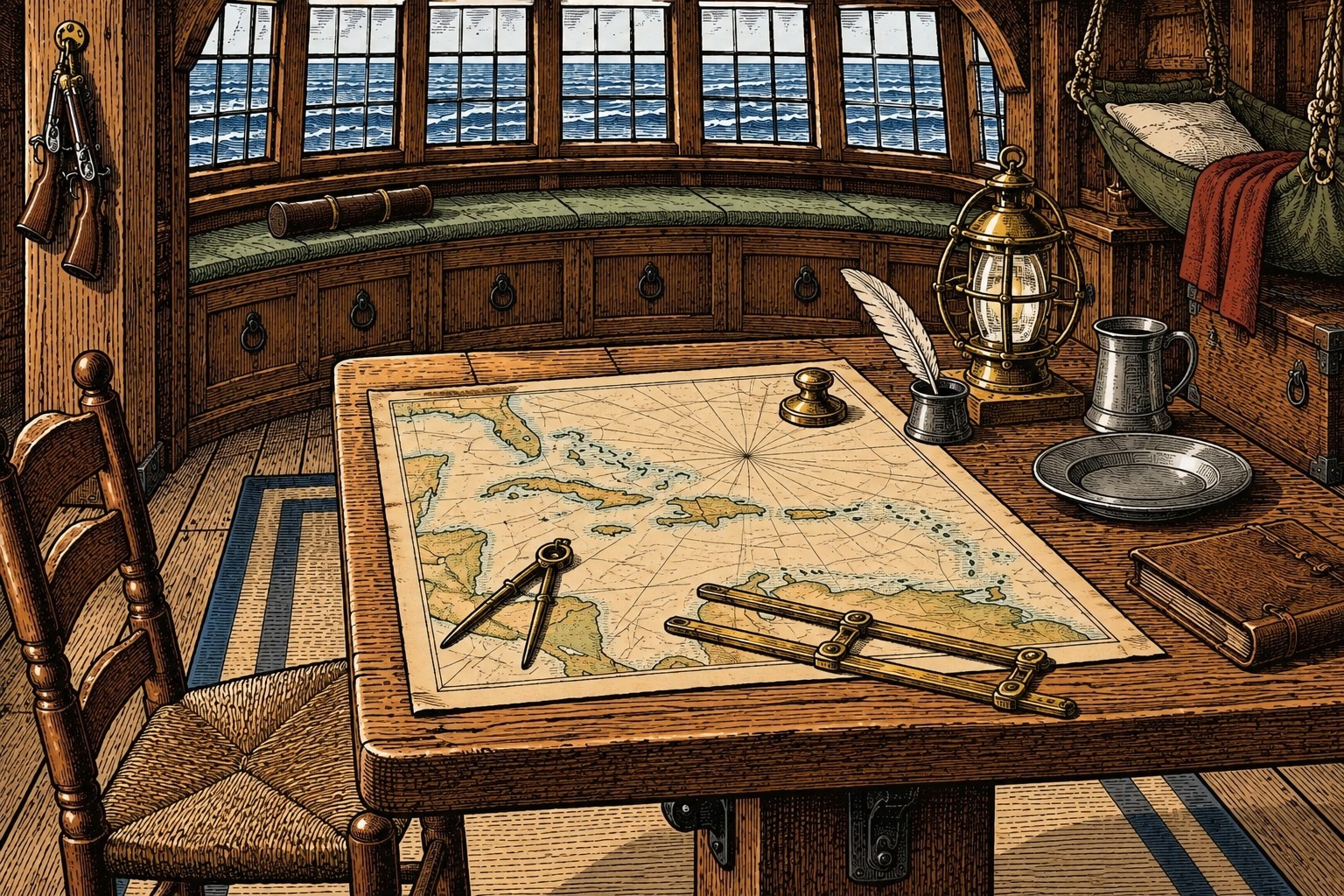
The game spans 1660 to 1730; its maps show 1716. Pirates and privateers operate within a wider Atlantic world. Powers of the Caribbean, Trade and Shipping, and Ships cover its rulers, commerce and vessels. Era Rules provides the mechanics, while the Historical Reference records events and people by date.
Dates retain the calendar of their source. English and colonial records use Old Style; Spanish, French and Dutch records, and treaties, use New Style. Before 1752 the English year began on 25 March, so a February date may appear as 1720/21.
What the Atlantic Was For

Atlantic commerce carries goods and people along three broad routes. Cloth, iron, guns, wine and credit leave Europe. Captives are carried from West Africa. Sugar, tobacco, rice, silver, logwood, hides and fish leave the Americas.
Sugar brings the greatest plantation wealth. Around 1700 the English islands outproduce their rivals. Barbados leads English production through the 1700s; Jamaica overtakes it in the 1710s or 1720s, depending on the accounts. Saint-Domingue grows faster than any other Caribbean colony. Tobacco leaves the Chesapeake in an annual fleet. Carolina exports rice and naval stores. Spain ships silver in two fleets: the flota bound for Veracruz and the galeones for Cartagena and Portobelo. Logwood from the Yucatán and Honduras coasts supplies dye; by 1718 the trade is worth at least 60,000 pounds a year to England. Fish and provisions sustain the plantations. New England and Newfoundland supply cod, lumber and horses, taking molasses home.
People are carried as the trade's largest cargo. The slave voyages database estimates that about 1,089,000 captives embarked between 1701 and 1725; about 12 to 14 in every hundred die during the crossing. Trade and Shipping covers goods, carriers and prices; Powers of the Caribbean explains each power's share.
The Region in 1716

The map records the region in 1716. Each crown's possessions extend well beyond the coasts where pirates cruise.
Britain controls Jamaica, Barbados, Bermuda and the Leewards: Antigua, Nevis, Montserrat and, since Utrecht, the whole of St Kitts. On the mainland it holds Nova Scotia and all of Newfoundland (the French shore and Placentia also gained at Utrecht), New England, New York, Pennsylvania, Maryland, Virginia and the Carolinas. It holds the Bahamas only on paper. Spain rules Cuba, Puerto Rico, eastern Hispaniola and the coast from Mexico to Venezuela. Spanish Florida consists of two presidios, St Augustine and Pensacola, with no settlement between. France controls Martinique, Guadeloupe, western Hispaniola (Saint-Domingue), Cayenne and the small Louisiana colony at Mobile on the Gulf. Dutch possessions are Curaçao, Bonaire, Aruba, Sint Eustatius, Saba, southern Sint Maarten, Suriname, Berbice and Essequibo. Denmark rules St Thomas. On the African coast, Cape Coast Castle and its forts belong to the African Company (the RAC); Elmina and a dozen neighbouring forts are Dutch. Between these holdings, speed at sea decides who can catch whom.
Law and Trade
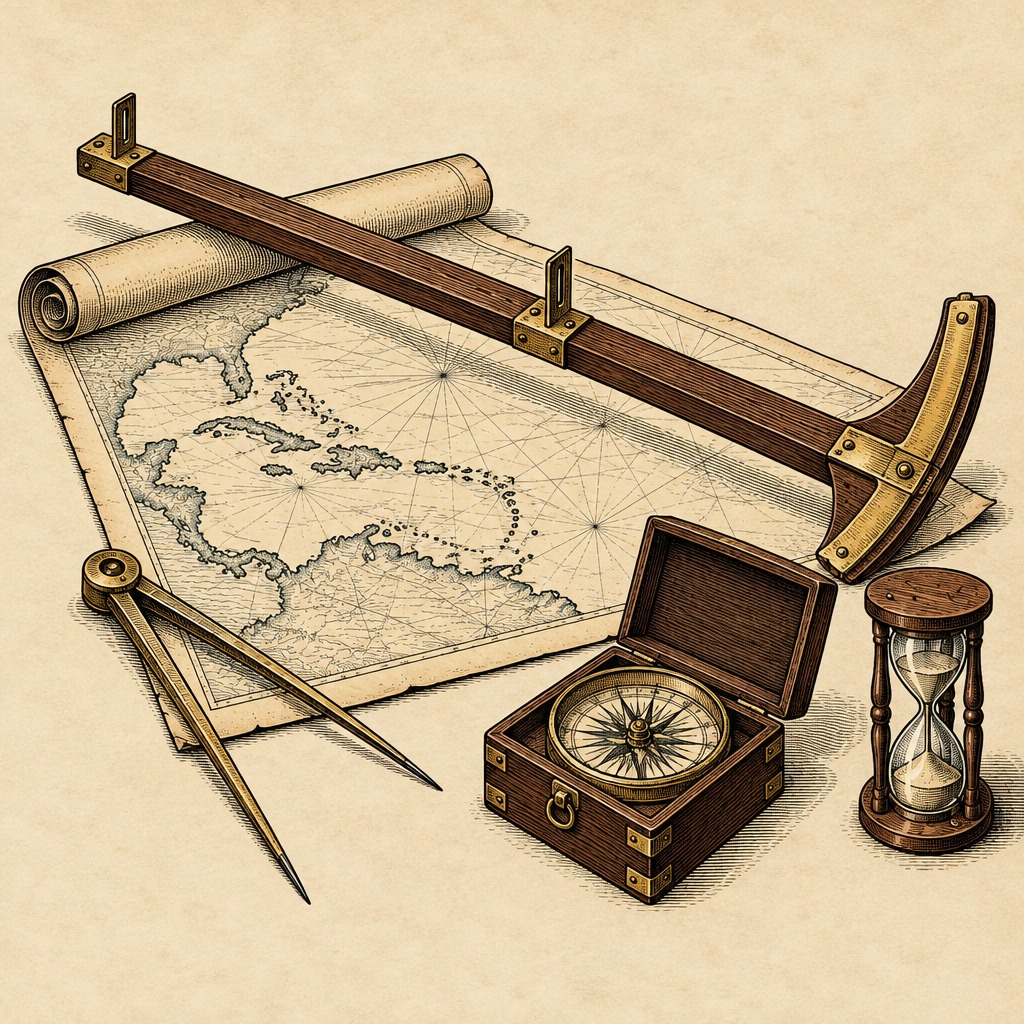
Trade law determines who can buy, sell and carry goods across the Atlantic. A cargo's destination or its buyer can turn a merchant into a smuggler; a commission and its limits can decide whether a captain is a pirate.
The Navigation Acts. Legislation passed from 1660 to 1696 restricts colonial commerce to English ships and ports. Enumerated goods, including sugar and tobacco, must go to England or an English colony. Colonial Admiralty courts hear violations. Lawful cargo requires a bond; selling to a Dutch buyer is an offence (Trade and Shipping, The English Frame; dates are in the Historical Reference).
Who governs the trade. The Board of Trade took over colonial business from a Privy Council committee in 1696. It examines colonial legislation and prepares instructions for governors. Since the 1660s Barbados and the Leewards have owed the Crown a duty of 4½ per cent on exports.
The Treaty of Madrid, 1670. Spain recognised English possession of Jamaica. Both crowns withdrew letters of reprisal, undertook to restrain their subjects' raids and barred trade in each other's Caribbean territories. A governor could no longer lawfully commission peacetime attacks on Spain. Buccaneer raids became piracy, although a sympathetic court and a share of the proceeds could still secure a governor's indulgence.
The asiento and the fairs. Spain excludes foreigners from colonial commerce but sells a contract to supply enslaved people. Genoese, Dutch, Portuguese and French holders have controlled the asiento; Britain's South Sea Company has held it since 1 May 1713 (Powers of the Caribbean). By 1716 the Portobelo fairs have nearly ceased, and smugglers work the Isthmus coast.
Free ports and smuggling. Free-port status is granted by law: Curaçao has held it since 1674; Nassau has no such status in 1716 (Powers of the Caribbean). From April 1717 the French Exclusif confines island commerce to French vessels sailing from specified French ports. Spain bars foreign traders from its coasts. Smuggling supplies much of the region. An English sloop landing rum on a French shore violates the laws of both crowns.
Courts. The Piracy Act of 1698 permits overseas trials before at least seven commissioners. Admiralty courts commissioned at Charles Town, Spanish Town and Cape Coast Castle try pirates; Vice-Admiralty courts condemn prizes. A wartime letter of marque authorises a private vessel to seize a named enemy's shipping. Taking a friendly power's vessel, or cruising without a commission, makes the captor a pirate. Commissions invite abuse: Captain Balchen reported that Jennings was authorised to hunt pirates but sailed "upon the wrecks" instead. English authorities likewise regard Spanish guardacosta commissions as a pretext for piracy. The King's proclamation of 5 September 1717 offers pardon for piracies committed before 5 January 1718 to anyone surrendering by 5 September 1718. A governor must hold a commission under the Great Seal to grant it. See Era Rules, Law at Sea and Ashore, for procedure and the Historical Reference for cases.
The Age in Four Phases
The Buccaneer Years, 1660 to 1697
England captured Jamaica in 1655 and retained it at the Restoration. Spanish Town serves as capital; Port Royal handles trade and anchors the Navy. Dutch and French wars shape the early years. France seized English St Kitts at Sandy Point in 1666; the Peace of Breda in July 1667 restored the Leewards and confirmed England's possession of New York. Buccaneers sailed from Jamaica, Tortuga, Petit-Goâve and Île-à-Vache, English and French seamen commissioned by governors to raid Spanish towns. Morgan sacked Panama in January 1671. In May 1683 de Graaf and van Hoorn plundered Veracruz for several days, then held hostages off Isla de Sacrificios until paid. Spain strengthened its defences, beginning Havana's walls in 1674. A Spanish force from Cuba burned the Bahamas settlements in January 1684.
France occupied all of St Kitts when the Nine Years War began in 1689; England recovered it in 1690. In 1694 du Casse landed 1,500 men at Port Morant and burned more than fifty sugar works. Jamaica was still recovering from the earthquake of 7 June 1692. It submerged half to two thirds of Port Royal, leaving about 18 to 25 of its roughly fifty acres, and killed some 2,000 immediately, perhaps 5,000 altogether. Pointis and du Casse captured Cartagena in May 1697. The Peace of Ryswick, signed on 20 September 1697, restored previous possessions. Spain subsequently tolerated French occupation of western Hispaniola, although the treaty ceded nothing and no border was drawn for eighty years. Some English-speaking pirates sailed the Pirate Round to the Indian Ocean in the 1690s. Henry Every captured the Ganj-i-Sawai in 1695; William Kidd went to the gallows in London in 1701. The Round remains a voyage the Company hears about, without rules in this book.
LEGEND
Stories make Every a king in Madagascar, married to the Mogul's daughter. The 1724 history that records much of his career rejects this account as a romance.
The Privateers' War, 1702 to 1713
Privateering expanded during the War of the Spanish Succession. Under the Cruisers and Convoys Act of 1708, captors kept a prize's entire value, giving privateers and naval crews the same incentive to hunt. Colonial settlements suffered on both sides. A Franco-Spanish attack burned Nassau in October 1703, killing more than a hundred. Codrington's English force destroyed Guadeloupe's sugar works in 1703; Iberville captured Nevis in April 1706 and carried away about 3,400 enslaved people. An Anglo-Dutch fleet destroyed Spain's silver escort at Vigo Bay in October 1702. In June 1708 Wager's squadron blew up the San José off Cartagena with about 600 aboard. Cassard's French squadron extracted ransoms from Surinam in October 1712 and Curaçao in February 1713.
Separate agreements brought peace: Britain and France signed at Utrecht on 11 April 1713, Britain and Spain on 13 July 1713, and Spain and the Dutch on 26 June 1714. Britain acquired Nova Scotia, French St Kitts, Newfoundland and the asiento. Thousands of seamen recruited for privateers and the Navy now faced discharge.
The Years of Nassau, 1713 to 1718
Naval employment collapsed after the war. Parliament funded 10,000 seamen in 1715, compared with about 40,000 in wartime. Jamaica's station had lacked a commander in chief since 1713 and consisted of a few small vessels under a captain; Vernon arrived as commodore in 1720. Merchant berths were also scarce for discharged hands.
Sloops from Jamaica and the Carolinas sought the 1715 fleet's wrecks and cruised the logwood coasts. Nassau, sacked in 1703 and 1706 and left without government, became their meeting place. Peace had also exposed the colonies' weakness. The Yamasee War began on Good Friday 1715 and nearly overwhelmed South Carolina. The Bahamas proprietors relinquished their government on 28 October 1717.
The Suppression, 1718 to 1730
Woodes Rogers received his commission on 6 January 1718. He reached Nassau on 26 July 1718 and landed on 27 July, greeted by about 300 armed men. The pardon divided the pirates; executions followed, including Bonnet at Charles Town on 10 December 1718 and Rackham's men in 1720. Trade restrictions also tightened: France's Exclusif, Havana's tobacco monopoly and the Crown's proclamation all came in 1717. Britain declared war on Spain on 17 December 1718 (Old Style); France followed in January 1719. The Treaty of The Hague ended the war on 17 February 1720. That month, Nassau's militia repelled a force of 1,200 sent from Cuba. HMS Swallow killed Bartholomew Roberts off Cape Lopez on 10 February 1722; 52 of his men were hanged at Cape Coast Castle. On 28 August 1722 a hurricane wrecked Port Royal's shipping. William Fly was executed in 1726; Olivier Levasseur was hanged on Bourbon (now Réunion) on 7 July 1730. Fever killed 3,000 to 4,000 men in Hosier's squadron during its 1726 and 1727 blockade of Portobelo. The Treaty of Seville, signed on 9 November 1729, referred trade disputes to commissioners. See the Historical Reference for the dated list.
Travel, Lanes and Winds
Easterly trade winds carry ships west from Europe and Africa through the islands. England to Barbados takes six to nine weeks. Downwind, Barbados to Jamaica takes less than two weeks; the return can demand fourteen weeks beating to windward. A short outward voyage can mean months getting back. Ships homeward bound work north through the Florida Straits to reach the Gulf Stream, then follow it north and east along the coast.
Seasons. Hurricanes threaten from June to November, especially August and September. Cruising favours the dry months, December to May. Spain's flota leaves for Veracruz in spring; the galeones depart in August for Cartagena and Portobelo. Both gather at Havana for the homeward crossing, filling the port with fleet seamen from May to August. Bermuda's salt rakers work the Turks Islands between March and November. Fever has its own seasons and kills more expedition members than any other danger.

The lanes. Ships leaving Jamaica for the Atlantic use the Windward Passage, between Cuba and Hispaniola. Havana's northbound traffic passes the wreck coast through the Florida Straits. Spanish routes lead from the Canaries through the Lesser Antilles to Veracruz or Cartagena. Mainland traffic includes the Chesapeake tobacco fleet, Carolina shipping, and New England's provision and molasses carriers; Newfoundland sends fish to Iberia and the islands. The Guinea passage carries captives from Cape Coast and Elmina on the Gold Coast, Whydah on the Slave Coast (the trade's second port by 1716), and Calabar and the Bight of Biafra to the islands. Jamaica reships captives to Spanish ports.
For voyages and cargoes, consult Trade and Shipping. Places and Campaign Tools covers distances, daily runs, stores, seasons and the speed of news.
How People Live
Aboard. A typical pirate Company has about eighty hands aboard a vessel of roughly 250 tons: three tons per man. Its potential prizes carry four to eight tons per man; the commonest is a 30-ton sloop crewed by seven. Navy rations allow a pound of biscuit daily, with salt meat and peas. Hammocks and decks provide whatever sleeping space a man can find. Experienced sailors dominate pirate crews: among 157 men whose previous occupations are known, all but two served in merchantmen, the Navy or privateers. Their average age is about 27. An able seaman earns 24s per lunar month in the Royal Navy, about 22s 6d after deductions, compared with 25s to 30s in merchant service (Gear and Prices). Wartime impressment supplies naval crews. Roberts's articles prohibit gambling for money and candles after eight o'clock (Era Rules, Crew and Articles).
Planters and merchants. A small, wealthy planter class owns the estates. Jamaica's 1713 count records about 7,000 whites and 55,000 enslaved people; Powers of the Caribbean and the Historical Reference give colony populations. Once the richest Leeward island, in the 1670s, Nevis has only about 1,100 whites by 1708. Merchants concentrate business in the ports. By 1716 Kingston is Jamaica's largest town and commercial centre. Colonial defence lacks manpower (Powers of the Caribbean, Britain). White indentured servants land at wharves also receiving Guinea ships; their terms last four or five years.
Enslaved and free Black people. Enslaved people form the majority in the sugar colonies, where estate labour shortens a captive's life (Trade and Shipping, On the Plantation). Free and freed Black communities live in ports and Maroon settlements in the hills. Colonial law restricts them: Jamaica's deficiency laws prescribe a ratio of white men to enslaved people, and a 1724 law forbids any Black person to strike a white one. Armed enslaved men serve in South Carolina's wartime militia. Black men also sail as seamen, pilots and pirates. Era Rules, Prejudice, handles the discrimination they encounter.
Indigenous peoples. A treaty of 1660 recognises Kalinago possession of Dominica and St Vincent; neither crown honours it. Jamaica's Miskito allies sell captives to the colony. Yamasee, Creek and Cherokee power shapes Carolina's frontier. The Yamasee War of 1715 to 1717 nearly destroyed South Carolina (Historical Reference, Part Four). By 1708 Carolina held 1,400 enslaved Native people. Spain's Apalachee missions were destroyed in 1704.
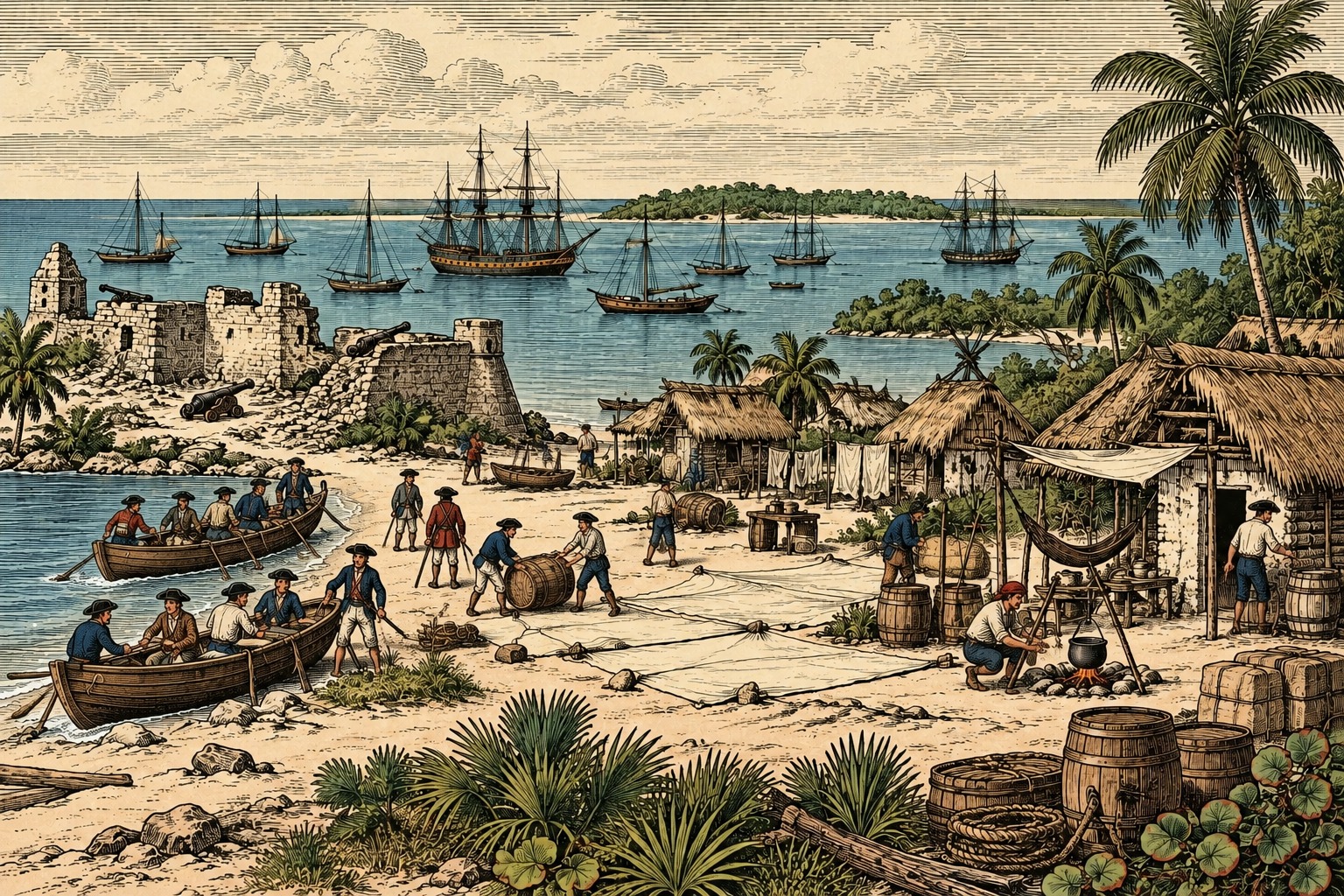
Ashore. Crews return to port to sell prizes, spend shares and recover. Nassau's houses on New Providence are split-log and wattle huts, thatched with palmetto and built without chimneys; Hog Island lies across the harbour. Port Royal in 1716 occupies only a third to a half of its former ground. Burned in 1703, it faces another inundation in 1722 while Kingston draws away its trade. Plunder disappears within days in either town. Men and women operate taverns and brothels as ordinary businesses. A keeper such as Calloway gathers news from across the port (Nassau; Port Royal).
Dress. Uniforms have yet to appear. Seamen wear slops, checked shirts, short jackets and knitted caps. A naval captain dresses in a gentleman's coat, a governor in a periwig, a merchant in broadcloth.
Women. The Company encounters most women ashore, managing households and accounts, keeping taverns and brothels in Nassau and Port Royal, or supplying the town. Widows continue their husbands' businesses. Women seldom sail, and Roberts's articles forbid them aboard. Anne Bonny and Mary Read, both in Rackham's crew, are the two women recorded among these years' Anglo-American pirates (Historical Reference). Tried at Spanish Town on 28 November 1720, both pleaded pregnancy. Neither was executed; Read died in prison. Kinsella is fictional. Every Role is open to women (Character Creation and Roles); a port's response depends on the Prejudice rule.
LEGEND
Estimates place men of African descent at a quarter to a third of the roughly 5,000 pirates afloat between 1716 and 1726. These figures draw on scattered crew lists rather than a census. Roberts's crew, the best documented, included 70 out of 276; individual crews ranged from none to over half. For play, use roughly a quarter overall, with considerable variation between crews.
Money
The Spanish silver dollar, or piece of eight, circulates as a hand-struck cob in 1716. For this book it is worth 4s 6d sterling. Colonial laws rate it higher; shortages of coin lead to payment in Jamaica money or sugar. Gear and Prices covers coins, prices and wages. Era Rules, Money and Credit defines the Stake and Credit.
The Year 1716
Utrecht ended the War of the Spanish Succession and left thousands of naval and privateer seamen discharged. The wreck of Spain's treasure fleet gave them an opportunity. At 2 a.m. on 31 July 1715 a hurricane struck off Florida's east coast. Cuban records report all eleven Spanish ships lost and about 1,500 dead. Spain organised salvage from Havana. Henry Jennings and Charles Vane seized a Spanish mail ship in December 1715 and learned the camp's location. Early in 1716 Jennings raided it with a superior force.
Captain Balchen of HMS Diamond reported on 13 May 1716 that James's and Jennings's sloops had fitted out in November and returned with considerable money; twenty more followed them. By July the French at Léogâne are protesting raids by Jamaica-based sloops, while Spain's coast guard seizes Jamaican fishermen along the wreck coast.

LEGEND

Accounts value the Florida camp's plunder at 87,500 pounds in gold and silver, 120,000 pieces of eight or 350,000 pieces of eight. They also disagree on the sloop's name and put the attacking force at 150 to 300 men.
Commerce and colonial law also shift during 1716. In August the South Sea Company sends its first annual ship, the Royal Prince, to the Indies, while protesting a reported Jamaican export duty of 40s for each enslaved person. On 16 August Denmark's king admits all nations to trade at St Thomas; the harbour is open but has no legal free-port status. In December Andrade's Spanish squadron accepts the surrender of twenty English, Dutch and colonial logwood vessels at Triste. Spain occupies the lagoon in its largest action against British trade that year. At the Turks Islands, sixty-five Bermuda sloops rake salt. Cuba changes governors on 26 May: Vicente de Raja succeeds the Marquis of Casa Torres. Florida changes governors on 13 July and again on 30 October. Raja restricts private tobacco sales months before the April 1717 monopoly that will force him out.
British authority lacks ships and men. Since April 1716 Walter Hamilton, Governor of the Leewards, has been stranded at Antigua for want of a man of war. HMS Swift reaches Port Royal on 4 December with six guns and 40 men, then waits for orders from home. The Leewards owe £10,000 for stores despite paying £78,000 in duty. Jamaica's recalled governor, Lord Archibald Hamilton, is replaced as Commander in Chief by Peter Heywood, the chief justice he had dismissed. On 3 December Heywood calls Providence the pirates' chief rendezvous. Dutch naval protection is also scarce: the Republic's 1716 squadron goes to Algiers. South Carolina's deputy governor, Robert Daniell, grants private commissions to sloop masters while the Yamasee War, begun in 1715, has cost the colony 95,000 pounds. Samuel Bellamy parts company with Benjamin Hornigold. The colonies receive 639 Preston prisoners from the Jacobite rising for sale; about 80 travel aboard the Friendship to Maryland.

The map year leaves openings that 1717 begins to close. France, Spain and Britain tighten trade restrictions, the proprietors surrender government of the Bahamas, and the Crown offers a pardon. The Campaign Frame in Places and Campaign Tools starts play on Nassau's beach in 1716, before the navy arrives.
Where to Read More

| To find | Read |
|---|---|
| What each crown, company and people holds, wants and fears | Powers of the Caribbean |
| Goods, carriers, convoys, merchant ships and the slave trade | Trade and Shipping |
| Hulls, rigs and what they carry | Ships |
| Nassau, Port Royal and the other ports | Nassau, Port Royal, Other Ports |
| Prices, wages and the coin | Gear and Prices |
| Infamy, Reach, Standing, Prejudice, the pardon and money | Era Rules |
| Distances, seasons, news and the campaign frame | Places and Campaign Tools |
| Dated events and the people in them | Historical Reference |