Openframe Ship Catalog · Chapter 1
The House of Openframe
The Antaean Openframe Consortium dominates commercial hull construction across the Antaean League.
Openframe sells the hull that can still become a different ship tomorrow.
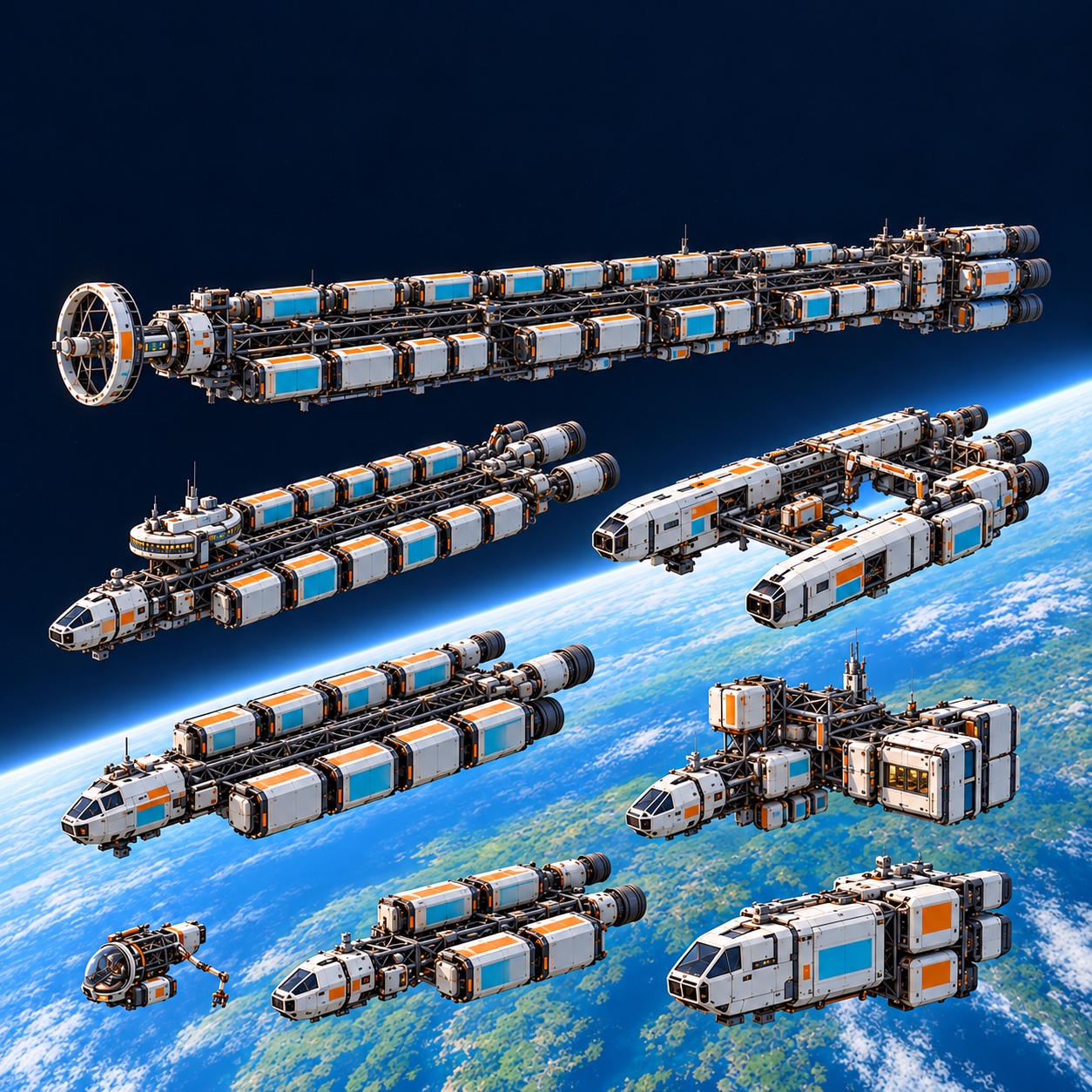
Its ships are built around modular spines, interchangeable bays, standardized cargo clamps, detachable pods and licensed interfaces. They are common because they are useful. They are also common because lenders understand them, ports can service them and corporations can repossess them efficiently.
How a Spacer Reads an Openframe Ship
It is easy to change. Openframe's Signature systems are cargo handling, mission modules, communications, transponders, support craft and workshops. The ship adapts to the job: a freighter this season, a mobile workshop the next. The paperwork works and the interfaces fit.
It is not built to win fair fights. Openframe's Weak systems are armor, direct combat durability, high-output fire control and thermal control under extreme load. An Openframe hull has armor of 1 or 2 and, when it is hurt, its spine flexes in ways that interfere with precision work.
It costs more to keep than to buy. Entry cost is moderate. Lifetime ownership is not: leases, module rentals, subscription licensing and insurer-backed loans are how most crews pay. Parts are excellent almost everywhere, and authorized service is extremely common.
It is mixed. The League is the most mixed of the five powers. An Openframe yard, port or crew is as likely to hold Ossen, Hazren, Zosa and Dhoran as humans, and the hull is built to take them all.
The saying along the docks: "Openframe sells the ship twice: once in steel and once in licenses."
Openframe at a Glance
| Common name | Openframe |
| Alignment | Antaean League |
| Market | Commercial, modular, shipping, station support |
| Reputation | Anything can fit if the paperwork clears |
| Price tier | Moderate entry cost, expensive lifetime ownership |
| Financing | Corporate leasing, module rentals, subscription licensing, insurer-backed loans |
| Parts | Excellent almost everywhere |
| Service | Extremely common |
| Gray market | Excellent, but license audits create risk |
| Authority heat | Moderate when modules do not match manifests |
What This Book Covers
Eight ship lines. A work pod, a light freighter, a modular shuttle, a heavy freighter, a mission tender, a bulk freighter, a fleet tender and a container hauler. They run from Scale 2 to Scale 7, the ceiling for commercial shipwrights.
Nineteen hulls. Every line has two or three versions. Openframe numbers a version as a revision of its open standard: the Model 20 v1.0, v1.1 and v1.2.
Every hull is built to the same grade. Openframe sells for open commercial use, so every hull in this book is built to the Civilian operator tier. Chapter 2 explains how to read an entry's stat block.
Licensed slots. The slots a hull has in its first version are Open. Every slot a later version adds is Licensed, and works only while the hull's license is current. Chapter 4 has the rule and Chapter 10 the fees.
Signature components. Chapter 9 lists the modules and systems that only Openframe builds.
What Openframe does not build. Cutters, gunships, fighters and any hull built to fight; luxury and science hulls, which are Viridian's; heavy armor. A crew that wants a warship should look at Crown Meridian, Openframe's Partner.
Using This Book
The Vehicles Manual comes first. The Vehicles Manual prints four Openframe hulls: the Models 20, 40, 60 and 80. They are the v1.0 of their lines in this book, and every number in their stat blocks is the same in both books. Where the two books differ, the Vehicles Manual is right.
Class follows Scale. A hull's class matches the size category it sits in. The Model 60 is a modular bulk freighter at Scale 6 and the Model 80 a bulk container hauler at Scale 7 (Vehicles Manual, Chapter Four, Class Table).
Prices are catalog prices for a factory-new hull at an Openframe yard, with the factory package fitted. Chapter 10 has used prices and license fees.