Openframe Ship Catalog · Chapter 3
The Openframe Look
An Openframe ship looks as though it has already been modified, because that is the point. Spacers read the maker from the silhouette before the transponder resolves.
Materials and Marks
Frames. Pale industrial gray and white, in smooth panels with clean seams.
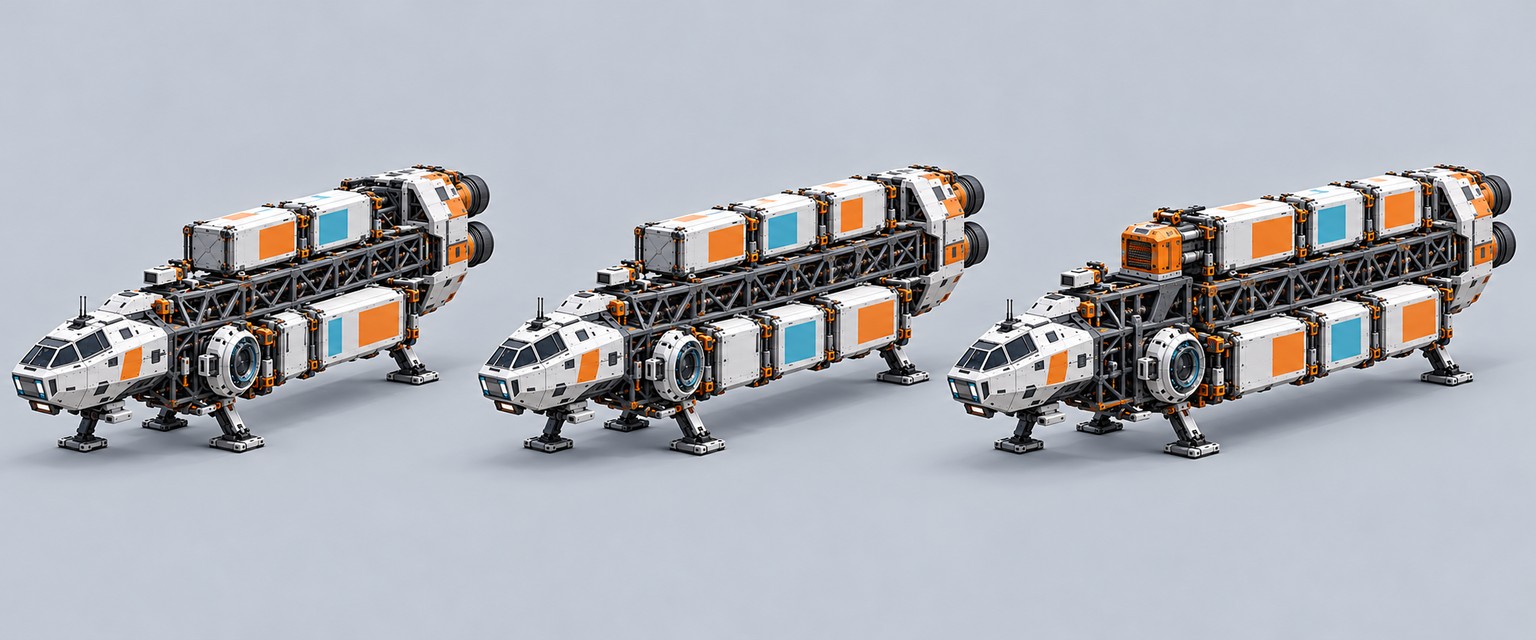
Spines. An exposed dark truss or spine carries the ship. The structure shows, because the structure is what everything clamps to.
Pods and clamps. Detachable cargo pods, container locks and standardized cargo clamps. A pod is a white box with an orange or cyan panel.
License panels. Orange and cyan rectangles on pods and housings show that a module is licensed. They are plain colored panels. Serial plates are blank in this book.
Collars and arms. Standardized docking collars, fold-out utility arms and replaceable mission sections: the ship's hands.
Interiors. Practical and commercial. Different sections may come from different construction years. A corridor may end in a bulkhead designed for a module the ship no longer carries. Everything has a serial number, and many features need an active license.
The Three Hull Styles
Modular Spineframe. A central truss or spine carrying detachable pods, clamps and branches, with an offset cockpit or command pod. Used for the freighters.
Split-Hull Catamaran. Twin hulls on either side of an open work gap, joined by cross-members and crane arms. Used for the fleet tender.
Asymmetric Utility Hull. A compact hull that is deliberately lopsided: booms, one large mission section on one side, utility arms on the other. Used for the work pod, the shuttle and the mission tender.
Telling a Version by Sight
A version adds room, and the hull shows it. A spacer who knows the line can read a ship's version from a distance.
| Line | Version | What shows |
|---|---|---|
| Model 10 | v1.1 | A second long utility arm on the far side; a tool housing on top |
| Model 20 | v1.1 | Two more pods on the spine (six, up from four) |
| Model 20 | v1.2 | A thicker truss behind the cockpit; one more orange equipment housing |
| Model 30 | v1.1 | A second cargo pod under the passenger section; an aft utility arm |
| Model 40 | v1.1 | Two more pods on the lower spine (twelve, up from ten); a thicker spine |
| Model 40 | v1.2 | A second row of clamps on top; two extra thruster blocks on the nose |
| Model 50 | v1.1 | One more mission container, a cyan lab; a larger power housing |
| Model 60 | v1.1 | Two more pods on the habitation branch |
| Model 60 | v1.2 | A doubled section of spine amidships; a flat radiator panel on top |
| Model 70 | v1.1 | An extra drone-bay housing on one hull; a longer crane arm |
| Model 80 | v1.1 | One more rack of container pods and one more clamp row |